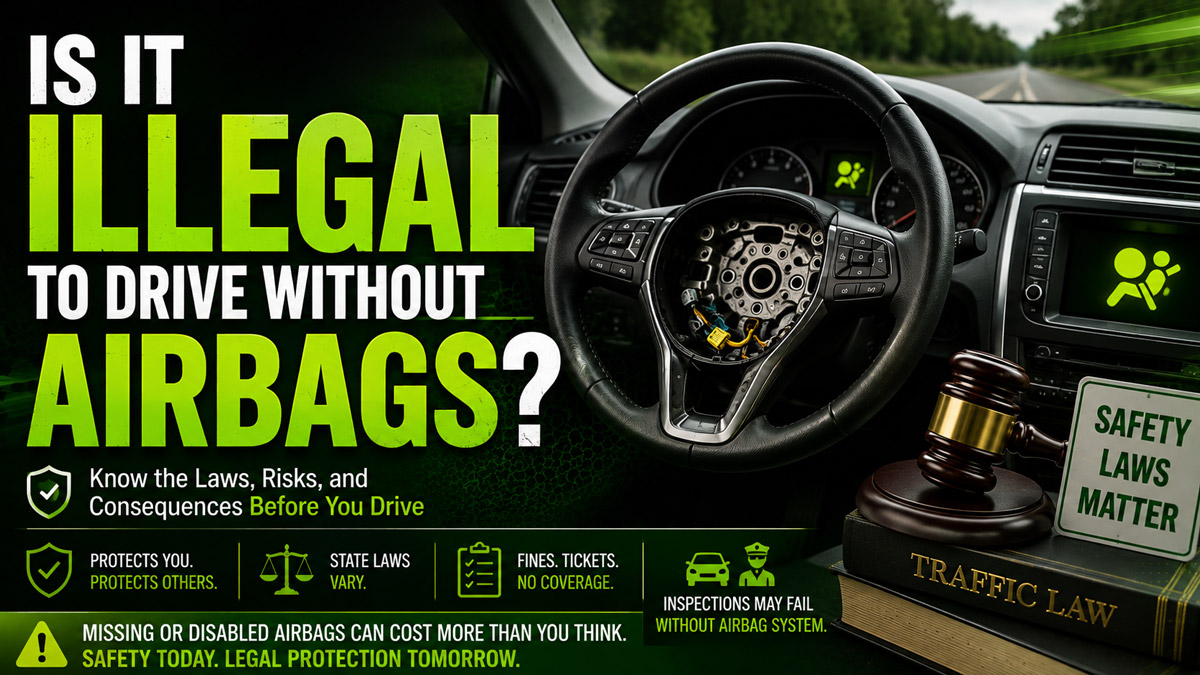
It is not automatically illegal under federal U.S. law for a private owner to drive a vehicle with missing, deployed, or non-functioning airbags. However, the vehicle may be illegal to operate under state inspection, registration, equipment, insurance, or vehicle-tampering rules, especially when factory airbags were deliberately removed or the defect was concealed.
Key Facts at a Glance
- Federal law primarily restricts manufacturers, dealerships, and repair businesses from disabling federally required safety equipment.
- A private owner may not face a specific federal driving offense, but state law can still prohibit operating the vehicle.
- An illuminated airbag or SRS warning light may cause a safety-inspection failure in some jurisdictions.
- Removing an airbag-equipped steering wheel can create legal, insurance, inspection, and civil-liability problems.
- A vehicle built before airbags were required is generally not illegal merely because it lacks airbags.
- Seatbelts do not provide the same head and chest protection as a functioning airbag system.
Is It Illegal to Drive Without Airbags Under Federal Law?
Federal law does not generally create a nationwide traffic offense that automatically makes a private person’s vehicle illegal to drive whenever an airbag is missing or disabled. Federal requirements focus mainly on how vehicles are manufactured and whether commercial businesses improperly make required safety equipment inoperative.
Federal Motor Vehicle Safety Standard No. 208 establishes occupant-crash-protection requirements for new vehicles. Dual front airbags became standard federal equipment on most passenger cars beginning with the 1998 model era, followed by light trucks.
A dealership, mechanic, repair shop, vehicle modifier, or other commercial business generally cannot knowingly remove or disable compliant safety equipment without an authorized reason. This restriction is commonly called the federal “make inoperative” prohibition.
Private vehicle owners occupy a more complicated position. Federal law may not directly prohibit an owner from altering a personally owned vehicle, but that does not make the modification legal for public-road use. State equipment laws, inspection standards, insurance contracts, fraud laws, and negligence rules may still apply.
When Can State Law Make Driving Without Airbags Illegal?
State law can make a vehicle with missing airbags illegal when the condition violates inspection requirements, required-equipment statutes, registration rules, or prohibitions against tampering with vehicle safety systems.
The exact outcome depends on:
- The state where the vehicle is registered
- Whether that state performs safety inspections
- The vehicle’s year and original equipment
- Whether the airbags deployed accidentally or were intentionally removed
- Whether the SRS warning light remains illuminated
- Whether the vehicle has a salvage or rebuilt title
- Whether the missing airbag was disclosed during a sale
Some states inspect restraint-system warning lights or verify that factory safety equipment is present. Others perform no regular safety inspection but can still enforce equipment laws after a traffic stop, crash investigation, title inspection, or vehicle sale.
A lack of annual inspection does not necessarily mean airbag removal is lawful. It may simply mean the defect is less likely to be discovered before an accident or ownership transfer.
Can a Car Pass Inspection Without Airbags?
A car may fail inspection if the jurisdiction checks the Supplemental Restraint System, requires the airbag warning lamp to complete its normal self-test, or prohibits missing factory-installed safety equipment.
During a normal self-test, the SRS light usually illuminates briefly when the ignition is switched on and then turns off. The following conditions may indicate a failure:
- The SRS light stays on.
- The light never illuminates during startup.
- The warning lamp has been covered or removed.
- A diagnostic scan shows an active restraint-system fault.
- The steering-wheel or dashboard airbag is visibly missing.
- The vehicle has undeclared crash or salvage damage.
Inspection rules vary substantially. Owners should check the current vehicle-equipment and inspection rules for their registration state rather than assuming that another state’s policy applies.
Is It Illegal to Remove a Factory Airbag?
Removing a factory airbag can violate state equipment or inspection laws and can expose a commercial installer to federal penalties. Even when a private owner performs the removal, the modified vehicle may no longer satisfy public-road requirements.
One common example is replacing an airbag-equipped steering wheel with an aftermarket racing wheel. The modification may also remove or interfere with:
- The driver’s frontal airbag
- The clockspring
- Horn operation
- Steering-wheel controls
- Crash-sensor communication
- Seatbelt pretensioner coordination
A steering wheel designed for track use does not automatically become road-legal because it can be physically installed. A track-only vehicle should normally be transported to events rather than driven on public roads after federally certified occupant-protection equipment has been removed.
Is It Illegal to Drive After the Airbags Deploy?
Driving after airbag deployment is not always a separate criminal offense, but the vehicle may be unsafe, unroadworthy, or unable to pass inspection. Airbag deployment also indicates that the vehicle experienced a crash severe enough to activate part of the restraint system.
Deployment can affect more than the visible airbag. Repairs may include:
- Driver and passenger airbag modules
- Side or curtain airbags
- Seatbelt pretensioners
- Buckles and tension sensors
- Crash-impact sensors
- The airbag control module
- Steering-wheel clockspring
- Dashboard panels
- Seat covers or headliners
- Wiring and electrical connectors
The vehicle should not be considered repaired merely because the torn airbag fabric has been removed. The complete SRS must be diagnosed and restored according to manufacturer procedures.
Can You Drive With the Airbag Warning Light On?
A vehicle can often still move with the airbag warning light illuminated, but the SRS may not protect occupants correctly during a crash. Depending on the fault, one airbag, several airbags, seatbelt pretensioners, or the entire restraint system may be disabled.
Common causes include:
- A disconnected connector under a seat
- Low battery voltage
- A failed clockspring
- A damaged impact sensor
- A defective passenger-occupancy sensor
- Water intrusion
- Seatbelt-buckle faults
- Previous airbag deployment
- An unrepaired airbag control module
- Incorrectly installed aftermarket accessories
A standard engine-code reader may not access SRS codes. Diagnosis normally requires a scan tool that supports the vehicle’s airbag control module.
Clearing a fault code without repairing the cause does not restore protection. The warning usually returns when the control module repeats its self-check.
How Dangerous Is Driving Without Airbags?
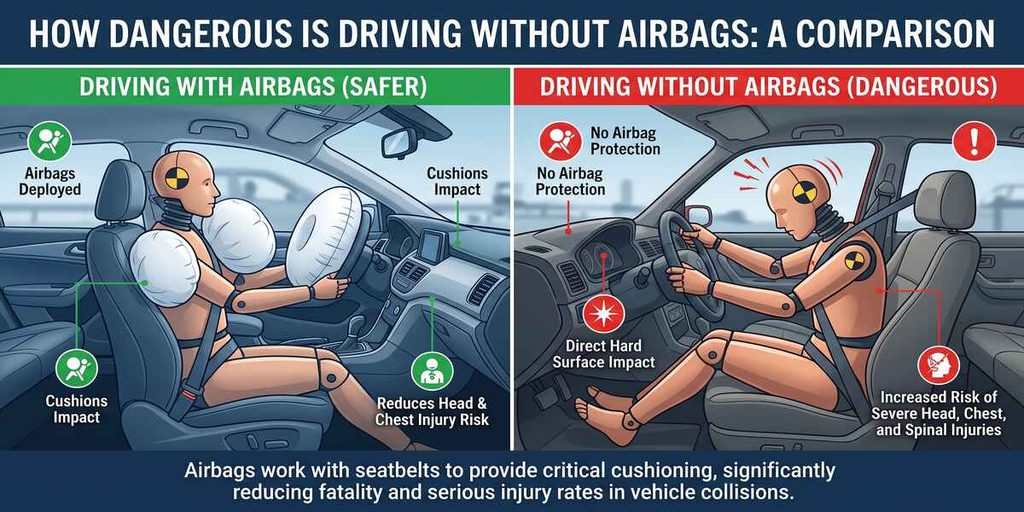
Driving without airbags substantially reduces protection in frontal and side-impact crashes, particularly for the head, chest, neck, and upper body. Airbags are supplemental restraints, meaning they are engineered to work with seatbelts rather than replace them.
During a qualifying crash, impact sensors measure rapid deceleration and send information to the airbag control unit. The control unit determines whether deployment thresholds have been reached and activates the appropriate airbag and pretensioner circuits within milliseconds.
The inflated bag helps:
- Slow occupant movement more gradually
- Reduce contact with the steering wheel
- Reduce impact with the dashboard
- Limit contact with side glass and pillars
- Distribute forces across a larger body area
- Help control head and chest movement
A seatbelt remains essential, but it cannot reproduce all of these functions. Without an airbag, a belted occupant may still strike hard interior surfaces during a severe collision.
Driving With Airbags vs. Without Airbags
| Factor | Functional Airbags | Missing or Disabled Airbags |
| Crash protection | Airbags and pretensioners operate as designed | Head and chest protection may be reduced |
| Warning light | SRS light completes normal self-test | Warning may stay on, flash, or be disabled |
| Inspection | More likely to meet original safety requirements | May fail depending on state rules |
| Insurance | Normal factory safety configuration | May require disclosure and affect claims |
| Resale | Easier to sell with documented repairs | Lower value and greater disclosure risk |
| Passenger liability | Factory protection remains available | Owner may face stronger negligence allegations |
| Repair cost | Routine maintenance only | Airbag-system restoration may cost thousands |
| Road legality | Usually compliant if no other defects exist | Depends on vehicle age and local law |
Can Insurance Deny a Claim Because Airbags Are Missing?
An insurer may investigate, reduce, dispute, or deny part of a claim when undeclared airbag removal, prior crash damage, fraud, or an unauthorized modification contributed to the loss. The result depends on policy wording, state insurance law, causation, and whether the owner disclosed the modification.
Potential insurance consequences include:
- Cancellation or non-renewal
- Higher premiums
- Reduced vehicle valuation
- Denial of damage linked to an undisclosed modification
- Disputes over pre-existing crash damage
- Liability allegations from injured passengers
- Recovery actions against repairers or sellers
A missing airbag does not automatically invalidate every part of an insurance policy. For example, an insurer may still owe coverage for an unrelated theft claim. However, undisclosed removal becomes particularly serious when an occupant’s injuries would probably have been reduced by a functioning airbag.
The safest approach is to disclose significant safety-system modifications in writing and obtain the insurer’s response before driving the vehicle.
Can You Sell a Car Without Airbags?
A vehicle with missing or non-functional airbags may be sold in some circumstances, but the seller must not misrepresent its condition or conceal the defect. State disclosure, dealer, salvage-title, consumer-protection, and fraud laws may apply.
High-risk sales practices include:
- Covering the SRS warning light
- Removing the warning-light bulb
- Installing a resistor to simulate an airbag
- Claiming the airbags were replaced when they were not
- Advertising the vehicle as accident-free after deployment
- Failing to disclose a salvage or rebuilt title
- Installing counterfeit or unsuitable airbag components
A written disclosure should clearly identify which airbags are missing, deployed, disabled, or malfunctioning. The buyer should also receive any diagnostic reports and repair estimates.
Selling a vehicle “as is” does not necessarily protect a seller who intentionally hides a dangerous defect.
Are Older Cars Without Airbags Illegal?
Older cars are generally not illegal merely because they were manufactured before airbags were required. Vehicle safety requirements typically apply according to the standards in effect when the vehicle was built.
A properly registered classic vehicle may legally operate without airbags when airbags were never part of its certified original design. The distinction is important:
- Originally built without airbags: Usually lawful if the vehicle meets applicable historical equipment rules.
- Originally built with airbags that were removed: Potential violation, inspection failure, or undisclosed modification.
- Airbags deployed and not repaired: Possible roadworthiness, inspection, insurance, and liability problems.
Owners of classic vehicles should still maintain functional seatbelts, brakes, tires, lighting, steering, and structural components. Historical registration does not make an unsafe vehicle immune from all equipment laws.
Can an Airbag Be Legally Disabled?
A working airbag may be legally deactivated in limited circumstances when an approved exemption, manufacturer procedure, or factory-installed switch applies. Convenience, appearance, or steering-wheel customization is generally not a sufficient justification.
Legitimate situations may include:
- A documented medical condition
- A physical condition that prevents maintaining a safe seating distance
- Transportation of an infant in a vehicle without a rear seat
- A vehicle with a manufacturer-authorized passenger-airbag switch
- Specialized vehicle configurations covered by applicable regulations
The correct process may involve written authorization and installation by an approved repair facility. Owners should not disconnect the module, remove a fuse, cut wiring, or install a resistor as a substitute for an authorized deactivation procedure.
Many modern passenger airbags already use an occupant-classification system. The system may automatically suppress deployment when the seat is empty, occupied by a small child, or carrying an object that falls below the programmed threshold.
How Much Does It Cost to Replace Airbags?
Airbag-system repairs commonly cost between $1,000 and $5,000, although extensive multi-airbag deployment in a luxury or newer vehicle can cost more. The total depends on how many restraint components activated and how much interior damage occurred.
Typical cost factors include:
| Component | Typical Cost Consideration |
| Driver airbag | Module, steering-wheel trim, clockspring |
| Passenger airbag | Module and possible dashboard replacement |
| Curtain airbag | Airbag, headliner, pillar trim and clips |
| Seat airbag | Airbag module and replacement seat upholstery |
| Pretensioner | One or more seatbelt assemblies |
| SRS module | Reset, programming, or replacement |
| Crash sensors | Sensor replacement and calibration |
| Labor | Diagnosis, interior removal, installation and programming |
Used airbag parts are especially risky because storage conditions, crash history, recalls, compatibility, and authenticity may be unknown. Safety-critical replacement parts should match the vehicle identification, trim, model year, and manufacturer procedure.
What Should You Do If Your Car Has No Working Airbags?
Do not treat the warning light as a cosmetic dashboard problem. The correct response is to identify why the system is disabled and determine whether the vehicle can legally and safely return to service.
Step 1: Confirm the Warning-Light Behavior
Turn the ignition on without starting the engine. Verify whether the SRS lamp illuminates briefly and then turns off.
A light that stays on, flashes, never appears, or returns after startup requires investigation.
Step 2: Check the Vehicle’s History
Review accident records, repair invoices, title status, recall information, and previous-owner disclosures. Look for evidence of dashboard replacement, steering-wheel changes, deployed seatbelts, or salvage repairs.
Step 3: Scan the SRS Module
Use a professional scan tool capable of reading manufacturer-specific restraint codes. Record every current, pending, and historical code before clearing anything.
Step 4: Inspect the Entire Restraint System
A qualified technician should inspect airbags, pretensioners, sensors, wiring, connectors, the clockspring, control modules, and occupant-detection components.
The battery must normally be disconnected and manufacturer waiting procedures followed before touching SRS connectors.
Step 5: Obtain a Written Repair Estimate
Ask for an itemized estimate showing parts, programming, labor, trim replacement, calibration, and post-repair testing.
Step 6: Check Local Legal Requirements
Confirm the rules with the state inspection authority, motor-vehicle department, or qualified local attorney. Do not rely solely on advice from an online forum or parts seller.
Step 7: Repair and Document the System
Use compatible parts and retain invoices, diagnostic reports, programming records, and photographs. Documentation protects resale value and helps prove that the system was restored correctly.
Common Mistakes That Create Legal Problems
Hiding the Airbag Light
Covering the SRS light does not repair the vehicle. It may constitute fraud during an inspection or sale and prevents the driver from monitoring future system faults.
Installing a Resistor Instead of an Airbag
A resistor may fool part of the diagnostic circuit into reading expected resistance, but it cannot provide crash protection. Using one to conceal a missing airbag creates major liability.
Assuming a Seatbelt Is Enough
Seatbelts and airbags perform different functions. Removing one part of the coordinated system changes occupant movement and increases the chance of striking the vehicle interior.
Using the Wrong Salvage Part
An airbag from a similar-looking vehicle may have different deployment logic, connectors, inflator characteristics, or calibration requirements.
Clearing Codes Before Recording Them
Clearing diagnostic information too early can erase useful evidence about the failed circuit, previous deployment, voltage loss, or repair history.
Is It Ever Reasonable to Drive Without Airbags?
Driving without airbags may be legally acceptable in a vehicle that was never manufactured with them, such as a properly registered classic car. It is much harder to justify driving a modern vehicle whose factory airbags are missing, deployed, deliberately disabled, or replaced with simulated components.
Track cars are another special case. A vehicle with racing seats, harnesses, a roll cage, helmet requirements, and a competition steering wheel may be suitable for controlled motorsport use while being inappropriate or unlawful for public-road operation.
A vehicle awaiting airbag repair should preferably remain parked or be transported. The fact that the engine starts and the steering works does not mean the occupant-protection system is roadworthy.
The Bottom Line
Is it illegal to drive without airbags? Federal law does not automatically make every private driver a criminal simply because a vehicle’s airbags are missing or defective. However, driving can become illegal under state inspection, equipment, registration, tampering, or disclosure laws, and intentional removal can create serious insurance and civil-liability consequences.
A classic vehicle originally built without airbags is different from a modern vehicle whose factory SRS has been removed or left unrepaired after deployment. For a modern car, the safest legal approach is to diagnose the fault, restore the complete restraint system, document the repair, and verify the requirements in the state where the vehicle is registered.
Frequently Asked Questions
Can police pull you over for an airbag light?
An airbag warning light alone may not always be visible to an officer, but police can investigate equipment violations after a traffic stop or crash. A visibly missing steering-wheel airbag, unsafe modification, inspection rejection, or fraudulent warning-light concealment may create additional enforcement issues.
Can a dealership sell a car without airbags?
A dealership generally cannot misrepresent a vehicle as having functional airbags when they are missing or defective. Dealers are also subject to federal restrictions against making safety equipment inoperative, along with state dealer, disclosure, inspection, and consumer-protection laws.
Will disconnecting the battery reset the airbag light?
Disconnecting the battery rarely provides a permanent airbag-light repair. Stored SRS codes often remain in nonvolatile memory, and an active wiring, sensor, module, pretensioner, or clockspring fault will cause the warning to return after the system completes another self-test.
Can you replace an airbag yourself?
Airbag replacement is not an appropriate beginner repair because undeployed inflators contain energetic materials and can cause severe injury if handled incorrectly. Correct repair may also require programming, torque specifications, sensor replacement, module configuration, wiring checks, and manufacturer-specific post-repair tests.
Does an aftermarket steering wheel pass inspection?
An aftermarket steering wheel may fail inspection when it removes a factory airbag, interferes with the horn, triggers an SRS fault, or violates required-equipment rules. Track-oriented steering wheels should not be assumed legal for a street-registered vehicle.
Is a car automatically totaled when airbags deploy?
Airbag deployment does not automatically total a vehicle. Insurers compare repair cost, pre-crash value, salvage value, structural damage, local total-loss thresholds, and parts availability. Because complete SRS repairs can be expensive, airbag deployment frequently contributes to a total-loss decision.