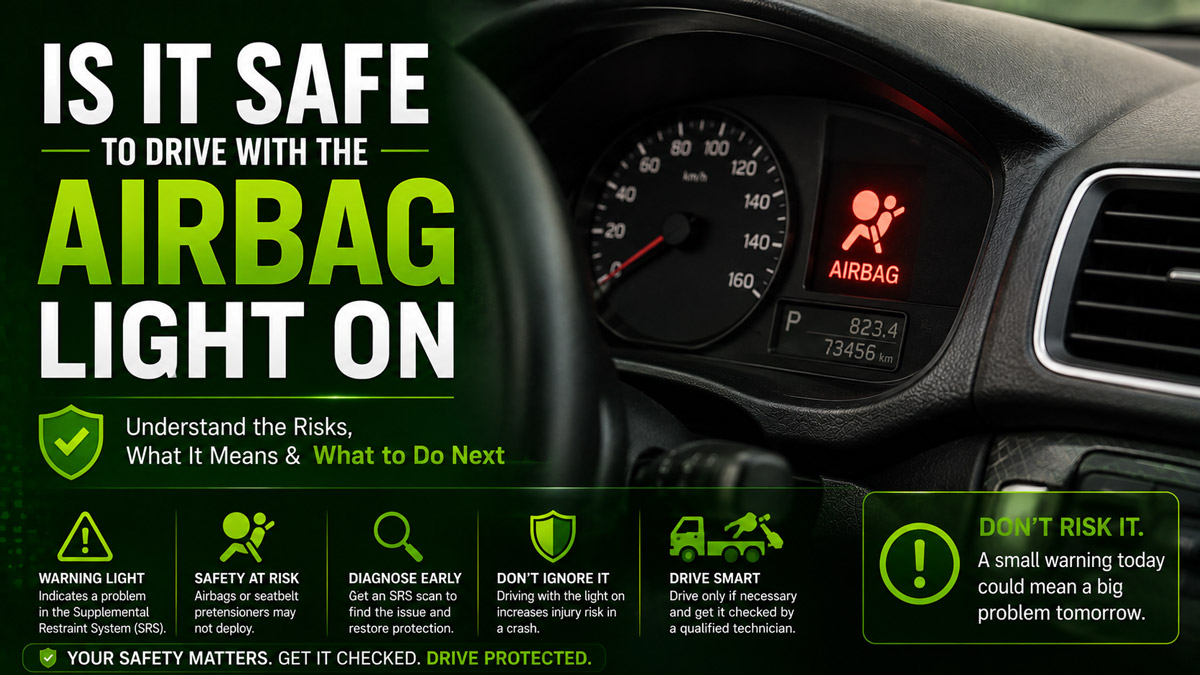
No, it is not considered safe to drive with the airbag light on. The warning means the Supplemental Restraint System has detected a fault, so one or more airbags, crash sensors, or seat-belt pretensioners may not operate correctly in a collision. Limit driving to a direct trip to a qualified repair facility unless other symptoms make towing necessary.
Key Facts at a Glance
- An illuminated airbag light means the SRS has stored a fault code.
- One or more airbags or seat-belt pretensioners may be disabled.
- Ordinary engine-code readers often cannot retrieve SRS codes.
- Clearing the warning without repairing the fault does not restore protection.
- The safest response is prompt diagnosis with an SRS-capable scanner.
- Airbag wiring and modules should not be tested with ordinary electrical probes.
What Does the Airbag Warning Light Mean?
The airbag warning light means the vehicle’s Supplemental Restraint System has identified an electrical, communication, sensor, or component fault. The SRS may disable the affected circuit—or, depending on the vehicle, place a larger portion of the restraint system into a protective shutdown mode.
The SRS normally includes:
- Driver and passenger airbags
- Side and curtain airbags
- Crash or impact sensors
- Seat-belt pretensioners
- Passenger-occupancy sensors
- Steering-wheel clock spring
- SRS control module
- Backup power supply
- Wiring, connectors, and communication circuits
When the ignition is switched on, the airbag light should illuminate briefly while the system performs a self-check. It should then turn off. A light that stays on, flashes repeatedly, or returns while driving indicates a stored problem.
Will the Airbags Deploy With the Light On?
The airbags may not deploy correctly when the warning light is illuminated. The exact result depends on the fault, but a driver cannot determine which restraint devices remain functional without reading the stored SRS diagnostic code.
For example, a fault in the passenger-seat occupancy sensor might disable only the passenger airbag. A communication or control-module fault could affect several airbags and pretensioners. A broken steering-wheel clock spring may interrupt the driver airbag circuit while leaving other airbags available.
The critical point is that the warning light removes certainty. Even if some airbags remain operational, you cannot assume the system will provide full crash protection.
How Dangerous Is It to Continue Driving?
Driving with an airbag light increases injury risk because the vehicle may be relying mainly on seat belts and structural crash protection. Airbags are supplemental restraints, but they are designed to work together with seat belts during moderate-to-severe impacts.
The danger is highest when:
- The driver airbag circuit has failed
- Several SRS codes are present
- Seat-belt pretensioners are disabled
- The vehicle has previous collision damage
- Airbags or modules have been removed
- The warning appeared after water entered the cabin
- The light is accompanied by electrical or battery problems
The vehicle may still steer, brake, and accelerate normally. That does not mean its crash-protection system is functioning normally.
Can You Drive to a Repair Shop?
A short, direct drive to a nearby repair facility may be reasonable when the vehicle otherwise operates normally and the only symptom is the airbag warning light. Wear the seat belt, avoid unnecessary passengers, keep speeds moderate, and minimize the trip.
Arrange towing instead when:
- The vehicle was recently involved in a collision
- An airbag has deployed
- The steering wheel or seat wiring has been disturbed
- The vehicle has severe electrical problems
- The warning appeared with smoke, burning smells, or damaged wiring
- The seat belt will not latch or retract
- The steering wheel controls fail after a clock-spring problem
- The manufacturer has issued instructions not to drive the vehicle
A tow is also preferable when the repair facility is far away or the trip requires high-speed highway driving.
What Should You Do When the Light Comes On?
Take the warning seriously and arrange diagnosis as soon as practical.
- Confirm that the light stays on.
Restart the vehicle once in a safe location. A temporary startup irregularity may disappear, but a returning light still requires diagnosis. - Check the battery condition.
A weak battery, recent jump-start, or charging-system voltage drop can create SRS undervoltage codes. - Look under the front seats without touching connectors.
Check whether luggage, bottles, or seat movement may have disturbed the wiring. Do not unplug yellow SRS connectors while the battery is connected. - Note recent events.
Tell the technician about battery replacement, water spills, seat removal, steering repairs, bodywork, or a recent impact. - Schedule an SRS diagnostic scan.
The stored code identifies the circuit or system area that needs testing.
Do not assume that disconnecting the battery will fix the problem. It may erase unrelated settings while leaving the SRS fault active.
What Commonly Causes the Airbag Light?
Several faults can activate the warning, ranging from low voltage to damaged restraint components.
Weak Battery or Low System Voltage
A discharged battery, failing alternator, or recent jump-start may cause the SRS module to record an undervoltage fault. Replacing or charging the battery may correct the voltage problem, but the stored SRS code may still require professional clearing after the system is tested.
Loose Wiring Under a Front Seat
Front-seat movement can pull or loosen wiring for side airbags, seat-belt pretensioners, buckle switches, and passenger-detection sensors. Water, dirt, or objects under the seat may also damage connectors.
A technician should inspect the circuit because unplugging or probing airbag wiring incorrectly can trigger additional faults or create an accidental deployment risk.
Faulty Steering-Wheel Clock Spring
The clock spring maintains electrical connections while the steering wheel rotates. Internal ribbon wiring can wear or break, interrupting the driver airbag, horn, and steering-wheel controls.
Possible clues include:
- Airbag warning light
- Horn failure
- Inoperative steering-wheel buttons
- Cruise-control problems
- Clicking sounds while turning the wheel
Passenger-Occupancy Sensor Fault
The passenger seat contains sensors that estimate whether the seat is occupied and whether the passenger airbag should be enabled. Sensor failure, wet upholstery, damaged wiring, or heavy objects placed incorrectly on the seat can create a warning.
The separate “Passenger Airbag Off” indicator is not always a fault. It may illuminate normally when the seat is empty or when the system detects a small occupant. The main SRS warning light is the more serious indication.
Damaged Seat-Belt Pretensioner
Pretensioners tighten seat belts during a collision. A failed electrical circuit, deployed pretensioner, damaged buckle switch, or previous crash can activate the airbag warning.
After a collision, a pretensioner may require replacement even when the airbag did not visibly deploy.
Faulty Impact Sensor
Impact sensors send crash information to the SRS control module. Corrosion, collision damage, water intrusion, wiring faults, or internal sensor failure can interrupt communication.
Replacing a sensor without confirming the exact code is poor practice because wiring or module faults can produce similar symptoms.
SRS Control Module Fault
The control module evaluates crash information and commands deployment. It may store crash data after an accident or develop internal communication, power, or memory faults.
A module should be repaired, reset, programmed, or replaced only according to the vehicle manufacturer’s procedures. Installing a random used module may create compatibility and safety problems.
Previous Collision or Improper Repair
A vehicle that has been repaired after a crash may contain deployed pretensioners, missing airbags, damaged wiring, resistors installed to hide faults, or an incorrectly reset control module.
An active warning on a used vehicle should therefore be treated as a major pre-purchase concern, not as a minor dashboard defect.
How Is an Airbag-Light Problem Diagnosed?
A proper diagnosis identifies the stored SRS code before parts are replaced.
Step 1: Scan the SRS Module
A technician connects a scan tool capable of communicating with the vehicle’s airbag module. A basic engine-code reader may read powertrain codes but not manufacturer-specific SRS faults.
The code may identify a circuit such as:
- Driver airbag resistance too high
- Passenger pretensioner circuit open
- Occupancy sensor calibration fault
- Impact sensor communication failure
- SRS supply voltage too low
A code identifies the affected circuit, not automatically the failed part.
Step 2: Inspect the Related Circuit
The technician checks the relevant connectors, wiring, power supply, grounds, and components. Manufacturer wiring diagrams and test procedures are important because airbag circuits use special connectors and safety precautions.
Step 3: Repair or Replace the Faulty Component
The actual repair may involve securing a connector, repairing approved wiring sections, replacing a clock spring, calibrating an occupancy sensor, replacing a pretensioner, or programming an SRS module.
Step 4: Clear the Code and Retest
After the repair, the technician clears the stored fault, cycles the ignition, and verifies that the warning completes its normal startup check. Some repairs also require calibration, programming, or a road test.
A successful repair is confirmed when the light stays off and the SRS scan reports no active fault.
How Much Does It Cost to Fix an Airbag Light?
Airbag-light repairs commonly range from approximately $75 for diagnosis to $800 or more for complex module or occupancy-sensor work. Vehicle design, parts availability, programming requirements, and local labor rates can change the final price significantly.
| Repair or Service | Typical Total Cost | Typical Time |
| SRS diagnostic scan | $75–$150 | 15–60 minutes |
| Wiring or connector repair | $100–$350 | 1–2 hours |
| Clock spring replacement | $200–$500 | 1–2 hours |
| Impact sensor replacement | $150–$400 | About 1 hour |
| Seat-belt pretensioner replacement | $200–$600 | 1–2 hours |
| Passenger-seat sensor repair | $300–$700 | 2–3 hours |
| SRS module service or replacement | $300–$800+ | 1–3 hours |
These are broad estimates rather than quotes. Luxury vehicles, integrated seat assemblies, dashboard airbags, and modules requiring dealer programming can cost considerably more.
Can You Reset the Airbag Light Yourself?
You can clear some SRS codes with a compatible professional-level scanner, but clearing the code does not repair the underlying fault. If the problem remains, the warning will return immediately or after the module repeats its self-test.
A DIY scan may be useful for identifying the affected circuit. Physical repairs become risky when they involve airbags, pretensioners, steering-wheel removal, control modules, or yellow SRS wiring.
Safe DIY Checks
- Confirm battery voltage and charging condition
- Check whether the warning appeared after a dead battery
- Remove loose objects from under the seats
- Record whether the light is constant or intermittent
- Read codes with a vehicle-compatible SRS scanner
Tasks Best Left to a Technician
- Removing an airbag
- Testing an inflator circuit
- Replacing a steering-wheel clock spring
- Repairing SRS wiring
- Resetting crash data
- Programming a control module
- Calibrating a passenger-seat sensor
What Should You Never Do Around Airbag Wiring?
Never probe an airbag connector with a standard multimeter or test light. Electrical testing methods that are safe on ordinary circuits may apply current to an inflator circuit and create an accidental deployment risk.
Also avoid:
- Disconnecting yellow connectors with the battery connected
- Installing resistors to trick the SRS module
- Buying unknown used airbags
- Applying power directly to an inflator
- Striking or dropping an airbag module
- Placing an airbag face-down after removal
- Clearing codes repeatedly without diagnosis
Vehicle-specific service information must be followed because backup-power discharge times and handling procedures vary.
Can the Airbag Light Cause an Inspection Failure?
An illuminated airbag warning may cause a safety inspection failure in jurisdictions that inspect restraint systems. Requirements vary by country, state, province, and inspection program.
Even where the warning is not part of the formal test, selling a vehicle with a known SRS defect may create disclosure, liability, insurance, or resale-value concerns. Repairing the system is safer than relying on whether an inspector notices the light.
Is an Intermittent Airbag Light Still Serious?
Yes. An airbag light that turns on only when the seat moves, the steering wheel turns, or the vehicle travels over bumps often indicates an unstable electrical connection.
Intermittent faults may point to:
- Loose under-seat connectors
- Broken clock-spring wiring
- Chafed harnesses
- Corroded terminals
- Low system voltage
- Module communication interruptions
The fact that the light later turns off does not prove the circuit is reliable. Record when the warning appears because that pattern can help the technician reproduce the fault.
Should You Buy a Car With the Airbag Light On?
Do not buy a vehicle with an active airbag warning unless an independent inspection identifies the exact fault and the repair cost is reflected in the purchase decision. A seller’s claim that the problem is “only a sensor” is not a diagnosis.
Before purchase, request:
- A complete SRS scan
- Collision-history information
- Evidence of prior airbag repairs
- Inspection of seat belts and pretensioners
- Confirmation that all airbags are present
- A written repair estimate
A warning light can represent a relatively simple wiring issue, but it can also reveal incomplete collision repairs or missing safety components.
When Is It Safe to Drive Again?
The vehicle is ready for normal use when the underlying fault has been repaired, required programming or calibration has been completed, and the SRS warning performs its normal startup sequence before turning off.
Do not rely only on code deletion. A complete post-repair check should confirm:
- No active SRS codes remain.
- The warning light turns off after startup.
- The passenger-airbag indicator behaves normally.
- Steering-wheel controls and horn operate correctly.
- Seat-belt systems function correctly.
- Repaired wiring and connectors are securely retained.
Frequently Asked Questions
Can a bad battery turn on the airbag light?
Yes. Low battery voltage, a failed alternator, or a jump-start event can cause the SRS module to store an undervoltage code. The battery or charging fault should be corrected first, followed by an SRS scan to determine whether the warning clears or another problem is present.
Will disconnecting the battery reset the light?
Disconnecting the battery usually does not permanently reset an active SRS fault. The warning commonly returns when the module detects the same problem during its next self-check. Battery disconnection can also erase vehicle settings and should not replace proper diagnosis.
Can a fuse cause the airbag light?
A blown fuse or poor power-supply connection can prevent the SRS module or one of its circuits from operating. However, replacing a fuse without determining why it failed may leave a short circuit unresolved. Use the manufacturer’s fuse specification and arrange diagnosis if the replacement fuse blows again.
Why did the airbag light appear after moving the seat?
Moving the seat can pull, pinch, or loosen wiring connected to a side airbag, buckle switch, pretensioner, or occupancy sensor. Do not disconnect the connector while the battery is connected. A technician should inspect the under-seat circuit and retrieve the stored SRS code.
Is the passenger-airbag-off light the same warning?
No. A passenger-airbag-off indicator may illuminate normally when the passenger seat is empty or occupied by a lightweight passenger. The main airbag or SRS warning light indicates a system fault. Consult the owner’s manual when either indicator behaves unexpectedly.
Can airbags deploy accidentally because the warning light is on?
An illuminated warning does not normally mean deployment is imminent. It means the system detected a fault and may disable the affected circuit. However, damaged wiring and improper testing can create hazards, which is why airbag components should be handled using manufacturer-approved procedures.
The Bottom Line
It is not safe to continue normal driving with the airbag light on because the vehicle cannot guarantee that its airbags and seat-belt pretensioners will work correctly during a crash. A short drive directly to a nearby repair facility may be reasonable when the vehicle otherwise operates normally, but prompt SRS diagnosis is essential. Repair the underlying fault rather than simply clearing the warning.