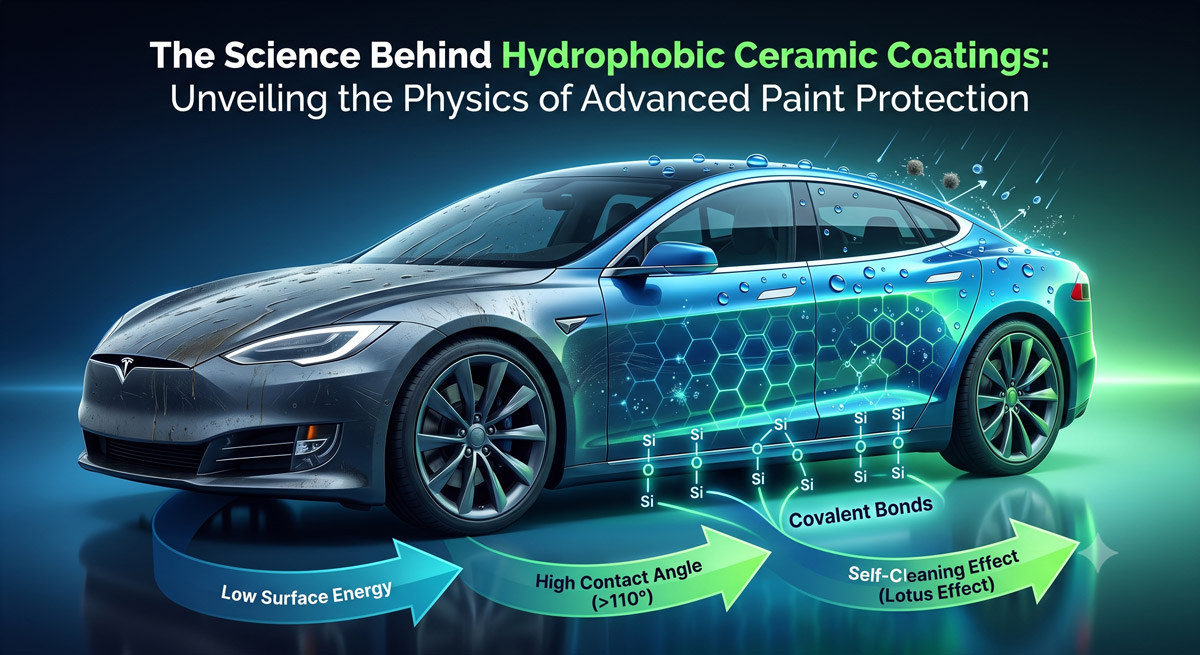
Automotive paint finishes are subjected to continuous environmental degradation. Solar ultraviolet radiation, industrial fallout, acidic rainfall, bird droppings, road salts, and organic contaminants constantly bombard vehicle clear coats. Traditional protective solutions such as natural carnauba waxes and synthetic polymer sealants offer temporary relief, but their sacrificial organic bonds degrade rapidly when exposed to environmental heat, friction, and washing chemicals.
Over the past decade, automotive surface care has undergone a massive technological shift driven by advanced nanotechnology and liquid silica chemistry. Understanding the science behind hydrophobic ceramic coatings reveals why these liquid formulations outperform conventional waxes by orders of magnitude. Rather than sitting passively on top of painted surfaces, ceramic coatings fundamentally re engineer the physical properties, chemical reactivity, and surface energy of clear coats.
This comprehensive guide explores the deep scientific principles that govern hydrophobic ceramic coatings. We will examine covalent molecular bonding, surface energy thermodynamics, liquid contact angle physics, the self cleaning lotus effect, degradation pathways, and essential maintenance protocols.
Key Scientific Takeaways
- Covalent Integration: Ceramic coatings form permanent chemical bonds with clear coat polymers rather than relying on weak physical adhesion.
- Low Surface Energy: By dropping surface energy below 18 mN/m, coatings create an apolar barrier that forces polar water molecules to bead tightly.
- Extreme Contact Angles: Advanced SiO2 and TiO2 matrices elevate water contact angles beyond 110 degrees and minimize roll off angles.
- Microscopic Self Cleaning: Hydrophobic droplet movement physically encapsulates and sweeps away surface debris via the lotus effect.
Nanotechnology and Molecular Bonding: How SiO2 and TiO2 Transform Vehicle Clear Coats
To comprehend the performance of hydrophobic ceramic coatings, one must first look at automotive paint under high magnification. Standard factory clear coat, despite appearing smooth to the naked eye, is extremely porous. It consists of a polyurethane polymer mesh filled with microscopic peaks, valleys, craters, and structural imperfections ranging from 10 to 100 nanometers in scale. These micro pores trap moisture, dirt, oxidation, and chemical pollutants, accelerating paint dullness and clear coat breakdown.
Hydrophobic ceramic coatings solve this structural flaw through nanotechnology. Formulation chemistry relies on liquid silica monomers, organosilanes, polysilazanes, and titanium nanoparticles suspended in volatile solvent carriers.
Surface Structure Comparison
Uncoated Porous Paint vs. Sealed Ceramic Covalent Matrix
Uncoated Paint
Unprotected- Microscopic valleys trap water, dirt, and road grime
- Causes water to flatten, sheet, and form mineral spots
- Highly vulnerable to chemical contamination and oxidation
Ceramic Coated
Protected- Fills microscopic pores to form an optically flat surface
- Extremely high contact angle creates spherical water beads
- Prevents dirt adhesion for easy hydrophobic self-cleaning
The Role of Silicon Dioxide (SiO2) and Titanium Dioxide (TiO2)
The chemical backbone of most modern ceramic coatings is formed by Silicon Dioxide (SiO2). When purified silica is synthetically processed into nanoparticles measuring between 10 and 50 nanometers, it gains unique optical transparency and chemical reactivity.
- Silicon Dioxide (SiO2): Provides structural hardness, optical clarity, thermal stability, and low surface energy. Upon curing, SiO2 converts into a dense glass like matrix of repeating siloxane bonds (Si-O-Si).
- Titanium Dioxide (TiO2): Frequently added to premium professional coatings to enhance depth of shine, add photocatalytic properties, and provide extreme ultraviolet radiation absorption. TiO2 neutralizes free radicals generated by sunlight, preventing clear coat yellowing and oxidation.
- Polysilazanes: Organic and inorganic silicon nitrogen polymers that react with ambient humidity during application. As the solvent evaporates, polysilazanes undergo hydrolytic polycondensation, releasing ammonia gas as a byproduct and leaving behind a pure silicon dioxide network.
Covalent Bonding vs Physical Adhesion
Traditional carnauba waxes and synthetic polymer sealants adhere to automotive paint purely through weak physical forces known as van der Waals attraction. Because no chemical bond is established, heat from direct sunlight or washing with detergents easily breaks these weak bonds, stripping the protection within weeks.
In contrast, hydrophobic ceramic coatings undergo true covalent chemical bonding with the factory clear coat.
- Solvent Evaporation: The liquid coating is wiped onto the prepped paint. Volatile carrier solvents evaporate, bringing silica nanoparticles into direct contact with hydroxyl groups (-OH) present on the clear coat surface.
- Hydrolysis and Condensation: Moisture in the air triggers a chemical condensation reaction. Organosilane compounds in the coating react with hydroxyl groups on the polyurethane clear coat.
- Permanent Cross Linking: Strong chemical covalent bonds (Si-O-Paint) are formed. The coating cross links into a continuous three dimensional crystal matrix that physically becomes an integrated top layer of the paint system.
Because covalent bonds require immense energy to break, a cured ceramic coating cannot be washed off with water, soaps, or high pressure sprayers. It can only be removed through mechanical abrasion such as machine polishing.
Chemical Covalent Nano-Bonding Structure
Molecular cross-linking of SiO2 to the clear coat polymer mesh
The Physics of Surface Energy and Interfacial Thermodynamics
The property of hydrophobicity, water repellency, is governed by fundamental physical laws of thermodynamics, specifically surface energy and interfacial tension.
Every solid material possesses a specific surface free energy, measured in millinewtons per meter (mN/m) or dynes per centimeter. Surface energy determines how strongly a solid attracts or repels liquid molecules placed upon it.
Surface Energy Physics & Hydrophobicity
How surface tension (mN/m) controls liquid wetting vs. spherical beading
Uncoated Clear Coat
~40 mN/mAdhesive forces exceed liquid cohesion. Liquid spreads and wets the surface easily.
Ceramic Coated Surface
~15 mN/mLiquid is repelled; internal cohesive forces dominate to form tight droplets.
High Surface Energy vs Low Surface Energy
Unprotected automotive clear coat is a high surface energy material, typically exhibiting surface free energy values between 35 and 45 mN/m. Water, by comparison, has an exceptionally high liquid surface tension of approximately 72.8 mN/m at room temperature, driven by intense internal hydrogen bonding between oxygen and hydrogen atoms.
When water contacts an unprotected clear coat:
- The high surface energy of the paint pulls strongly on the water molecules.
- The adhesive force between the paint and the water overcomes the internal cohesive forces within the liquid.
- As a result, the water flattens out, wetting the surface and forming large sheets or flat puddles that cling tightly to the paint.
When a ceramic coating cures over the paint:
- The cross linked siloxane matrix presents a non polar (apolar) surface facing outwards.
- The surface energy of the material drops dramatically to between 12 and 18 mN/m.
- Because the apolar ceramic surface offers virtually no attractive electromagnetic forces, adhesive attraction drops.
- The internal cohesive hydrogen bonds within the water molecule dominate completely, pulling the liquid inward into a tight sphere to minimize its contact area with the low energy surface.
The Young-Dupré Equation and Wetting Behavior
The quantitative relationship between solid surface energy, liquid surface tension, and interfacial tension is defined by Young’s Equation:
Young’s Equation & Contact Angle Mechanics
Interfacial energy balance controlling contact angle (θ)
Where:
- γSV is the surface free energy of the solid in equilibrium with vapor.
- γSL is the interfacial tension between the solid and the liquid.
- γLV is the surface tension of the liquid in equilibrium with vapor.
- θ is the contact angle formed at the three phase contact line.
By engineering the solid surface to minimize γSV through dense silica nanoparticles, the term cosθ is forced into negative values, resulting in contact angles θ significantly greater than 90 degrees.
Water Contact Angle Measurements: Quantifying Hydrophobic Efficiency
In surface science, the efficiency of a protective coating is objectively measured by its Water Contact Angle (WCA). The contact angle is the angle formed by a liquid droplet at the intersection where liquid, gas, and solid meet.
Water Contact Angle (WCA) Spectrum
Classifying surface wettability from flat sheeting to elite ceramic beading
Hydrophilic
WCA < 90°Liquid flattens and sheets across the clear coat. High risk of water spotting and grime accumulation.
Hydrophobic
WCA 90°–110°Water repelled into defined domes. Standard behavior for sealant, waxes, and basic PPF.
Superhydrophobic
WCA > 110°Tight spherical beads bounce off surface, carrying dirt and contamination away effortlessly.
The Three Wetting Classifications
Surfaces are categorized into three distinct regimes based on their water contact angle measurements:
- Hydrophilic (Water Attracting): Contact angle is less than 90 degrees. Water spreads out across the surface in a thin film. Factory clear coats, glass without coatings, and oxidized surfaces are naturally hydrophilic.
- Hydrophobic (Water Repellent): Contact angle ranges between 90 degrees and 110 degrees. Water forms distinct beads. Quality carnauba waxes and basic synthetic sealants operate within this category.
- Superhydrophobic (Ultra Water Repellent): Contact angle exceeds 110 degrees, often reaching 115 to 120 degrees in advanced ceramic formulations. Water forms near perfect spheres that roll off at slight angles.
Contact Angle Comparison Matrix
The table below outlines the physical and performance metrics across different surface protection technologies.
Dynamic Contact Angles: Advancing, Receding, and Roll Off Hysteresis
While static contact angle measures water bead roundness on a flat surface, dynamic contact angles govern how water behaves on a moving vehicle. Dynamic performance is evaluated using two critical parameters:
- Advancing Contact Angle (θAθA): The angle measured at the front edge of a water droplet as it expands or slides down an inclined surface.
- Receding Contact Angle (θRθR): The angle measured at the rear edge of the droplet as it pulls away from the surface.
- Contact Angle Hysteresis (Δθ=θA−θRΔθ=θA−θR): The numerical difference between advancing and receding angles.
Contact Angle Hysteresis (Δθ)
Dynamic droplet mechanics on an inclined or sliding surface
If contact angle hysteresis is high, the droplet sticks to the surface, refusing to move even if the static contact angle is high. Hydrophobic ceramic coatings are specifically engineered to minimize contact angle hysteresis. By lowering hysteresis below 5 degrees, water droplets experience virtually zero adhesion friction, allowing them to roll off tilted panels at vehicle speeds as low as 10 to 15 miles per hour.
The Self Cleaning Effect: The Microscopic Lotus Effect in Action
One of the most valuable operational benefits of hydrophobic ceramic coatings is the self cleaning effect. This phenomenon is modeled directly after nature, specifically the leaf of the lotus plant (Nelumbo nucifera).
Self-Cleaning Mechanism (Lotus Effect)
How superhydrophobic roll-off encapsulates and removes dirt particles
Traditional Surface
Washing RequiredWater flattens into puddles, pinning dirt and mineral deposits directly against the clear coat pores.
Ceramic Coated Surface
Self-Cleaning ActionSpherical beads roll freely across the low-energy surface, picking up dirt particles and lifting them away.
Mechanics of Contaminant Encapsulation
On a conventional paint surface, dust, dirt, microscopic metal particles, bird drop acids, and road grime establish physical and chemical contact with clear coat pores. When rain falls on an uncoated car, the water wets the dirt, spreading it into a muddy layer that dries into stubborn water stains and embedded grime.
On a ceramic coated surface, three physical factors create the self cleaning mechanism:
- Reduced Surface Adhesion: Because the coating presents an apolar, low energy barrier, solid contaminants cannot form mechanical or chemical bonds with the substrate. Adhesion forces between dirt and the coated paint are reduced by 50% to 70%.
- High Liquid Cohesion: Water droplets retain high surface tension, forming spherical beads rather than flat films.
- Debris Encapsulation and Sweeping: As spherical water droplets roll across the inclined panels of a moving vehicle, the adhesive force between the dirt particle and the water droplet is significantly greater than the adhesion force between the dirt particle and the low energy ceramic surface.
Consequently, as the water bead rolls forward, it physically picks up, encapsulates, and sweeps away resting dust particles without scratching the underlying paint.
Environmental Contaminants Neutralized by Ceramic Matrices
- Bird Droppings and Tree Sap: Contains uric acids and sticky resins. The non porous ceramic matrix prevents acidic penetration into clear coat layers.
- Road Tar and Brake Dust: Metallic iron particles cannot embed into the hardened silica structure, allowing easy removal during routine washes.
- Ultraviolet Degradation: Photodegradation caused by solar UV photons is blocked by TiO2 and SiO2 energy absorption, preserving color clarity.
Structural Degradation Pathways and the Water Spotting Risk
Despite their extraordinary durability, hydrophobic ceramic coatings are not indestructible. Understanding the chemical and physical pathways of degradation helps vehicle owners maximize coating lifespan and avoid common maintenance pitfalls.
Coating Life Cycle Degradation
From initial cure through environmental clogging, decontamination, and terminal wear
Factors Driving Hydrophobic Degradation
While the underlying covalently bonded SiO2 foundation remains attached to the paint for years, the ultra low surface energy top layer naturally degrades over time due to specific stresses:
- Traffic Film and Clogging: Microscopic road oils, unwashed mineral deposits, and fuel exhaust particulates settle into the microscopic valleys of the coating. This layer masks the low energy hydrophobic surface, causing water to flatten even though the protective ceramic matrix is fully intact.
- Aggressive Washing Chemicals: Washing a coated car with extremely harsh high pH degreasers (pH > 12) or highly acidic cleaners (pH < 2) repeatedly can oxidize top tier organosilane functional groups, degrading hydrophobicity prematurely.
- Mechanical Friction: Automatic drive through brush car washes, dirty microfiber towels, and abrasive wiping create micro scratching that wears down top layer functional groups.
The Physics of Water Spotting (Type 1 and Type 2 Etching)
A common misconception is that ceramic coatings prevent water spots entirely. In reality, highly hydrophobic surfaces can actually increase the risk of water spotting if mismanaged.
Because ceramic coatings force water into tight, elevated beads, each droplet acts as a spherical lens containing dissolved tap water or rain minerals such as calcium carbonate, magnesium, and silicates.
The Convex Lens Water Spot Effect
How solar ray refraction and thermal evaporation cause concentrated mineral etching
When a vehicle covered in high contact angle water beads sits in direct sunlight:
- Solar Thermal Focus: The spherical shape of the bead acts like a magnifying lens, focusing solar heat directly onto a tiny point on the coating.
- Rapid Evaporation: Water evaporates from the bead perimeter inward, concentrating all dissolved minerals into a dense, hard mineral ring (Type 1 Water Spot).
- Chemical Etching: If left unaddressed under extreme heat, acidic mineral deposits can slowly etch into the top siloxane layer (Type 2 Water Spot).
To prevent water spotting, water beads must be dried promptly, or the surface should be treated with ceramic boosters that minimize mineral adhesion.
Surface Preparation and Professional Installation Science
The performance of any hydrophobic ceramic coating is directly proportional to the quality of surface preparation performed prior to application. Applying a ceramic coating over contaminated or unpolished paint compromises covalent bonding.
Ceramic Coating Preparation Protocol
5-step surface decontamination & correction workflow
Essential Steps for Optimal Covalent Integration
- Chemical Decontamination: Application of pH neutral iron removers containing ammonium thioglycolate. This chemical reacts with embedded brake dust particles, converting insoluble iron into soluble water complex compounds.
- Mechanical Claying: Using detailing clay to shear off above surface tree sap, overspray, and industrial fallout.
- Paint Correction (Polishing): Machine polishing using aluminum oxide abrasives levels out swirl marks and micro scratches. This step maximizes surface smoothness, ensuring uniform contact angle dynamics across all panels.
- Solvents and Surface Prep Wipes: Wiping the paint with an isopropyl alcohol (IPA) solution or dedicated solvent prep cleanser. This step strips all remaining polishing oils, silicones, and surfactants, exposing pure, unblocked hydroxyl groups on the clear coat surface.
- Controlled Application Environment: Applying the liquid coating in a temperature controlled environment (65°F to 75°F, 40% to 50% relative humidity). Flash time, the duration between liquid application and leveling wipe, must be carefully managed to prevent high spots and uneven cross linking.
Maintenance Science: Preserving Long Term Hydrophobic Performance
To maintain peak water beading and self cleaning capabilities over a multi year lifespan, a specific maintenance methodology rooted in chemical compatibility must be followed.
Declogging vs Reapplying
When a ceramic coating appears to lose its hydrophobicity after 12 months, it is rarely due to coating failure. In over 90% of cases, the silica matrix is simply clogged by traffic film and hard water minerals.
Performing a deep decontamination wash using a mild acidic shampoo (pH 4 to 5) dissolves bound calcium and magnesium salts, unclogging the silica pores and restoring original contact angles without needing to reapply the coating.
Conclusion: The Future of Nanoscale Automotive Surface Protection
The science behind hydrophobic ceramic coatings represents a monumental advance over traditional automotive waxes and sealants. By utilizing liquid silica chemistry, organosilanes, and nanotechnology, these advanced coatings establish permanent covalent bonds with vehicle clear coats. They lower surface energy, elevate water contact angles beyond 110 degrees, minimize contact angle hysteresis, and harness the self cleaning lotus effect to keep vehicles protected under severe environmental conditions.
Whether you are looking to protect a daily driver or maintain a high end exotic vehicle, understanding the chemistry of surface energy and molecular bonding empowers you to select the ideal protection system and maintain it for years of flawless performance.
Next Step: Transform Your Vehicle with Professional Grade Ceramic Science
Are you ready to experience the ultimate in long term paint protection, extreme optical gloss, and effortless self cleaning maintenance?
Explore our premium range of professional SiO2 ceramic coating kits and maintenance products, or contact our team of certified surface care specialists today to schedule an expert installation consultation tailored to your specific vehicle.