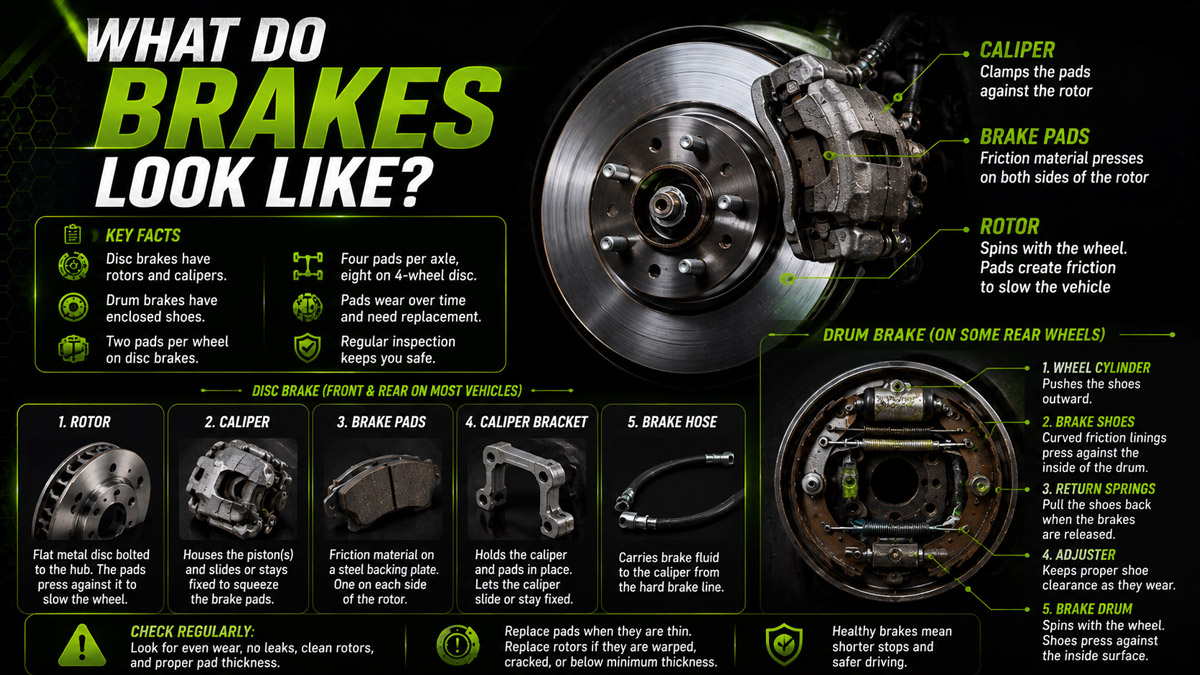
Car brakes look like heavy metal components mounted directly behind each wheel. Disc brakes have a flat circular rotor gripped by a thick caliper, while drum brakes look like a closed metal bowl that hides curved shoes, springs, and a wheel cylinder inside.
Key Facts at a Glance
- Disc brakes look like shiny circular plates with metal calipers wrapped around one edge.
- Drum brakes look like enclosed round metal housings attached to the wheel hubs.
- Brake pads are flat friction blocks positioned inside disc-brake calipers.
- Brake shoes are curved friction-lined parts hidden inside brake drums.
- Healthy rotors are relatively smooth, evenly colored, and free from deep grooves or cracks.
- Fluid, blue discoloration, uneven wear, or metal-on-metal scoring indicates a problem.
Where Are Car Brakes Located?
Car brakes are mounted at each wheel, between the wheel hub and the wheel itself. You usually need to look through the wheel spokes or remove the wheel to see the complete assembly.
On most modern vehicles, the front brakes are larger because the front axle handles most of the vehicle’s braking force. Rear brakes may be smaller disc brakes or enclosed drum brakes.
The visible arrangement normally includes:
- A rotor or drum rotating with the wheel
- A caliper or wheel cylinder applying force
- Brake pads or shoes creating friction
- A flexible hydraulic hose carrying brake fluid
- A backing plate, bracket, shield, or mounting hardware
Components such as the brake pedal, booster, master cylinder, fluid reservoir, metal brake lines, and anti-lock braking system module are located elsewhere in the vehicle.
What Do Disc Brakes Look Like?
Disc brakes look like flat metal discs with chunky clamp-shaped calipers positioned over their outer edges. The rotor resembles a large dinner plate, while the caliper resembles a heavy metal jaw.
Disc brakes are common on front wheels and increasingly used on all four wheels.
What Does a Brake Rotor Look Like?
A brake rotor is a round steel or iron disc mounted to the wheel hub. It has a broad friction surface where the brake pads make contact.
Rotors may be:
- Plain: Smooth friction faces with no added openings
- Slotted: Machined with shallow channels
- Cross-drilled: Made with multiple small holes
- Drilled and slotted: Equipped with both features
- Vented: Constructed with cooling channels between two friction surfaces
- Solid: Made as one solid plate, often on lighter-duty rear brakes
A normal rotor usually appears gray or silver where the pads contact it. Light orange surface rust can form after rain or washing and often disappears after several normal brake applications.
Deep grooves, cracks, dark patches, or blue-purple discoloration are not normal.
What Does a Brake Caliper Look Like?
A brake caliper is a thick metal housing that straddles part of the rotor. It may be gray, black, silver, red, yellow, or another painted color.
The caliper contains one or more pistons that push the brake pads against the rotor. Most daily-use vehicles have sliding calipers with pistons on one side. Performance vehicles may use larger fixed calipers with pistons on both sides.
Common visual features include:
- A bulky cast-metal body
- A bridge extending over the rotor
- A rubber brake hose attached to the housing
- A bleeder screw near the upper portion
- Guide pins or mounting bolts
- Pads visible between the caliper and rotor
Large calipers do not automatically indicate stronger brakes. Effective braking also depends on rotor diameter, pad material, piston area, tire grip, vehicle weight, cooling, and electronic control.
What Do Brake Pads Look Like?
Brake pads look like flat or slightly curved metal plates with blocks of dark friction material bonded to one side. Two pads are normally installed at each disc-brake wheel: one on each side of the rotor.
A new passenger-vehicle pad commonly has roughly 8–12 millimeters of friction material, although specifications vary. Replacement is often recommended when the usable material reaches approximately 3 millimeters.
A pad has three main visual layers:
- A steel backing plate
- A friction-material block
- A shim or coating intended to reduce vibration and noise
The friction material may appear dark gray, brown, black, or metallic. A very thin strip of material, uneven taper, cracking, glazing, or separation from the backing plate indicates wear or damage.
What Do Drum Brakes Look Like?
Drum brakes look like round, enclosed metal bowls mounted over the wheel hubs. Their working components cannot normally be seen until the drum is removed.
Drums are still used on the rear axles of some compact cars, economy vehicles, trucks, vans, and hybrids. They are durable and integrate easily with mechanical parking-brake systems.
What Does a Brake Drum Look Like?
A brake drum resembles a thick steel or cast-iron bowl. Its outer face may be smooth except for wheel studs, inspection holes, or retaining fasteners.
The inner cylindrical surface serves as the friction surface. Brake shoes press outward against it to slow the wheel.
A healthy drum should have:
- A relatively smooth internal friction surface
- No deep circular scoring
- No major heat cracks
- No heavy fluid contamination
- An inside diameter within the manufacturer’s service limit
A noticeable ridge at the open edge can develop as the working surface wears. A deep ridge may make drum removal difficult and may indicate substantial wear.
What Do Brake Shoes Look Like?
Brake shoes look like two curved metal arcs arranged in a circle inside the drum. Their outer edges are lined with dark friction material.
The assembly also contains:
- Return springs
- Hold-down springs and pins
- An adjuster mechanism
- A wheel cylinder
- A parking-brake lever or cable
- A metal backing plate
The hardware can look complicated because several springs control shoe position and return movement. Photographing the assembly before disassembly helps prevent incorrect reinstallation.
What Does a Wheel Cylinder Look Like?
A wheel cylinder is a small horizontal metal cylinder positioned between the upper ends of the brake shoes. Rubber boots cover pistons at both ends.
When the brake pedal is pressed, hydraulic pressure pushes the pistons outward. The pistons spread the shoes against the drum.
Wetness under the rubber boots, peeling paint on the backing plate, or oily contamination on the shoes usually indicates brake-fluid leakage.
Disc Brakes vs. Drum Brakes: Visual Comparison
| Feature | Disc Brake | Drum Brake |
| Main visible shape | Flat circular plate | Closed round bowl |
| Friction component | Flat brake pads | Curved brake shoes |
| Applying component | Caliper | Wheel cylinder |
| Parts visible without opening | Rotor and caliper | Mostly the drum exterior |
| Cooling | Open to airflow | Heat retained inside housing |
| Inspection difficulty | Relatively easy | Drum usually requires removal |
| Common placement | Front or all four wheels | Often rear wheels |
| Parking brake | Separate or integrated mechanism | Commonly integrated into shoes |
Disc brakes are easier to recognize and inspect because the rotor and caliper remain exposed. Drum brakes hide most wear surfaces and hardware, so external appearance alone cannot confirm their internal condition.
How Do Brakes Work?
Car brakes convert wheel motion into heat through friction. Hydraulic pressure moves pads against rotors or shoes against drums, slowing the rotating wheels.
The process happens in six stages:
- The driver presses the pedal.
Pedal force begins the braking request. - The brake booster assists the force.
Vacuum or electric assistance reduces the effort required from the driver. - The master cylinder moves brake fluid.
Hydraulic pressure travels through metal lines and flexible hoses. - The caliper piston or wheel cylinder moves.
Hydraulic pressure is converted into mechanical movement. - The friction material contacts the rotating surface.
Pads clamp the rotor, or shoes expand against the drum. - Motion becomes heat.
Friction reduces wheel speed while the brake assembly absorbs and releases heat.
Anti-lock braking systems can rapidly adjust pressure to prevent wheel lockup during hard braking. Electronic stability systems may also apply individual brakes to help control vehicle direction.
What Do Healthy Brakes Look Like?
Healthy brakes look clean, dry, evenly worn, and structurally intact. Normal components may have minor dust, light surface rust, or faint polishing marks without being defective.
Healthy Disc-Brake Signs
A healthy disc-brake assembly generally has:
- Similar pad thickness on both sides
- Rotor faces without deep grooves
- No visible fluid around the caliper or hose
- Intact rubber boots
- Secure hardware
- Even gray or metallic rotor coloration
- No major cracks or broken edges
Fine circular lines on a used rotor can be normal. The important distinction is whether the marks are shallow and uniform or deep enough to catch a fingernail.
Healthy Drum-Brake Signs
A healthy drum-brake assembly generally has:
- Dry friction surfaces
- Even shoe-lining thickness
- Correctly seated springs
- No wheel-cylinder leakage
- A freely moving adjuster
- No broken or detached lining
- A drum within its maximum diameter specification
Brake dust inside the drum is expected. Oil, grease, or brake fluid is not.
What Do Worn Brake Pads Look Like?
Worn brake pads have very little friction material remaining above the backing plate. At approximately 3 millimeters or less, replacement should be planned promptly.
Visible warning signs include:
- Friction material almost level with the backing plate
- One pad noticeably thinner than the other
- Tapered wear from one end to the other
- Cracks or missing chunks
- A smooth, glass-like glazed surface
- Friction material separating from the steel plate
- A wear-indicator tab touching the rotor
Uneven inner and outer pad wear often points to sticking slide pins, a seized caliper piston, damaged hardware, or restricted pad movement.
What Do Bad Brake Rotors Look Like?
Bad brake rotors may have deep scoring, heat discoloration, cracks, rust pitting, an outer wear lip, or irregular dark patches. Visual damage often accompanies noise, pulsation, or reduced braking performance.
| Rotor Appearance | Likely Meaning |
| Deep circular grooves | Pads worn excessively or debris trapped |
| Blue or purple areas | Severe overheating |
| Dark uneven patches | Uneven pad deposits or heat concentration |
| Heavy pitting | Long-term rust or moisture exposure |
| Cracks | Thermal or structural damage |
| Large outer lip | Significant friction-surface wear |
| Mirror-like surface | Possible glazing |
| Oil or grease | Contamination from another component |
A rotor cannot be declared warped by appearance alone. Brake pulsation may come from thickness variation, uneven pad deposits, hub corrosion, improper wheel-nut torque, or excessive runout.
What Does an Overheated Brake Look Like?
An overheated brake may look blue, purple, dark gray, glazed, cracked, or unusually dusty. The affected wheel may also be much hotter than the others.
Common causes include:
- A sticking caliper piston
- Seized guide pins
- A collapsed brake hose
- An overadjusted drum brake
- A parking brake that does not release
- Continuous braking on long descents
- Excessive towing load
- Aggressive repeated stops
Heat can harden pad surfaces, boil moisture-contaminated brake fluid, damage seals, and reduce friction. Smoke, a burning smell, or a glowing rotor requires the vehicle to be stopped safely and allowed to cool.
Do not touch a suspected overheated wheel or brake component. Temperatures can remain dangerous long after the vehicle stops.
What Does a Brake-Fluid Leak Look Like?
A brake-fluid leak looks like clear, pale yellow, or brownish oily liquid around a caliper, wheel cylinder, hose, metal line, master cylinder, or reservoir. Brake fluid feels slippery but is usually thinner than engine oil.
Leak clues include:
- Wet caliper surfaces
- Fluid inside a wheel
- Dampness below a wheel-cylinder boot
- Peeling paint near leaking fluid
- A falling reservoir level
- A soft or sinking brake pedal
- A brake warning light
A suspected hydraulic leak is a safety-critical fault. Adding fluid does not repair the leak, and continued driving can result in partial or complete braking loss.
Can You See Brakes Through the Wheel?
You can often see disc-brake rotors and calipers through open wheel spokes. Brake pads may also be partly visible, but shields, wheel design, and caliper position can block the view.
A through-the-wheel inspection can reveal:
- Rotor rust or scoring
- Obvious cracks
- Caliper position
- Severe pad wear
- Fluid contamination
- Loose or damaged components
However, it cannot reliably show both pad surfaces, measure rotor thickness, inspect the inner rotor face, or confirm caliper operation.
A complete inspection usually requires removing the wheel.
What Do Performance Brakes Look Like?
Performance brakes often have larger rotors, multi-piston calipers, high-temperature pads, cooling ducts, and drilled or slotted friction surfaces. Brightly painted calipers are common but are primarily cosmetic unless the underlying design is also upgraded.
Carbon-ceramic rotors may look darker, smoother, or more uniform than conventional iron rotors. They are lightweight and highly heat-resistant but expensive and vulnerable to certain forms of impact damage.
Oversized brake components can reduce clearance between the caliper and wheel. Wheel diameter alone does not determine clearance because spoke shape and offset also matter.
What Do Electric-Vehicle Brakes Look Like?
Electric-vehicle friction brakes generally look similar to conventional disc or drum brakes. The main difference is that regenerative braking allows the electric motor to perform part of the vehicle’s deceleration.
Because friction brakes may be used less frequently, electric vehicles can develop:
- Rotor surface rust
- Sticking pads
- Corroded hardware
- Uneven friction surfaces
- Reduced pad wear despite vehicle age
Low mileage on the pads does not guarantee healthy brakes. Age, moisture, road salt, and limited friction-brake use can still damage components.
How Long Do Brake Components Last?
Brake pads commonly last about 30,000–70,000 miles, while rotors may last approximately 50,000–80,000 miles. These are broad ranges rather than guaranteed replacement intervals.
Actual life depends on:
- Vehicle weight
- Driving speed
- Stop-and-go traffic
- Mountain driving
- Towing
- Pad composition
- Rotor design
- Caliper condition
- Driver braking habits
- Road salt and corrosion
Brake shoes can sometimes last longer than disc pads because rear drum brakes often perform less braking work. Inspection measurements are more reliable than mileage alone.
How Much Does Brake Service Cost?
Professional brake service commonly costs $150–$350 per axle for pads alone and approximately $350–$750 per axle for pads and rotors. Vehicle type, labor rates, component quality, and brake design can move costs outside these ranges.
| Service | Typical Professional Range |
| Basic brake inspection | $0–$100 |
| Pads only, per axle | $150–$350 |
| Pads and rotors, per axle | $350–$750 |
| Caliper replacement | $300–$800 each |
| Rear drum service | $300–$700 per axle |
| Brake-fluid flush | $100–$250 |
Performance cars, luxury vehicles, heavy-duty trucks, electronic parking brakes, and carbon-ceramic systems can cost substantially more.
A standard pad-and-rotor service usually requires one to two labor hours per axle. Corrosion, seized fasteners, damaged calipers, or electronic procedures can extend the job.
Common Brake Inspection Mistakes
Judging Pads by the Outer Pad Alone
The inner pad can wear much faster than the visible outer pad. A proper inspection checks both pads on each wheel.
Assuming Every Rotor Groove Requires Replacement
Light marks may be normal. Replacement decisions should consider thickness, scoring depth, runout, cracking, heat damage, and manufacturer specifications.
Touching Brakes Immediately After Driving
Brake components can remain hot enough to burn skin. Allow sufficient cooling time before inspection.
Treating Surface Rust as Rotor Failure
A thin orange film after rain is common. Heavy scaling, deep pitting, or rust that remains after normal braking deserves closer inspection.
Spraying Lubricant on Friction Surfaces
Oil, grease, and general-purpose lubricant reduce friction and can ruin pads or shoes. Only approved brake-cleaning products should contact friction surfaces.
Ignoring Uneven Wear
Replacing pads without correcting seized pins, damaged hardware, or a sticking piston can cause the new pads to fail quickly.
When Should a Vehicle Stop Being Driven?
Stop driving when the brakes grind heavily, the pedal sinks toward the floor, brake fluid is leaking, a wheel is smoking, braking force drops sharply, or the vehicle pulls violently during braking.
Other urgent signs include:
- A red brake warning light with abnormal pedal feel
- A damaged or disconnected brake hose
- A cracked rotor
- A loose caliper
- Friction material completely missing
- A wheel that remains locked after pedal release
A high-pitched squeal may be an early wear warning, but grinding usually means the friction material is gone and metal parts are contacting the rotor or drum.
Frequently Asked Questions
What color should brake rotors be?
Used brake rotors normally appear gray or metallic silver across the pad-contact area. Light orange rust after rain can be normal. Blue, purple, black, heavily pitted, or unevenly spotted surfaces may indicate overheating, corrosion, or irregular friction contact.
Are brake pads visible without removing the wheel?
Brake pads are sometimes visible through wide wheel spokes or an inspection opening in the caliper. The view is often incomplete, especially for the inner pad. Wheel removal provides a more reliable inspection of pad thickness, wear pattern, hardware, and both rotor surfaces.
Why do some cars have red brake calipers?
Red calipers are usually painted for appearance and visibility, particularly on sports or luxury vehicles. The color does not determine braking performance. Caliper size, piston design, rotor diameter, pad material, cooling, tires, and electronic controls have a greater effect on stopping ability.
What does brake dust look like?
Brake dust looks like fine gray, black, or brown powder deposited on wheels, calipers, and nearby suspension parts. Some dust is normal. One wheel becoming much darker than the others may indicate a dragging brake, unusually aggressive pad wear, or a caliper problem.
Do all four wheels have brakes?
Nearly all modern passenger vehicles have service brakes at all four wheels. The design may differ by axle, such as front disc brakes and rear drums. The parking brake usually operates only the rear brakes, although its activation method can be mechanical or electronic.
Can bad brakes look normal?
Bad brakes can look normal during a limited external inspection. Internal seal failure, contaminated fluid, air in hydraulic lines, excessive rotor runout, a failing booster, or intermittent anti-lock braking faults may not produce obvious visual damage. Appearance should be combined with measurements, pedal testing, scan data, and road-test symptoms.
The Bottom Line
What do brakes look like? Disc brakes look like exposed round rotors with thick calipers and flat pads, while drum brakes look like enclosed metal bowls hiding curved shoes and springs. Healthy brakes are dry, evenly worn, and free of deep grooves, cracks, leaks, severe rust, or heat discoloration.
Visual inspection can identify many problems, but it cannot confirm every hydraulic, electronic, or dimensional fault. Grinding, fluid leakage, smoke, a sinking pedal, or sharply reduced stopping power requires immediate professional inspection.