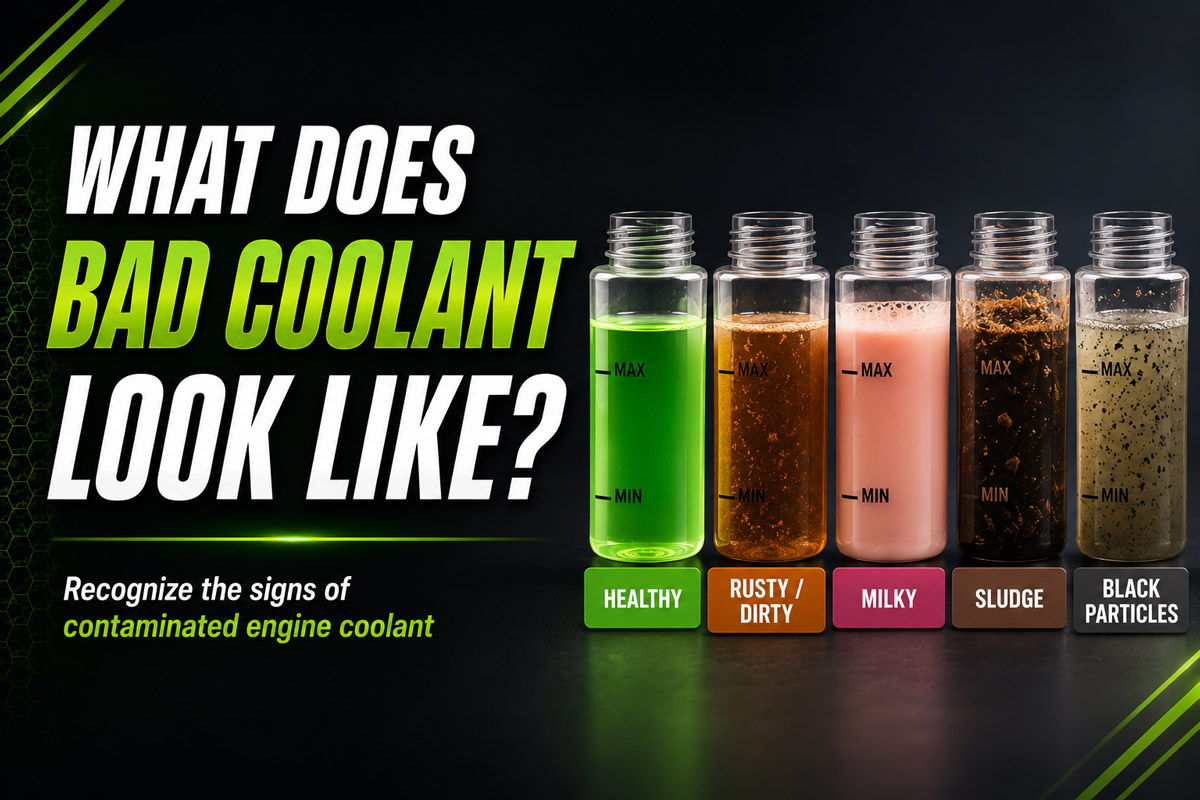
Bad engine coolant typically appears dark, murky, brown, or milky, and it often contains visible rust particles, thick sludge, or floating debris. While healthy antifreeze maintains a bright, translucent hue, compromised fluid loses its visual clarity, drops in pH, and emits a distinctly burnt or sweet odor.
Key Facts / At a Glance
- Healthy coolant is translucent (bright green, orange, pink, or blue), while degraded coolant becomes opaque, muddy, or gelled.
- A milky or “strawberry milkshake” appearance is a critical failure indicating engine oil or transmission fluid has mixed with the coolant.
- Normal operating coolant pH ranges from 8.5 to 10.5; a pH below 8.0 means the fluid has become highly acidic and corrosive.
- Mixing incompatible coolant types (such as IAT and OAT) causes chemical fallout, creating a thick sludge that blocks engine passages.
- Testing the fluid with a digital multimeter yielding over 300 millivolts indicates active internal electrolysis.
Why Does Engine Coolant Go Bad?
Engine coolant goes bad because continuous thermal cycling depletes its chemical corrosion inhibitors over time. Engine coolant is a highly specialized thermal management fluid composed of an alcohol base (ethylene or propylene glycol), water, and passivating corrosion inhibitors. As the fluid continuously circulates through an engine block reaching 195°F to 220°F, those chemical inhibitors microscopically shield internal metals like aluminum, iron, and copper.
Over multiple heat cycles, these protective inhibitors break down. Once the chemistry depletes, the fluid’s pH balance shifts rapidly downward, turning the liquid acidic. This highly acidic fluid then begins attacking the internal engine surfaces it was designed to protect, leading directly to the distinct visual changes seen in the radiator or expansion tank.
What Are the Visual Signs of Degraded Antifreeze?
Recognizing what bad coolant looks like requires understanding the mechanical failures associated with each visual state.
What Causes Brown or Muddy Liquid?
A brown or muddy appearance indicates extreme oxidation and heavy rust formation inside the engine block. When the corrosion inhibitors fail, the water in the mixture begins oxidizing internal iron components. The resulting rust flakes off and circulates through the system, acting like liquid sandpaper that destroys water pump seals. If the fluid looks like river mud, the engine block is actively deteriorating.
Why Does Coolant Look Milky or Frothy?
Milky, frothy, or strawberry milkshake-colored coolant means engine oil or automatic transmission fluid is actively mixing with the antifreeze. This is a severe mechanical emergency. It is almost universally caused by an internal failure in the oil cooler, the transmission cooler, or a ruptured head gasket. Furthermore, heavy foaming at the top of the fluid indicates air intrusion, which causes cavitation erosion directly on the water pump impeller.
What Forms Thick Sludge or Gel?
Thick gel or jelly-like sludge forms when you mix two chemically incompatible coolant technologies. Pouring traditional green Inorganic Acid Technology (IAT) coolant into a vehicle running an orange Organic Acid Technology (OAT) coolant creates an immediate chemical reaction. The silicates drop out of suspension and form a heavy paste that instantly clogs the narrow tubes of the radiator and heater core.
Why Are There Black Particles in the Fluid?
Floating black specks or slime point to the localized degradation of internal rubber hoses. When coolant becomes overly acidic or reaches excessive localized boiling points, it attacks the internal lining of the rubber cooling hoses. The hoses begin shedding rubber debris directly into the fluid stream, which eventually accumulates at the highest point in the system.
How Do You Test Coolant Health?
You can test coolant health using a combination of visual inspection, pH test strips, a hydrometer, and a digital multimeter. Do not rely on mileage alone to determine fluid health.
- Cold Engine Verification: Never open a hot cooling system. Introducing atmospheric pressure to liquid at 220°F causes explosive boiling. Wait a minimum of two hours after engine shutdown.
- Reservoir Inspection: Shine a flashlight through the plastic overflow bottle. Look for fluid clarity, floating debris, and verify the fluid sits above the minimum fill line.
- Physical Fluid Sampling: Use a clean automotive fluid pipette to extract three ounces of coolant from the radiator into a clear glass container.
- Chemical and Electrical Testing:
- pH Test: Dip an automotive pH strip into the fluid. The target pH is 8.5 to 10.5. Anything below 8.0 requires immediate replacement.
- Voltage Test: Place a digital multimeter’s negative probe on the battery ground and the positive probe in the coolant. A reading exceeding 300mV indicates excessive electrolysis.
Expert Insight: Refractometers look highly technical, but they have a severe diagnostic limitation. While they accurately measure the freezing point of the glycol, dirt and other heavy contaminants can skew the refractive index. A refractometer might show adequate freeze protection on a heavily oxidized fluid that is actively corroding your engine block.
Does Coolant Color Tell You Its Condition?
Coolant color is no longer a reliable indicator of its underlying chemical type, but a loss of clarity always signals degradation. Historically, green meant IAT and orange meant OAT. Today, automotive manufacturers use varying dyes for identical chemical bases, meaning you cannot verify compatibility strictly by visual color.
| Coolant Technology Type | Fresh Visual Color | Bad/Degraded Color | Main Chemical Composition | Target Replacement Cycle |
| Inorganic Acid Technology (IAT) | Bright Green | Dark Muddy Brown | Ethylene glycol with Silicates & Phosphates | 2 Years / 30,000 Miles |
| Organic Acid Technology (OAT) | Orange, Red, or Pink | Pale Yellow or Opaque Crimson | Organic Acids (No Silicates) | 5 Years / 150,000 Miles |
| Hybrid OAT (HOAT) | Yellow, Turquoise, or Blue | Deep Murky Charcoal | Organic Acids mixed with low Silicates | 5 Years / 100,000 Miles |
| Silicated/Phosphated HOAT (Si-OAT / P-HOAT) | Pink, Purple, or Blue | Murky Pink or Opaque Purple | Specialized OEM hybrid blends | 5 Years / 150,000 Miles |
If the original bright dye has faded to a muddy, opaque, or pale version of its former self, the fluid is chemically exhausted.
Which Repair Method Should You Choose?
You should choose a professional machine flush if the system is heavily contaminated with rust or oil, but stick to a basic drain and fill for routine maintenance on fragile, high-mileage systems.
Method A: Basic Drain and Fill
- Pros: Inexpensive ($15 to $40 DIY); perfectly safe for fragile, aging heater cores.
- Cons: Gravity draining leaves up to 40% to 50% of the old, degraded fluid trapped inside the engine block’s lower water jackets.
- Verdict: Choose this method if you replace your fluid on strict, routine intervals before the pH drops.
Method B: Professional Machine Flush
- Pros: Exchanges 99% of the old fluid and physically forces rust scale and accumulated debris out of the system.
- Cons: High cost ($150 to $250); the machine’s pressure can rupture weak water pump seals or aging radiator side-tanks.
- Verdict: Choose this method if you have purchased a used car with dark brown coolant or thick sludge.
Frequently Asked Questions
Can bad coolant cause an engine to overheat?
Yes, degraded coolant loses its thermal transfer efficiency and boils at a significantly lower temperature. This creates trapped air pockets inside the cylinder head, preventing proper heat dissipation and causing the dashboard temperature gauge to rapidly spike into the red zone.
Is it safe to drive with brown coolant?
You should not drive with brown coolant for extended periods. The brown color indicates active rust and oxidation, meaning the fluid is highly acidic and currently corroding your water pump, heater core, and internal engine gaskets. Schedule a flush immediately.
What happens if I put tap water in my radiator?
Tap water introduces destructive minerals like calcium and magnesium into the cooling system. Under high engine temperatures, these minerals precipitate out and form hard scale deposits that permanently block the narrow internal tubes of the radiator and heater core.
How often should engine coolant be replaced?
Traditional Inorganic Acid Technology (IAT) green coolants require total replacement every two years or 30,000 miles. Conversely, modern Organic Acid Technology (OAT) and hybrid variations typically last up to five years or 150,000 miles before their corrosion inhibitors fully deplete.
Can I mix pink and orange coolant together?
You should never mix different coolant colors unless you verify their exact underlying chemical structures are identical. Mixing incompatible inhibitor technologies, such as an OAT orange with a silicated HOAT pink, triggers a chemical reaction that solidifies the fluid.