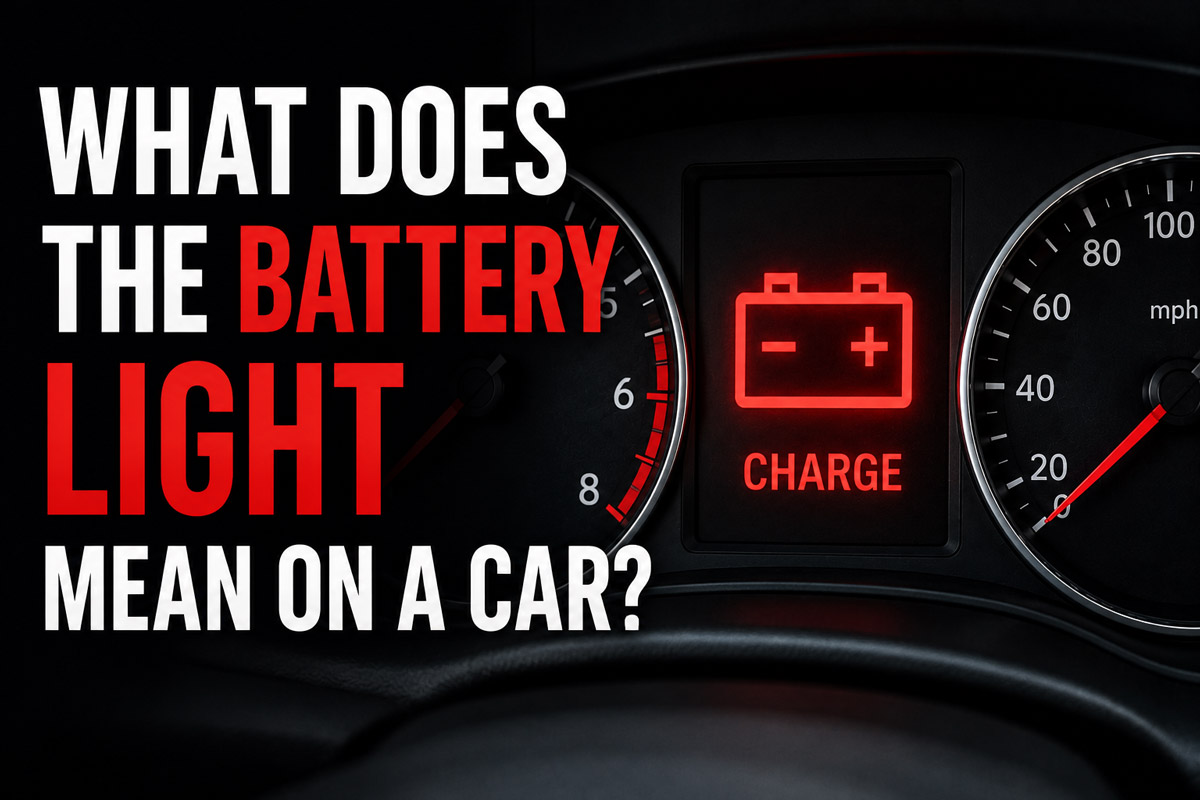
The car battery light indicates a critical malfunction in your vehicle’s electrical charging system, meaning the alternator is no longer generating sufficient power. When this dashboard warning illuminates, your vehicle is running exclusively on its 12.6-volt battery reserve, and the engine will stall completely once the system voltage drops below 10.5 volts.
Key Facts / At a Glance
- The dashboard battery indicator triggers automatically when the system voltage drops below 12.5 volts.
- A vehicle will typically stall within 15 to 45 minutes of the light illuminating as the Engine Control Unit (ECU) starves for power.
- The most common root cause is a failing alternator or a snapped serpentine belt, not a dead battery.
- Immediately turn off high-draw accessories—like air conditioning, heated seats, and the radio—to maximize your driving range to a safe location.
How Does the Vehicle Charging System Work?
The vehicle charging system works by creating a continuous electrical loop between the battery, the alternator, and the Engine Control Unit (ECU). The battery light acts as a gateway indicator for this loop. The alternator serves as the primary generator, converting mechanical rotational energy from the engine into alternating current (AC). Internal diodes instantly convert this into direct current (DC) to power the vehicle’s electronics and recharge the battery.
A voltage regulator maintains the system output strictly between 13.5 and 14.8 volts while the engine runs. In modern vehicles, an Intelligent Battery Sensor (IBS) attached to the negative terminal continuously analyzes the state of charge, state of health, and temperature. This sensor communicates with the vehicle’s computer via a Local Interconnect Network (LIN) bus. The ECU constantly monitors this data; if the active charging voltage drops below 12.5 volts, the circuit grounds and illuminates the dashboard battery light.
What Causes the Battery Light to Turn On?
The battery light turns on primarily because the alternator output drops below the 12.5-volt threshold, forcing the car to run on battery reserves. Six distinct component failures can cause this voltage drop.
What Happens When the Charging System Fails?
When the charging system fails, your vehicle experiences a cascading power starvation sequence that typically ends in total engine stall within 15 to 45 minutes. Because the alternator is no longer providing DC power, the vehicle immediately begins draining the battery’s reserve capacity.
- Voltage Drop: System voltage drops below the 12.5-volt charging threshold.
- Indicator Activation: The dashboard battery icon illuminates red.
- Load Shedding: Modern ECUs actively disable high-draw non-essential electronics (infotainment, heated seats, blind-spot monitoring) to conserve power.
- Accessory Starvation: Headlights physically dim and dashboard lights flicker.
- Critical Component Starvation: System voltage drops below 10.5 volts.
- Engine Stun: The vehicle stalls completely due to a lack of electrical power for fuel injection and spark plug ignition.
How Do I Diagnose a Car Battery Light?
Diagnosing a battery light requires a digital multimeter and visual inspection to isolate the failed component. This process takes about 15 minutes, requires basic hand tools, and depends entirely on measuring engine-off voltage versus engine-running voltage.
Before You Start:
- Time: 15 minutes
- Difficulty: Beginner
- Tools Needed: Digital multimeter, safety glasses, protective gloves, 10mm wrench.
Step 1: Perform a Safe Visual Inspection
Pull over safely, shut off the engine, and open the hood. Inspect the serpentine belt at the front of the engine; if it is snapped, frayed, or missing entirely, the alternator cannot spin. Check the battery terminals for heavy white, green, or blue powdery corrosion, which acts as an insulator and blocks charging current.
Step 2: Verify Battery Connection Tightness
Wear protective gloves and safety glasses, then gently wiggle the battery cable clamps. They should be entirely immobile. If they move or twist by hand, tighten the terminal nuts using a 10mm or 12mm wrench. Loose clamps prevent the alternator from pushing amperage back into the battery.
Step 3: Measure Engine-Off Battery Voltage
Set a digital multimeter to the 20V DC setting. Touch the red probe to the positive (+) terminal and the black probe to the negative (-) terminal. A healthy baseline reading is 12.4 to 12.6 volts. If the multimeter reads under 12.0 volts, the battery is heavily discharged and must be placed on a trickle charger before continuing diagnostics.
Expert Checkpoint: You will know your battery has a dead cell if it reads exactly 10.5 volts after a full night on a charger.
Step 4: Measure Engine-Running System Voltage
Jump-start the vehicle if necessary, and leave the engine running. Keep the multimeter connected to the battery terminals. A healthy alternator will push the reading up to between 13.5 and 14.8 volts. If the voltage remains at or below 12.6 volts and steadily drops as the engine idles, the alternator has failed and requires replacement.
How Much Does It Cost to Fix a Charging System?
Fixing a vehicle charging system costs between $5 for DIY terminal cleaning and up to $800 for a professional alternator replacement. Labor rates and parts choices heavily dictate the final price.
Which Replacement Parts Should You Choose?
You should choose replacement parts based on your vehicle’s specific electronic load requirements and your long-term ownership plans. When replacing charging system components, buyers face two primary decisions regarding technology and manufacturing origin.
New OEM vs. Remanufactured Alternators
New Original Equipment Manufacturer (OEM) alternators maximize reliability and match factory specifications exactly. They offer the longest lifespan and lowest defect rate but carry the highest price premium. Remanufactured alternators are rebuilt using a recycled outer housing with brand new wearable internals (brushes, diodes).
Limitations: Remanufactured alternators are excellent for budget repairs, but they are not ideal for high-mileage commercial vehicles or remote off-road builds, as their initial failure rate right out of the box is slightly higher than new OEM units.
Absorbed Glass Mat (AGM) vs. Standard Flooded Batteries
Absorbed Glass Mat (AGM) batteries suspend the electrolyte in fiberglass mats, making them spill-proof and highly resistant to vibration. They are engineered specifically to handle the heavy electrical loads of modern vehicles with automatic stop-start systems. Standard flooded lead-acid batteries are budget-friendly options that use liquid acid.
Limitations: Standard flooded batteries are absolutely not suited for modern vehicles equipped with stop-start technology. Installing a flooded battery in a car designed for an AGM battery will result in premature battery failure, often within 8 to 12 months, due to the aggressive discharge cycles.
What Are the Most Common Mistakes to Avoid?
The most common mistake drivers make is replacing the battery first without testing the alternator output. A dead alternator will destroy a brand new battery in less than an hour of driving, leaving you stranded with two ruined components.
- Ignoring a Flickering Light: A dashboard light that flickers only at low RPMs (like sitting at a stoplight) indicates an alternator failing specifically at low speeds. Ignoring it guarantees a total system failure at highway speeds.
- Running High-Load Accessories: Leaving the AC, seat heaters, and high beams on while the battery light is active drains the vehicle’s reserve capacity exponentially faster.
- Clearing Code Faults Without Repairs: Erasing the dashboard error code via an OBD-II scanner does not fix the physical hardware issue. Because the ECU constantly monitors voltage via the IBS, the battery light will immediately return the second the engine starts.
Expert Insight: If you notice a faint whining or grinding noise under the hood simultaneously with the battery light, the alternator bearings are failing mechanically. Stop driving immediately; a seized alternator pulley will snap the serpentine belt, instantly disabling your water pump and power steering.
Frequently Asked Questions
Can I drive with the battery light on?
You can only drive short distances with the battery light on, typically just far enough to safely pull over or reach a nearby mechanic. Without the alternator charging the system, the vehicle will completely stall within 15 to 45 minutes once the battery drains.
Does the battery light mean I need a new battery?
No, the battery light rarely means the battery itself is the primary issue. It indicates that the battery is not receiving a charge, which points to a failing alternator, a broken serpentine belt, or corroded wiring.
Why does my battery light flicker only at stoplights?
A battery light that flickers at idle but goes away when you accelerate indicates a weak alternator. The alternator generates less electricity at lower engine RPMs; as the brushes or diodes wear out, it struggles to maintain the 13.5-volt threshold while idling.
Is the battery light the same as the check engine light?
No, the battery light exclusively monitors the electrical charging system (battery, alternator, voltage regulator). The check engine light monitors the vehicle’s emissions, engine timing, fuel delivery, and exhaust systems.