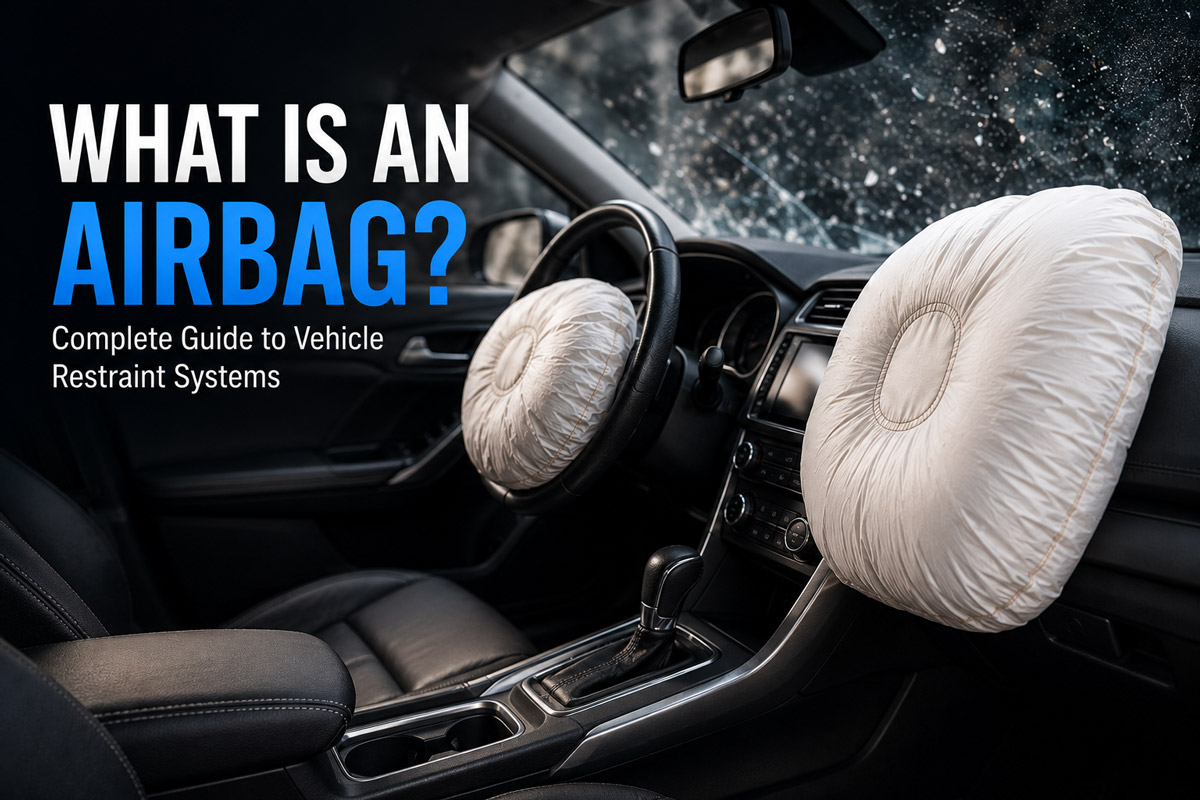
An airbag is a vehicle safety restraint system consisting of a flexible fabric envelope designed to inflate rapidly during a collision. It cushions vehicle occupants and prevents them from striking internal vehicle structures like the steering wheel, dashboard, or windows. Modern airbags deploy in milliseconds to absorb kinetic energy and deflate immediately to safely decelerate the human body.
Key Facts / At a Glance
- Deployment Speed: Airbags deploy at speeds exceeding 200 mph (322 km/h) to position the cushion before the occupant moves forward.
- Inflation Time: A standard frontal airbag reaches full inflation in roughly 0.03 seconds (30 milliseconds).
- Trigger Threshold: Systems typically activate at impact forces equivalent to hitting a rigid wall at 10 to 15 mph (16 to 24 km/h).
- Chemical Mechanism: Inflation is driven by a rapid pyrotechnic reaction that produces harmless nitrogen or argon gas.
- System Integration: Airbags are a Supplemental Restraint System (SRS); they are designed to work in tandem with, not replace, seatbelts and pretensioners.
How Does an Airbag Work? The Step-by-Step Deployment Process
An airbag works by converting a mechanical impact into an electrical signal, which triggers a chemical reaction to rapidly inflate a protective nylon cushion. This entire process occurs faster than the human eye can blink. The deployment sequence relies on a highly synchronized network of sensors and microprocessors.
1. Collision Detection and Sensor Activation
Collision detection begins when crash sensors measure severe deceleration and impact forces. Modern vehicles use Micro-Electro-Mechanical Systems (MEMS) accelerometers mounted in the front crush zones, doors, and the vehicle’s center of mass. Gyroscopic sensors monitor roll angles, while pressure sensors inside the door cavities detect the rapid air pressure spikes associated with side impacts.
2. Signal Processing via the Electronic Control Unit (ECU)
Signal processing occurs when the Electronic Control Unit (ECU) analyzes the sensor data. The ECU evaluates the vehicle’s deceleration rate (Delta-V), the occupant’s weight (via seat sensors), and seatbelt usage status. If the algorithm determines the crash severity warrants deployment, it sends an electrical firing signal. This processing takes approximately 10 to 15 milliseconds.
3. Chemical Ignition and Rapid Gas Inflation
Chemical ignition happens when the ECU sends an electrical current to the inflator module’s squib (a small heating element). The squib ignites a solid chemical propellant—historically sodium azide, but modern systems utilize safer compounds like guanidine nitrate. The propellant burns instantly, undergoing a phase change that generates a massive volume of nitrogen gas, blowing off the module cover and filling the airbag.
4. Occupant Cushioning and Controlled Deflation
Occupant cushioning occurs as the fully inflated bag receives the forward momentum of the human body. Crucially, an airbag is not a bouncy pillow; it acts as a kinetic energy dissipator. The moment the occupant strikes the fabric, the trapped gas escapes through precisely engineered vent holes in the back of the bag. This controlled deflation prevents the occupant from ricocheting backward and reduces the risk of whiplash.
What Are the Main Types of Airbags in Modern Vehicles?
Automakers engineer distinct types of airbags to manage specific vector forces depending on the angle of the collision. A modern passenger vehicle typically houses between six and ten individual airbag modules.
Frontal Airbags (Driver and Passenger)
Frontal airbags are primary restraint modules housed in the steering wheel and passenger-side dashboard. They protect the head, neck, and chest from striking the steering column or windshield during forward collisions. The driver’s side airbag is round and compact, while the passenger-side bag is significantly larger and shaped like a cylinder or tube to bridge the wider gap between the seat and the dashboard.
Side-Torso Airbags
Side-torso airbags are compact modules typically mounted inside the outer edge of the seat backrest or, less commonly, in the door panel. They deploy forward and outward to cushion the occupant’s ribs, pelvis, and torso during a T-bone or side-impact collision. Mounting them in the seat ensures they remain perfectly aligned with the occupant’s body regardless of seat positioning.
Side-Curtain Airbags
Side-curtain airbags are elongated modules that deploy downward from the interior roofline, covering the front and rear side windows. They prevent severe head injuries against the B-pillar or intrusive objects and are specifically engineered to remain inflated longer (up to several seconds) to prevent occupant ejection during vehicle rollovers.
Knee Airbags
Knee airbags are positioned beneath the steering column and the lower passenger dashboard. They minimize lower extremity injuries, such as shattered patellas or femurs. More importantly, they control the occupant’s kinematics by keeping their lower body pinned to the seat, preventing them from sliding underneath the seatbelt (a phenomenon known as “submarining”).
Center/Far-Side Airbags
Center airbags deploy from the inboard side of the driver’s seat toward the vehicle’s center console. They are designed to prevent the driver and passenger from violently colliding with each other during a side-impact crash on the opposite side of the vehicle.
Airbag Technology Generations: Which System Does Your Car Have?
Airbag systems have evolved significantly over the last three decades to mitigate the injuries caused by early deployment mechanisms.
| Airbag System Type | Primary Mechanism | Pros | Cons |
|---|---|---|---|
| Traditional Frontal (Gen 1) | Single-stage pyrotechnic inflation firing at 100% force regardless of crash severity. | Proven track record; standard architectural baseline for automotive safety. | High risk of deployment injuries for unbelted drivers, small adults, and children. |
| Advanced Multi-Stage (Gen 2/3) | Dual-stage inflators that adjust deployment force (e.g., 70% or 100%) based on crash severity and occupant weight. | Significantly safer for small-stature individuals and children; adapts to seatbelt usage. | Highly complex sensor networks; expensive to diagnose and repair if weight calibration fails. |
| Inflatable Seatbelts | Tubular airbags integrated directly into the rear seatbelt webbing. | Spreads crash forces across a wider area of the torso; excellent for frail or elderly rear passengers. | Creates bulkier belt straps that can be uncomfortable; high replacement cost post-deployment. |
Verdict: Advanced Multi-Stage systems are the definitive modern standard, offering the highest safety margin by actively tuning the blast force to the occupant’s biometrics.
Key Technical Specifications: How Fast Does an Airbag Deploy?
An airbag deploys in approximately 30 milliseconds—less than one-tenth the time it takes a human to blink. The speed and force required to intercept a human body moving at highway speeds dictate extreme technical specifications:
- Deployment Velocity: The fabric exits the housing at speeds between 150 and 200 mph (241 to 322 km/h).
- Inflation Time: Frontal bags inflate in 0.03 to 0.05 seconds. Side airbags, which have less crumple zone buffer, inflate faster—in roughly 0.015 to 0.02 seconds.
- Deflation Time: The bag empties completely in under 2 seconds post-crash to ensure the occupant can breathe and exit the vehicle.
- Acoustic Output: The chemical detonation generates a sound pressure level of 150 to 170 decibels (dB). This frequently causes temporary tinnitus and occasionally permanent, minor hearing loss.
How Much Does Airbag Replacement Cost?
Airbag replacement costs typically range from $1,000 to $4,000 per module, making it one of the most expensive automotive repairs following a collision. An airbag is a one-time-use component; once deployed, the entire assembly must be replaced.
The high cost is driven by the interconnected nature of the Supplemental Restraint System (SRS). A proper repair requires replacing the airbag module itself ($300–$1,000), the seatbelt pretensioners that fired simultaneously ($150–$300), and the crash sensors ($100–$250). Furthermore, the central ECU must often be reprogrammed or entirely replaced ($400–$800) because it hard-codes crash data into its memory. If the passenger airbag deploys, it typically shatters the dashboard cover, requiring a full dashboard replacement which can add $1,000 to $2,000 in parts and 3 to 6 hours of labor.
What Are the Most Common Airbag Mistakes and Hazards?
The most common airbag mistakes revolve around out-of-position seating and physical obstructions, which turn a life-saving device into a localized explosive hazard. Airbags require a clear path and adequate distance to properly expand before intercepting a human body.
- Seating Proximity (The 10-Inch Rule): Sitting closer than 10 inches (25 cm) to the steering wheel places your chest in the deployment blast zone before the bag is fully inflated. This drastically increases the risk of broken ribs or cardiac contusions. Drivers should tilt the steering wheel downward toward the chest, not the face.
- Dashboard Obstructions: Never allow passengers to rest their feet on the dashboard. In a crash, a deploying passenger airbag will force the occupant’s knees violently into their face, often causing catastrophic pelvic and facial fractures.
- Restraint Interference: Do not place aftermarket phone mounts, dashcams, or hard plastic decorations over airbag deployment covers (steering wheel center, passenger dash, or A-pillars). A 200-mph deployment turns these items into lethal projectiles.
- Child Placement: Children under 13 years old must always sit in the back seat. The explosive force of a passenger airbag is calibrated for adult bodies and can cause fatal neck injuries to infants in rear-facing seats or small children.
How Can You Diagnose an Airbag Warning Light?
An illuminated SRS (Supplemental Restraint System) dashboard warning light indicates that the vehicle’s computer has detected a fault and has proactively disabled the airbag system. You can diagnose an airbag light by utilizing an OBD2 diagnostic scanner capable of reading SRS/body control codes.
Common Diagnostic Faults:
- Clockspring Failure: The clockspring is a coiled ribbon cable inside the steering column that maintains an electrical connection to the steering wheel airbag as it turns. Over time, the ribbon snaps, triggering an open-circuit fault. This is the most common cause of an SRS light.
- Seat Belt Buckle Switches: The system constantly monitors whether seatbelts are latched. Dirt or spilled liquids in the seatbelt buckle can short the microswitch, causing the system to throw an error.
- Under-Seat Connector Disruption: Moving the front seats forcefully back and forth can tug on the yellow SRS wiring harnesses underneath, causing a momentary loss of continuity in the side-airbag or weight-sensor circuits.
- Low Battery Voltage: The ECU requires precise voltage to monitor sensor resistance. A dying car battery or failing alternator will frequently trigger false SRS codes.
Expert Advice for DIY Mechanics: Never use a standard multimeter to probe airbag connector pins. The minute electrical current introduced by the multimeter can be enough to trigger the squib inflator, deploying the airbag directly into your face. Always disconnect the negative battery terminal and wait 15 minutes before servicing any SRS components to allow the backup capacitors to drain.
Frequently Asked Questions (FAQ)
Can an airbag deploy if the car is turned off?
Generally, no. The Supplemental Restraint System relies on electrical power from the vehicle’s battery. If the ignition is turned entirely off, the ECU is depowered, and the airbags will not deploy. However, some modern vehicles maintain standby power for several minutes after being turned off, meaning deployment is still possible shortly after parking.
Do airbags expire or need maintenance?
Modern airbags (manufactured after the late 1990s) are designed to last the entire lifetime of the vehicle and do not require maintenance. Early 1990s systems recommended inspections every 10 years, but advancements in glass-to-metal sealing for the squib igniters have eliminated moisture intrusion, ensuring the chemical propellant remains stable indefinitely.
Why do airbags smell like smoke after deploying?
The smoke-like smell after deployment is a mixture of cornstarch, talcum powder, and harmless chemical byproducts. Manufacturers coat the inside of the folded airbag with talcum or cornstarch to prevent the nylon fabric from sticking together over years of storage. The chemical reaction also releases minor amounts of aerosolized particulates that smell metallic or burnt, but this is not a fire.
Is it safe to drive with the airbag light on?
No, it is not safe. When the SRS or Airbag light is illuminated on your dashboard, the vehicle has detected a systemic fault and has entered a fail-safe mode. This means the entire airbag system is deactivated and will not deploy in the event of a collision.
Can you reuse an airbag after a crash?
No. An airbag module is strictly a single-use, pyrotechnic device. Once the chemical propellant has burned to inflate the nylon bag, it cannot be reset, refilled, or repackaged. The entire module, including the housing, inflator, and fabric, must be removed and replaced with a brand-new factory unit.