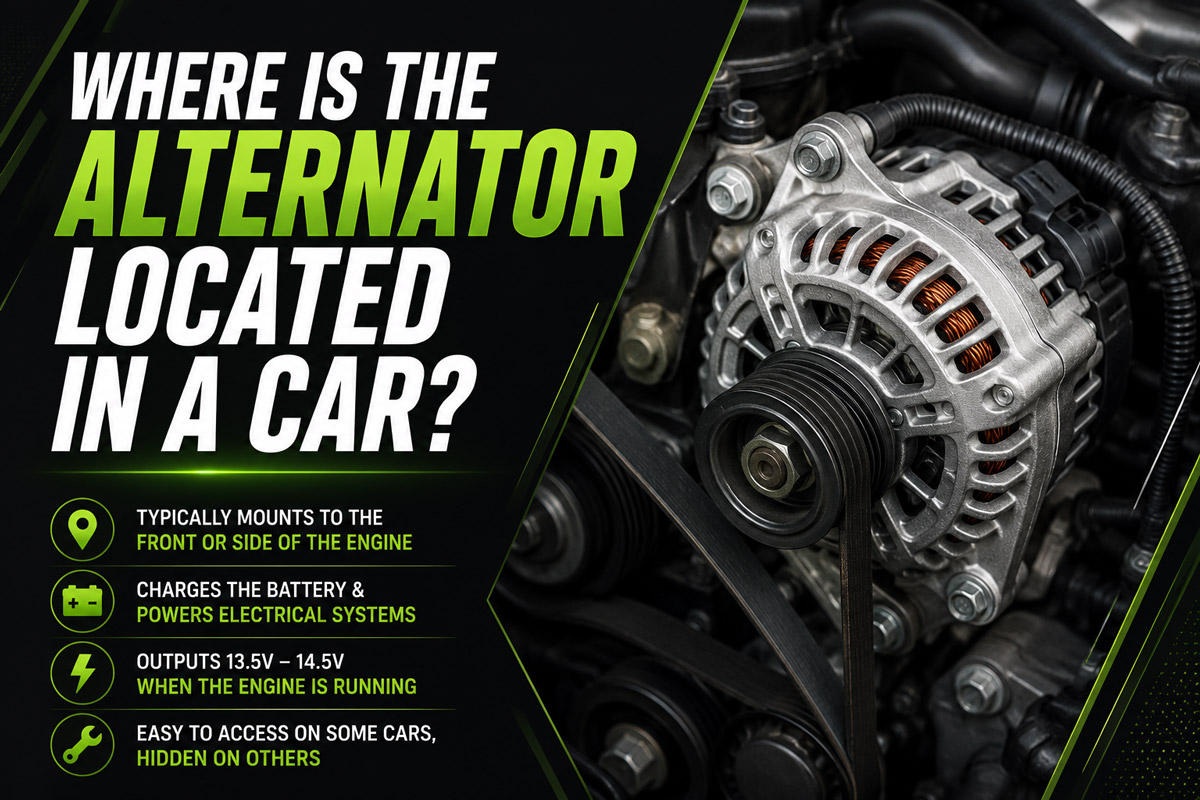
The alternator is typically bolted directly to the front or side of the engine block, aligned perfectly with the serpentine belt system. In standard rear-wheel-drive configurations, the alternator sits prominently at the upper-front of the engine bay, but alternative drivetrain layouts frequently obscure this critical electrical component.
At a Glance
- Standard vehicle alternators mount to the upper-front of the engine block on the serpentine belt routing path.
- Front-wheel-drive vehicles push the alternator against the passenger-side inner fender well due to transverse engine orientation.
- A healthy vehicle alternator outputs between 13.5 and 14.5 volts while the internal combustion engine is running.
- Modern mild-hybrid cars eliminate the traditional alternator entirely, replacing it with a Belt-Driven Integrated Starter Generator (BISG).
- A failing alternator will drain a fully charged 12V battery and stall the engine within 5 to 30 minutes of driving.
What Does a Car Alternator Look Like?
A standard car alternator is roughly the size of a coconut or a pint glass, housed in a distinct slotted aluminum casing. The slotted aluminum housing exists to dissipate extreme heat, and peering through these vents reveals the tightly coiled copper internal wiring (the stator). The front of the alternator features a grooved metal pulley, while the rear houses plastic electrical plug connections and a thick charging cable leading directly to the battery.
How Does Engine Layout Change Alternator Position?
Engine orientation dictates the exact placement of the alternator bracket. While classic rear-wheel-drive cars offer top-mounted access, space constraints in modern engineering drastically alter this location.
Where Is the Alternator on a Front-Wheel-Drive Car?
On front-wheel-drive vehicles with transverse engines, the alternator is positioned on the passenger side of the engine bay, squeezed tightly against the inner fender well. Because the engine sits sideways, the entire serpentine belt system faces the passenger tire. Mechanics frequently must remove the front right wheel and the interior plastic splash shield to properly access or extract the alternator unit.
How Do V6 and V8 Engines Hide the Alternator?
On several V6 and V8 platforms, such as the Cadillac Northstar engines, the alternator is wedged directly into the “V” bank of the engine block, completely buried beneath the plastic intake manifold. Following the serpentine belt from the top of the engine bay fails completely in these scenarios. Accessing a V-bank alternator requires depressurizing the fuel system and fully removing the upper intake manifold assembly.
Why Are Some Alternators Mounted Under the Engine?
Automakers mount alternators at the absolute bottom of the engine block near the oil pan to lower the vehicle’s center of gravity and package complex front-end structures. On vehicles like certain generations of the Honda Accord or Ford Escape, the alternator cannot be seen or extracted from above. Technicians must lift the vehicle, remove aerodynamic undertrays, and occasionally lower the subframe to perform a replacement.
What Is a Liquid-Cooled Alternator?
A liquid-cooled alternator is a specialized high-output charging unit completely enclosed in an engine-coolant jacket to manage massive thermal loads. Used prominently in early 2000s BMW 7-Series and Mercedes-Benz V8 models, this design abandons the traditional slotted aluminum case. Instead, the liquid-cooled alternator bolts into a sealed cavity integrated directly with the vehicle’s pressurized cooling plumbing, making replacement highly labor-intensive.
Do Modern Mild Hybrids Have a Traditional Alternator?
No, modern mild-hybrid vehicles do not use a traditional alternator. The conventional alternator is replaced by a Belt-Driven Integrated Starter Generator (BISG). The BISG system functions as a high-voltage motor-generator that seamlessly handles engine starting, kinetic energy regeneration, and battery charging. Because the BISG operates on 48-volt architecture rather than standard 12-volt systems, conventional alternator troubleshooting methods and voltage tests do not apply.
Alternator Specifications and Capacities
Understanding the mechanical and electrical specifications of an alternator helps diagnose undercharging issues and explains why pulley sizing is strictly engineered.
How Fast Does an Alternator Pulley Spin?
The alternator pulley is specifically engineered to spin two to three times faster than the engine’s crankshaft pulley. This precise rotational gear ratio ensures the internal rotor generates sufficient electrical current to run the vehicle’s accessories even when the car is idling at 700 RPM. Altering the pulley size directly impacts charging output and can overheat the internal bearings.
How Many Amps Does a Car Alternator Produce?
Standard passenger vehicle alternators produce between 50 and 70 amps at idle, maxing out around 100 amps at highway speeds. Conversely, modern luxury vehicles equipped with intensive electronics—such as heated seats, air suspension, and premium infotainment—feature high-output alternators pushing 150 to 200+ amps. Installing an alternator with an amp rating lower than factory specifications will cause premature failure.
Diagnosing and Troubleshooting Alternator Issues
Electrical failures often mimic one another. Isolating the alternator from the battery and surrounding hydraulic pumps prevents expensive misdiagnoses.
What Are the First Physical Signs of a Failing Alternator?
The first physical signs of a failing alternator are dimming headlights at idle, a whining noise from the engine bay, and an illuminated battery warning light on the dashboard. The whining noise occurs when the internal bearings wear out or the copper stator shorts, causing immense magnetic resistance. Additionally, electrical accessories like power windows or radio displays may operate sluggishly as voltage drops below critical thresholds.
Does a Dead Battery Mean the Alternator Is Bad?
Not necessarily; a car battery can fail independently due to age, sulfation, or extreme temperature fluctuations. To isolate the issue, technicians check the battery terminals with a digital multimeter while the engine runs. A healthy alternator should output between 13.5 and 14.5 volts. If the multimeter reads below 13.5 volts with the engine running, the alternator is failing to charge the system.
Why Do Alternators Get Soaked in Engine Oil?
Alternators frequently become soaked in engine oil because they are mounted directly beneath valve cover gaskets, variable valve timing (VVT) solenoids, or power steering pumps. When these upper-engine seals deteriorate, gravity pulls fluid directly into the open cooling vents of the alternator below. Engine oil rapidly degrades the internal carbon brushes and shorts out the solid-state voltage regulator, causing sudden charging failure.
Can You Drive a Car With a Failing Alternator?
Yes, but only for 5 to 30 minutes. Once the alternator stops generating current, the vehicle relies entirely on the reserve capacity of the 12V battery. High-draw components like spark plugs, electronic fuel injectors, and the engine control module (ECM) will rapidly drain the remaining battery voltage. Once the battery drops below roughly 10.5 volts, the engine will stall completely and lose power steering.
Replacement and Repair Expectations
Replacing an alternator ranges from a quick driveway repair to a major mechanical undertaking, depending entirely on the vehicle’s drivetrain packaging.
How Long Does It Take to Replace a Car Alternator?
Replacing an alternator takes one to three hours for most standard passenger vehicles. Top-mounted alternators on longitudinal engines can often be swapped in under 45 minutes by a skilled DIYer. However, vehicles requiring wheel removal, subframe dropping, or intake manifold removal (such as buried V-bank alternators) can push shop labor times to four or five hours.
How Much Does an Alternator Replacement Cost?
A standard alternator replacement costs between $400 and $800, split evenly between parts and professional labor. OEM (Original Equipment Manufacturer) alternators typically cost $250 to $450, while aftermarket remanufactured units range from $130 to $250. Luxury vehicles with liquid-cooled alternators or high-output BISG units routinely see replacement costs exceeding $1,200 due to expensive parts and extended labor hours.
The Bottom Line
The alternator is typically positioned on the front or side of the engine block, seamlessly integrated with the serpentine belt routing. However, transverse engines, V-bank designs, and under-engine mounting can completely hide the unit from top-down view. Always check battery voltage with a multimeter while the engine is running—looking for that crucial 13.5 to 14.5-volt range—before condemning the alternator and beginning a repair.