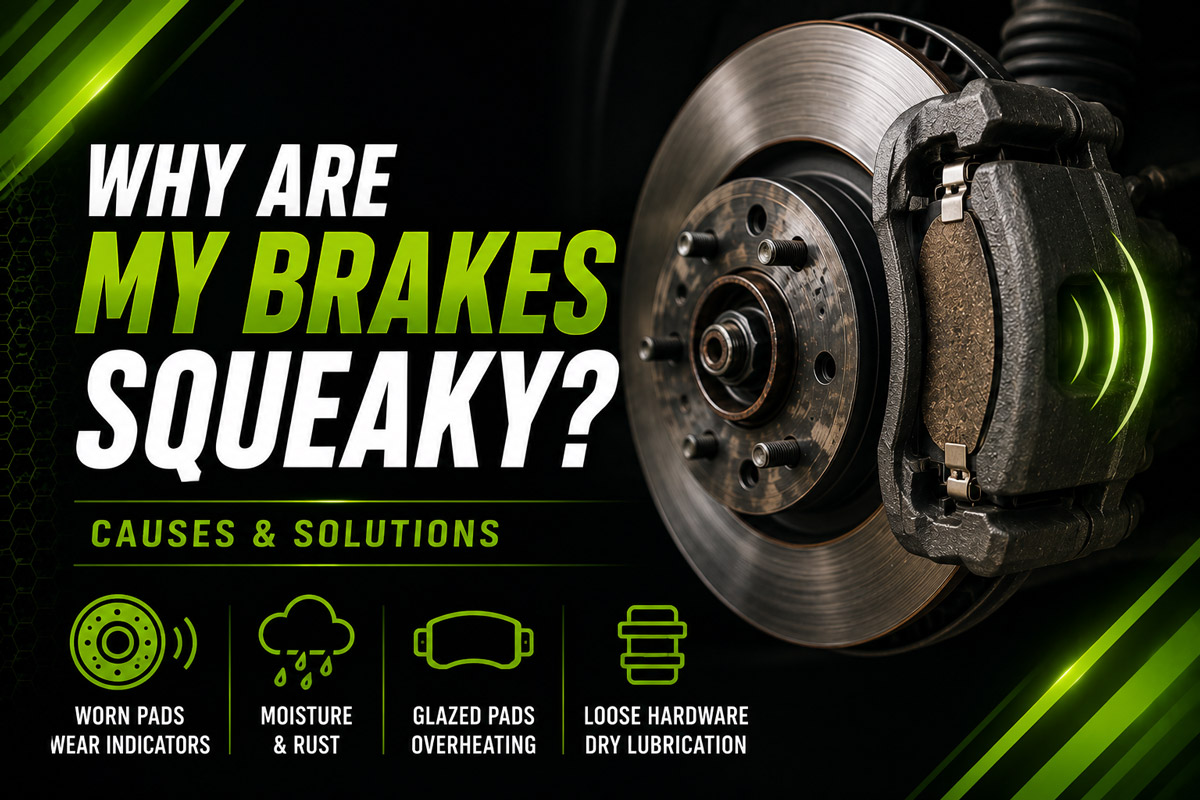
If you are asking the question, “why are my brakes squeaky,” the exact mechanical answer is that high-frequency vibrations occur when hydraulic pressure forces brake pads against spinning metal rotors. This friction-induced resonance acts like a violin bow across a string, typically triggered by worn pads hitting their built-in metal wear indicators, glazed friction surfaces from overheating, or morning moisture causing microscopic surface rust.
Key Facts / At a Glance:
- New brake pads measure 10 mm to 12 mm thick; built-in metal wear indicators purposefully activate at exactly 2 mm.
- Brake squeak is an audible vibration resonating between 1,000 Hz and 15,000 Hz.
- Missing anti-rattle shims or a lack of silicone lubricant on backing plates causes roughly 30% of non-wear-related brake noise.
- Ceramic brake pads operate the quietest, while semi-metallic pads inherently produce higher noise levels under standard braking.
- A complete brake pad replacement typically costs $150 to $300 per axle and takes an experienced technician 1 to 2 hours.
Exactly Why Are My Brakes Squeaky?
Brake squeak is caused by alternating sticking and slipping between the brake pad and the rotor, which generates a high-frequency vibration that amplifies through the brake caliper and suspension geometry. When a driver depresses the brake pedal, hydraulic fluid pushes the caliper piston, forcing the pads to grip the spinning rotor. If any component in this closed system is compromised, vibration translates into an audible squeal.
Worn Friction Material and Wear Indicators
Modern brake pads feature a small steel tab called a wear indicator. When the friction material degrades down to 2 mm, this metal tab makes direct contact with the spinning cast-iron rotor. The resulting sound is a purposeful, high-pitched squeal designed to alert the driver that a pad replacement is immediately necessary.
Glazed Pads and Rotors
Excessive heat hardens the brake pad surface smooth, a condition known as glazing. When brakes are applied forcefully down steep grades or subjected to heavy stop-and-go traffic, temperatures exceed the friction compound’s operating limit. The pad surface crystalizes into a glass-like finish, drastically reducing friction and creating a loud, continuous squeal when pressed against the rotor.
Moisture, Rust, and Weather Conditions
Vehicles parked overnight in humid or rainy environments naturally accumulate a thin layer of flash rust on the bare iron rotors. During the first few brake applications of the morning, the brake pads must scrape this surface rust away. This micro-abrasion creates a temporary, low-volume squeak that should disappear completely after a few minutes of driving.
Missing Shims and Dry Hardware
Brake pads require tight tolerances to remain silent. Anti-rattle clips, shims, and high-temperature silicone paste cushion the microscopic gaps between the pad backing plate and the metal caliper. Reusing stretched hardware or forgetting to lubricate the backing plates allows the pad to flutter rapidly during engagement, creating a high-frequency resonance.
Trapped Debris
Dust, sand, and small rocks can become lodged between the brake pad and the rotor surface. This creates an uneven friction plane and a sharp, inconsistent squeal. High-performance slotted rotors excel at ejecting this debris, whereas standard flat rotors may trap the particulate until it is physically ground into dust.
How Do Different Brake Pad Materials Sound?
Different brake pad materials produce varying noise levels based on their friction compounds, with ceramic being the quietest and semi-metallic generating the highest decibels. Selecting the right material dictates your vehicle’s baseline brake acoustics and overall stopping performance.
| Material Type | Noise Level | Pros | Cons | Best Suited For |
| Ceramic | Very Low | Quietest operation, lowest dust output, longest lifespan. | Most expensive, poor cold-climate performance. | Daily commuters prioritizing silence and clean wheels. |
| Semi-Metallic | High | Excellent stopping power, high heat dissipation. | Noisy operation, heavy black dust, higher rotor wear. | Heavy haulers, towing applications, and track enthusiasts. |
| Organic (NAO) | Low | Soft and quiet engagement, lowest upfront cost. | Wears out the fastest, overheats rapidly under heavy loads. | Budget drivers and light-duty urban commuting. |
Expert Insight: Never pair an aggressive semi-metallic pad with a cheap, unresurfaced standard rotor. The aggressive metal fibers in the pad will chew into the softer cast iron, guaranteeing a loud squeal regardless of how much lubricant you apply to the hardware.
Is It Safe to Drive with Squeaky Brakes?
Driving with squeaky brakes is only safe if the noise is caused by morning moisture, trapped dust, or the inherent material properties of aggressive semi-metallic pads. If the squeal is continuous, distinctly metallic, or accompanied by a pulsing sensation in the pedal, driving is unsafe because your pad material has likely degraded below the 3 mm minimum safe thickness.
When pads wear entirely through the friction material, the metal backing plate grinds directly into the rotor. This destroys the rotor instantly and can cause the caliper piston to over-extend and leak hydraulic fluid, leading to total brake failure. A squeak is a warning; a grind is an active failure.
How Much Does It Cost to Fix Squeaky Brakes?
Fixing squeaky brakes costs between $50 for a basic diagnostic and hardware lubrication, and up to $800 for a complete pad and rotor replacement per axle. Prices fluctuate based on the vehicle make, the quality of the friction material chosen, and whether the work is performed at a dealership or an independent shop.
- Diagnostic Fee: $50 – $150 (Requires 30 to 60 minutes)
- Pad Replacement Only: $150 – $300 per axle (Requires 1 to 2 hours)
- Rotor Resurfacing: $60 – $100 per axle (Requires 1 hour)
- Full Brake Job (Pads & Rotors): $350 – $800 per axle (Requires 2 to 3 hours)
How Do I Stop My Brakes From Squeaking?
You can stop your brakes from squeaking by replacing worn pads before they hit 2 mm, applying high-temperature silicone paste exclusively to the pad backing plates, and properly bedding in new brake pads to establish an even friction transfer layer. Diagnosing the exact source of the noise determines the correct repair path.
Replacing Pads and Resurfacing Rotors
Installing new brake pads onto heavily grooved, unresurfaced rotors is the leading cause of post-brake-job squeaks. The new flat pad cannot make full contact with a wavy rotor surface. Rotors must either be turned (resurfaced) on a brake lathe to restore a perfectly flat plane or replaced entirely alongside the new pads.
Applying Proper Brake Lubrication
Metal-to-metal contact points between the brake pad ears, the caliper bracket, and the caliper piston require specific lubrication to dampen vibrations.
Expert Insight: Mechanics frequently make the mistake of using standard chassis grease or petroleum-based anti-seize on brake components. These melt at high temperatures and run onto the friction surface, ruining the pad. You must use a dedicated high-temperature silicone or ceramic brake paste, applied sparingly only to the backing plate and slide pins.
The Critical Pad Bed-In Process
Skipping the bed-in (or break-in) process ensures your new brakes will squeak. Bedding transfers a microscopic, even layer of pad material onto the bare metal rotor, which is required for quiet operation. To bed new brakes safely: perform 5 to 6 aggressive stops from 45 mph down to 10 mph without ever coming to a complete halt. Drive for five minutes to let the system cool.
Common Brake Maintenance Mistakes
DIY mechanics and rushed technicians often induce brake squeal by skipping critical assembly steps. Avoiding these verifiable failure modes prevents the 1,000 Hz resonance from developing:
- Skipping the bed-in process: Failing to transfer friction material to the rotor causes raw pad-to-iron contact, resulting in a persistent glaze.
- Dry assembly: Forgetting to apply silicone brake lubricant to backing plates and slide pins leaves metal free to rattle.
- Reusing damaged hardware: Snapping old, heat-cycled anti-rattle clips back onto new pads fails to hold the pad tightly inside the caliper bracket.
- Mismatched components: Installing aggressive performance pads on standard, non-slotted economy rotors causes rapid glazing and harmonic imbalance.
Frequently Asked Questions
Why do my brakes squeak only when reversing?
Brakes squeak in reverse because the pads spend 99% of their life wearing at a specific forward angle. Reversing changes the directional force on the pad, pushing it against the opposite side of the caliper bracket and vibrating un-bedded edges against the rotor.
Can a car wash cause brakes to squeal?
Yes, high-pressure car washes spray chemical soaps and cold water directly onto hot brake rotors. This strips away the microscopic friction transfer layer required for quiet operation and accelerates flash rust, leading to a temporary squeal until the layer reforms.
Why are my brand new brakes squeaking?
Brand new brakes squeak if they were not properly bedded in, if the technician reused old anti-rattle hardware, or if new pads were installed on old, unresurfaced rotors. Furthermore, installing semi-metallic pads will naturally produce more noise than the factory ceramic pads.
Does brake cleaner fix squeaky brakes?
Brake cleaner only fixes squeaks temporarily if the noise is caused by trapped brake dust or surface oils. It evaporates rapidly and leaves no residue. If the squeak is caused by worn pads, missing shims, or glazed surfaces, brake cleaner will not solve the underlying mechanical failure.
At what thickness should I replace my brake pads?
You should replace your brake pads when the friction material reaches 3 mm in thickness. At 2 mm, the audible wear indicators will activate. Allowing pads to wear below 2 mm risks destroying the rotor and over-extending the caliper piston.
The Bottom Line on Squeaky Brakes
Resolving why are my brakes squeaky requires distinguishing between a harmless morning moisture scrape and the 2 mm mechanical wear indicator doing its job. By understanding the interaction between friction materials, proper silicone lubrication, and the required bed-in process, drivers can silence high-frequency resonance and maintain optimal vehicle safety.