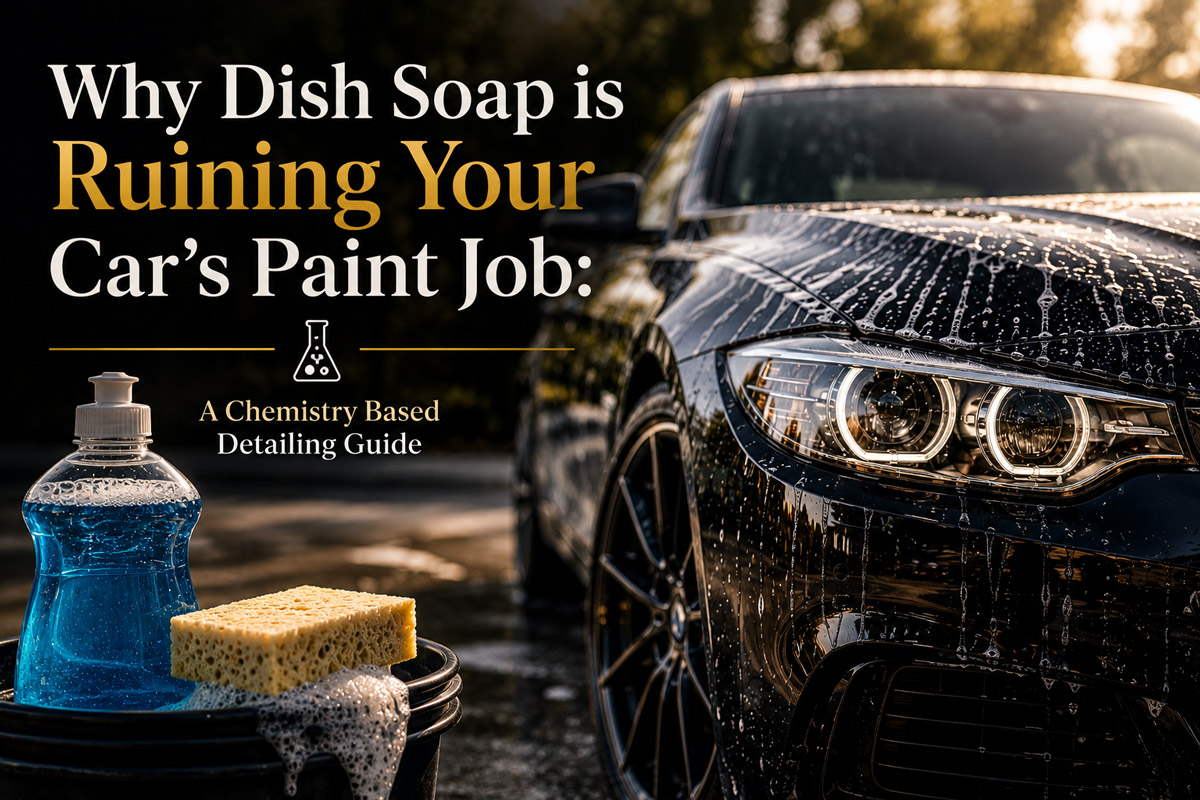
It is a warm weekend morning, and you decide to give your vehicle a quick wash in the driveway. You head to the kitchen sink, grab a bottle of blue dish soap like Dawn, Palmolive, or Joy, squeeze a generous squirt into a bucket of water, and start scrubbing away. At first glance, the results look fantastic. The soap creates thick foam, easily cuts through grease, removes stuck bugs, and leaves your vehicle looking shiny and clean.
However, behind that temporary shine lies a costly detailing mistake. Using household dish soap on automotive paint is one of the fastest ways to cause cumulative exterior damage to your vehicle. While dish soap will not instantly dissolve your automotive paint upon contact, its aggressive chemical formulation is specifically engineered for kitchenware, not delicate vehicle finishes.
Every time you wash your car with dish liquid, you are subjecting the exterior finish to harsh alkaline surfactants designed to strip organic oils, break down synthetic sealants, dry out rubber moldings, and leave your raw clear coat completely defenceless against ultraviolet radiation, environmental fallout, and mechanical scratching.
In this comprehensive guide, we will analyze the precise chemical mechanics of dish soap, examine the five major ways it damages your vehicle, compare dish soap directly with dedicated automotive shampoo using an interactive chart and responsive table, explore the rare exceptions where professional detailers use it, and outline the ideal wash workflow to keep your car looking brand new.
The Hidden Chemistry: How Dish Soap Reacts With Automotive Paint
To understand why dish soap damages vehicle paint, one must look at basic chemical formulation. Automotive finishes consist of multiple layers, including a primer coat, a base color coat, and a protective transparent clear coat layer measuring roughly 35 to 50 microns in thickness. This outer clear coat is shielded by waxes, synthetic polymer sealants, or ceramic coatings applied by vehicle owners.
Dish soap and dedicated automotive shampoos are formulated for entirely different surface chemistries and cleaning objectives.
Alkaline pH Disparity and Clear Coat Sensitivity
Chemistry operates on the pH scale, which measures acidity and alkalinity from 0 to 14. Pure water sits at a neutral pH level of 7.0. Modern automotive clear coats and protective waxes are engineered to remain stable when cleaned with pH neutral products hovering precisely around pH 7.0.
Household dish liquid is intentionally formulated as an alkaline cleaner, typically measuring between pH 8.0 and pH 9.5. Manufacturers deliberately elevate dish soap alkalinity to break down animal fats, food greases, and vegetable oils baked onto ceramic plates and stainless steel pans.
When exposed to alkaline dish soap, the protective oils within carnauba wax and the chemical bonds within synthetic paint sealants undergo rapid saponification and emulsification. Repeated exposure to high pH cleaners weakens the clear coat resin matrix over time, causing premature thinning, cloudiness, and loss of structural elasticity.
Anionic Surfactant Mechanics: SLS and SLES
The primary active cleaning agents in household dish soap are aggressive anionic surfactants such as Sodium Lauryl Sulfate (SLS) and Sodium Laureth Sulfate (SLES). These compounds possess a dual nature: a hydrophilic water attracting head and a lipophilic oil attracting tail.
In kitchen applications, the lipophilic tails bind to food grease, allowing water to carry away oil molecules effortlessly. However, when applied to a vehicle exterior, these surfactants cannot distinguish between unwanted road grease and the essential protective wax oils shielding your paint. The dish soap surfactants instantly attach to carnauba wax, synthetic sealants, and hydrophobic toppers, emulsifying them completely so they rinse down the driveway drain.
Visual Comparison of pH Levels in Car Care
Understanding chemical acidity and alkalinity on vehicle finishes
5 Ways Dish Soap Silently Destroys Your Vehicle Finish
While washing your vehicle with dish liquid once will not strip the paint down to metal overnight, using it routinely initiates a silent chain reaction of exterior degradation. Here are the five principal ways dish soap damages your car.
1. Complete Stripping of Sacrificial Wax and Paint Sealants
Car wax and synthetic polymer sealants serve as sacrificial barriers. They absorb environmental wear so your clear coat does not have to. A premium carnauba wax or synthetic paint sealant protects your vehicle against moisture, dirt embedding, industrial fallout, and ultraviolet light.
Because dish soap is formulated to strip kitchen grease, a single wash with a product like Dawn emulsifies and completely strips away this protective wax layer. Once stripped, your clear coat sits completely naked. Any subsequent exposure to rain, road grime, or solar heat acts directly on the raw clear coat layer without any protective cushion.
2. Severe Lack of Lubricity and Creation of Micro Swirl Marks
One of the most vital characteristics of a professional automotive shampoo is lubricity, often referred to as slickness. High quality car soaps contain specialized lubricity polymers that create a slick cushion between your wash mitt and the paint surface. These lubricity agents surround and suspend abrasive dirt particles inside soapy bubbles, allowing them to glide off without scratching.
Dish soap lacks these specialized automotive lubricity polymers. While dish liquid creates voluminous suds, those suds offer virtually zero slickness on paint. When you drag a microfiber mitt or sponge across a panel sudsed with dish soap, abrasive dirt grains are pressed directly against the naked clear coat. This grinding action creates fine circular scratches, spiderwebbing, and micro swirl marks that dull your vehicle depth of shine under direct sunlight.
3. Accelerated UV Radiation Damage and Clear Coat Oxidation
Sunlight contains potent ultraviolet rays that constantly degrade automotive coatings. Unprotected clear coats absorb ultraviolet energy, causing the synthetic resin bonds within the paint to break down chemically over time.
When dish soap strips away sacrificial waxes and UV blocking sealants, solar radiation hits the bare clear coat unimpeded. Over months of exposure, this accelerates clear coat oxidation. Initial signs of oxidation include loss of gloss, chalky haze, and milky patches. Left untreated, severe oxidation causes clear coat failure, where the top coat blisters, cracks, and peels away in sheets, requiring expensive professional panel repainting.
4. Dry Rot and Premature Aging of Rubber Seals and Plastic Trim
Modern vehicles feature extensive nonmetal exterior components, including EPDM rubber door seals, window weatherstripping, plastic cowl covers, and unpainted vinyl trim. These rubber and plastic components contain vital plasticizers and moisturizing oils that keep them flexible and watertight.
Dish soap surfactants do not stop at stripping wax from metal panels; they leached essential plasticizers out of surrounding rubber and plastic trim as well. Frequent dish soap washes cause rubber window seals to dry out, turn brittle, lose flexibility, and crack. Dry rotted weatherstripping eventually allows rain water to leak inside cabin door panels, causing hidden rust and electrical damage. Furthermore, plastic trims rapidly fade from deep black to dull chalky gray.
5. Hard Water Spotting and Mineral Etching on Exposed Clear Coat
When you wash your vehicle at home, tap water contains dissolved minerals such as calcium, magnesium, and iron. When water droplets sit on a car surface protected by a hydrophobic carnauba wax or ceramic coating, the water beads up cleanly and slides off the panel easily.
When dish soap strips away all hydrophobic protection, water no longer beads; it flattens and sheets across the bare panels. As you dry the vehicle, water trapped in panel gaps or left to evaporate in sun light leaves concentrated mineral deposits on the bare clear coat. Without a protective wax buffer, these mineral deposits react with solar heat to etch permanently into the transparent clear coat, leaving stubborn crater spots that require machine polishing to remove.
Detailed Chemical & Operational Comparison
| Evaluation Parameter | Household Dish Soap | pH Neutral Automotive Shampoo |
|---|---|---|
| pH Balance Level | Alkaline (pH 8.5 to 9.5) | Neutral (pH 7.0 exact) |
| Primary Surfactants | Aggressive Anionic (SLS / SLES) | Gentle Amphoteric & Nonionic |
| Lubricity & Slickness | Very Low (Causes Swirl Marks) | Ultra High (Encapsulates Grit) |
| Wax & Sealant Protection | Strips Instantly (100% Removal) | Preserves Layer & Enhances Gloss |
| Rubber & Plastic Safety | Dries Out Plasticizers (Dry Rot) | Safe (Conditions & Preserves) |
| Rinsing Cleanliness | Leaves Alkaline Film Residue | Rinses Completely Free of Residue |
| Primary Intended Function | Degreasing Kitchen Cookware | Safe Maintenance Vehicle Washing |
When Professional Detailers Actually Use Dish Soap (And How)
Despite the clear risks, you may occasionally hear professional detailers mention using dish soap like Dawn in specific scenarios. It is crucial to understand that professional detailers do not use dish soap for routine maintenance washing. Instead, they use it strictly as an intentional chemical stripping tool under carefully controlled conditions.
The Rare Exceptions: Strip Wash and Contamination Emergencies
There are only two specific instances where using a diluted dish soap mix on a car finish is considered acceptable by detailing professionals.
- Pre Paint Correction Strip Washing: When a detailer prepares to perform multi stage machine paint correction, polish away scratches, or apply a durable ceramic coating, they must start with a totally naked paint surface. In this controlled context, an alkaline wash is intentionally used to strip away old, degraded waxes and oily silicone residues before compounding.
- Emergency Contaminant Decontamination: If your vehicle is splashed with heavy road tar, aggressive tree sap, or petroleum sludge that dedicated gentle shampoos cannot dissolve, a localized splash of diluted dish liquid can break down the stubborn oil based contamination before it permanently etches the surface.
Strict Detailing Protocol for Safe Dish Soap Application
If you choose to use dish soap for a controlled pre wax strip wash, you must adhere strictly to professional safety protocols to minimize harm.
- Work Exclusively in Full Shade: Never use dish soap under direct sunlight or on hot vehicle panels. Solar heat causes alkaline soap to dry rapidly, creating severe chemical water staining on clear coat and glass.
- Use Extreme Dilution Ratios: Limit dish soap concentration to no more than one tablespoon of soap per five gallons of clean water. Excessive concentration intensifies surfactant drying on rubber trim.
- Work Rapidly Section by Section: Wash one panel at a time using a soft microfiber mitt, and rinse thoroughly immediately before moving to the next section. Do not allow soap suds to dwell on panels.
- Promptly Apply Fresh Paint Protection: Immediately after drying the vehicle following a strip wash, you must reapply a high quality paste wax, synthetic polymer sealant, or ceramic coating spray. Leaving the bare clear coat unprotected invites rapid oxidation.
The Master Detailer Car Washing Protocol for Flawless Paint
To maintain a showroom finish without introducing swirl marks or stripping protective coatings, replace household dish liquid with a dedicated pH neutral car wash workflow. Follow these step by step master detailing instructions every time you wash your vehicle.
Step 1: Shade Positioning and Cool Surface Check
Always park your vehicle in a shaded area or garage, out of direct sunlight. Touch the hood and side panels with your palm to verify they are cool to the touch. Washing a hot vehicle causes water and soap to evaporate prematurely, leaving mineral spots and soap streaks.
Step 2: Clean Wheels and Tires First
Wheels accumulate heavy brake dust, metallic particles, and road grime. Always clean wheels and tires before washing the paint. Use a dedicated wheel cleaner, soft barrel brushes, and a separate wheel wash bucket so you do not transfer abrasive metal shavings onto your delicate body panels.
Step 3: Touchless Prerinse and Snow Foam Encapsulation
Before touching the paint with a wash mitt, rinse the entire vehicle thoroughly with clean water or a pressure washer to dislodge loose grit, sand, and dust. For optimal paint protection, apply a rich blanket of pH neutral snow foam using a foam cannon attached to your pressure washer. Allow the snow foam to dwell for three to five minutes. The foam bubbles soften dirt and lift particles off the surface touchlessly. Rinse away the foam completely.
Step 4: Two Bucket Wash Method With Grit Guard Inserts
Prepare two five gallon wash buckets. Fill Bucket One with clean water and a recommended measure of pH neutral automotive shampoo. Fill Bucket Two with pure clean rinse water. Place a plastic grit guard insert at the bottom of both buckets.
- Dip your plush microfiber wash mitt into the soapy Bucket One.
- Gently wipe one upper vehicle panel using straight back and forth lines (avoid circular wiping motions to minimize swirl marks).
- Plunge the dirty wash mitt into Bucket Two, rubbing it against the grit guard insert to release trapped dirt particles to the bottom of the bucket.
- Wring out the mitt before dipping it back into Bucket One for fresh suds.
Step 5: Flood Rinse Technique
After sudsing and washing all panels from top to bottom (saving heavy lower rocker panels for last), remove the spray nozzle from your hose. Allow a gentle stream of unpressurized water to cascade down the vehicle panels. This sheeting action carries away up to eighty percent of surface water droplets naturally, making drying effortless.
Step 6: Microfiber Towel Drying With Drying Aid
Never dry your vehicle using bath towels, old t shirts, or natural chamois leathers, as these materials trap surface dirt and scratch bare paint. Instead, use a thick, high GSM microfiber drying towel.
For maximum slickness and shine, spray a quick detailer or ceramic spray gloss enhancer lightly onto each wet panel as a drying aid. The drying aid provides additional lubrication while wiping away remaining water, leaving a hydrophobic protective barrier behind.
Safe pH Neutral Automotive Shampoos Recommended by Experts
Investing in a dedicated automotive shampoo costs very little while providing thousands of dollars in clear coat protection value. Here are the four primary categories of safe car soaps to consider.
- Pure pH Neutral Maintenance Shampoos: Formulas such as Chemical Guys Mr. Pink or Meguiar’s Gold Class are engineered for weekly washing. They feature high slickness lubricity polymers, rich foaming action, and zero wax stripping chemicals, making them safe for waxes, sealants, and clear coats.
- Wash and Wax Maintenance Soaps: These shampoos contain real carnauba wax or synthetic gloss enhancers suspended in suds. As you wash, the soap deposits a micro thin layer of wax, boosting shine and extending existing protection between full wax applications.
- Ceramic SiO2 Maintenance Shampoos: Infused with silicon dioxide (SiO2) micro particles, these advanced soaps are designed specifically for vehicles protected by ceramic coatings or ceramic paint sealants. They restore hydrophobic water beading properties while cleaning.
- Dedicated Automotive Strip Shampoos: If you need to remove old wax safely before detailing, use a dedicated automotive strip wash soap instead of dish liquid. These specialized formulas safely dissolve degraded wax layers using paint safe citrus solvents without drying out rubber gaskets or cracking plastic trim.
Conclusion
Household dish soap like Dawn or Palmolive is a miraculous cleaner for kitchen grease, but it has no business near your car finish. Its high alkaline pH level and aggressive anionic surfactants strip away protective waxes, break down synthetic sealants, create paint swirl marks, dry out rubber trim, and leave clear coats exposed to severe ultraviolet oxidation.
By making a simple switch to a pH neutral automotive shampoo and adopting the two bucket wash method, you preserve your paint clear coat depth, maintain hydrophobic protection, protect nonmetal trim, and ensure your vehicle retains maximum aesthetic beauty and resale value for years to come.
Next Step
Protect your automotive investment by upgrading your driveway wash setup today. Swap out kitchen dish liquid for a premium pH neutral automotive shampoo, stock up on plush microfiber wash mitts, and inspect your vehicle current paint protection layer. If water no longer beads cleanly on your vehicle panels after washing, apply a fresh coat of ceramic sealant or carnauba wax to keep your finish shielded against the elements.