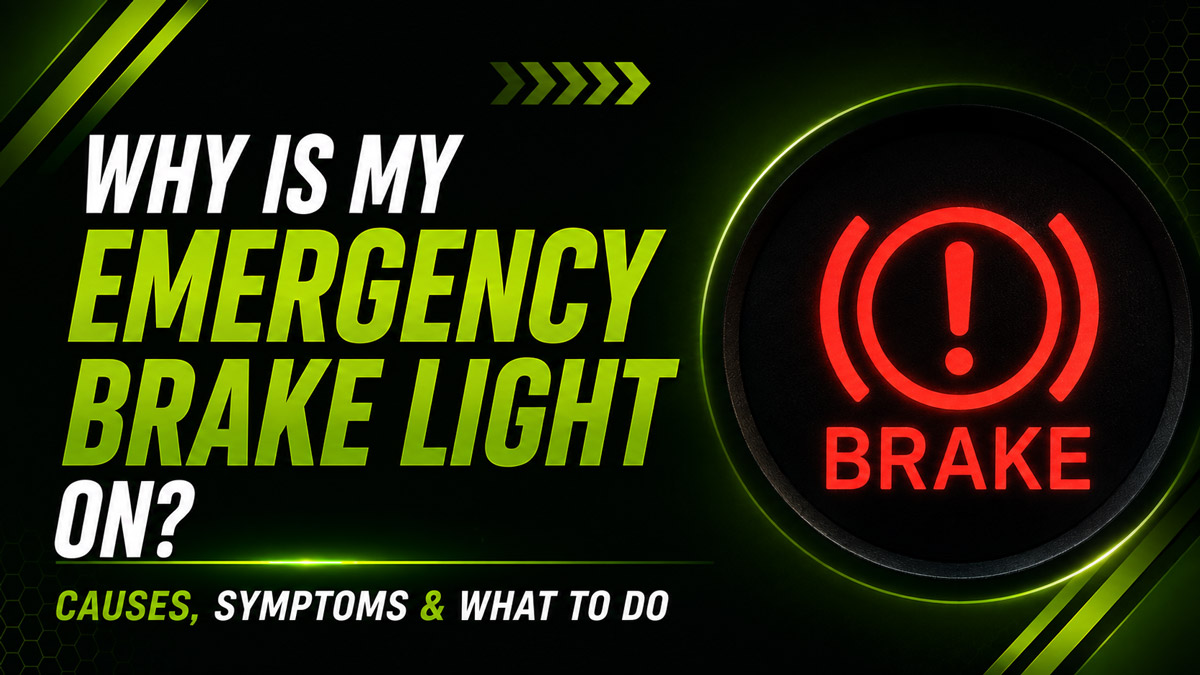
Your emergency brake light may be on because the parking brake is still engaged, the brake-fluid level is low, hydraulic pressure has dropped, or the vehicle has detected a fault in the parking-brake, ABS, or braking-control system. If the light remains on after releasing the parking brake, inspect the fluid level and brake-pedal feel before driving.
Key Facts / At a Glance
- A red BRAKE, “P,” or exclamation-mark warning can indicate more than an engaged parking brake.
- A soft, sinking, or unusually firm brake pedal means the vehicle should not be driven.
- Brake fluid may fall gradually as brake pads wear, but a sudden drop usually indicates a leak.
- A red brake light combined with an amber ABS light may indicate an electronic braking fault.
- Driving with a stuck parking brake can overheat the pads, shoes, rotors, bearings, and wheel seals.
- An ABS-capable scan tool is usually required to diagnose electronic parking-brake and wheel-speed-sensor faults.
Why Is the Emergency Brake Light On?
The emergency brake light normally illuminates when the parking brake is applied. If it stays illuminated after the brake is released, the vehicle may have detected an incomplete release, low brake fluid, hydraulic pressure loss, worn friction components, or an electronic control fault.
The same dashboard lamp may monitor several systems. This is why releasing the parking brake does not automatically prove that the warning is harmless.
Common causes include:
- The parking brake is partially engaged.
- The parking-brake switch is stuck or misadjusted.
- A mechanical parking-brake cable is binding.
- The brake-fluid reservoir is below the MIN mark.
- Brake pads or shoes are badly worn.
- Brake fluid is leaking from a hose, line, caliper, wheel cylinder, or master cylinder.
- The electronic parking brake has malfunctioned.
- The ABS or brake-control module has stored a fault.
What Does the Emergency Brake Light Look Like?
An emergency brake warning usually appears as a red symbol showing BRAKE, a letter P inside a circle, or an exclamation mark inside a circle. The exact symbol and meaning vary by manufacturer.
A red “P” most commonly identifies the parking brake. A red exclamation mark or BRAKE label may also warn about low fluid or hydraulic failure. An amber parking-brake symbol more often indicates an electronic parking-brake malfunction rather than normal brake engagement.
Check the owner’s manual before assuming that two similar symbols have the same meaning.
Can I Drive With the Emergency Brake Light On?
You should not drive until you confirm that the parking brake is fully released and the brake pedal feels normal. A red brake warning can indicate a condition that reduces braking force without giving you much additional warning.
Stop driving and arrange a tow when:
- The brake pedal feels soft, spongy, or sinks toward the floor.
- The brake-fluid reservoir is empty or significantly below MIN.
- Fluid is visible beneath a wheel, along a brake line, or near the master cylinder.
- The vehicle pulls sharply during braking.
- Braking distance has increased.
- The warning flashes or is accompanied by an audible alarm.
- The parking brake will not release.
- A wheel smells burned, smokes, or becomes excessively hot.
- Both the red brake light and ABS light appear with abnormal braking.
A short trip to a repair shop may be reasonable when:
- The parking brake is fully released.
- The reservoir level is between MIN and MAX.
- The pedal remains firm and consistent.
- The vehicle stops normally without pulling or grinding.
- No fluid leak, smoke, heat, or burning odor is present.
Even in this lower-risk situation, drive directly to a repair facility rather than continuing normal use.
Is the Parking Brake Fully Released?
A partially engaged parking brake is the simplest and most common explanation. Pull the lever up slightly before pressing the release button, or lift the parking-brake pedal slightly before activating its release.
For an electronic parking brake, keep your foot on the brake pedal and operate the EPB switch according to the owner’s manual. Some systems will not release unless the ignition is on, the driver’s door is closed, or the seat belt is fastened.
After releasing the brake:
- Confirm that the lever or pedal returns fully.
- Check whether the dashboard light goes out.
- Move the vehicle a few feet at low speed.
- Listen for scraping or dragging.
- Stop if the vehicle resists movement.
Do not press the accelerator harder to overcome resistance. Driving through a stuck parking brake can generate enough heat to damage rotors, drums, seals, bearings, and tires.
Why Does the Light Stay On After Releasing the Brake?
The light may remain on because the parking-brake switch still reports an engaged position. Mechanical switches can stick, corrode, become misaligned, or fail internally.
A handbrake switch is commonly located beneath the center console near the lever. Pedal-operated systems may use a switch near the parking-brake pedal. Electronic systems rely on position sensors, motors, wiring, and a control module.
A technician may test:
- Switch continuity
- Connector condition
- Wiring resistance
- EPB motor operation
- Actuator position
- Module fault codes
- Cable tension and return movement
A failed switch may illuminate the warning even when the brake is physically released. However, the physical brake must still be inspected before replacing the switch.
Could a Stuck Parking-Brake Cable Cause the Light?
A rusted, frozen, stretched, or internally damaged cable can prevent a mechanical parking brake from releasing completely. The cabin lever may appear released while one rear brake remains applied.
Typical symptoms include:
- Poor acceleration
- A vehicle that feels unusually heavy
- Burning friction-material odor
- One hot rear wheel
- Smoke near a wheel
- Reduced fuel economy
- Grinding or scraping
- The vehicle pulling to one side
Cable binding is more common after exposure to water, road salt, freezing temperatures, or long periods without parking-brake use.
Do not touch a suspected hot wheel, rotor, or drum with bare hands. Compare wheel temperatures from a safe distance or use a non-contact infrared thermometer.
Can Low Brake Fluid Turn On the Emergency Brake Light?
Low brake fluid can activate the same red warning used for the parking brake. A float sensor inside the reservoir detects when the fluid falls below a specified level.
The reservoir is usually mounted on the master cylinder near the rear of the engine compartment. With the vehicle parked on level ground, inspect the fluid through the translucent reservoir without removing the cap unless necessary.
The level should be between the MIN and MAX markings.
Why brake fluid becomes low
Brake fluid may drop because:
- Brake pads have worn and the caliper pistons remain farther outward.
- Rear brake shoes are worn or poorly adjusted.
- A caliper or wheel cylinder is leaking.
- A flexible hose or steel line has failed.
- The master cylinder is leaking internally or externally.
- The hydraulic clutch shares the reservoir and has developed a leak.
A gradual level reduction can accompany normal pad wear, but brake fluid is not normally consumed like engine oil. A rapid or repeated drop requires immediate inspection.
Should I Simply Add Brake Fluid?
Do not blindly top off a low reservoir before determining why the level dropped. Adding fluid may temporarily turn off the light while hiding worn pads or a dangerous hydraulic leak.
If fluid is only slightly below the normal range and the pads are worn, replacing the pads may push the caliper pistons inward and return fluid to the reservoir. A reservoir filled to MAX before pad replacement could then overflow.
Brake fluid should only be added when:
- The correct specification is known.
- A leak assessment has been performed.
- The reservoir and surrounding area are clean.
- The fluid comes from a sealed container.
- The cause of the low level is being corrected.
Use only the DOT specification listed on the reservoir cap or in the owner’s manual. DOT 3, DOT 4, DOT 5, and DOT 5.1 fluids are not universally interchangeable.
How Does Brake-Pedal Feel Help Diagnose the Problem?
Brake-pedal feel helps distinguish an electrical warning from a hydraulic braking failure. Test the pedal while the vehicle is stationary and the engine is running.
| Pedal Behavior | Possible Cause | Recommended Action |
| Firm and consistent | Switch, sensor, EPB, or minor fluid-level issue | Inspect before continued use |
| Soft or spongy | Air, fluid leak, overheated fluid, hose expansion | Do not drive |
| Slowly sinks | Internal master-cylinder bypass or external leak | Tow the vehicle |
| Very hard | Booster, vacuum, electric-assist, or hydraulic-assist fault | Do not drive normally |
| Pulsates during normal braking | Rotor variation, wheel issue, or ABS activation | Inspect promptly |
| Travels farther than normal | Worn brakes, poor adjustment, air, or leak | Avoid driving |
Pump the pedal only for diagnostic observation. Pumping may temporarily build pressure in some failed systems, but it does not repair the underlying problem.
Can Worn Brake Pads Trigger the Light?
Worn brake pads can contribute to a brake warning by lowering the reservoir level as the caliper pistons extend. Some vehicles also have dedicated electrical pad-wear sensors.
A pad-wear sensor may illuminate a separate amber symbol rather than the red BRAKE warning. The exact behavior depends on the vehicle.
Signs of worn pads include:
- Squealing during braking
- Grinding from metal-to-metal contact
- Reduced pad thickness
- Longer stopping distance
- Brake pedal pulsation
- Excessive brake dust
- Visible rotor scoring
Many technicians recommend replacement before the friction material reaches approximately 2–3 mm, although the manufacturer’s minimum specification should control the decision.
What If the ABS Light Is On Too?
A red brake light combined with an amber ABS light can indicate a fault affecting anti-lock braking, electronic brake-force distribution, stability control, or an electronic parking brake. Conventional braking may remain, but emergency-control features can be reduced or disabled.
Possible causes include:
- Failed wheel-speed sensor
- Damaged sensor wiring
- Corroded tone ring
- Low system voltage
- ABS pump failure
- Hydraulic control-unit fault
- Brake-pressure-sensor fault
- Steering-angle or yaw-sensor fault
- Communication failure between modules
A basic engine-code reader may not detect these faults. Diagnosis generally requires a scanner that can communicate with the ABS, EPB, and stability-control modules.
Can a Weak Battery Cause the Brake Light?
Low battery voltage can trigger parking-brake, ABS, stability-control, and brake-assist warnings, especially during startup. Electronic braking modules require stable voltage to perform self-tests and operate motors or pumps.
Suspect a voltage-related issue when:
- Several warning lights appeared simultaneously.
- The engine cranked slowly.
- The battery was recently discharged.
- The battery or alternator was replaced.
- The warnings started after a jump-start.
- The lights disappear after restarting but later return.
Battery voltage should generally be checked at rest, during cranking, and with the engine running. A voltage problem should not be assumed until mechanical and hydraulic brake safety has been verified.
Why Is the Light Flashing?
A flashing brake warning is more urgent than a normal parking-brake reminder on many vehicles. It may indicate incomplete electronic parking-brake operation, hydraulic pressure loss, brake-control failure, or a system-specific malfunction.
Stop safely, set the transmission to Park or engage a manual transmission gear, and consult the owner’s manual. Do not continue driving solely because the vehicle still appears to stop normally.
Some electronic parking brakes flash while applying or releasing. The light should stop flashing once the commanded movement is completed. Continuous flashing indicates that the system did not reach the expected position.
How Do You Diagnose an Emergency Brake Light?
Diagnose the warning from the safest and simplest cause to the most complex.
Step 1: Read the exact dashboard symbol
Identify whether the warning is red or amber and whether it shows BRAKE, “P,” “!”, ABS, or another symbol. Photograph the instrument panel if the warning is intermittent.
Step 2: Release the parking brake completely
Cycle the lever, pedal, or electronic switch. Confirm that the mechanism returns to its fully released position.
Step 3: Test brake-pedal feel
With the vehicle stationary, press and hold the pedal. Do not drive if it is soft, sinks, or feels significantly different from normal.
Step 4: Check the brake-fluid level
Inspect the reservoir on level ground. A level below MIN requires investigation for pad wear or leakage.
Step 5: Look for hydraulic leaks
Check beneath the vehicle, behind each wheel, along visible brake lines, and near the master cylinder. Brake fluid is commonly clear to amber and feels slick.
Step 6: Check for a dragging brake
Move only at very low speed if pedal feel and fluid level are normal. Stop if the car resists, pulls, smells hot, or produces smoke.
Step 7: Scan the brake modules
Use an ABS- and EPB-capable scan tool. Record all codes and freeze-frame data before clearing anything.
Step 8: Inspect the mechanical and electrical components
Test the parking-brake switch, cables, actuators, wheel-speed sensors, connectors, and pad thickness according to the diagnostic codes and symptoms.
Emergency Brake Light Repair Costs
Repair costs depend on the vehicle, fault location, labor rate, and whether related brake components were damaged.
| Problem | Typical Repair | Typical Cost | Typical Time |
| Misadjusted parking-brake switch | Adjust or replace switch | $50–$200 | 0.5–1 hour |
| Low fluid caused by worn pads | Replace pads and inspect rotors | $150–$500 per axle | 1–2.5 hours |
| Stuck parking-brake cable | Replace one or more cables | $150–$500 | 1–3 hours |
| Electronic parking-brake actuator | Replace motor or caliper assembly | $300–$1,000+ | 1–3 hours |
| Wheel-speed sensor fault | Replace sensor or repair wiring | $150–$450 | 0.5–1.5 hours |
| Brake hose or line leak | Replace line and bleed system | $200–$1,000+ | 1–5 hours |
| Failed master cylinder | Replace and bleed system | $350–$900 | 2–4 hours |
| ABS hydraulic module | Repair or replace module | $800–$2,500+ | 2–6 hours |
These are typical shop ranges rather than fixed quotes. Luxury vehicles, rusted brake lines, integrated electronic calipers, and difficult module programming can increase the total.
Common Diagnostic Mistakes
Topping off fluid without checking the brakes
Adding fluid may hide a leak or delay replacement of critically worn pads. Determine the cause of the low level first.
Clearing codes before recording them
Clearing ABS or EPB codes removes evidence that can identify an intermittent sensor, voltage, or actuator fault.
Assuming the warning is only a switch problem
A stuck switch is possible, but hydraulic and mechanical brake safety should be verified before treating the warning as an electrical nuisance.
Continuing to drive through brake drag
A dragging parking brake creates intense heat. Continued driving can destroy pads, shoes, rotors, drums, bearings, seals, and electronic actuators.
Using a generic engine-code reader
Many inexpensive readers communicate only with the powertrain module. Brake diagnosis requires access to chassis, ABS, stability-control, or EPB modules.
Does the Warning Mean Something Different on an EV or Hybrid?
An EV or hybrid still uses conventional hydraulic friction brakes, even though regenerative braking performs part of the deceleration. A red brake warning should therefore receive the same safety response as it would in a gasoline vehicle.
Regenerative braking may be reduced when the battery is cold, fully charged, or unable to accept additional energy. That condition usually produces a regeneration or power-related message rather than a persistent red hydraulic brake warning.
EVs and hybrids may also use electrically powered brake boosters and integrated brake-control modules. Diagnosis often requires manufacturer-capable software and high-voltage safety procedures.
Frequently Asked Questions
Why does my brake light turn on when I go around corners?
A brake light that appears during cornering commonly indicates that the fluid level is near the reservoir’s minimum threshold. Fluid moves to one side of the reservoir, causing the float sensor to trigger. Inspect the brake-pad thickness and hydraulic system rather than merely adding fluid.
Can cold weather make the parking-brake light stay on?
Cold weather can freeze moisture inside a parking-brake cable or cause a mechanical linkage to bind. Electronic systems can also respond poorly to weak battery voltage in low temperatures. Do not drive if a wheel remains locked, the vehicle resists movement, or the warning continues flashing.
Why does the brake light come on and then go off?
An intermittent warning may result from fluid near the MIN mark, a loose switch, damaged wiring, low system voltage, or a sensor fault. Record when it happens—during braking, turning, bumps, startup, or cold weather—to help isolate the cause.
Will disconnecting the battery reset the brake light?
Disconnecting the battery may temporarily clear some electronic warnings, but it will not fix low fluid, a leak, a stuck cable, worn brakes, or a failed sensor. It may also erase useful diagnostic information and require window, steering-angle, or electronic parking-brake relearning.
Can I reset an electronic parking brake myself?
Some vehicles allow an electronic parking-brake reset through a button sequence, scan tool, or maintenance mode. The correct process is model-specific. Do not force an actuator or retract an electronic caliper without the approved procedure because gear, motor, and control-module damage can result.
Why is the light still on after replacing the brake pads?
The warning may remain because the reservoir sensor is stuck, a pad-wear sensor was not replaced, the parking-brake switch is misadjusted, an ABS code remains active, or the electronic parking brake was not calibrated. Scan the brake modules and verify fluid level before replacing additional parts.
The Bottom Line
When asking “why is my emergency brake light on?”, first confirm that the parking brake is completely released. Then check the brake-fluid level and pedal feel. A low reservoir, soft pedal, fluid leak, dragging wheel, flashing warning, or combined BRAKE and ABS warning means the vehicle should be stopped and professionally inspected rather than driven.