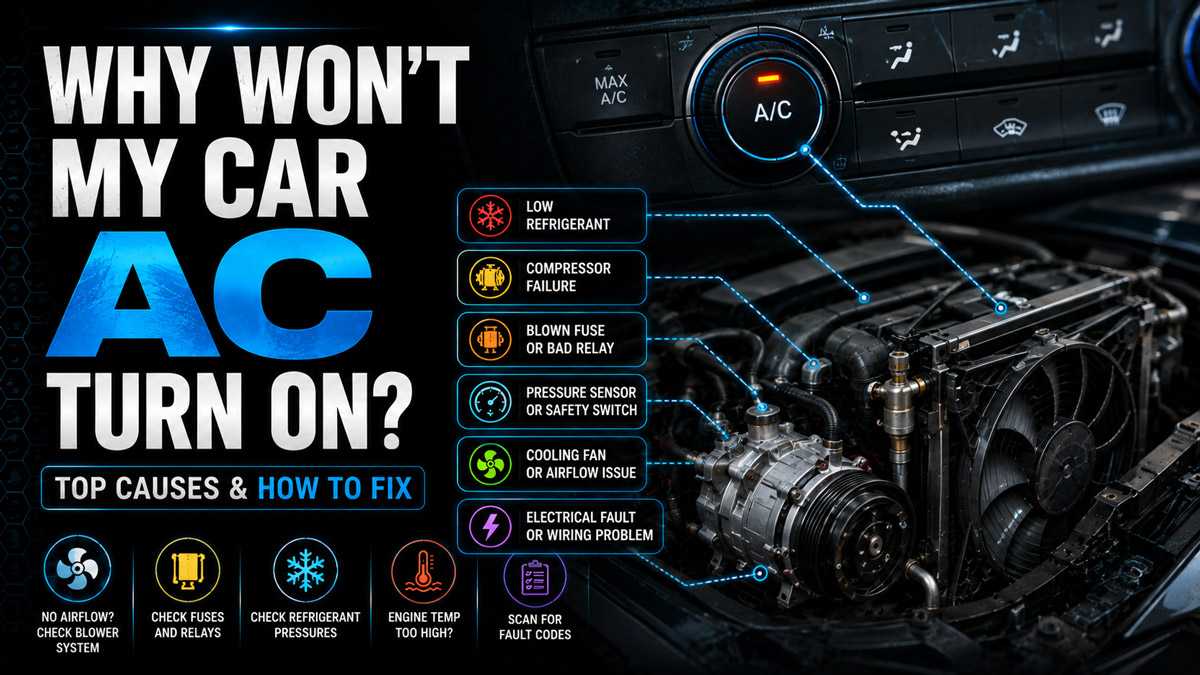
A car AC usually will not turn on because the HVAC control module or engine computer has detected low refrigerant pressure, excessive pressure, an electrical fault, unsafe engine temperature, or a compressor problem. The fault may also be inside the cabin if the blower motor produces no airflow when the AC button is pressed.
At a Glance
- A lit AC button confirms that the request was received, not that the compressor was authorized to run.
- Strong warm airflow usually indicates a refrigeration or compressor-control problem rather than a blower failure.
- No airflow from the vents points first to the blower fuse, relay, motor, resistor, wiring, or climate-control panel.
- Low refrigerant can open the low-pressure protection circuit and prevent compressor operation.
- Modern variable-displacement compressors may operate without a visibly cycling magnetic clutch.
- Refrigerant should not be added until system pressures, refrigerant type, charge quantity, and leak condition are known.
What Happens When You Press the Car AC Button?
Pressing the AC button sends a cooling request to the vehicle’s climate-control module; it does not necessarily send power directly to the compressor. The module or engine control unit checks operating conditions before allowing the compressor to create refrigerant pressure.
Depending on the vehicle, the computer may evaluate:
- Refrigerant pressure
- Evaporator temperature
- Outside-air temperature
- Engine coolant temperature
- Engine speed and load
- Throttle position
- Battery voltage
- Cooling-fan operation
- Compressor speed or control-valve feedback
A traditional system then energizes a compressor clutch relay, allowing battery voltage to reach the magnetic clutch coil. A clutchless variable-displacement system instead commands an electronic control valve that changes compressor output.
The computer may reject the AC request when one of these inputs appears unsafe or implausible. For example, a low-pressure signal may suggest that refrigerant has leaked out, while an excessive coolant-temperature signal may cause the computer to reduce engine load.
This explains why an AC indicator can illuminate while nothing appears to happen under the hood. The button has requested cooling, but the control system has not necessarily approved compressor operation. Manufacturer documentation also shows that compressor operation can be governed by conditions beyond the button’s immediate position.
What Are the Most Common Reasons the AC Will Not Engage?
The most common causes are low refrigerant, a failed compressor clutch or control valve, a blown fuse, a faulty relay, a defective pressure sensor, damaged wiring, or a computer-imposed shutdown. The correct starting point depends on whether air still comes through the dashboard vents.
Professionals first separate an airflow fault from a refrigeration fault. Recharging a vehicle with no blower operation will not restore dashboard airflow. Replacing a blower motor will not correct a compressor that never develops a pressure difference.
This distinction prevents the most common diagnostic mistake: assuming every “AC not turning on” complaint means the same component has failed.
How Can I Tell Whether the Blower or Compressor Is Not Working?
Turn the fan to its highest setting and check for airflow from several vent positions. No airflow indicates a blower-side problem; strong airflow that is not cold indicates a cooling-side problem.
Use this quick test:
- Start the engine and set the parking brake.
- Select maximum cooling and recirculation.
- Turn the cabin fan to its highest speed.
- Test the dashboard, floor, and defrost outlets.
- Listen for changes when switching fan speeds.
- Check whether the air is strong, weak, or completely absent.
If there is no air on any setting, inspect the blower fuse, blower relay, motor connector, ground, fan-speed controller, resistor module, and climate-control head. A blower that works only on its highest setting often has a failed resistor on older manual systems. A blower that works intermittently after the dashboard or lower housing is tapped may have worn motor brushes or a loose connection.
If airflow is strong but warm, the blower is doing its job. Diagnosis should move toward compressor command, refrigerant pressure, condenser-fan operation, temperature doors, and the refrigerant circuit.
A blocked cabin air filter usually reduces airflow rather than preventing the AC compressor from receiving a command. It can still make a functioning system feel ineffective, especially at lower fan speeds.
Can Low Refrigerant Prevent the AC From Turning On?
Yes. Low refrigerant can prevent compressor operation because many systems disable the compressor when refrigerant pressure falls below a protective threshold. The shutdown protects the compressor from inadequate lubrication and abnormal operating conditions.
Refrigerant does not normally get “used up” like fuel. A low charge generally indicates leakage through a hose, seal, condenser, service valve, evaporator, compressor shaft seal, or another connection.
A low-pressure switch may open the clutch circuit directly on an older system. Newer vehicles often use a pressure transducer that reports a pressure value to a control module. The module then decides whether compressor operation is permitted. Low-pressure protection is a recognized reason for a compressor clutch not engaging.
A universal static-pressure target should not be used to judge every vehicle. Static pressure changes substantially with ambient temperature, refrigerant type, and system condition. A resting R-134a system may show roughly 70–100 psi on a warm day, but that reading alone does not prove the charge is correct.
Do not repeatedly add refrigerant until the compressor starts. A partially charged system, failed pressure sensor, inactive compressor, or cool ambient temperature can produce misleading readings. The specified refrigerant weight on the under-hood label is more authoritative than a generic pressure chart.
Can a Blown Fuse or Bad Relay Stop the Car AC?
Yes. A blown fuse, defective relay, corroded terminal, weak ground, or damaged wire can interrupt power to the compressor clutch, control valve, blower motor, cooling fan, or HVAC module.
Check the owner’s manual or fuse-box diagram for circuits labeled:
- A/C
- MG CLT or magnetic clutch
- HVAC
- Blower
- PCM or ECM
- Cooling fan
- Compressor
- Climate control
A transparent fuse may look intact while failing under load, so confirmation with a multimeter or test light is more reliable than visual inspection. Replace a blown fuse only with the same amperage rating. A higher-rated fuse can allow wiring to overheat before circuit protection operates.
A relay can sometimes be tested by swapping it with an identical, noncritical relay carrying the same part number and terminal arrangement. A relay that clicks is not automatically good; burned internal contacts can click while failing to pass sufficient current.
If the replacement fuse blows immediately, stop replacing it. The circuit may contain a shorted clutch coil, damaged wire, seized component, failed fan motor, or incorrect previous repair.
Automotive AC troubleshooting references identify low clutch voltage, faulty relays, poor grounds, and damaged connections as common reasons a compressor clutch will not engage.
Why Is the AC Light On but the Compressor Stays Off?
The AC light means the climate-control panel registered the driver’s request; it does not prove that the computer commanded the compressor. The request can be denied because a required sensor value or operating condition is outside the permitted range.
Common computer-controlled lockouts include:
- Refrigerant pressure too low or too high
- Engine coolant temperature too high
- Outside temperature below the programmed limit
- Evaporator temperature near freezing
- Wide-open throttle or heavy engine load
- Battery voltage outside the acceptable range
- Engine speed above a programmed limit
- Cooling-fan fault
- Invalid pressure or temperature sensor data
- Stored compressor-protection fault
Some vehicles also turn off the indicator when the request is denied, while others leave the light illuminated. Therefore, the dashboard light cannot be used as a compressor test.
A scan tool capable of reading body, HVAC, and powertrain data is especially useful. The technician can compare “AC request,” “AC permission,” “compressor command,” refrigerant pressure, evaporator temperature, ambient temperature, and coolant temperature.
A revealing example is an ambient sensor displaying −40°F or −40°C. That value commonly indicates an open circuit rather than actual weather. The climate module may then inhibit compressor operation because it believes outside conditions are too cold.
How Do I Check Whether the Compressor Clutch Is Engaging?
On a traditional clutch-equipped compressor, inspect whether the center hub begins rotating with the outer pulley after the AC is requested. Keep hands, clothing, tools, and hair away from belts, fans, and rotating components.
Use this sequence:
- Park outdoors in a ventilated area.
- Start the engine and apply the parking brake.
- Select maximum cooling, recirculation, and high blower speed.
- Open the hood and locate the belt-driven compressor.
- Observe the compressor pulley from a safe distance.
- Listen for a click and watch the center hub.
- Note whether the hub remains stationary, engages continuously, or cycles rapidly.
The outer pulley normally turns whenever the engine runs. On a clutch system, the center portion should turn when the clutch engages. Rapid engagement and disengagement can indicate low charge, abnormal pressure, freeze protection, or a control fault.
A stationary hub does not identify the failed part by itself. The clutch may lack voltage, have an open coil, have excessive air gap, or be intentionally disabled by the control module.
Do not apply power directly to the clutch unless the wiring diagram and refrigerant pressures have been checked. Direct power can force the compressor to operate despite a low charge, excessive pressure, or mechanical seizure.
What Does Equal Pressure on Both AC Gauges Mean?
Nearly equal high-side and low-side pressures while the engine is running usually mean the compressor is not creating a pressure differential. The compressor may be disengaged, internally damaged, commanded to minimum displacement, or affected by a failed control valve.
When the compressor is off long enough, refrigerant migrates until pressure equalizes throughout the system. Both gauges may then show a similar static reading. The exact value depends heavily on ambient temperature and refrigerant type.
Equal readings do not automatically mean the system needs more refrigerant. Adding refrigerant to a non-pumping system can overcharge it. If the compressor later begins operating, excessive charge can create abnormally high head pressure and poor cooling.
Check the following before adding refrigerant:
- Is the compressor clutch engaged?
- Does the vehicle use a clutchless variable compressor?
- Is the control valve receiving a command?
- Is the belt and compressor pulley intact?
- Does scan data show compressor permission?
- Are the service couplers connected correctly?
- Do gauge readings change when engine speed is raised moderately?
A severely worn compressor may rotate without producing a meaningful pressure split. A variable compressor may also remain at almost zero displacement because of a valve, wiring, sensor, or command problem. DENSO documentation confirms that electronically controlled compressor valves are distinct service and diagnostic components.
Can a Bad Cooling Fan Make the AC Shut Off?
Yes. A failed radiator or condenser fan can cause refrigerant pressure to rise rapidly at idle, forcing the control system to reduce or stop compressor operation. The AC may cool normally at road speed because natural airflow replaces the missing fan airflow.
Typical symptoms include:
- Cold air while driving but warm air at traffic lights
- Cooling for several seconds after startup, followed by warm air
- Abnormally high high-side pressure
- Compressor cycling off at idle
- Engine temperature rising with the AC on
- One fan operating while a second fan remains stationary
- Cooling improving when water is gently sprayed across a dirty condenser
With the AC requested on a warm day, many vehicles command at least one electric cooling fan. Fan strategy varies, so a stationary fan is not automatically defective; scan-tool command data and the manufacturer’s wiring diagram provide a better test.
Inspect the condenser for plastic bags, mud, insects, leaves, bent fins, or material trapped between the condenser and radiator. Clean it with low-pressure water and appropriate cleaner. Do not place a pressure-washer nozzle close to the fins because the thin aluminum can fold over and restrict airflow further.
A cooling-fan fault is especially likely when the AC fails only at low speed but becomes cold within a minute of driving.
Can Engine Overheating Disable the Air Conditioner?
Yes. Many engine computers disable or reduce AC compressor operation when coolant temperature becomes excessive. Removing compressor load and condenser heat helps protect the engine from further overheating.
The AC system may therefore stop cooling even when every refrigerant component is functional. The underlying cause may be:
- Low engine coolant
- Cooling-system leakage
- Stuck thermostat
- Failed radiator fan
- Blocked radiator
- Weak water pump
- Air trapped in the cooling system
- Incorrect coolant-temperature sensor reading
- Head-gasket or combustion-gas problem
The exact cutoff temperature varies by manufacturer, engine, operating mode, and calibration. Manufacturer technical information shows that coolant temperature and engine speed can be explicit conditions for compressor authorization.
Never continue idling solely to test the AC when the temperature warning appears, steam is visible, or coolant is boiling. Turn the AC off, move to a safe location, stop the engine, and allow the cooling system to cool.
Do not open a hot radiator cap or pressurized coolant reservoir. Hot coolant can erupt under pressure and cause severe burns.
When the AC shuts off at the same time the temperature gauge rises, diagnose the engine cooling system before recharging or replacing AC parts.
Can Temperature Sensors Prevent the AC From Working?
Yes. A faulty ambient-temperature sensor, evaporator thermistor, coolant-temperature sensor, or cabin-temperature sensor can prevent compressor operation by reporting an implausible or unsafe temperature.
The evaporator temperature sensor protects the evaporator core from freezing. The control module normally cycles or reduces compressor output as the evaporator approaches freezing conditions. If the sensor falsely reports an extremely low temperature, the module may keep the compressor off even though the cabin is hot.
The ambient-temperature sensor can also inhibit AC operation when the computer believes outside temperature is below the programmed operating threshold. Common clues include:
- Outside-temperature display is obviously wrong
- Display shows −40°
- AC stopped after bumper, grille, or front-end repairs
- Sensor connector is damaged or unplugged
- Cooling begins after the temperature display becomes normal
- Scan data differs significantly from actual temperature
The coolant-temperature sensor creates a similar problem if it falsely indicates engine overheating.
Do not replace a sensor solely because its displayed reading is unusual. Check the connector, wiring integrity, reference voltage, ground, resistance specification, and scan-tool data. A broken wire can produce the same fault as a failed sensor.
Professionals compare sensor values after the vehicle has been parked overnight. Coolant, intake-air, ambient, and other temperature readings should usually be reasonably close before startup.
What If the Car Has a Clutchless Variable Compressor?
A clutchless variable-displacement compressor may spin whenever the engine runs, so watching for clutch engagement is not a valid test. Compressor output is controlled internally, often by an electronically operated control valve.
The pulley, shaft, and internal compressor components may rotate continuously while piston stroke changes according to cooling demand. At minimum displacement, the compressor can appear mechanically active while creating little or no useful pressure difference.
Common faults include:
- Failed electronic control valve
- Blocked valve screen
- Open or shorted valve coil
- Missing pulse-width-modulated command
- Incorrect refrigerant-pressure signal
- Internal compressor wear
- Mechanical damper or limiter failure
- Wiring or control-module fault
Diagnosis requires checking the exact compressor design, control-valve command, current draw, pressures, temperature change, and relevant fault codes. A basic recharge hose cannot show whether the control module is commanding 5%, 50%, or 100% displacement.
Some compressors permit separate replacement of the electronic control valve, while others require compressor replacement or manufacturer-specific procedures. A low-cost valve should not be installed merely because both gauge readings are equal; equal pressure can also result from low refrigerant, an inactive command, or internal compressor failure.
DENSO technical material documents external compressor control valves and variable-displacement compressor hardware, confirming that clutch observation alone is insufficient on these systems.
Why Does the AC Start After Tapping the Compressor?
An AC clutch that engages after the clutch plate is lightly tapped often has excessive clutch air gap or a weak magnetic coil. The tap briefly moves the plate close enough for the magnetic field to pull it against the pulley.
Clutch air gap increases as friction surfaces wear. Heat can worsen the symptom because electrical resistance rises and the magnetic coil may produce less effective pulling force. The result is an AC system that works when cold, fails after a hot restart, or engages only after vibration.
However, tapping the compressor does not prove that every other component is good. Vibration can also affect:
- A loose clutch connector
- A failing relay
- Worn motor or clutch wiring
- Internal compressor components
- A sticking electronic control valve
Measure the clutch air gap at several points and compare it with the vehicle-specific service specification. Many clutches use shims to set clearance, but the correct range and service procedure differ by compressor.
Removing a shim without measuring can leave too little clearance. An excessively tight clutch may drag continuously, overheat, damage the pulley bearing, or keep the compressor engaged when it should release.
Automotive diagnostic guidance recognizes excessive clutch air gap, weak voltage, and excessive coil resistance as reasons the clutch may fail to engage.
Can I Bypass the Pressure Switch or Compressor Relay?
A pressure switch or relay should not be permanently bypassed. A brief, controlled electrical test may be part of professional diagnosis, but forcing compressor operation can defeat protections against refrigerant loss, excessive pressure, overheating, and compressor damage.
A jumper wire can answer only a limited question: whether a downstream component reacts when power is supplied. It does not prove that the compressor is safe to operate.
Potential consequences include:
- Running the compressor with insufficient lubricant circulation
- Activating a compressor against excessive system pressure
- Damaging a slipping or overheated clutch
- Burning wiring when a short circuit is present
- Starting a seized compressor
- Overloading the engine cooling system
- Creating an arc near moving components
- Damaging a control module by applying power to the wrong terminal
Modern pressure transducers are particularly unsuitable for bypassing. A three-wire transducer may use a 5-volt reference, ground, and signal circuit. Applying 12 volts to the signal wire can damage the sensor or control module.
Use wiring diagrams, scan data, voltage-drop tests, and manufacturer test procedures instead. When a pressure switch appears open, measure actual system pressure and verify the switch specification before condemning it.
The protective function is intentional: low- and high-pressure devices interrupt compressor operation when refrigerant conditions become unsafe.
How Much Does It Cost to Fix an AC That Will Not Turn On?
A repair may cost about $20 for a simple fuse or relay or exceed $2,000 for a compressor failure that contaminates the system. Vehicle design, refrigerant type, labor rates, access, and the failed component determine the final price.
Typical broad ranges are:
These are planning ranges, not quotations. Some modern vehicles require R-1234yf equipment and refrigerant, which can increase service cost. Hybrid and electric vehicles may use high-voltage electric compressors and electrically nonconductive oil, requiring specialized procedures.
The least expensive diagnosis is not always a recharge. A proper inspection can prevent refrigerant overcharging, unnecessary compressor replacement, or repeated leakage.
When Should I Stop Troubleshooting and Call a Professional?
Stop DIY diagnosis when the repair requires opening the refrigerant system, interpreting high-side pressure, working near high voltage, or overriding a safety circuit. Refrigerant recovery and charging should be performed with the correct equipment and the exact specified charge weight.
Professional service is appropriate when:
- The compressor or clutch receives power but does not operate
- The high-side pressure climbs rapidly
- The engine overheats with the AC on
- A fuse repeatedly blows
- Wiring is melted or visibly damaged
- The compressor grinds, smokes, or locks
- Refrigerant has leaked out more than once
- Both gauges remain equal with the compressor commanded on
- The vehicle uses R-1234yf
- The vehicle is hybrid or fully electric
- The dashboard reports an isolation or high-voltage fault
- Refrigerant oil or dye appears inside the cabin
- An evaporator, condenser, compressor, or hose must be replaced
Automotive refrigerant is stored under pressure. Manufacturer documentation warns that the system should be serviced by qualified personnel because opening it can cause injury.
Before visiting a shop, record the symptoms: ambient temperature, whether airflow is present, whether cooling changes at road speed, whether the compressor is commanded, and whether the engine temperature rises. Those details can shorten diagnostic time.
The Bottom Line
A car AC that will not turn on usually has either an airflow failure, a rejected compressor request, or a compressor that cannot respond to the command. Strong warm airflow points toward refrigerant, compressor, fan, sensor, or control problems, while zero airflow points toward the blower circuit. Do not assume that a lit AC button proves compressor operation, and do not add refrigerant solely because the compressor is inactive. Modern clutchless compressors and computer-controlled safety lockouts often require pressure readings, scan data, electrical testing, and vehicle-specific service information for an accurate diagnosis.