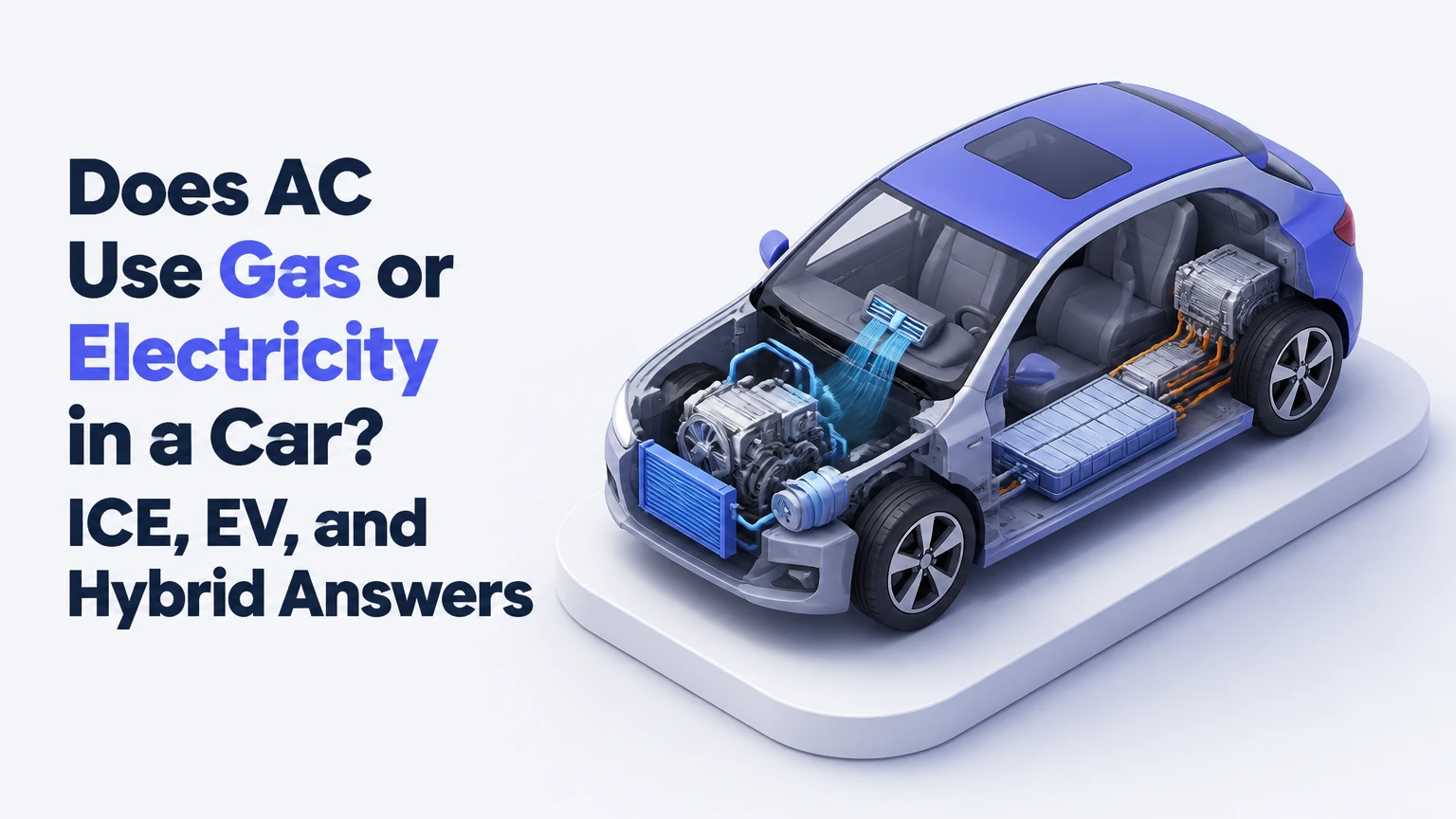
A car air-conditioning system uses both engine energy or battery electricity and a small 12-volt electrical supply. In a gasoline or diesel vehicle, the engine usually drives the AC compressor through the serpentine belt, while electricity runs the blower, controls, sensors, and cooling fans. Hybrid and electric vehicles generally use a high-voltage electric compressor instead.
Key Facts
A conventional gasoline-car AC compressor normally takes mechanical power from the running engine.
The cabin blower, control module, sensors, and condenser fan use electrical power.
A battery-electric vehicle runs its compressor from the high-voltage traction battery, not gasoline.
A hybrid may cool the cabin while its gasoline engine is stopped because the compressor is electric.
Car AC removes heat and humidity from cabin air; it does not manufacture cold air.
The refrigerant is a sealed working fluid, not fuel burned by the engine.
Does AC Use Gas or Electricity in a Car?
A gasoline or diesel car uses fuel indirectly for air conditioning because the engine burns fuel to turn the belt-driven compressor. The same car also uses electricity for its blower motor, electronic controls, clutch, sensors, and radiator or condenser fans. An EV uses electricity for every major AC function, drawing it from the high-voltage battery.
The word “gas” creates two separate possibilities. Gasoline or diesel is the vehicle’s energy source, whereas refrigerant is the pressurized fluid circulating inside the cooling circuit. Car AC does not normally consume refrigerant during operation. If the refrigerant level falls, the system has a leak or was serviced incorrectly.
The exact fuel penalty depends on engine size, outside temperature, humidity, vehicle speed, cabin temperature, compressor design, and the control strategy. A small engine can show a larger percentage loss than a large engine because the same compressor load represents a greater share of available output.
What Is the Short Answer by Vehicle Type?
| Vehicle type | Compressor power source | Other AC electrical load | Main operating effect |
|---|---|---|---|
| Gasoline car | Serpentine belt and running engine | 12-volt battery and alternator | Higher fuel consumption |
| Diesel car | Serpentine belt and running engine | 12-volt battery and alternator | Higher fuel consumption |
| Conventional hybrid | High-voltage electric motor, or hybrid-specific design | 12-volt and high-voltage systems | Engine can stop during cooling |
| Plug-in hybrid | Usually high-voltage battery compressor | 12-volt and traction battery | Uses stored charge before engine restart |
| Battery-electric vehicle | High-voltage electric compressor | 12-volt and traction battery | Reduces driving range rather than burning fuel |
How Does a Gasoline-Car AC System Work?
A gasoline-car AC system transfers heat from the cabin to outside air through a closed refrigerant loop. The belt-driven compressor raises refrigerant pressure, the condenser rejects heat, the expansion device lowers pressure, and the evaporator absorbs cabin heat before the blower sends cooled air through the vents.
The compressor is the main energy consumer. A magnetic clutch or variable-displacement mechanism connects the compressor to the rotating accessory drive. Newer systems may adjust compressor displacement continuously instead of switching only between fully on and fully off.
The Six Stages of Cooling
- Compression: Low-pressure refrigerant vapor enters the compressor. The compressor raises its pressure and temperature.
- Condensation: The hot, high-pressure vapor enters the condenser, which sits near the engine radiator. Airflow removes heat until the refrigerant becomes a high-pressure liquid.
- Moisture and contamination control: A receiver-drier or accumulator stores refrigerant and uses desiccant to absorb moisture. The precise component depends on system design.
- Expansion: An expansion valve or fixed orifice restricts refrigerant flow. Pressure drops, and part of the liquid flashes into a cold, low-pressure mixture.
- Evaporation: The mixture enters the evaporator behind the dashboard. Warm cabin air passes over its fins, transferring heat into the refrigerant.
- Return: The refrigerant leaves the evaporator as a low-pressure vapor and returns to the compressor.
The evaporator also dehumidifies the cabin. Water extracted from humid air collects on the evaporator and usually drains through a tube beneath the vehicle. That is why a clear puddle under the passenger side can be normal after using AC.
Which Electrical Parts Use Battery Power?
The blower motor, electronic climate-control module, temperature sensors, compressor clutch, and condenser fan use electrical power in a conventional vehicle. The alternator normally supplies that electricity while the engine runs, so saying “the battery powers the AC” is incomplete for an ICE car.
A 12-volt battery supplies starting power and stabilizes the electrical system, but the alternator replenishes it during operation. The alternator itself adds a mechanical load to the engine, which means the electrical portion of AC also has an indirect fuel cost.
The condenser fan matters especially at low road speeds. At highway speed, ram air can move substantial air through the condenser. In traffic or while parked, the fan must remove the compressor’s rejected heat, or high-side pressure can rise and cooling can weaken.
AC Component and Energy Source
| Component | Typical power source in ICE car | Typical job | Failure symptom |
|---|---|---|---|
| Compressor | Engine belt, approximately 3-5 horsepower typical peak load | Raises refrigerant pressure | Warm air, noise, belt damage |
| Blower motor | 12-volt electrical system | Moves cabin air | Weak or absent airflow |
| Condenser fan | 12-volt electrical system | Removes heat at low speed | Cold while moving, warm at idle |
| Compressor clutch | 12-volt electrical signal | Engages belt-driven compressor | No cooling despite normal airflow |
| Climate-control module | 12-volt electrical system | Reads sensors and commands actuators | Incorrect temperature control |
| Evaporator temperature sensor | 12-volt low-current circuit | Prevents evaporator icing | Cycling problems or intermittent cooling |
How Do Hybrids and Electric Cars Power AC?
Hybrids and electric vehicles commonly use a high-voltage electric compressor powered by the traction battery. The compressor has an integrated electric motor and inverter, so it does not need a belt connected to the gasoline engine. That architecture allows cooling while the engine is stopped.
A few older or simpler hybrid designs use a compressor that can operate mechanically and electrically, so the vehicle specification matters. The owner’s manual or compressor label is more reliable than assuming every hybrid uses the same arrangement.
Battery-electric vehicles have no engine to drive a compressor. Their compressor typically operates from a 300-450 volt battery system in many mainstream vehicles, while newer platforms may use 800-volt architectures. The exact voltage varies by model and should not be treated as a universal specification.
Hybrid, Plug-In Hybrid, and EV Comparison
| Powertrain | Compressor arrangement | Can cool with engine stopped? | Energy consequence |
|---|---|---|---|
| Mild hybrid | Belt-driven or electric, model-dependent | Sometimes | Fuel use varies by architecture |
| Full hybrid | Usually high-voltage electric | Yes | Battery state may trigger engine operation |
| Plug-in hybrid | High-voltage electric in most modern designs | Yes | Uses traction charge before gasoline fuel |
| Battery EV | High-voltage electric | Yes | Reduces available driving range |
| Fuel-cell vehicle | High-voltage electric | Yes | Draws from the vehicle electrical system |
Can an EV Run AC While Parked?
An electric vehicle can normally run climate control while stationary, including during remote preconditioning. The compressor draws energy from the traction battery, while the 12-volt system runs control electronics and some low-voltage accessories.
Preconditioning while connected to a charger is usually the most efficient range strategy. Grid electricity cools the cabin before departure, so the traction battery does less work during the first miles. Cabin insulation, solar load, ambient temperature, and the vehicle’s heat-pump design still affect the result.
How Much Fuel Does Car AC Consume?
A belt-driven car AC system typically imposes a compressor load of roughly 3-5 horsepower under demanding conditions, but the resulting fuel increase is not a fixed percentage. A compact engine in hot, humid traffic may show a larger proportional penalty than a larger engine cruising at steady speed.
The U.S. Department of Energy’s FuelEconomy.gov warns that “using air conditioning in hot weather can reduce your vehicle’s fuel economy by more than 25%,” especially under severe conditions. That figure is a warning about possible maximum real-world impact, not a guaranteed loss for every trip.
The compressor load is greatest when the cabin is very hot, the system is on maximum cooling, the vehicle is idling, or the condenser receives poor airflow. Once the cabin reaches the set temperature, automatic climate control may reduce compressor displacement and lower the average load.
What Determines the Fuel Penalty?
| Condition | Effect on compressor demand | Practical result |
|---|---|---|
| Cabin parked in direct sun | High initial heat load | Heavy fuel use during pull-down |
| Recirculation selected | Reuses cooled cabin air | Faster cooling and lower average load |
| Fresh-air mode in extreme heat | Continuously cools hot outside air | Longer compressor operation |
| Stop-and-go traffic | Little natural condenser airflow | Cooling fan and compressor work harder |
| Steady highway cruising | Strong condenser airflow | Efficient heat rejection |
| Moderate outdoor temperature | Lower heat-transfer requirement | Smaller fuel penalty |
How Does AC Affect an Electric Car’s Range?
Electric-car AC reduces range by using traction-battery energy, but the percentage loss varies too widely for one universal number. A typical cabin-cooling draw may range from about 0.5-3 kW after stabilization, while initial pull-down in extreme heat can briefly require more.
For perspective, a vehicle consuming 18 kWh per 100 kilometers and using 1.5 kW for climate control at 60 km/h spends about 2.5 kWh per 100 kilometers on that load. The calculation changes with speed because climate power is time-based while driving energy is often reported by distance.
Heating can affect an EV more severely than cooling because resistance heaters may use several kilowatts continuously. A heat pump can reduce winter demand. That distinction matters when comparing summer AC range loss with winter climate-control loss.
Why EV AC Is Different
An electric compressor maintains a controlled speed independent of engine RPM. The vehicle can provide full cooling at a stop, precondition through an app, and regulate output with an inverter. The trade-off is direct battery consumption and potentially expensive high-voltage compressor replacement.
Can Car AC Work When the Engine Is Off?
A conventional belt-driven AC system cannot provide normal cooling when the engine is off because the compressor stops turning. The blower may continue moving air, but it will not produce sustained cold air unless the vehicle has a separate electric compressor or an auxiliary cooling system.
A hybrid or EV can continue cooling with the engine stopped because its electric compressor receives power from the high-voltage battery. Some gasoline vehicles have remote-start or idling strategies, but those still run the engine and consume fuel.
Turning the AC on does not usually require switching it off before stopping the engine. Modern vehicles manage compressor engagement electronically, and the common instruction to disable AC before starting or shutting down is generally unnecessary unless a manufacturer specifically says otherwise.
Is the Gas Inside Car AC the Same as Gasoline?
The refrigerant inside car AC is not gasoline, diesel, or a fuel additive. Refrigerant is a chemical working fluid that changes pressure and state inside the sealed system, allowing the circuit to absorb cabin heat and release it outside.
Older vehicles often use R-134a. Many newer vehicles use R-1234yf because of its lower global-warming impact under current environmental regulations. Some specialized systems use carbon dioxide, designated R-744, but that is not the normal refrigerant in most passenger cars.
Do not mix refrigerants or oils. Refrigerant type, charge quantity, and compressor lubricant are vehicle-specific, and an incorrect mixture can damage components or create a safety problem during service.
Should You Use Recirculation or Fresh Air?
Use recirculation after the cabin begins cooling, especially in hot weather and heavy traffic. Recirculation reduces the heat load because the evaporator repeatedly cools cabin air instead of continuously processing hot, humid outside air.
Fresh-air mode remains useful when the cabin needs ventilation or when windows are fogging. Recirculation alone is not a substitute for clearing a windshield, and drivers should never ignore reduced visibility to save fuel.
Recirculation can also reduce exposure to traffic exhaust, although it does not create a sealed cabin. Keep the setting practical, ventilate when needed, and follow the vehicle’s defogging instructions.
Is Water Under the Car After AC Normal?
Clear water dripping beneath the passenger side is usually normal condensate from the evaporator. Air-conditioning moisture drains outside through a dedicated tube, particularly after the system operates in humid weather.
Water inside the passenger footwell is not normal. A blocked evaporator drain, damaged drain connection, or leaking heater or body seal can cause interior wetness and may create mold or electrical damage.
| Symptom | Likely cause | Immediate action |
|---|---|---|
| Clear water under vehicle | Normal evaporator condensate | Check that the cabin remains dry |
| Water on passenger carpet | Blocked drain or unrelated leak | Inspect promptly |
| Warm air at all speeds | Low charge, compressor, clutch, or control fault | Stop adding refrigerant blindly |
| Cold while moving, warm at idle | Condenser fan or airflow problem | Check fan operation professionally |
| Weak airflow | Clogged cabin filter or blower fault | Inspect filter and blower |
| Musty odor | Damp evaporator or microbial growth | Replace filter and clean HVAC case |
What Problems Indicate a Fault?
Warm air with normal airflow often points to low refrigerant, a compressor-control problem, a failed clutch, or a restriction. Low refrigerant means the system has lost charge through a leak; recharging without leak diagnosis treats the symptom temporarily.
Weak airflow usually points to a cabin filter, blower motor, resistor, evaporator icing, or blocked intake problem rather than a refrigerant shortage. Refrigerant controls temperature transfer, not the volume of air leaving the vents.
A squeal when AC engages can indicate a slipping belt, worn compressor bearing, or excessive compressor resistance. A repeated clicking noise may come from normal clutch cycling, but rapid cycling with poor cooling deserves diagnosis.
Common Fault Patterns
- Warm at idle, cool at speed: Check condenser airflow, fan operation, and high-side pressure.
- Warm everywhere: Test refrigerant charge, compressor engagement, fuses, and pressure switches.
- Strong airflow but poor cooling: Check temperature at the vent and system pressures.
- Weak airflow at every setting: Inspect the cabin filter, blower motor, and intake.
- Musty smell after shutdown: Dry the evaporator, replace the cabin filter, and clean the HVAC housing.
- High-voltage warning in an EV: Do not open the compressor circuit; use a qualified EV technician.
What Do AC Recharge and Repairs Cost?
A refrigerant recharge commonly takes about 45-90 minutes, but a correct service includes recovery, vacuum testing, measured refrigerant charging, and leak assessment. Price varies by country, refrigerant type, vehicle access, and whether parts must be replaced.
The figures below are typical workshop ranges, not universal prices. They are shown in Bangladeshi taka because local labor and refrigerant costs differ substantially from North American and European markets.
| Service or component | Typical price in BDT | Typical workshop time | Main cost variable |
|---|---|---|---|
| R-134a recharge and inspection | 3,500-7,000 | 45-90 minutes | Leak testing and charge quantity |
| R-1234yf recharge | 6,000-15,000 | 60-120 minutes | Refrigerant price and machine |
| Condenser replacement | 15,000-35,000 | 1.5-3 hours | Front-end access and refrigerant recovery |
| ICE compressor replacement | 25,000-85,000+ | 2-4 hours | Compressor brand and belt system |
| EV compressor replacement | 60,000-200,000+ | 3-8 hours | High-voltage isolation and part price |
| Evaporator replacement | 30,000-70,000+ | 5-8 hours | Dashboard removal and reassembly |
An EV compressor requires oil compatible with its high-voltage motor insulation. Installing the wrong lubricant can damage the compressor electrically even when the refrigerant charge is correct. That is why EV AC service should go to a technician trained for high-voltage isolation.
How Can You Reduce AC Energy Use?
Reduce the initial heat load before demanding maximum cooling. Park in shade, use a windshield sunshade, open the windows briefly to release trapped hot air, then close the windows and select recirculation.
At highway speed, closed windows often reduce aerodynamic drag compared with driving with all windows open. At lower speeds, the fuel difference is less predictable, so comfort, air quality, humidity, and vehicle design should guide the decision rather than a universal 60 km/h rule.
Use the correct cabin filter and keep the condenser unobstructed. A restricted filter reduces airflow, while blocked condenser fins increase pressure and compressor work. Neither problem is fixed by adding refrigerant.
Practitioner Rules That Prevent Expensive Mistakes
- Do not use stop-leak refrigerant unless the vehicle manufacturer explicitly approves it. Sealant can restrict expansion devices and contaminate professional recovery equipment.
- Do not diagnose low refrigerant from vent temperature alone. A failed condenser fan can produce warm air while the refrigerant charge remains correct.
- Run AC periodically in cooler months. Ten minutes about once a month helps circulate lubricant through seals, but it does not repair an existing leak.
- Do not service an EV compressor as though it were a belt-driven unit. High-voltage isolation and electrically compatible oil are separate safety requirements.
- Do not leave recirculation on indefinitely when windows fog. Visibility takes priority over efficiency.
The Bottom Line
The answer to “does ac use gas or electricity in a car” depends on the powertrain. A gasoline or diesel vehicle burns extra fuel because its engine mechanically drives the compressor, while electricity powers the blower and controls. A hybrid or EV usually powers the compressor from a high-voltage battery, so cooling consumes stored electrical energy instead of directly burning gasoline.
Car AC refrigerant is neither fuel nor something the system should regularly consume. A falling refrigerant level indicates a leak or service problem. For efficient operation, reduce cabin heat, use recirculation after initial ventilation, maintain the cabin filter, and obtain professional diagnosis when cooling weakens.
Frequently Asked Questions
Does turning on AC use more gas than driving with the windows down?
At highway speeds, open windows can increase aerodynamic drag enough to offset or exceed the AC penalty, but the result varies by vehicle shape, speed, temperature, and compressor efficiency. At low speeds, open windows may use less fuel, although they provide less humidity control and less protection from heat or pollution.
Does car AC drain the battery when the engine is off?
A conventional ICE car’s blower may drain the 12-volt battery while the engine is off, but its compressor cannot provide normal cooling without engine rotation. An EV or hybrid can cool while stopped by drawing energy from its high-voltage traction battery.
Does diesel-car AC work differently from gasoline-car AC?
The cooling cycle is broadly the same, and both typically use an engine-driven belt compressor. Diesel engines may have different accessory layouts, compressor controls, and idle strategies, but AC still increases engine load and therefore fuel consumption.
Does AC use more fuel at idle or while driving?
AC often places a more noticeable load on fuel use at idle because the compressor consumes power while the vehicle covers zero distance. Driving airflow can improve condenser heat rejection, but high cabin heat and low road speed can still produce heavy compressor demand.
Should I turn off AC before switching off the car?
Most modern vehicles do not require this practice because electronic controls manage compressor engagement and engine starting loads. Turning off AC before shutdown can reduce the initial blower odor in some vehicles, but it is not normally necessary for compressor protection unless the manufacturer specifies it.