Yes, you can put a turbocharger on most gasoline or diesel internal-combustion cars, but a safe retrofit requires more than bolting on a turbo. Engine condition, compression ratio, available space, fuel and ECU capacity, drivetrain strength, cooling, fabrication, emissions rules, and budget determine whether the conversion is practical.
Key Facts at a Glance
- A turbocharger uses exhaust energy to compress intake air and increase the engine’s oxygen supply.
- No universal boost limit exists. A stock engine’s safe pressure depends on its pistons, rods, head gasket, fuel, ignition calibration, and knock control.
- A reliable conversion normally needs an exhaust manifold, downpipe, oil feed and drain, intercooler, charge pipes, fuel upgrades, and ECU calibration.
- Typical professional retrofit costs range from $6,000 to $15,000, with custom fabrication or engine rebuilding adding substantially more.
- A compression test and leak-down test cannot prove an engine is boost-ready, but they can identify engines that should not be modified.
- A factory-turbo car is usually cheaper, easier to insure, and more reliable than converting an unrelated naturally aspirated daily driver.
Can You Put a Turbo on Any Car?
You can physically turbocharge nearly any car with an internal-combustion engine, but “possible” does not mean “sensible.” The strongest candidates have an existing turbocharged sibling, a robust engine block, electronic fuel injection, manual transmission options, and enough room for a manifold, downpipe, intercooler, and heat shielding.
A turbocharger does not create power independently. It increases the mass of air entering the cylinders, which requires additional fuel and a revised ignition strategy. The engine, cooling system, clutch or torque converter, transmission, axles, brakes, and tires must then tolerate the resulting torque.
Some cars are poor candidates. Carbureted engines need fuel-pressure and enrichment changes, modern direct-injection engines may require high-pressure fuel-system control, and hybrid vehicles can have complex engine-start and emissions strategies. A small engine with a continuously variable transmission may also be mechanically healthy yet uneconomical to modify.
The practical answer is therefore conditional: yes for a project car with suitable engineering and budget, usually no for an inexpensive commuter whose owner expects factory reliability.
Which cars make the easiest turbo projects?
Cars with factory turbo relatives make the easiest projects because manufacturers often share blocks, sensors, wiring, cooling parts, transmissions, and ECU strategies across naturally aspirated and turbo trims. Examples include Mazda MX-5 generations with documented forced-induction support, Volkswagen engines sold in both turbo and non-turbo forms, and Honda platforms with large aftermarket knowledge bases.
A vehicle-specific kit is preferable to universal parts when the kit includes a tested manifold, downpipe, oil-pan solution, intercooler brackets, and ECU instructions. Universal kits reduce purchase price but transfer fitment, heat management, and calibration responsibility to the builder.
How Does a Turbocharger Work?
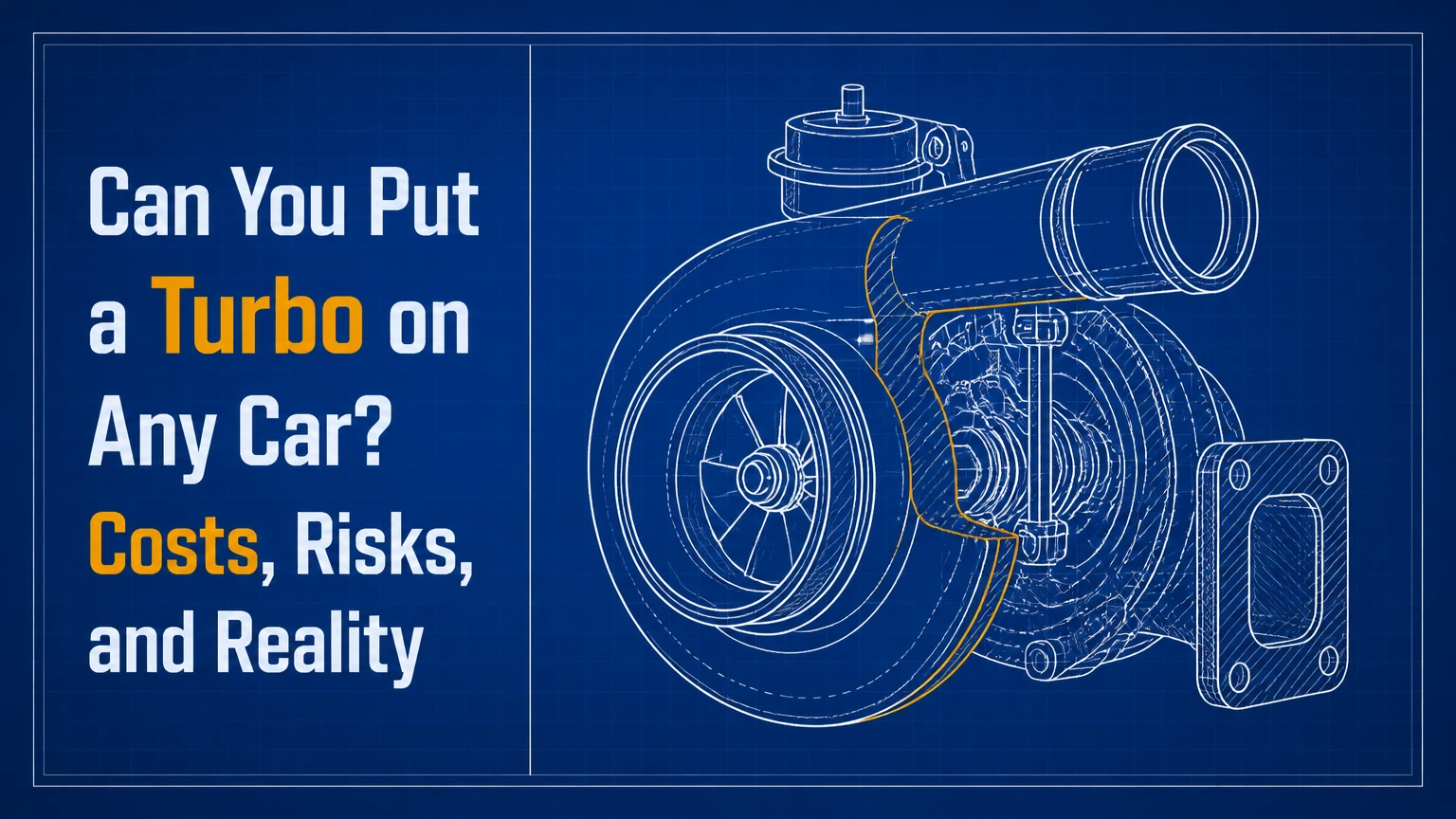
A turbocharger converts exhaust-gas energy into intake-air pressure. Exhaust leaving the engine spins a turbine wheel, a shared shaft transfers that rotation to a compressor wheel, and the compressor forces denser air through the intake system.
The turbine and compressor rotate on one shaft inside a center housing. Garrett Motion describes the turbocharger as a device that uses exhaust energy to compress air entering the engine; the engineering consequence is increased air mass, not simply higher manifold-pressure numbers.
Compression heats air. An intercooler lowers charge temperature, reducing the likelihood of detonation and improving oxygen density. A wastegate controls turbine drive energy by bypassing some exhaust around the turbine when the target boost level is reached.
A blow-off valve or recirculation valve handles pressure trapped between the compressor and a closed throttle. A recirculating valve returns that air to the intake, while an atmospheric blow-off valve vents it. Neither valve substitutes for correct turbo sizing, wastegate control, or ECU calibration.
What parts are required for a turbo retrofit?
A complete retrofit has five connected systems: exhaust energy, compressed air, lubrication and cooling, fuel delivery, and electronic control. Omitting one system can produce oil leakage, detonation, excessive heat, unstable boost, or engine failure.
| System | Required components | Typical retrofit specification |
|---|---|---|
| Exhaust | Turbo manifold, turbine gasket, downpipe, wastegate | 2.5-3.0 inch downpipe for many 4-cylinder builds |
| Charge air | Intercooler, aluminum pipes, couplers, clamps | 2.0-2.5 inch charge piping, pressure-tested |
| Lubrication | Oil feed, restrictor if required, gravity drain, pan fitting | 5/8 inch or larger drain, continuously downhill |
| Fuel | Injectors, pump, fuel-pressure control, filter | Injector headroom of at least 15-20% |
| Management | ECU, MAP sensor, wideband oxygen sensor, tune | Calibration on the intended fuel and boost |
| Heat control | Heat shield, turbo blanket, coolant upgrades | Shield intake, wiring, brake and fuel lines |
The exact parts vary by engine. A water-cooled turbo needs correctly routed coolant lines, while a journal-bearing turbo may need a different oil-feed restriction from a ball-bearing unit. Turbo manufacturers’ instructions take priority over generic kit advice.
How Do You Know if an Engine Can Handle Boost?
An engine is a viable turbo candidate when it has stable oil pressure, even compression, low leak-down, healthy cooling, sufficient fuel capacity, and a calibration strategy that controls knock. A compression test and leak-down test are screening tools, not guarantees of safe high-boost operation.
Before purchasing parts, inspect the engine for:
- Compression variation between cylinders. Exact limits depend on the manufacturer, but a large cylinder-to-cylinder difference is a warning even when the average reading looks acceptable.
- Leak-down results. Air escaping through the intake, exhaust, crankcase, or cooling system identifies different mechanical problems.
- Oil pressure at hot idle and operating speed. Compare readings with the factory service manual.
- Cooling-system condition. A marginal radiator, old hoses, weak water pump, or damaged head gasket becomes a larger risk under sustained boost.
- Knock-control capability. A modern ECU with a functioning knock sensor offers more protection than a fixed ignition system.
- Drivetrain condition. A worn clutch can slip immediately after torque increases.
The stock internals are only one part of the limit. Fuel quality, intake temperature, ignition timing, torque curve, and tuning quality can matter as much as nominal boost pressure.
Is 5-8 PSI safe on every stock engine?
No. The frequently repeated 5-8 psi recommendation is not a universal safety threshold. A stock engine designed for 10 psi from the factory may tolerate modest additional pressure poorly if its pistons, rods, cooling, or ECU were not engineered for it, while a strong low-compression engine may handle a carefully calibrated low-pressure system.
Boost pressure alone does not measure engine stress. A small turbo at 10 psi and a large turbo at 10 psi can deliver different airflow, backpressure, and cylinder filling. Detonation, excessive exhaust temperature, lean operation, and torque spikes cause failures that a boost gauge cannot predict.
A conservative starting point for a stock naturally aspirated engine is often 3-5 psi, followed by data logging and inspection. That is a practitioner starting range, not a guarantee or a manufacturer rating.
What Must Be Changed During Installation?
A turbo conversion requires staged mechanical installation followed by fuel-system verification and ECU calibration. Experienced builders usually spend more time solving heat, oil-drain, sensor, and access problems than physically fastening the turbocharger.
Step 1: Define the power and torque target
Set a wheel-horsepower target, intended fuel, maximum engine speed, and road or track use before selecting a turbo. A 30% power increase has different requirements from a 100% increase because torque, heat rejection, injector size, and drivetrain loading rise with the target.
Step 2: Select the turbo and manifold
Choose a compressor and turbine using the engine’s airflow target, displacement, redline, and desired response. An oversized turbo can produce late boost and poor drivability; an undersized unit can create excessive exhaust backpressure and heat.
Install a cast or tubular manifold with correct flange alignment. Check clearance to the hood, radiator, steering shaft, firewall, air-conditioning lines, and brake components before final welding.
Step 3: Build the exhaust and heat protection
Fit the downpipe with a flexible section, oxygen-sensor provisions, catalytic-converter placement, and adequate clearance. Add heat shielding between the turbine and intake, wiring, fuel rail, brake master cylinder, and cooling hoses.
A turbo blanket can reduce radiant heat, but it cannot repair an incorrectly routed exhaust or insufficient under-hood ventilation. Track cars may need additional oil and coolant temperature monitoring.
Step 4: Install oil and coolant plumbing
Take oil from a suitable pressure source and use the turbo manufacturer’s recommended restrictor. The drain must return above the oil level, remain large enough for unrestricted gravity flow, and avoid sharp upward sections.
Drilling and tapping an oil pan requires removing and cleaning the pan so metal chips cannot enter the engine. Pressurized drain-back systems are possible when gravity routing is impossible, but they add a pump, control, and failure point.
Step 5: Add intercooling and charge pipes
Mount an intercooler where it receives direct airflow without blocking the radiator. Keep charge piping short and secure, then pressure-test the system before tuning.
A wideband oxygen sensor, boost reference, intake-air-temperature sensor, and correctly scaled MAP sensor provide the data required for calibration. The system should not rely on a factory sensor that cannot read the intended pressure range.
Step 6: Upgrade fuel delivery and calibrate the ECU
Size injectors for horsepower, fuel type, duty-cycle margin, and fuel pressure. Install a pump that maintains pressure under load, then verify actual fuel pressure rather than assuming the pump meets its advertised flow.
A professional tuner should configure injector characterization, enrichment, ignition timing, boost control, throttle behavior, knock response, and fail-safes. The vehicle should be tuned on the fuel it will actually use, with a wideband sensor and controlled load testing.
How Much Does It Cost to Turbocharge a Car?
A turbo retrofit typically costs $3,000-$7,000 for a carefully selected DIY build and $6,000-$15,000 or more through a professional shop. Engine rebuilding, custom ECU work, transmission upgrades, emissions equipment, and correction of old-car problems can push the total beyond $20,000.
| Build level | Parts cost | Labor and tuning | Typical total |
|---|---|---|---|
| Basic DIY, used components | $1,500-$3,500 | $500-$2,000 | $2,000-$5,500 |
| Quality vehicle-specific kit | $3,500-$7,000 | $2,000-$5,000 | $5,500-$12,000 |
| Custom street conversion | $4,500-$9,000 | $4,000-$9,000 | $8,500-$18,000 |
| Forged-engine performance build | $8,000-$15,000 | $6,000-$15,000 | $14,000-$30,000+ |
Typical labor ranges vary by region and fabrication burden. A shop charging $120-$200 per hour may need 20-40 hours for a straightforward conversion, while a custom engine-management and exhaust project can require substantially more.
Budget for a 20-30% contingency. Older cars commonly need hoses, belts, sensors, clutch parts, brakes, tires, and cooling repairs once the power increase exposes existing weaknesses.
How long does installation take?
An experienced DIY builder should allow two to six weekends for a documented platform, while a professional shop may need one to three weeks of workshop time. Custom fabrication, unavailable parts, ECU reverse engineering, and emissions inspection can extend the calendar considerably.
A first start is not the finish line. Allow time for leak checks, heat cycling, boost-control verification, conservative dyno sessions, and road data logging.
Is Turbocharging Legal and Insurable?
Turbocharging legality depends on jurisdiction, vehicle age, emissions rules, noise limits, inspection procedures, and insurance policy terms. In the United States, the Environmental Protection Agency regulates tampering with emissions controls, while California’s Air Resources Board applies additional certification requirements.
A turbo conversion may become illegal for public-road use if it removes or relocates a catalytic converter, disables oxygen sensors, defeats evaporative controls, or uses parts without required emissions approval. Some regions permit modifications on older vehicles, but the cutoff year differs.
Contact the local inspection authority and insurer before buying parts. Ask whether the modification needs an emissions certificate, engineering approval, declared-value coverage, or a policy endorsement. A technically successful car can still fail inspection or lose coverage after an undisclosed modification.
Track-only vehicles face different rules, but they still need fire protection, secure fuel plumbing, and event-compliant safety equipment.
Turbocharger or Supercharger, Which Is Better?
A turbocharger usually delivers greater peak power per unit of engine displacement, while a supercharger offers more predictable throttle response and simpler exhaust routing. The better choice depends on packaging, desired response, heat management, available tuning, and whether the car is a street vehicle or competition project.
| Criterion | Turbocharger | Centrifugal supercharger | Positive-displacement supercharger |
|---|---|---|---|
| Power source | Exhaust gas | Crankshaft belt | Crankshaft belt |
| Low-rpm response | Boost builds with exhaust flow | Boost rises with engine speed | Strong low-rpm boost |
| Parasitic loss | Low at cruise, exhaust backpressure under load | Belt-driven loss | Belt-driven loss at all speeds |
| Main installation work | Manifold, downpipe, oil lines, intercooler | Bracket, belt drive, intake | Intake manifold, belt drive, bypass valve |
| Typical heat issue | Turbine and exhaust radiant heat | Charge-air heating | Charge-air heating and belt load |
| Best application | High-output street or track build | Linear power increase | Immediate torque and response |
A turbocharger is not automatically more efficient in a retrofit. Poor turbine sizing, excessive backpressure, and rich calibration can erase fuel-economy gains. A supercharger is not automatically easier either, because bracket alignment, belt control, crankshaft harmonics, and intake-manifold fitment can dominate the project.
What Are the Main Turbocharger Types?
Turbocharger configurations differ in exhaust routing, response, complexity, and operating range. A single turbo suits many four-cylinder conversions, while twin-scroll, parallel-twin, sequential, variable-geometry, and electrically assisted systems solve more specialized packaging or response problems.
| Configuration | Mechanical feature | Common application | Retrofit complexity |
|---|---|---|---|
| Single turbo | One turbine and compressor | Inline-4, inline-6, V6 | Moderate |
| Twin-scroll | Divided turbine inlet | Four-cylinder, inline-6 | Moderate-high |
| Parallel twin | One turbo per cylinder bank | V6, V8 | High |
| Sequential twin | Small and large turbo staged | Selected factory performance engines | Very high |
| VGT | Adjustable turbine vanes | Diesel engines, selected gasoline engines | Very high |
| Electric assist | Motor helps compressor acceleration | Hybrid or advanced OEM systems | Very high |
Twin-scroll systems require a correctly paired exhaust manifold. Installing a twin-scroll turbo on an undivided manifold does not provide the intended pulse separation.
Variable-geometry turbochargers need actuator control, vane calibration, and materials capable of surviving high exhaust temperature. Electric turbo systems require high-voltage or high-current electrical architecture, so they are rarely sensible aftermarket choices.
What Usually Goes Wrong?
The most expensive turbo failures usually begin with an incorrect fuel map, inadequate oil drainage, uncontrolled heat, or an assumption that the factory drivetrain has unused capacity. A turbocharger installation can be mechanically complete and still fail because the engine management system was never calibrated for boosted cylinder pressure.
Common failure modes include:
- Detonation or a melted piston: insufficient fuel, excessive ignition timing, high intake temperature, or low-octane fuel causes abnormal combustion. Stop testing and inspect before adding boost.
- Blue exhaust smoke: a restricted oil drain, excessive crankcase pressure, failed turbo bearing system, or incorrect oil-feed restriction can push oil into the intake or exhaust.
- Slow spool: exhaust leaks before the turbine, an oversized turbo, incorrect cam timing, or a leaking wastegate reduces turbine energy.
- Boost spikes: a sticking wastegate, poor actuator reference, or unsuitable boost controller can raise pressure beyond the tune’s safe range.
- Clutch slip: increased torque exceeds the friction capacity of the clutch. A stronger clutch may require checking flywheel, transmission, and axle condition.
- Coolant overheating: the radiator may lose airflow behind an oversized intercooler, or the engine may reject more heat than the original system can dissipate.
- Compressor surge: pressure reverses toward the compressor when the throttle closes and the system lacks suitable bypass control. The solution is correct valve placement and compressor matching, not simply a louder valve.
Garrett Motion distinguishes a wastegate, which controls turbine flow, from a blow-off or bypass valve, which manages compressor-side pressure. Confusing those components can create unstable boost and turbo damage.
What does turbo smoke or whining mean?
Blue smoke after installation requires immediate diagnosis because it can indicate oil draining failure, crankcase ventilation problems, or turbocharger damage. A high-pitched metallic whine, blade contact, shaft play, or oil contaminated with metal means the vehicle should not be driven until the turbo and lubrication system are inspected.
Check oil level, feed pressure, drain angle, PCV operation, inlet restrictions, and intercooler oil accumulation. A small oil film in charge piping can be normal on some systems, but pooled oil or rapidly increasing smoke is not a normal break-in condition.
Which Approach Makes Sense for Different Owners?
A turbo retrofit makes sense for an experienced enthusiast with a supported platform, a defined power target, workshop access, and money for tuning and repairs. It makes less sense for an owner who needs daily transportation, fixed monthly costs, factory emissions compliance, and predictable resale value.
| Owner situation | Sensible choice | Approximate budget | Main reason |
|---|---|---|---|
| Supported project car | Vehicle-specific turbo kit | $5,500-$12,000 | Existing documentation and parts |
| Daily commuter | Factory-turbo replacement car | Vehicle-dependent | OEM reliability and legal compliance |
| Track-only builder | Custom turbo system | $10,000-$30,000+ | Power takes priority over convenience |
| Carbureted classic owner | Engine-management conversion first | $7,000-$20,000 | Fuel control limits safe boost |
| Hybrid owner | Specialist-approved system | $10,000-$25,000+ | Integrated ECU and emissions complexity |
The most reliable shortcut is often buying a factory-turbo version of the same model or a complete donor vehicle. Factory engineering may include stronger pistons, oil squirters, cooling capacity, transmission calibration, engine mounts, brakes, and emissions certification that are expensive to reproduce individually.
Frequently Asked Questions
Can a diesel car be turbocharged if it was naturally aspirated?
A naturally aspirated diesel can often accept a turbo, but fuel control, compression ratio, exhaust temperature, oil cooling, and injection timing require specialist attention. Diesel engines do not use gasoline-style stoichiometric AFR control, so gasoline tuning advice cannot be transferred directly. The injection pump or diesel ECU must limit fueling until sufficient air is available.
Does a turbocharger reduce fuel economy?
A turbocharger can reduce fuel economy when the driver uses the additional power, because more air supports more fuel consumption. Under light load, engine downsizing and reduced pumping losses can improve efficiency, but an aftermarket conversion rarely delivers factory-level economy without extensive calibration and emissions development.
Can a carbureted engine run a turbo?
A carbureted engine can run a turbo with a blow-through or draw-through system, but fuel pressure regulation, float-bowl reference, enrichment, ignition control, and fuel distribution become difficult. Electronic fuel injection with programmable engine management is generally the safer route for a street conversion.
Do turbo cars need forged pistons and connecting rods?
Forged pistons and rods are not mandatory for every low-boost build. They become appropriate when the power target, cylinder pressure, engine speed, detonation risk, or factory component weakness exceeds the stock parts’ margin. A factory-turbo engine may already contain stronger internals than its naturally aspirated counterpart.
Can a turbo be installed without an intercooler?
A low-boost system can operate without an intercooler in limited conditions, but intake temperatures rise as compressor pressure increases. An intercooler gives the tuner more detonation margin and more repeatable performance, especially in hot weather or during repeated acceleration. Packaging constraints do not remove the need to monitor charge temperature.
Is an engine swap better than adding a turbo?
An engine swap can be better when a factory-turbo engine, transmission, wiring harness, ECU, and brakes are available as a complete donor package. A turbo retrofit is better when the original engine has strong aftermarket support and the installation can retain compliant emissions equipment. Compare total installed cost, not the price of the turbo kit alone.
The Bottom Line
Can you put a turbo on any car? In a physical sense, almost any internal-combustion car can be adapted, but a reliable conversion requires a healthy engine, correctly matched turbocharger, upgraded fuel system, controlled heat, proper oil drainage, drivetrain planning, and professional ECU tuning. For a project car, the conversion can be worthwhile. For a dependable daily driver, a factory-turbo vehicle is usually the safer financial and engineering decision.