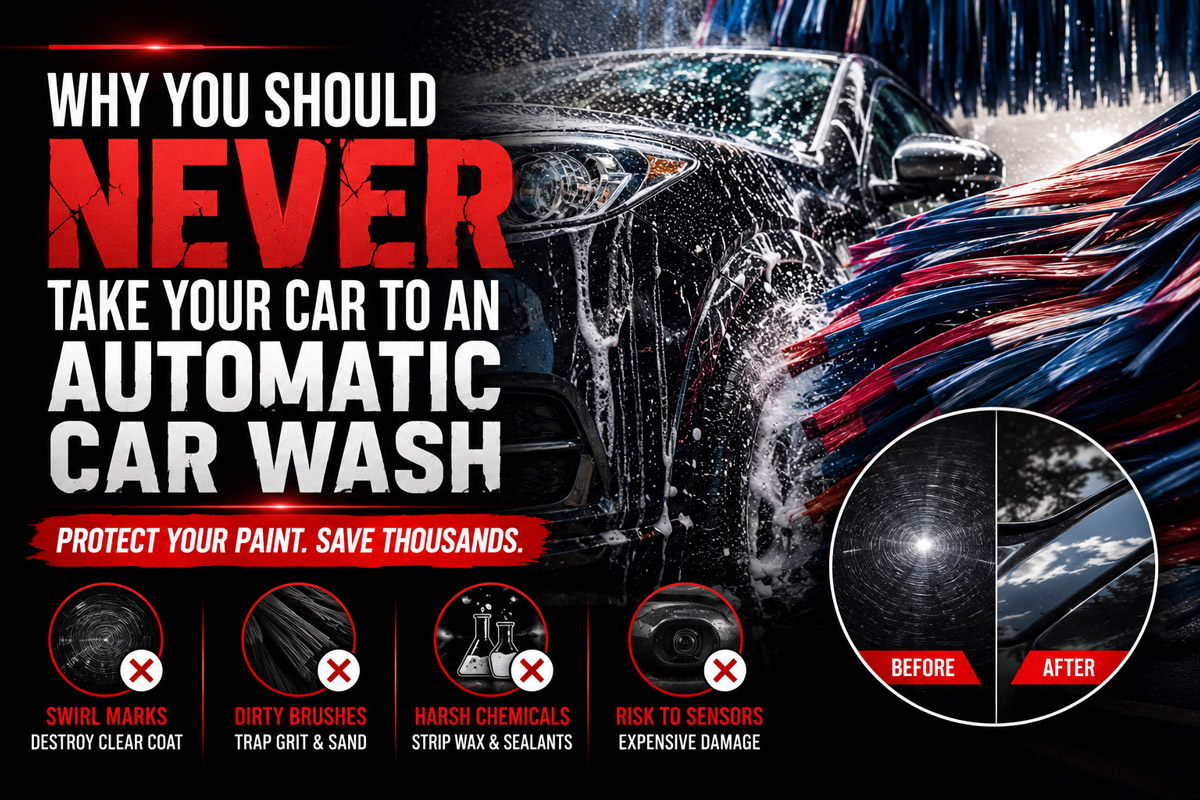
Maintaining a clean vehicle is a point of pride for millions of car owners. Driving through an automated wash tunnel appears to offer the ultimate convenience: quick service, low prices, and a shiny vehicle in under five minutes. However, behind the colorful foam and flashing LED lights lies an unfortunate reality that professional detailers know all too well. Automatic car washes are one of the primary causes of severe paint degradation, clear coat swirl marks, rubber trim discoloration, and expensive structural damage to modern vehicle sensors.
Every time a vehicle passes through an automated tunnel, its protective clear coat is subjected to harsh physical friction, aggressive industrial chemicals, or contaminated recycled water. What seems like an affordable ten dollar wash can easily turn into a multi thousand dollar paint correction bill.
This comprehensive guide breaks down the science of clear coat damage, reveals the hidden traps of both friction and touchless systems, explores mechanical risks to modern automobile technology, and provides safe, practical alternatives to preserve your vehicle finish for years to come.
Automatic Car Wash Paint Damage: The Friction Brush Sandpaper Trap
The most common automated car washes utilize spinning cloth strips, foam fingers, or heavy duty brushes to physically agitate dirt off the vehicle surface. Facilities often market these brushes as soft cloth or gentle foam. While the synthetic material itself may start out soft, the environment inside a high volume commercial wash bay makes gentleness impossible.
The Wet Sandblaster Effect
Consider what enters an automated wash tunnel right before your vehicle. Trucks covered in mud, commuter cars encrusted with road salt, and utility vans caked in abrasive sand all pass through the exact same machinery. Automated commercial facilities rarely stop their operations to clean or sanitize individual brush components between customer cycles.
As a result, fine grit, small rocks, mud, and road debris become embedded deep inside the fibers of the spinning brushes. When these brushes rotate against your paint at high speeds, they act like coarse sandpaper. In the automotive detailing industry, this phenomenon is widely known as the wet sandblaster effect. The spinning brushes slap contaminated fibers against your clear coat thousands of times per minute, grinding abrasive particles directly into the finish.
Swirl Marks and Clear Coat Structure
Modern vehicle paint consists of three primary layers: the primer layer, the base color coat, and the outer clear coat. The clear coat is a thin layer of transparent resin, usually measuring between 35 to 50 microns thick, roughly equivalent to the thickness of a single strand of human hair. This outer resin provides gloss and shields the color coat from ultraviolet rays and oxidation.
When contaminated brushes strike the vehicle, they create micro scratches and circular V shaped grooves in the clear coat. When sunlight strikes a flat, smooth surface, light reflects evenly, producing a deep mirror gloss. However, when sunlight strikes millions of microscopic scratches, the light scatters in all directions. This creates spiderweb patterns commonly referred to as swirl marks. Over time, heavy swirling makes dark paint look dull, hazy, and washed out.
- Brushes accumulate heavy dirt, sand, and mud from hundreds of previous vehicles every day.
- Spinning machinery lacks delicate pressure control, applying uneven force across complex body contours.
- Microscopic scratches accumulate with every visit, slowly stripping away clear coat thickness.
Recycled Water Car Wash Grit Damage and Harsh Chemical Formulas
Many drivers assume that the water and cleaning solutions used in commercial car washes are fresh and pure. However, environmental regulations and high operational costs force commercial car wash facilities to reuse vast quantities of water.
The Contaminated Recycled Water Illusion
To operate economically, commercial washes process thousands of gallons of runoff daily through reclaim filtration tanks. While these filtration systems capture large debris like gravel and heavy sludge, low maintenance facilities often fail to filter out fine suspended solids, dissolved salts, and microscopic mineral particles.
When the wash jets blast water at high pressure onto your car, they are effectively spraying fine silt and salt slurry back onto your paint. This high pressure slurry hits delicate clear coat resin, window seals, and rubber trim, compounding the abrasive damage caused by friction brushes.
Stripped Paint Protection and Harsh pH Levels
To clean a dirty car in under ninety seconds without manual labor, commercial automated washes rely on heavy duty chemical detergents rather than gentle automotive shampoos.
- Acidic Pre Soaks: Used to break down organic traffic film and road salt, often featuring aggressive chemical compounds with a pH scale range of 2 to 3.
- Alkaline Detergents: High alkaline soaps with a pH level of 11 to 13 are used to cut through grease and oil road grime rapidly.
These extreme chemical formulations are incredibly harsh on protective finishes. A single pass through a commercial automated tunnel can completely strip away quality Carnauba wax, polymer paint sealants, and spray ceramic coatings. Repeated exposure to extreme pH levels weakens the hydrophobic properties of installed ceramic coatings, leading to premature coating failure and oxidized paint finish.
Touchless Car Wash Pros and Cons: Why Brushless Isn’t Completely Safe
Recognizing the paint damage caused by friction brushes, many car owners switch to touchless car washes. Touchless systems use high pressure water jets and chemical agents without physical brushes or cloth strips touching the car. While touchless washes eliminate the risk of brush induced swirl marks, they introduce severe secondary risks.
Extreme Chemical Concentrations and Trim Damage
Because touchless systems cannot physically scrub dirt off the paint, they must rely entirely on stronger chemical concentrations to break down stubborn traffic film.
These hyper aggressive chemical solutions pose a significant risk to exterior materials other than clear coat paint. Plastic door pillar trim, anodized aluminum roof rails, and rubber window seals are susceptible to chemical burn. Touchless wash chemical buildup frequently causes dark plastic trim to fade, chalk, or turn grey. On electric vehicles and luxury cars with sensitive trim coatings, touchless washes are known to cause permanent rainbow pattern discoloration across exterior window trim.
Persistent Road Film and Water Spot Etching
Touchless washes often fail to completely clean a vehicle. A fine, invisible layer known as road film, composed of oily soot, tire rubber dust, and exhaust particles, bonds tightly to automotive clear coat. High pressure water alone cannot break this bond without mechanical agitation.
Furthermore, the automated blow dryers inside touchless tunnels fail to evaporate all water completely. Drops of recycled, mineral heavy water remain on the warm paint surface. As these droplets evaporate in the sun, calcium and magnesium minerals etch into the clear coat, forming stubborn water spots that require machine polishing to remove.
Automated Car Wash Hidden Risks: Mechanical Damage to Modern Tech
Beyond paint finish degradation, automated car wash tunnels create physical risks for modern automobile components and advanced safety technology.
Damage to Sensors, Backup Cameras, and Driver Assistance Systems
Modern vehicles are equipped with Advanced Driver Assistance Systems (ADAS). These features rely on delicate radar sensors, ultrasonic parking sensors, and high definition cameras integrated into front grilles, side mirrors, and bumper covers.
- Misalignment of Radar Sensors: The intense force of high pressure water sprays and rotating brushes can shift or misalign sensitive bumper radar modules, triggering dashboard error codes.
- Cracking Camera Lenses: Dirt filled brushes spinning at high speeds can scratch or crack delicate glass and plastic lenses on surround view cameras.
- Water Ingress: High pressure water jets forced against sensor seals can cause moisture intrusion, damaging internal electronic circuitry.
Component Snagging and Wheel Gouging
Conveyor tracks and mechanical brushes do not accommodate custom wheel sizes, low profile tires, or exterior accessories.
- Conveyor Guide Rail Scuffs: Metal guide tracks inside automated tunnels are notorious for gouging low profile alloy wheels, causing costly wheel curb rash.
- Tearing Off Accessories: High speed cloth strips easily snag rear windshield wipers, aftermarket spoilers, roof rack crossbars, and flexible radio antennas.
- Side Mirror Dislodgement: Heavy friction rollers apply strong lateral forces that can snap power folding mirror gear mechanisms inside side mirror assemblies.
Financial Comparison: Cheap Car Wash vs Paint Correction Cost
While a ten dollar automated tunnel wash appears budget friendly, the financial consequences accumulate over time. Restoring paint that has suffered years of automatic car wash damage requires professional paint correction.
Paint correction is a labor intensive process where a skilled detailer uses dual action machine polishers, microfiber pads, and diminishing abrasive compounds to shave down microscopic layers of clear coat until the surface is level and smooth again.
Cost Comparison: Automatic Washes vs Paint Correction
As highlighted in the chart above, driving through automated washes for a year might cost three hundred dollars in tunnel fees. However, repairing the resulting micro scratches requires an expensive professional multi step paint correction, costing anywhere from six hundred to over fifteen hundred dollars depending on paint hardness and severity.
How to Wash Car Without Scratching Paint: Safe Alternatives
To preserve vehicle resale value, maintain maximum gloss, and protect clear coat resin, vehicle owners should adopt safe maintenance techniques.
The Two Bucket Method Car Wash Guide
The gold standard for safe automotive washing is the two bucket hand wash method. This system minimizes physical friction and prevents trapped dirt from recontacting the paint finish.
Equipment Needed:
- Two clean five gallon buckets
- Two Grit Guard insert grids (placed at the bottom of each bucket)
- Premium pH neutral automotive shampoo
- Plush microfiber wash mitt (avoid sponges)
- Ultra soft microfiber drying towels or a leaf blower
Step by Step Process:
- Setup Buckets: Fill Bucket 1 with water and the recommended dose of pH neutral car soap. Fill Bucket 2 with clean water only. Place a Grit Guard at the bottom of both buckets.
- Initial Pre Rinse: Thoroughly rinse the vehicle with a pressure washer or garden hose to remove loose dirt and heavy grit before touching the paint.
- Wash Top to Bottom: Soak your microfiber wash mitt in Bucket 1. Gently glide the mitt across paint panels in straight, overlapping lines. Avoid wiping in circular motions.
- Rinse the Mitt Frequently: After cleaning a single panel, submerge the dirty wash mitt into Bucket 2. Agitate the mitt against the Grit Guard grid at the bottom to release trapped dirt particles.
- Dip Back into Soap: Wring out excess rinse water from the mitt, then submerge it back into Bucket 1 for fresh, clean suds. Repeat this process until the car is completely clean.
- Safe Drying: Dry the vehicle using clean plush microfiber drying towels or a dedicated air blower to avoid contact friction altogether.
Safe Usage of DIY Coin Operated Wash Bays
If you do not have access to a driveway or running water at home, self serve coin operated wash bays offer a suitable alternative if used carefully.
- Use High Pressure Spray Wands: Use the pressure wand for rinsing, pre soaking, and final rinsing. High pressure water safely dislodges heavy dirt without physical contact.
- NEVER Use the Provided Foaming Scrub Brush: The foaming brush at coin operated bays is severely contaminated. Previous users frequently use these brushes to scrub muddy off road tires, truck beds, and engine bays. Using this brush on your clear coat will instantly cause deep swirl marks.
- Bring Your Own Microfiber Mitt: Bring your own wash mitt and bucket to the self serve bay for manual agitation.
Professional Mobile Detailing Maintenance
For vehicle owners who lack time to perform hand washes, hiring a certified professional detailer is the safest option. Professional detailers utilize soft water filtration, clean microfiber towels for every panel, pH balanced chemicals, and proper hand washing techniques to keep your paint in pristine condition.
Conclusion: Protecting Your Vehicle Investment
While automatic car washes offer fast convenience, the hidden physical, chemical, and mechanical risks far outweigh the time saved. Spinning friction brushes act like high grit sandpaper, stripping clear coat thickness and filling paint with unsightly swirl marks. Meanwhile, touchless automated washes rely on aggressive acid pre soaks and high alkaline detergents that strip protective wax coatings, etch glass, and discolor exterior trim.
By adopting safe cleaning practices like the two bucket method, using quality pH neutral shampoos, and utilizing clean microfiber towels, you protect your vehicle clear coat, maintain maximum gloss, and preserve high resale value.
Next Step: Upgrade Your Car Care Routine Today
Ready to give your car the safe, professional care it deserves?
Explore our complete range of premium detailing guides, high quality microfiber accessories, and pH neutral car soaps designed to protect your vehicle paint finish. Contact our expert detailing team today for a personalized car care consultation or download our free Ultimate DIY Car Washing Checklist to get started at home!