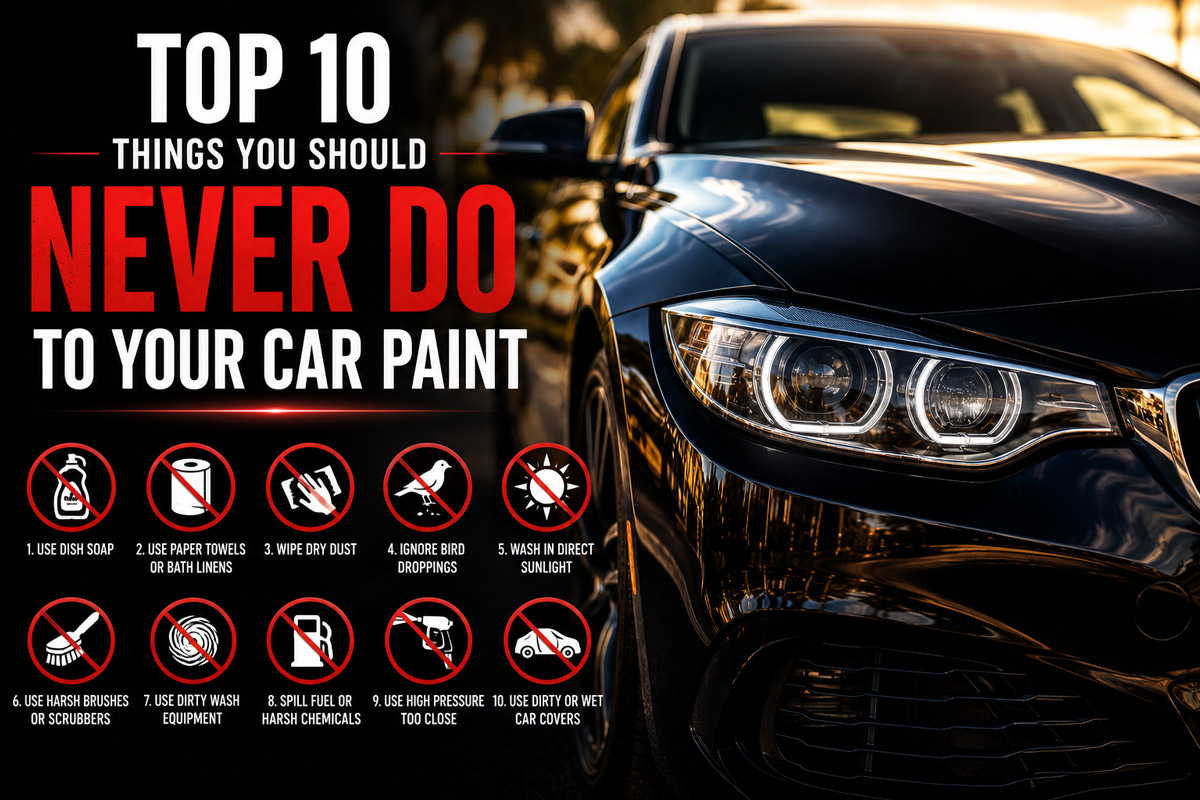
Automotive paint is far more than a decorative layer of color. It is an engineered, multilayer shield designed to protect structural sheet metal from corrosion, oxidation, and environmental degradation. Modern factory paint systems consist of three primary layers: a corrosion resistant primer, a color base coat, and a protective clear coat. Among these, the clear coat layer measures a microscopic thirty to fifty microns in thickness, roughly equivalent to half the thickness of a single human hair.
Despite its resilience against everyday driving conditions, your vehicle clear coat is extremely vulnerable to mechanical friction, thermal stress, and chemical erosion. Many vehicle owners unknowingly commit daily care mistakes that degrade this protective boundary, leading to premature fading, severe etching, and costly clear coat failure.
To help you preserve your vehicle finish and maintain maximum resale value, this comprehensive guide explores the top ten destructive practices you must avoid, the chemical and physical processes behind paint damage, and proven solutions for long term vehicle protection.
Understanding Automotive Paint Layers and Vulnerabilities
Before examining specific bad habits, it is essential to visualize how thin and delicate your car paint truly is. The graphic below highlights the structure of modern automotive paint systems and where common damage occurs.
Automotive Paint Layer Thickness and Damage Profile
Factory Automotive Paint Layer Breakdown
Cross-section measurement in microns and structural vulnerability profiles
Primary shield against UV rays, acid rain, bird droppings, and swirl marks.
Contains color pigments, metallic flakes, and pearl effects. Provides visual depth.
Levels substrate unevenness, aids paint adhesion, and acts as rust inhibitor.
Vehicle body panel structure. Exposure triggers immediate atmospheric oxidation and rust.
1. Washing Your Car With Household Dish Soap
One of the most frequent car detailing mistakes to avoid is using liquid household dish soap to clean your vehicle exterior. Dish soaps are specially formulated to break down heavy cooking grease, food oils, and stubborn organic residues from kitchenware.
The Chemistry of Dish Soap Damage
Dish soap contains aggressive surfactants with high alkalinity. When applied to automotive paint, these chemicals easily dissolve protective car wax layers, synthetic sealants, and soft sacrificial coatings.
Long Term Consequences
Without a protective layer of wax or sealant, your clear coat becomes directly exposed to environmental pollutants, industrial fallout, and solar ultraviolet radiation. Regular dish soap usage strips natural oils from clear coat resins, leaving the surface dry, oxidized, and vulnerable to premature clear coat failure prevention issues.
The Professional Solution
Always clean your vehicle using a dedicated pH balanced car wash shampoo. Quality auto shampoos provide lubricity to prevent scratching while lifting surface dirt without stripping existing protective coatings.
2. Cleaning or Drying With Paper Towels and Bath Linens
When drying a wet car panel, grabbing a household bath towel, an old cotton shirt, or kitchen paper towels seems convenient. However, this simple practice causes instant surface marring.
Mechanical Friction and Fiber Coarseness
Kitchen paper towels consist of pressed wood pulp particles, while standard household towels contain coarse cotton loops and rough stitching. When wiped across smooth paint, these fibers act like ultra fine sandpaper, carving thousands of micro scratches into your glossy surface.
Microfiber Technology vs Household Fabrics
Professional automotive detailing relies exclusively on plush microfiber towels. High quality microfiber features a synthetic blend of polyester and polyamide woven into millions of split fibers per square inch. This unique structure cradles abrasive dirt particles deep within its pile, keeping debris away from the delicate paint surface.
Drying Material Paint Safety Matrix
Evaluating common drying materials by fiber composition and scratch vulnerability
| Drying Material | Material Composition | Paint Scratch Risk | Recommended Use |
|---|---|---|---|
| Paper Towels | Coarse wood pulp fibers | Extremely High | Never on Paint |
| Bath Towels | Heavy loop cotton threads | High Risk | Household Use Only |
| Old T-Shirts | Worn jersey cotton blend | Moderate to High | Shop Rags Only |
| Plush Microfiber (70/30) | Split polyester & polyamide | Near Zero | Safe for All Paint |
3. Wiping Off Dust and Light Dirt Without Liquid Lubrication
Many vehicle owners attempt to remove light morning dust or road film by dry wiping their car body panels with a dry rag. Similarly, writing messages on a dirty window or dusty trunk lid causes immediate finish damage.
Understanding Dust Abrasiveness
Road dust contains high concentrations of microscopic silica particles, pulverized quartz, and sharp mineral debris. Dragging a dry towel across dusty paint forces these hard mineral grains directly into the clear coat, grinding them across the surface under hand pressure.
How to Safely Clean Light Dust
Never allow a dry towel to contact dusty bodywork. To remove light dust safely, use a quick detailer spray or a high lubrication rinseless wash solution. Spritzing the panel thoroughly encapsulates dust particles in lubricant, allowing a soft microfiber towel to wipe them away safely without scratching.
4. Ignoring Acidic Bird Droppings and Bug Splatters
Bird droppings and bug splatters are among the most destructive chemical compounds your car encounters during daily driving. Leaving these contaminants to dry on your paint causes permanent physical damage within hours.
Thermal Etching Mechanism of Environmental Acids
How solar heat and biological contaminants combine to permanently damage clear coats
Direct Sunlight & High Heat
Radiant heat rapidly elevates body panel temperatures, increasing chemical reactivity.
Clear Coat Thermal Expansion
The outer clear coat matrix warms, expands, and softens, making it permeable to foreign compounds.
Deep Acid Penetration
Uric acid and digestive enzymes dissolve into the softened clear coat structure.
Cooling & Contraction Trapping
As the surface cools, the clear coat contracts, locking the chemical deformation into the paint.
Permanent Chemical Etching & Crater Formation
Irreversible structural pitting that requires abrasive machine compounding or wet sanding to level.
The Chemical Mechanics of Etching
Bird droppings have an aggressive acidic profile with pH levels ranging from 3.0 to 4.5 due to high uric acid concentration. Bug splatter contains harsh organic enzymes that break down as insects decompose.
When your car sits under direct sunlight, thermal heat causes clear coat paint resin to expand and soften. As the acid sits on the warm paint, it chemically burns into the clear coat. When the panel cools at night, the clear coat contracts, trapping the etched pattern permanently into the paint structure.
Bird Dropping Paint Etch Repair Strategy
- Act quickly as soon as you spot a dropping or bug splatter.
- Saturate the area with quick detail spray or a wet water soaked microfiber towel for two minutes to soften the residue.
- Gently lift the contaminant away without rubbing or scrubbing hard.
- If chemical etching has already occurred, light machine polishing using a dual action polisher is required to level the damaged clear coat.
5. Scraping Off Hardened Tree Sap and Road Tar
Parking under pine trees or driving through active highway construction zones often coats body panels with sticky tree sap and black road asphalt tar. Trying to remove these bonded contaminants using fingernails, credit cards, or scrubbing sponges will rip paint right off the primer.
Polymer Bonding of Tree Sap
Pine sap contains natural terpene hydrocarbons that bond aggressively to clear coat resin as the sap hardens under heat. Road tar contains petroleum solvents and heavy mineral oil distillates that fuse to warm vehicle rocker panels.
Safe Sap and Tar Removal Methods
Do not use mechanical force or kitchen scrub sponges to remove sap. Instead, dissolve the chemical bonds using safe solvents:
- Apply isopropyl alcohol (70 percent concentration) or a dedicated chemical bug and tar remover directly onto a soft microfiber towel.
- Hold the saturated towel against the sap spot for thirty seconds to allow the solvent to soften the hardened resin.
- Gently wipe the dissolved residue off the panel without applying heavy pressure.
- Apply a protective layer of spray wax over the cleaned spot, as solvents temporarily remove wax protection.
6. Allowing Gasoline and Brake Fluid Spills to Sit on Panels
DIY garage work and hasty gas station fill ups often lead to accidental chemical spills on surrounding bodywork. Failing to flush these volatile fluids immediately leads to total paint destruction.
Gasoline Fuel Damage
Fuel nozzles frequently drip gasoline onto the paint panel directly below the fuel cap door. Gasoline contains aromatic hydrocarbons that strip protective wax instantantly and leave dull, yellowish stains on white or light colored clear coats.
The Lethal Effect of Brake Fluid
Brake fluid, particularly DOT 3 and DOT 4 glycol ether formulations, acts as a aggressive commercial paint stripper. If brake fluid contacts your vehicle fender, it penetrates the clear coat within seconds, causing the underlying base paint layer to bubble, lift, wrinkle, and completely peel away to raw metal.
Emergency Response Steps
If chemical spills occur, instantly drench the area with massive amounts of clean water to dilute the chemical concentration. Wash the panel immediately with pH balanced car shampoo and reapply wax or sealant protection.
7. Washing and Waxing Your Car in Direct Noon Sunlight
Working on your vehicle under direct sunlight might seem like ideal weekend weather, but intense solar heat makes safe detailing virtually impossible.
Hard Water Spot Calcification
Tap water contains dissolved minerals, predominantly calcium carbonate and magnesium. When you wash a hot car panel under direct sunlight, water evaporates rapidly, leaving concentrated mineral rings behind. These dried minerals etch chemically into the hot clear coat, creating stubborn water spots that cannot be removed by simple washing.
Wax Curing Complications
Automotive paste wax applied to scorching hot metal panels cures almost instantly into a hard, uneven crust. Buffing off sun baked wax requires extreme elbow grease and heavy pressure, which causes severe microfiber toweling scratches across your panels.
Best Washing Practices
Always detail your vehicle in full shade, inside a garage, or during cool early morning and late evening hours when paint panels feel cool to the touch.
8. Washing and Buffing Paint in Circular Motions
For decades, popular culture encouraged car owners to apply wax and clean panels in wide circular patterns. Professional detailers now recognize circular scrubbing as a primary cause of visual paint defects.
Light Reflection & Scratch Geometry Comparison
How surface defect orientation dictates light scattering and visibility
Circular Swirl Scratches
(Visible from All Angles)Linear Micro-Scratches
(Visible from Specific Angle)The Optics of Swirl Marks
When a wash mitt or microfiber towel picks up a small piece of gritty dirt, moving the cloth in circles drags that abrasive particle in 360 degree concentric loops. Under direct sunlight or street lights, these circular scratches reflect light from every viewing angle, creating unsightly spider web swirl marks.
Linear Washing Technique
Always wash, wipe, and dry vehicle panels using straight, linear motion following the natural airflow lines of the bodywork. If a linear scratch occurs, it reflects light from only one specific angle, making it virtually invisible under normal daylight conditions.
9. Reusing a Clay Bar That Has Touched the Ground
Using a detailing clay bar is an effective method to remove embedded industrial fallout, brake dust, and tree sap from clear coats before polishing. However, dropped clay must be handled with strict safety discipline.
Detailing Clay Contamination Dynamics
Detailing clay is engineered to be sticky and pliable so it can pull microscopic contaminants out of clear coat pores. If a piece of clay slips from your hand and contacts the garage floor or driveway, its sticky surface instantly collects heavy sand grains, dirt gravel, and sharp floor debris.
The Golden Clay Bar Safety Rule
Never attempt to fold, knead, or rinse dropped clay. Kneading dropped clay simply buries sharp gravel particles inside the clay matrix. Reapplying that contaminated clay to your car acts like rubbing 80 grit sandpaper across your glossy paint.
If your clay bar touches the floor, throw it into the trash immediately and grab a fresh, clean clay bar or synthetic clay towel segment.
10. Permitting Winter Road Salt and Irrigation Minerals to Dry
Environmental contaminants continuously attack vehicle body panels, but deicing road salt and residential lawn sprinklers present severe long term corrosion risks.
Road Salt Corrosion Chemistry
Winter road salt relies on sodium chloride, calcium chloride, and magnesium chloride. These salts act as powerful electrolytes that drastically accelerate electrochemical metal oxidation. When salt slush bakes onto lower rocker panels and chassis components, rust forms rapidly beneath compromised paint layers.
Lawn Sprinkler Mineral Etching
Lawn irrigation systems often utilize untreated well water high in iron, calcium, and mineral deposits. Sprinklers spraying across parked cars leave heavy mineral spots that bake under solar heat, etching deep craters into the clear coat structure.
Complete Paint Hazards and Solutions Matrix
To help you protect your vehicle finish, the table below provides a quick reference guide comparing common paint hazards, their underlying damage mechanisms, overall risk levels, and recommended solutions.
Paint Damage & Hazard Corrective Matrix
Evaluating common paint threats, damage mechanics, and safe removal protocols
| Paint Hazard | Damage Mechanism | Severity Level | Safe Corrective Action |
|---|---|---|---|
| Dish Soap Washing | Strips protective wax and sealant barriers | Moderate | Use pH-balanced car wash soap |
| Paper Towel Drying | Coarse wood fiber scratching | Moderate | Dry with plush microfiber towels |
| Bird Droppings | Uric acid heat etching into clear coat | Critical | Softened removal with quick detailer |
| Brake Fluid Spills | Chemical paint stripping and peeling | Extreme | Instant flooding with clean water |
| Circular Washing | Concentric 360-degree swirl marks | Moderate | Clean using linear straight lines |
| Dropped Clay Bar | Grit entrapment clear coat gouging | Severe | Dispose of dropped clay immediately |
| Winter Road Salt | Electrochemical metal rusting | Severe | Frequent undercarriage rinses |
Modern Paint Protection Options: Wax vs Sealants vs Ceramic Coatings
Avoiding harmful habits is the first half of maintaining pristine automotive paint. The second half involves applying a high quality protective layer over your clear coat. Below is an overview of popular protective solutions.
Paint Protection Technology Evolution & Durability
Comparing chemical mechanisms, lifespan, and surface bond structures
Carnauba Paste Wax
Organic ProtectionNatural organic wax layer. Delivers warm gloss but melts under engine heat and solar radiation.
Synthetic Paint Sealant
Polymer CrosslinkingEngineered synthetic polymers that crosslink over clear coat for enhanced UV and detergent resistance.
Nano Ceramic Coating
Covalent SiO₂ MatrixSilicon dioxide nano-particles form a permanent chemical bond, creating a hydrophobic glass-like barrier.
1. Traditional Carnauba Wax
Carnauba paste wax delivers a warm, deep gloss enhancement. Derived from Brazilian palm leaves, carnauba forms a sacrificial hydrophobic layer over clear coat. However, carnauba melts under high solar heat and breaks down within four to eight weeks, requiring frequent reapplication.
2. Synthetic Polymer Sealants
Synthetic paint sealants utilize crosslinking polymer chains that bond tightly to automotive paint. Sealants offer superior heat tolerance and chemical resistance compared to natural wax, providing reliable protection for four to six months.
3. Ceramic Coatings (Silicon Dioxide)
Ceramic coatings represent advanced nano chemical paint protection. Utilizing silicon dioxide (SiO2) or silicon carbide (SiC), liquid ceramic coatings cure into a hard, hydrophobic glass matrix over clear coat panels. Ceramic coatings protect against chemical bird dropping etching, oxidation, and road grime for two to five years while making routine washing effortless.
4. Paint Protection Film (PPF)
For maximum physical impact protection, paint protection film (PPF) is an ultra tough polyurethane layer installed over high impact areas such as front bumpers, hoods, and side mirrors. PPF absorbs flying rock chips, road gravel strikes, and deep scratches while featuring self healing thermal properties.
Conclusion: Preserving Your Vehicle Finish for the Long Haul
Your vehicle clear coat is a thin, sophisticated shield that requires mindful care. By eliminating destructive detailing practices such as dish soap washing, dry wiping, circular scrubbing, and ignoring acidic bird droppings, you can preserve your car paint in showroom condition for years. Combined with safe washing techniques, high quality microfiber towels, and modern ceramic protection, your vehicle finish will maintain high gloss reflection and strong resale value.
Take the Next Step in Vehicle Protection
Ready to elevate your auto care routine and protect your car paint from permanent damage? Download our free comprehensive vehicle detailing checklist or speak with our automotive protection specialists today to schedule a professional paint inspection and ceramic coating consultation. Protect your investment and enjoy a flawless drive!