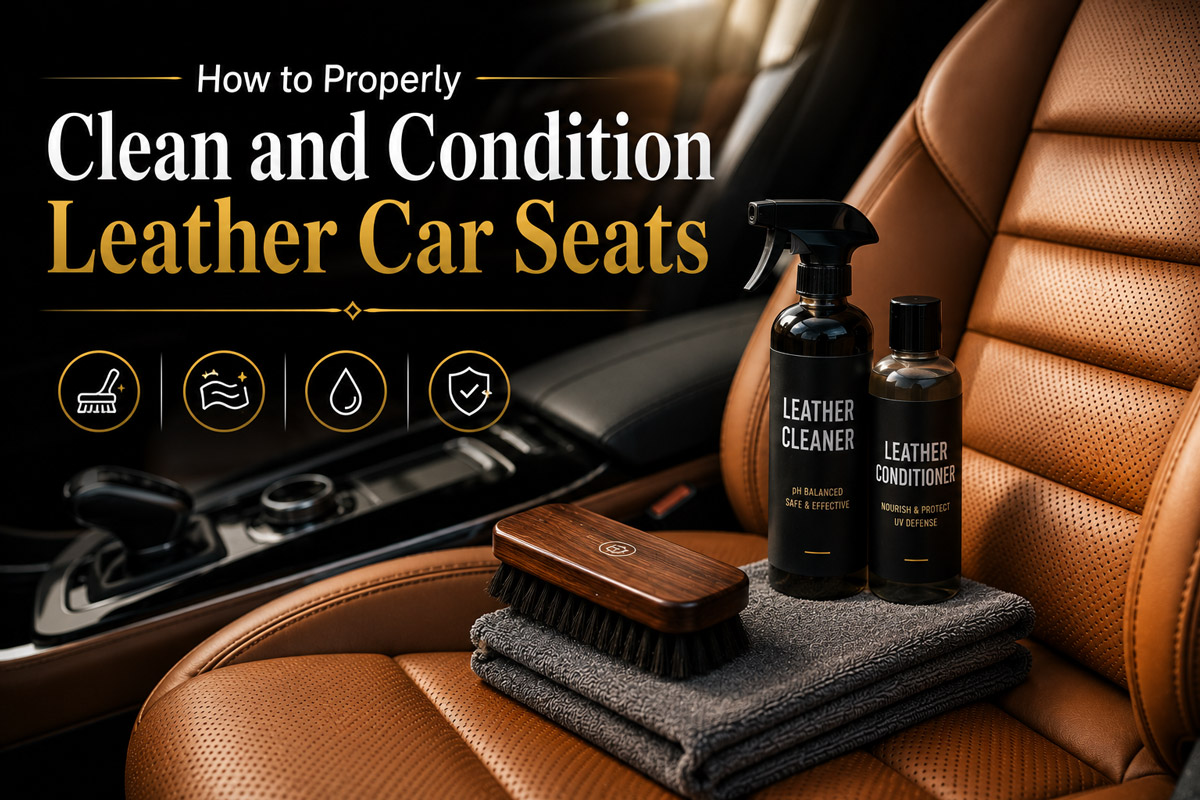
Properly cleaning and conditioning leather car seats requires vacuuming all debris, scrubbing the surface with a pH-balanced leather cleaner using a soft horsehair brush, and wiping away the remaining residue. After the seats air dry, apply a water-based leather conditioner, allow it to cure for 20 minutes, and buff off the excess.
At a Glance
- Always use pH-balanced (7.0–7.5) cleaners to protect the factory clear coat on automotive leather.
- Healthy, clean automotive leather features a matte finish; shiny leather indicates dirt or excessive product buildup.
- Water-based leather conditioners must cure for 20 to 30 minutes before final buffing to penetrate the hide effectively.
- Never spray liquid cleaners directly onto perforated seats to prevent liquid from rotting the foam underneath.
- Synthetic and vegan leathers require specialized UV protectants rather than traditional penetrating leather conditioners.
How often should you clean and condition leather car seats?
Vehicle owners should clean and condition leather car seats every three to six months for standard daily driving. Maintaining this quarterly schedule prevents body oils, dirt, and UV rays from degrading the protective topcoat applied at the factory.
High-traffic vehicles, convertibles exposed to direct sunlight, or cars parked outdoors in hot climates require maintenance every two months. Light-colored interiors do not strictly need more frequent conditioning than dark interiors, but they require monthly wipe-downs to prevent permanent dye transfer from clothing. Regular maintenance keeps the leather fibers hydrated and flexible, stopping the irreversible shrinkage that causes the surface material to split and crack.
What equipment do you need to clean automotive leather?
Properly cleaning and conditioning automotive leather requires a specific set of non-abrasive tools and pH-balanced chemicals. Using improper equipment permanently scratches the leather’s topcoat or strips its protective oils.
Leather Care Tools & Products Specification
| Tool / Product | Purpose | Specification |
|---|---|---|
| Vacuum Attachment | Removes abrasive debris | Soft bristle brush (avoid hard plastic tips) |
| Leather Cleaner | Lifts dirt and body oils | pH-balanced between 7.0 and 7.5 |
| Scrubbing Tool | Agitates dirt out of grain | Genuine horsehair brush |
| Towels | Wipes away residue | Edgeless microfiber cloths |
| Conditioner | Rehydrates leather fibers | Water-based, high-grade liquid or cream |
What is the correct way to wash leather car seats?
- Vacuum the interior: Use a soft brush attachment to remove abrasive dirt from the seams and creases. This prevents loose debris from scratching the leather during the scrubbing phase.
- Apply the cleaner: Spray a pH-balanced leather cleaner directly onto a microfiber cloth or a horsehair brush.
- Agitate the leather: Scrub the seat gently using small, overlapping circular motions. Allow the foaming action to lift dirt out of the leather grain.
- Wipe away residue: Immediately wipe the treated section with a clean, damp microfiber cloth to remove the suspended dirt and remaining cleaner.
- Air dry the seats: Allow the automotive leather to air dry naturally for 10 to 15 minutes before attempting to apply any conditioning products.
How do you apply and cure leather conditioner?
- Dispense the product: Apply a quarter-sized drop of a high-grade, water-based leather conditioner directly onto a clean microfiber applicator pad.
- Massage into the leather: Rub the conditioner into the seat using overlapping circular motions, working section by section to ensure even coverage.
- Allow the conditioner to cure: Let the product sit on the leather surface for 20 to 30 minutes. This dwell time allows the hydrating ingredients to penetrate the protective clear coat and reach the leather fibers.
- Buff the surface: Wipe the seats thoroughly with a clean, dry microfiber cloth. This final buffing step removes any excess product that failed to absorb.
What happens if you apply too much leather conditioner?
Applying too much leather conditioner leaves a greasy, slippery film on the seats that actively attracts and traps dust and dirt. When excess product sits on the surface instead of absorbing, it clogs the microscopic pores of the leather and degrades the factory polyurethane clear coat.
Over-conditioning also softens the underlying foam cushions, leading to premature sagging in the seat bolsters. If the seats feel slick or look artificially glossy after the curing period, the owner applied too much product. To fix over-conditioning, wipe the seats down with a damp microfiber cloth to strip the excess surface oils.
How do you clean perforated leather seats without clogging them?
Clean perforated leather seats by applying the leather cleaner strictly to the bristles of a horsehair brush rather than spraying the liquid directly onto the seat surface. Keep the brush bristles damp, not dripping wet.
Spraying liquids directly onto heated or cooled seats forces the cleaner down into the ventilation holes. Trapped moisture inside these perforations rots the foam cushioning beneath the leather and shorts out electrical heating elements. If the ventilation holes become severely clogged with old product or dirt, auto detailers must use dry ice cleaning to blast the perforations clear without introducing liquid moisture.
How do you test if car leather is aniline or pigmented?
Place a single drop of water on an inconspicuous section of the car seat to determine if the leather is aniline or pigmented.
If the water droplet sits on the surface and beads up, the car features standard pigmented leather protected by a polyurethane topcoat. If the water droplet immediately sinks into the material and creates a dark spot, the car features raw, uncoated aniline leather. Aniline leather frequently appears in ultra-luxury vehicles and requires specialized, chemical-free aniline creams. Standard automotive cleaners and conditioners will permanently stain raw aniline hides.
Can you use leather conditioner on vegan or synthetic seats?
No, traditional leather conditioners cannot penetrate the polyurethane (PU) or polyvinyl chloride (PVC) plastics used to manufacture vegan and synthetic leather seats. Applying standard leather conditioner to synthetic materials like Tesla’s white interior or BMW SensaTec leaves a greasy film that ruins the seat’s finish.
Synthetic auto interiors possess no natural fibers to hydrate. Therefore, owners should clean vegan leather using only mild soap and water or a dedicated synthetic interior cleaner. To protect synthetic seats from cracking, apply a UV blocker specifically designed for automotive vinyl and plastics rather than a penetrating leather lotion.
How do you remove blue jeans dye transfer from light leather?
Remove indigo denim dye transfer immediately using a dedicated leather dye remover or a cotton swab lightly dampened with 70% isopropyl alcohol. Standard leather cleaners will not budge cured dye transfer on light-colored seats.
When jeans rub against warm car seats, the friction opens the leather’s pores and deposits blue dye directly into the clear coat. While isopropyl alcohol dissolves the dye effectively, it also strips the factory protective topcoat. After removing a denim stain with alcohol or harsh solvents, owners must immediately reapply a leather sealant or ceramic coating to protect the raw spot.
How do you soften sun-baked, hardened leather car seats?
Soften cardboard-like, sun-baked leather by applying a heavy-duty collagen rejuvenator, wrapping the seat in plastic wrap, and letting the vehicle sit in the warm sun overnight. Standard leather conditioners sit uselessly on top of severely hardened seats.
Extreme sun exposure shrinks the protein fibers inside the leather hide, causing it to feel stiff and brittle. The heat activation from a warm car opens the pores of the clear coat, while the plastic wrap creates a greenhouse effect that forces the thick collagen cream deep into the shrunken fibers. This process restores flexibility to neglected seats.
How do you safely remove mold from car interiors?
Eradicate mold and mildew from leather car seats by lightly misting the affected area with a 1:1 mixture of isopropyl alcohol and water, then wiping it away immediately.
Wiping live mold with standard interior cleaners merely spreads the active spores deeper into the seat seams. The alcohol mixture kills the mold on contact without oversaturating the seat cushion. After killing and removing the visible mold, park the vehicle in direct, warm sunlight with the windows slightly cracked. The natural ultraviolet rays will dry out the interior and kill any remaining airborne spores.
Can you use dish soap or baby wipes on auto leather?
Vehicle owners should never use household dish soaps or baby wipes to clean automotive leather.
Dish soaps possess high pH levels (typically 8 to 9) formulated to cut heavy grease. When applied to car seats, these alkaline soaps strip the essential natural oils from the hide, causing the leather to shrink and crack rapidly. Similarly, baby wipes contain harsh alcohols and sanitizing chemicals that break down the leather’s clear coat over time. Relying on these household items permanently degrades the protective finish of automotive upholstery.
Why do leather car seats become shiny over time?
Leather car seats become shiny because of accumulated body oils, dirt, and excess conditioning products acting as an abrasive polish. Clean, healthy factory leather always features a flat, matte finish.
As passengers slide in and out of the vehicle, the friction forces microscopic dirt particles and natural skin oils into the grain of the leather. This smooths out the textured surface, resulting in a glossy, slippery appearance. Shiny leather is not a sign of well-conditioned seats; it indicates a severe need for deep cleaning to remove the greasy, abrasive film.
How do you fix deep wrinkles and cracks in leather seats?
Remove deep wrinkles by passing a clothing steamer over a microfiber towel resting on the seat, but repair actual structural cracks using a flexible leather filler kit.
The heat and moisture from a clothing steamer plump the leather fibers, erasing creases and sagging areas caused by heavy use. However, conditioning or steaming will never fix already cracked leather. Cracks indicate that the leather’s physical structure has split apart. To repair cracks, professionals must sand the area, apply a color-matched flexible filler to bridge the gap, and spray a new clear coat over the repair.
The Bottom Line
Properly cleaning and conditioning leather car seats relies on using pH-balanced cleaners, agitating dirt with a horsehair brush, and finishing with a high-quality water-based conditioner. Owners must identify their exact material—whether pigmented, aniline, or synthetic—to avoid applying the wrong chemicals that could permanently stain or degrade the finish. Maintaining a quarterly cleaning schedule effectively prevents the dirt accumulation that causes shiny surfaces, dye transfer, and irreversible cracking.