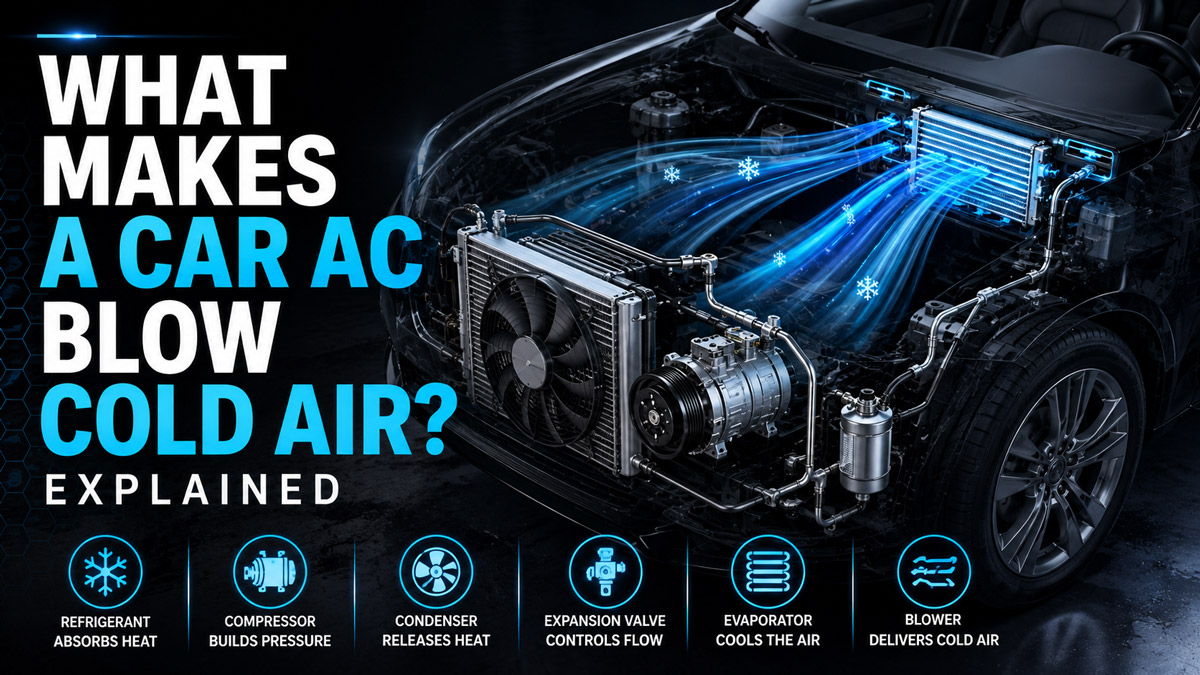
The most common reason a car is not blowing cold air is low refrigerant caused by a leak. Low system pressure can prevent the AC compressor from engaging or reduce the system’s ability to transfer heat. Other causes include a failed compressor, condenser airflow problems, electrical faults, evaporator icing and blocked cabin airflow.
At a Glance
- A refrigerant leak is the most common cause of gradually weakening car AC.
- Healthy center-vent air is commonly about 40°F–50°F when tested under suitable conditions.
- Cold air while driving but warm air at idle usually indicates poor condenser airflow.
- Different temperatures from the left and right vents often indicate a blend-door problem.
- Rapid compressor cycling commonly points to low refrigerant pressure or a faulty pressure signal.
- Adding refrigerant without identifying the fault can overcharge the system and make cooling worse.
What Are the Most Common Causes of Warm Car AC?
Warm car AC is usually caused by low refrigerant, a compressor problem, inadequate condenser airflow, an electrical fault or restricted airflow through the HVAC system. The correct diagnosis depends on whether the vents have strong airflow, whether the compressor engages and when the cooling problem occurs.
The most common causes include:
- Low refrigerant from a leak: Refrigerant can escape through hose connections, service valves, compressor seals, the condenser or the evaporator.
- Compressor failure: A worn compressor may engage but fail to create sufficient pressure difference between the high and low sides.
- Condenser fan failure: A stationary fan allows refrigerant pressure and temperature to rise when the vehicle is stopped.
- Electrical failure: A blown fuse, failed relay, damaged pressure sensor or open compressor clutch coil can prevent compressor operation.
- Airflow restriction: A clogged cabin filter or dirty evaporator can reduce the volume of air reaching the cabin.
- Temperature-door failure: A stuck blend door may mix heated air with properly cooled air.
- Refrigerant restriction: A blocked expansion valve, orifice tube or receiver-drier can create abnormal pressure readings and evaporator icing.
A professional diagnosis separates refrigeration problems from airflow and temperature-control problems before replacing parts.
How Does a Refrigerant Leak Stop the AC From Cooling?
A refrigerant leak lowers system pressure and reduces the amount of refrigerant available to absorb heat inside the evaporator. Once pressure falls below the vehicle’s programmed safety threshold, the low-pressure switch or pressure sensor may prevent the compressor from operating.
Refrigerant does not normally get “used up.” A properly sealed automotive AC system circulates the same refrigerant repeatedly. Therefore, a system that needs frequent recharging almost certainly has a leak, even when the escaping refrigerant leaves no visible liquid.
Common leak locations include the following:
- Compressor shaft seals
- Condenser damage from road debris
- Crimped hose connections
- Service-port valve cores
- Evaporator corrosion
- Receiver-drier or accumulator fittings
- O-rings between components
A small leak may cause cooling performance to decline over several months. A large leak may cause the AC to become warm within days or prevent the compressor from engaging at all.
Oil staining around an AC fitting can indicate a leak because refrigerant often carries compressor oil out of the system. However, the absence of visible oil does not prove that the system is sealed. Electronic leak detection, ultraviolet dye or nitrogen pressure testing may be required.
How Can I Tell Whether the Compressor Is Working?
A working compressor usually creates a noticeable pressure difference between the low-pressure and high-pressure sides of the AC system. On vehicles with a visible clutch, the clutch plate may also engage with a click when cooling is requested.
To perform a basic observation:
- Start the engine and set the AC to maximum cooling.
- Select recirculation mode and use a medium or high blower speed.
- Open the hood while staying clear of belts, fans and rotating components.
- Locate the compressor and observe whether its clutch engages, if the vehicle uses a clutched compressor.
- Listen for abnormal grinding, squealing or repeated clicking.
- Confirm that the condenser or radiator fan begins operating when required.
Clutch engagement alone does not prove that the compressor is healthy. A compressor can spin while its internal pistons, scroll assembly or seals fail to create sufficient pressure.
Many newer vehicles use variable-displacement compressors that may not cycle in the traditional way. Some compressors have no externally cycling clutch at all. Diagnosis on those vehicles may require scan-tool data for compressor command, refrigerant pressure, control-valve duty cycle and evaporator temperature.
Never place hands near an electric cooling fan. Many fans can start automatically even when the engine appears quiet.
What Should Car AC Pressure Readings Be?
On an R134a system at approximately 80°F ambient temperature, a normally operating AC system may show about 25–45 PSI on the low side and 150–250 PSI on the high side. Pressure targets change with ambient temperature, humidity, engine speed, airflow and vehicle design, so the service specification takes priority.
Pressure readings must be interpreted while the compressor is operating. Static pressure with the engine off mainly reflects refrigerant temperature and cannot confirm the exact refrigerant charge.
R1234yf systems may behave differently and require dedicated equipment. Mixing refrigerants, using contaminated gauges or venting refrigerant is unsafe and may violate environmental regulations.
How Cold Should the Air From the Vents Be?
A healthy car AC system commonly produces approximately 40°F–50°F air at the center vent under moderate conditions. The exact temperature depends on outdoor temperature, humidity, sun load, blower speed, engine speed and whether the system is using fresh-air or recirculation mode.
For a repeatable test:
- Park in the shade when possible.
- Start the engine and close the doors and windows.
- Set the temperature to maximum cold.
- Select recirculation mode.
- Set the blower to a medium speed.
- Place a digital thermometer in the center vent.
- Hold the engine near 1,500 RPM if the manufacturer’s procedure allows it.
- Allow the system to stabilize for approximately five minutes.
Vent temperature should be interpreted relative to ambient temperature. A vent reading of 55°F may indicate a problem on an 80°F day but could be more understandable during extremely hot, humid weather with a heat-soaked cabin.
The temperature of the air is only one diagnostic measurement. Strong airflow at 60°F suggests a refrigeration or temperature-mixing problem, while 42°F air with very weak airflow suggests a cabin filter, evaporator or blower-related restriction.
Why Does the AC Get Cold While Driving but Warm at Idle?
AC that becomes cold while driving but warm at idle usually indicates insufficient airflow through the condenser. Vehicle speed forces outside air through the condenser, temporarily compensating for a failed cooling fan, weak fan motor, damaged fan control module or blocked condenser surface.
The condenser releases heat collected from the passenger compartment. When the vehicle stops, the cooling fan must replace the natural airflow created by movement. Without enough airflow, high-side pressure rises and the system may lose cooling or shut the compressor down for protection.
Check the following conditions:
- Turn the AC to maximum cooling.
- Open the hood without touching moving parts.
- Observe whether the appropriate radiator or condenser fan is operating.
- Inspect the condenser for leaves, plastic bags, insects or bent fins.
- Watch the engine temperature gauge for signs of overheating.
A fan that spins slowly may still be defective. Some vehicles use multiple fan speeds, and failure of the low-speed circuit can create warm idle performance even though the fan eventually runs at high speed.
A condenser airflow problem should be repaired promptly. Sustained high pressure increases compressor load and can damage hoses, seals and compressor components.
Why Is One Side of the Car Cold and the Other Side Hot?
One side blowing cold while the other side blows warm usually indicates a blend-door actuator, air-mix door or HVAC control problem. The refrigerant circuit may be functioning correctly, but the HVAC case is routing heated air to one side of the cabin.
Dual-zone and tri-zone climate systems contain several doors that control temperature and airflow. A small electric actuator moves each door according to the selected temperature. Broken actuator gears, a stuck door or lost actuator calibration can leave one zone in the heated position.
Common clues include:
- Clicking or tapping behind the dashboard
- Temperature that does not respond on one side
- A problem that began after battery replacement
- Correct vent temperature on one side only
- A climate-control fault code stored in the HVAC module
Low refrigerant can sometimes create uneven vent temperatures because the evaporator may not cool uniformly. However, a large and consistent left-to-right temperature difference is more strongly associated with an air-door or control problem.
Some actuators can be replaced through the glove box or lower dashboard. Others require extensive trim removal. Before replacing an actuator, a technician may command each door with a scan tool and compare requested position with actual position.
Why Does the AC Blow Cold and Then Turn Warm?
AC that blows cold for several minutes and then becomes warm may be experiencing evaporator icing, excessive system pressure, compressor overheating or an electrical component that fails when hot. The change in airflow strength helps separate these possibilities.
If the vent airflow gradually becomes weak while the blower still sounds normal, the evaporator may be freezing. Ice forms across the evaporator fins and physically blocks airflow. Possible causes include:
- A faulty evaporator temperature sensor
- Incorrect refrigerant pressure
- Restricted airflow from a dirty cabin filter
- A blocked or malfunctioning expansion device
- Continuous compressor operation
Turning the AC off while leaving the blower running may restore airflow after the ice melts. A larger-than-normal puddle of water may appear under the vehicle during thawing.
If airflow remains strong but the air suddenly turns warm, the compressor may be disengaging. High pressure, low pressure, an overheating clutch coil, a failing relay or an intermittent sensor signal can cause shutdown.
A pressure reading taken only after the system has recovered may miss the fault. Diagnosis is most accurate while the AC is actively changing from cold to warm.
Why Is the Compressor Turning On and Off Repeatedly?
Rapid compressor cycling commonly occurs when refrigerant pressure is too low to keep the compressor safely engaged. The compressor starts, low-side pressure quickly falls below the cutoff point, the control system disengages the compressor and the pressure then rises enough for the cycle to repeat.
Some systems may cut off compressor operation at a low-side pressure near 15–25 PSI, although the exact threshold varies by vehicle and sensor strategy. Repeated cycling every few seconds is not normal under a significant cooling demand.
Other causes include:
- A low ambient temperature
- A faulty pressure switch or pressure sensor
- A restricted expansion device
- Poor condenser airflow
- An excessive or incorrect refrigerant charge
- A failing compressor clutch coil
- An inaccurate evaporator temperature sensor
Do not assume every cycling compressor needs more refrigerant. Some properly operating fixed-displacement systems cycle under light cooling demand, especially during cool weather.
The useful distinction is frequency and context. Cycling every few minutes after the cabin has cooled can be normal. Cycling every two to five seconds while the cabin remains hot usually indicates a pressure, sensor or control problem that needs testing.
Can a Cabin Air Filter Stop the AC From Cooling?
A severely clogged cabin air filter can make the AC feel ineffective by reducing airflow, but the filter does not usually prevent the refrigerant from becoming cold. The typical symptom is cold air moving weakly from the vents rather than strong airflow at a warm temperature.
The cabin filter traps dust, pollen, leaves and other airborne debris before air passes through the evaporator and enters the cabin. As the filter becomes restricted, the blower must work harder to move the same volume of air.
Signs of a clogged filter include:
- Weak airflow at every blower setting
- Increased blower noise with little air movement
- A musty odor
- Dust around the vents
- Windshield defogging that takes longer than usual
Many manufacturers recommend inspection or replacement approximately every 12,000–30,000 miles, but dusty roads, heavy pollen and urban pollution can shorten the interval substantially.
Remove the filter and inspect it against a light source. A filter packed with dark debris should be replaced rather than blown clean unless the manufacturer specifically identifies it as reusable.
If airflow remains weak with the filter removed temporarily, inspect the evaporator face, blower wheel, recirculation door and ductwork. Rodent nesting and collapsed filter material can also obstruct the HVAC system.
Why Is the AC Warm After a Refrigerant Recharge?
AC that remains warm after a recharge may be undercharged, overcharged, leaking, contaminated or suffering from a fault unrelated to refrigerant quantity. A recharge does not repair a failed compressor, condenser fan, electrical circuit, blend door or restricted expansion device.
Common post-recharge problems include:
- The system still has a leak: Newly added refrigerant may escape within hours, days or weeks.
- The charge is inaccurate: Refrigerant should be installed by weight according to the under-hood label.
- The system is overcharged: Excess refrigerant raises high-side pressure and can trigger compressor shutdown.
- Air remains in the system: Air and moisture reduce performance and can create corrosive acids.
- The wrong refrigerant was used: R134a and R1234yf are not interchangeable.
- The compressor is weak: Refrigerant quantity may be correct even though pressure separation is inadequate.
- The condenser fan is not operating: Cooling may return at speed and disappear at idle.
A proper recharge normally includes refrigerant recovery, vacuum evacuation, leak assessment and installation of the specified refrigerant mass. Charging solely by watching a low-side gauge is unreliable because low-side pressure changes with temperature, airflow and compressor control.
How Can I Diagnose Car AC Problems at Home?
A safe home diagnosis can identify symptom patterns, airflow problems and obvious electrical faults, but refrigerant recovery and internal repairs require proper equipment. Begin with observations before connecting gauges or adding refrigerant.
- Check airflow strength. Strong but warm airflow suggests a cooling or temperature-mixing problem. Weak airflow suggests a filter, blower or evaporator restriction.
- Compare vent temperatures. Measure the center vent and compare left and right zones.
- Listen for compressor operation. Note clicks, grinding noises or rapid cycling.
- Check cooling-fan operation. Verify that the fan runs when commanded, without placing hands near it.
- Inspect visible fuses. Use the owner’s manual to identify HVAC, compressor and cooling-fan circuits.
- Look for oily residue. Inspect AC hose joints, the condenser and service ports.
- Use ultraviolet dye correctly. Existing dye may reveal a leak as a bright fluorescent stain under a UV lamp.
- Scan for fault codes. Some scan tools can read HVAC, pressure-sensor and climate-control codes.
- Record the circumstances. Note whether the problem occurs at idle, after ten minutes, on one side or only during extreme heat.
Do not bypass pressure switches, jumper compressor relays indefinitely or release refrigerant. Those shortcuts can damage the compressor and create serious safety risks.
Should I Add Refrigerant or Use a Stop-Leak Product?
Do not add refrigerant until the system’s current charge and operating pressures have been evaluated. Avoid stop-leak products because sealants can obstruct small passages, interfere with service equipment and convert a repairable leak into a more expensive contamination problem.
A single low-side gauge on a recharge can cannot reliably determine the refrigerant charge. For example, high low-side pressure can indicate overcharge, a weak compressor or poor heat removal—not necessarily insufficient refrigerant.
Adding too much refrigerant may cause:
- Excessive high-side pressure
- Reduced cooling
- Compressor shutdown
- Increased compressor load
- Damage to seals or hoses
- Inaccurate future diagnosis
High-pressure protection may disable the compressor when pressure becomes dangerously elevated. The driver may then add even more refrigerant because the vents remain warm, worsening the original problem.
The professional approach is to recover and weigh the existing refrigerant, evacuate the system, verify vacuum stability and recharge the exact quantity listed on the vehicle label. A system requiring refrigerant should also be checked for leakage.
A simple service-port cap or valve-core leak may be inexpensive. Hiding that leak with a sealant creates unnecessary risk.
How Much Does It Cost to Fix Car AC?
Car AC repairs commonly cost from about $150 for basic diagnosis and recharge service to more than $2,000 for an evaporator or major dashboard-out repair. The final price depends on the failed component, refrigerant type, vehicle design, labor time and whether contamination has spread through the system.
R1234yf refrigerant service generally costs more than R134a service because the refrigerant and equipment are more expensive. Luxury vehicles, hybrids and tightly packaged engine compartments may also require additional labor.
A compressor replacement can become significantly more expensive when metal debris has entered the system. The condenser, expansion device and receiver-drier may need replacement, while the remaining lines must be flushed where permitted.
A written estimate should distinguish diagnosis, leak repair, refrigerant, oil, parts and labor.
Can I Drive Safely When the Car AC Is Not Working?
A vehicle can usually be driven with nonfunctional AC if the failure is limited to cabin cooling. Stop driving or disable the affected system when the compressor pulley is seizing, the serpentine belt is slipping, the engine is overheating or smoke and burning odors are present.
A seized compressor or pulley bearing can damage or break the serpentine belt. On many vehicles, the same belt drives the alternator, water pump or power-steering pump. Belt failure can therefore cause charging loss, engine overheating or heavy steering.
Warning signs requiring immediate attention include:
- Grinding from the compressor area
- A squealing or smoking belt
- Rising engine temperature
- Refrigerant or oil spraying in the engine compartment
- Electrical burning smells
- A cooling fan that fails while the engine temperature climbs
Reduced windshield defogging is another safety concern. The AC system removes moisture from cabin air even when heat is selected. During rain or cold weather, a failed system may make it harder to clear condensation from the windshield.
When the only symptom is warm vent air and the engine operates normally, driving is generally possible until an appointment is available. Avoid repeatedly switching on a compressor that makes abnormal mechanical noise.
When Should a Professional Inspect the AC System?
A professional should inspect the AC system when refrigerant has leaked out, compressor operation is abnormal, pressures are unknown or the repair requires opening the sealed refrigerant circuit. Professional service is also warranted when a DIY recharge fails to restore stable cooling.
Schedule diagnosis when:
- Cooling disappeared suddenly
- Refrigerant was added more than once
- The compressor cycles every few seconds
- AC operation causes grinding or belt noise
- One line freezes repeatedly
- Vent airflow fades after several minutes
- Cooling works only while driving
- Left and right vents have a large temperature difference
- The vehicle uses R1234yf refrigerant
- A hybrid or electric vehicle uses an electrically driven compressor
Hybrid and electric compressors may require special nonconductive oil. Contamination with conventional compressor oil can damage the system and create an electrical insulation risk.
A qualified technician should record ambient temperature, vent temperature, low-side pressure, high-side pressure, refrigerant weight and relevant scan data. Replacing parts based only on a warm-air complaint often wastes money.
The most useful first question is not “How much refrigerant should be added?” It is “Which part of the cooling process has stopped working?”
The Bottom Line
A car that is not blowing cold air most often has low refrigerant caused by a leak, but warm air does not automatically mean the system needs a recharge. Airflow strength, compressor behavior, pressure readings and the conditions under which cooling fails identify the actual fault. Cold air while driving points toward condenser airflow, while uneven vent temperatures point toward a blend-door problem. Avoid blind recharging and stop-leak products because an inaccurate charge can make diagnosis and repair more expensive.