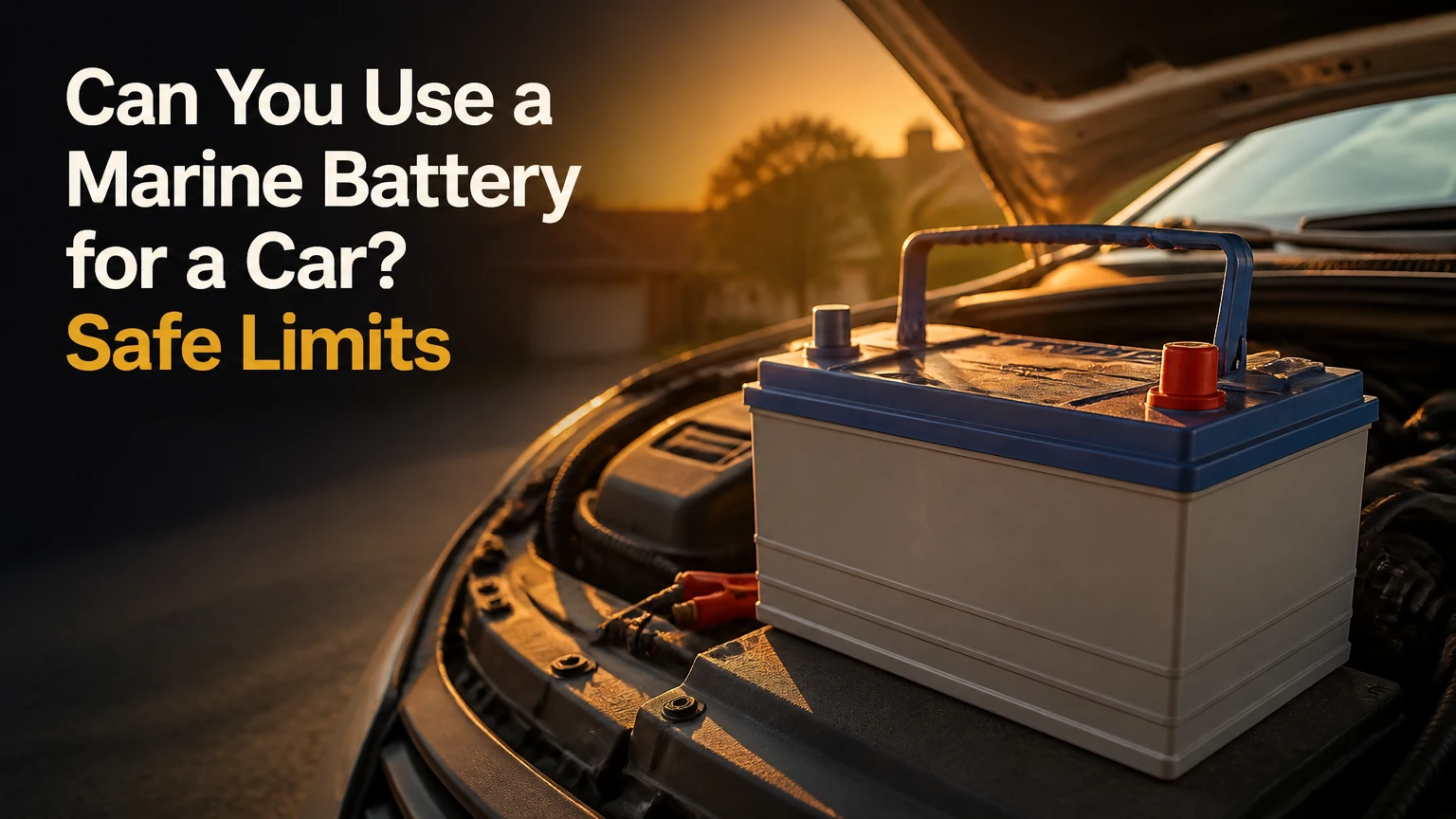
Yes, a marine battery can power a car temporarily if it is a 12-volt starting or dual-purpose battery with sufficient CCA, correct polarity, secure mounting, and compatible terminals. A pure deep-cycle marine battery is a poor primary replacement because its design favors prolonged discharge rather than the high-current burst required by an automotive starter.
Key facts at a glance
A marine starting battery with adequate CCA can start a compatible car in an emergency.
A dual-purpose marine battery is more suitable than a pure deep-cycle battery for automotive starting.
MCA and CCA are different ratings; compare the battery with your vehicle’s required CCA, not its MCA alone.
Group size, dimensions, terminal position, polarity, and hold-down hardware must match before installation.
A car alternator can recharge a marine lead-acid battery, but repeated deep discharge and incomplete charging can shorten battery life.
A 12-volt lithium marine battery is not automatically compatible with a car’s alternator or battery-management system.
Can You Use a Marine Battery for a Car?
A marine battery can be used in a car when its starting rating, voltage, physical fit, terminal arrangement, and charging requirements match the vehicle. The arrangement is usually reasonable as an emergency replacement, but a manufacturer-approved automotive battery remains the better daily choice for most cars.
Marine batteries are built for boats, where vibration, moisture, long periods of engine-off accessory use, and different starting conditions affect the design. Automotive batteries are optimized for repeated engine starts followed by relatively shallow recharging from the alternator.
The label matters more than the word “marine.” A marine cranking battery is closer to a car battery. A dual-purpose battery balances engine starting with moderate deep-discharge capability. A trolling-motor deep-cycle battery may have excellent reserve capacity but inadequate cranking power, particularly in freezing weather.
Which marine battery types can start a car?
Marine cranking and dual-purpose batteries can start many cars when their CCA meets the vehicle requirement. Pure deep-cycle batteries should not replace an automotive starting battery unless the manufacturer specifically rates the model for engine starting.
| Battery type | Typical construction | Typical rating | Automotive suitability |
|---|---|---|---|
| Marine cranking | Thin lead plates, high surface area | 500-1,000 MCA; 400-800 CCA | Emergency or model-approved replacement |
| Dual-purpose marine | Medium-thickness plates | 500-900 CCA; 100-200 minutes RC | Best marine option for mixed starting and accessory use |
| Flooded deep-cycle | Thick plates, repeated discharge design | 100-250 Ah; sometimes under 500 CCA | Poor primary car battery choice |
| AGM dual-purpose | Absorbent glass mat, sealed construction | 600-1,000 CCA; 120-220 minutes RC | Suitable only with correct fit and charging profile |
| LiFePO4 marine | Lithium cells and battery-management system | 100-300 Ah; manufacturer-specific peak current | Usually unsuitable under a standard alternator |
A marine battery’s intended use also affects warranty coverage. Many manufacturers specify separate automotive and marine applications, so a battery that physically fits may still have no warranty protection when installed in a car.
How does a marine battery differ from a car battery?
A car starting battery uses thin, numerous plates to expose more reactive surface area and deliver high current for several seconds. A deep-cycle marine battery uses thicker plates that tolerate deeper discharge, but the thicker construction generally sacrifices peak starting performance.
The starter motor can draw several hundred amps. Typical gasoline cars require approximately 400-800 CCA, while large diesel engines may require 800-1,200 CCA or more. The exact requirement comes from the vehicle manufacturer, battery label, owner’s manual, or the original battery specification.
An alternator does not replace battery selection. The alternator supplies electrical power after the engine starts, while the battery supplies the initial starter surge and stabilizes system voltage during transient loads.
What are CCA, MCA, and reserve capacity?
CCA measures the current a 12-volt lead-acid battery can deliver at 0°F, or -18°C, for 30 seconds while maintaining at least 7.2 volts. MCA is measured at 32°F, or 0°C, so the same battery normally shows a higher MCA number.
MCA is often roughly 20-25% higher than CCA, but the relationship varies by battery design and testing method. An 800-MCA marine battery should not automatically be treated as an 800-CCA automotive battery.
Reserve capacity, or RC, indicates how long a fully charged battery can deliver 25 amps before its voltage falls to 10.5 volts under the relevant test. RC helps estimate accessory runtime, but it does not prove that a battery can crank an engine.
| Rating | Test condition or meaning | Typical automotive relevance | Buying rule |
|---|---|---|---|
| CCA | 30 seconds at 0°F, minimum 7.2 V | 400-800 CCA for many gasoline cars | Meet or exceed the factory CCA |
| MCA | 30 seconds at 32°F, minimum 7.2 V | 500-1,000 MCA on marine labels | Do not substitute MCA for required CCA |
| RC | Minutes at 25 A before 10.5 V | 60-120 minutes for many cars | Use as an accessory-runtime indicator |
| Amp-hours | Capacity over a stated discharge period | Often not listed on starting batteries | Do not use Ah alone to select a starter battery |
| Voltage | Nominal electrical system voltage | 12 V nominal, about 12.6 V fully charged | Match a 12-volt vehicle system |
Yuasa’s vehicle-battery guidance distinguishes CCA from other capacity measurements because starting performance depends on high-current delivery, not merely stored amp-hours. That distinction explains why a 100-Ah deep-cycle battery can crank worse than a smaller 60-Ah starting battery.
Will a marine battery fit safely in a car?
A marine battery fits safely only when the battery tray, hold-down, terminals, polarity, cable reach, and hood clearance all match. A battery that starts the engine but moves during braking or allows the positive terminal to contact the hood is unsafe.
Battery group numbers provide a useful starting point, not a universal fit guarantee. Group 24, 27, and 31 marine batteries are common, while automotive applications frequently use groups such as 35, 51R, 58, 65, or 94R.
The “R” suffix usually indicates reversed terminal orientation within a group family. Reversing polarity or stretching cables to reach the posts can damage electronic control modules, fusible links, and the starter circuit.
| Fitment factor | Automotive example | Marine variation | Required check |
|---|---|---|---|
| Nominal voltage | 12 V | 12 V flooded, AGM, or lithium | Confirm 12 V system compatibility |
| Group size | 35, 51R, 65, 94R | 24, 27, 31 | Match dimensions, not group number alone |
| Length | 9.0-13.0 in typical | 10.0-13.0 in typical | Measure tray length |
| Width | 5.0-7.0 in typical | 6.5-7.0 in typical | Check side clearance |
| Height | 7.5-9.5 in typical | 8.5-10.0 in typical | Check hood and terminal clearance |
| Terminals | SAE tapered posts | SAE posts, threaded studs, dual terminals | Use approved adapters only |
| Hold-down | Vehicle-specific clamp | Often absent or different | Secure the case on all sides |
Why is secure mounting important?
Battery hold-down hardware prevents plate damage, terminal strain, and case movement during acceleration, cornering, and collisions. A loose battery can short against bodywork or disconnect the vehicle while moving.
Do not improvise with bungee cords, loose straps, wood blocks, or an unmodified metal bracket. A proper clamp must contact the battery’s approved hold-down points without crushing the case.
Can a car alternator charge a marine battery?
A standard car alternator can recharge a compatible 12-volt lead-acid marine battery after normal starting, but it is not a substitute for a marine-compatible multi-stage charger. Alternator damage is not inevitable, although a severely discharged battery can make the alternator run at high output and high temperature for an extended period.
An alternator regulates system voltage, commonly around 13.8-14.7 volts in conventional systems. Smart-charging vehicles may vary voltage according to battery temperature, state of charge, deceleration, and emissions strategy, so an AGM or lithium battery may require a vehicle-specific charging solution.
A car alternator is particularly poorly suited to recovering a deeply discharged battery. The battery may accept high current initially, then remain undercharged because the voltage and charging duration do not complete the absorption stage.
What charger should you use?
Use a charger whose chemistry and battery type settings match the battery. A flooded lead-acid marine battery may need a flooded setting, an AGM model needs an AGM setting, and LiFePO4 requires a lithium charger approved by the battery manufacturer.
| Battery chemistry | Typical full-charge voltage | Suitable external charger | Car-alternator caution |
|---|---|---|---|
| Flooded lead-acid | 14.4-14.8 V | 12 V multi-stage flooded charger | Water level and ventilation required |
| AGM lead-acid | 14.4-14.7 V | 12 V AGM charger | Avoid prolonged overvoltage |
| Gel lead-acid | 14.0-14.2 V | Dedicated gel profile | Incorrect voltage can damage the gel |
| LiFePO4 | 14.2-14.6 V, model-specific | Lithium charger with BMS compatibility | Standard alternator profile may be unsuitable |
Use a voltmeter to diagnose charging rather than assuming the battery is at fault. With the engine off after several hours of rest, a healthy fully charged lead-acid battery typically measures about 12.6-12.8 volts. With the engine running, many conventional systems measure approximately 13.8-14.7 volts, although manufacturer-controlled systems can operate outside that range.
What should you check before installing one?
Check five specifications before connecting a marine battery: battery chemistry, CCA, group dimensions, terminal polarity, and charging compatibility. The vehicle owner’s manual and the battery manufacturer’s application guide outrank a generic online compatibility chart.
Use this decision sequence:
- Identify the battery chemistry. Do not install a lithium marine battery in a conventional lead-acid vehicle system without an approved charging design.
- Read the CCA rating. Match or exceed the original battery’s CCA, especially for diesel engines and cold climates.
- Measure the battery and tray. Record length, width, height, terminal position, and cable reach.
- Confirm polarity. The positive and negative terminals must align with the vehicle cables.
- Inspect terminal style. Threaded studs require properly designed automotive adapters, not a loose clamp or improvised washer stack.
- Check the hold-down. The case must remain immobile under hand pressure.
- Verify charging requirements. Confirm that the alternator and external charger suit flooded lead-acid, AGM, or another chemistry.
- Check warranty language. A marine battery may exclude automotive installation.
The most frequently missed specification is height. A marine battery can fit the tray while its raised terminal touches the hood, producing a direct short capable of melting wiring or starting an engine-compartment fire.
How do you install a marine battery temporarily?
Install a marine battery temporarily only after confirming voltage, polarity, CCA, and physical fit. The work usually takes 15-30 minutes, requires basic hand tools and eye protection, and should stop immediately if the battery case is cracked, swollen, leaking, frozen, or hot.
Step 1: Turn off the vehicle
Park on a level surface, select Park or first gear, apply the parking brake, and remove the key. Switch off lights, audio equipment, climate controls, and aftermarket accessories.
You will know this step is complete when no electrical accessory is operating. A common mistake is leaving an ignition-controlled circuit active, which creates sparks or drains the replacement battery.
Step 2: Disconnect the old battery
Disconnect the negative cable first, then the positive cable. Remove the hold-down before lifting the battery vertically with both hands.
The negative-first sequence reduces the chance of a tool shorting the positive terminal to the vehicle body. Wear eye protection because lead-acid batteries can contain corrosive electrolyte and produce hydrogen gas during charging.
Step 3: Test the replacement battery
Measure the resting voltage if the battery has been stored. A lead-acid battery near 12.6 volts is typically fully charged, while a reading below 12.2 volts indicates substantial discharge.
Do not install a marine battery with a cracked case, bulging sides, acid residue, damaged posts, or an exposed lithium cell. Charging a physically damaged battery can create a fire or explosion hazard.
Step 4: Position and secure the battery
Place the marine battery in the tray with the positive terminal in the correct location. Confirm that the hood, terminals, cables, and surrounding metal have safe clearance.
Install the factory hold-down if it fits. If it does not, use a manufacturer-approved replacement bracket designed for the battery group and vehicle tray. The success checkpoint is zero movement when you push the battery firmly in every direction.
Step 5: Connect the cables
Connect the positive cable first and the negative cable second. Tighten the terminals enough to prevent rotation, but do not crush lead posts or over-torque threaded studs.
The vehicle should power up without smoke, heating cables, or repeated arcing. A loud spark, hot terminal, or rapidly heating cable indicates a short, reversed polarity, or incorrect connection.
Step 6: Start and verify charging
Start the engine without repeatedly cranking for long periods. Measure voltage at the battery terminals with the engine running and compare the result with the vehicle manufacturer’s charging specification.
A successful temporary installation produces normal cranking speed, stable dashboard electronics, and no battery warning light. Do not treat one successful start as proof that the setup is suitable for daily use.
When is a marine battery a sensible automotive choice?
A dual-purpose AGM marine battery can make sense in an off-road, overlanding, or utility vehicle when the vehicle manufacturer approves the battery and the electrical system supports its charging profile. The battery should remain a starting-capable primary battery, not a substitute for a properly isolated house battery.
For camping equipment, refrigerators, inverters, radios, and lighting, a separate auxiliary battery is safer. The starting battery then remains reserved for engine starting, while an isolator or DC-to-DC charger controls charging between the vehicle and the auxiliary battery.
| Vehicle situation | Recommended primary battery | Auxiliary arrangement | Reason |
|---|---|---|---|
| Daily commuter, gasoline engine | Factory-spec automotive battery | None | Prioritizes fit, CCA, warranty, and low cost |
| Diesel pickup in cold climate | High-CCA automotive AGM or flooded battery | Optional second battery | Diesel cranking load needs strong CCA |
| Overlanding SUV | Approved dual-purpose AGM | 100-200 Ah auxiliary battery | Supports accessories without sacrificing starting reserve |
| Trailer-towing truck | Factory starting battery | Isolated 100-200 Ah trailer battery | Prevents trailer loads from draining the starter battery |
| Trolling-motor vehicle | Automotive starting battery | 12 V or 24 V deep-cycle marine bank | Separates engine starting from propulsion loads |
Is a dual-purpose marine battery better than a car battery?
A dual-purpose marine battery is better only when the vehicle needs both engine starting and repeated accessory discharge, and the battery fits the application. A standard automotive battery is usually better for a commuter because it provides the required starting current at lower cost with fewer fitment and warranty complications.
Deep-cycle capability does not create free capacity. The battery’s thicker plates may tolerate deeper discharge, but repeated deep cycling under an engine-bay alternator can still cause incomplete charging and early failure.
What problems can occur?
The main problems are inadequate cranking power, incorrect fitment, incomplete charging, chemistry mismatch, reduced cold-weather performance, and warranty exclusion. These risks differ by battery type, so “marine battery” alone is too broad to predict the outcome.
Typical service life for a correctly selected automotive lead-acid battery is about 3-5 years, while a mismatched marine battery used daily in a car may last only 1-2 years. Those are practical ranges, not guarantees; heat, vibration, discharge depth, charging voltage, and climate can change the result substantially.
Why does the car click instead of starting?
Rapid clicking usually indicates low terminal voltage under starter load, poor terminal contact, insufficient CCA, or a failing starter circuit. A marine battery with a high MCA number can still produce inadequate cold-weather performance if its CCA is below the vehicle requirement.
Measure resting voltage, then perform a load test at an automotive parts store or repair shop. Clean corrosion from the terminals and verify the negative cable connection to the engine block and chassis.
Why do the lights dim after installation?
Dimming lights can indicate an undercharged battery, alternator fault, loose connection, excessive accessory demand, or voltage drop in the cables. A deep-cycle battery that has been discharged substantially may need several hours on a correctly configured external charger.
Check charging voltage at the battery, inspect the serpentine belt, and test the alternator under load. Replacing the battery without measuring the charging system can cause the same failure to recur.
Can a marine battery damage the car?
A compatible lead-acid marine battery normally does not damage a car merely because it is labeled marine. Damage becomes more likely when the battery is installed with reversed polarity, loose terminals, unsafe adapters, incorrect charging chemistry, inadequate mounting, or a short to the hood.
The alternator may experience excessive thermal stress when recovering a deeply discharged battery, but the battery type alone does not guarantee alternator failure. A properly functioning alternator can recharge many lead-acid battery designs, although the result may be inefficient or outside the battery maker’s recommended use.
How much does the switch cost?
A standard automotive battery typically costs about $90-$180, while dual-purpose or deep-cycle marine batteries commonly cost $130-$300 or more. Terminal adapters, a replacement hold-down, a smart charger, and a battery isolator can add $20-$300 depending on the setup.
A temporary swap is financially sensible when a suitable battery is already available and the alternative is towing. Buying a marine battery specifically for a normal commuter usually costs more than buying the correct automotive battery.
| Purchase or repair | Typical price | Typical service period | Cost implication |
|---|---|---|---|
| Automotive flooded battery | $90-$150 | 3-5 years | Lowest initial cost |
| Automotive AGM battery | $150-$300 | 3-6 years | Needed for some start-stop vehicles |
| Marine dual-purpose AGM | $180-$350 | 2-5 years in mixed use | Higher cost, accessory tolerance |
| Marine deep-cycle lead-acid | $130-$250 | 2-5 years by cycle depth | Poor primary starter replacement |
| 12 V smart charger | $40-$150 | 5-10 years typical | Useful for recovery and storage |
| Dual-battery isolator or DC-to-DC charger | $80-$300 | 5-10 years typical | Supports auxiliary loads safely |
What are the best alternatives?
The best alternative for ordinary driving is a vehicle-specific automotive battery matched to the original group size, CCA, reserve capacity, and chemistry. The best alternative for camping is a factory starting battery paired with a separately fused auxiliary battery and an isolator or DC-to-DC charger.
A jump starter is often safer than leaving a poorly fitted marine battery under the hood. Select a jump pack whose peak and starting-current ratings suit the engine size, and keep it charged according to its manual.
A battery shop can test the original battery, alternator, starter draw, and parasitic load. That diagnostic sequence matters because a replacement battery cannot correct a failing alternator, a shorted accessory, or a starter motor drawing excessive current.
Common mistakes and how to fix them
- Matching MCA to CCA: Replace the comparison with the manufacturer’s CCA requirement. MCA is measured at a warmer temperature.
- Using a pure deep-cycle battery: Choose a marine starting or dual-purpose model with a published CCA rating.
- Ignoring polarity: Stop before connecting cables if the positive terminal is on the wrong side.
- Skipping the hold-down: Install the correct bracket rather than relying on weight to keep the battery in place.
- Using a stud adapter incorrectly: Use a purpose-built terminal adapter that clamps securely and preserves cable contact area.
- Installing lithium without charging analysis: Confirm alternator, BMS, low-temperature charging, and vehicle electronics compatibility first.
- Assuming a long drive fully charges the battery: Use a compatible multi-stage charger after a deep discharge.
- Leaving accessories on the starting battery: Add an isolated auxiliary system instead.
One practical rule is to treat a marine battery as a temporary component unless the vehicle manufacturer and battery manufacturer approve the application. The emergency exception is useful, but it should not become an unexamined permanent modification.
FAQ
Can you use a boat battery in a car?
You can use a boat battery in a car when the boat battery is a 12-volt starting or dual-purpose model with adequate CCA and correct physical fitment. A trolling-motor deep-cycle battery is a poor choice because its design prioritizes sustained discharge rather than starter current.
Will a marine battery start a diesel car?
A marine battery can start a diesel car only when its tested CCA meets or exceeds the diesel vehicle’s requirement. Diesel engines typically demand more cranking current, and cold oil increases starter load, so an MCA-only rating is insufficient for selection.
Can an AGM marine battery replace an AGM car battery?
An AGM marine battery may replace an AGM automotive battery when dimensions, terminals, CCA, charging voltage, and vehicle battery-management requirements match. Start-stop cars often require battery registration or coding, which a physically compatible marine battery may not support.
Can you leave a marine battery connected to a car alternator?
You can leave a compatible lead-acid marine battery connected to a car alternator, but repeated deep discharge may leave the battery undercharged and increase alternator heat. A separate smart charger is better for recovery, while an auxiliary battery system is better for sustained accessories.
Is a marine battery safe in cold weather?
A marine starting battery with an adequate CCA rating can operate in cold weather, but a deep-cycle model may crank poorly as temperature falls. Check CCA at 0°F rather than relying on the warmer MCA number printed on many marine labels.
Should you use a marine battery for a car every day?
You should use a marine battery every day only when the specific battery is approved for automotive use and the vehicle’s charging, mounting, and fitment requirements are satisfied. For most commuters, the correct factory-spec automotive battery is cheaper, simpler, and more reliable.
The Bottom Line
Can you use a marine battery for a car? Yes, as an emergency substitute or as part of a properly engineered accessory system, provided the battery has adequate CCA, correct voltage, safe fitment, secure mounting, and compatible charging requirements. Choose a marine cranking or dual-purpose lead-acid battery rather than a pure deep-cycle model for starting.
For daily driving, install the vehicle manufacturer’s recommended automotive battery. For camping or high accessory loads, retain the automotive starting battery and add an isolated deep-cycle auxiliary battery instead of forcing one battery to perform two incompatible jobs.