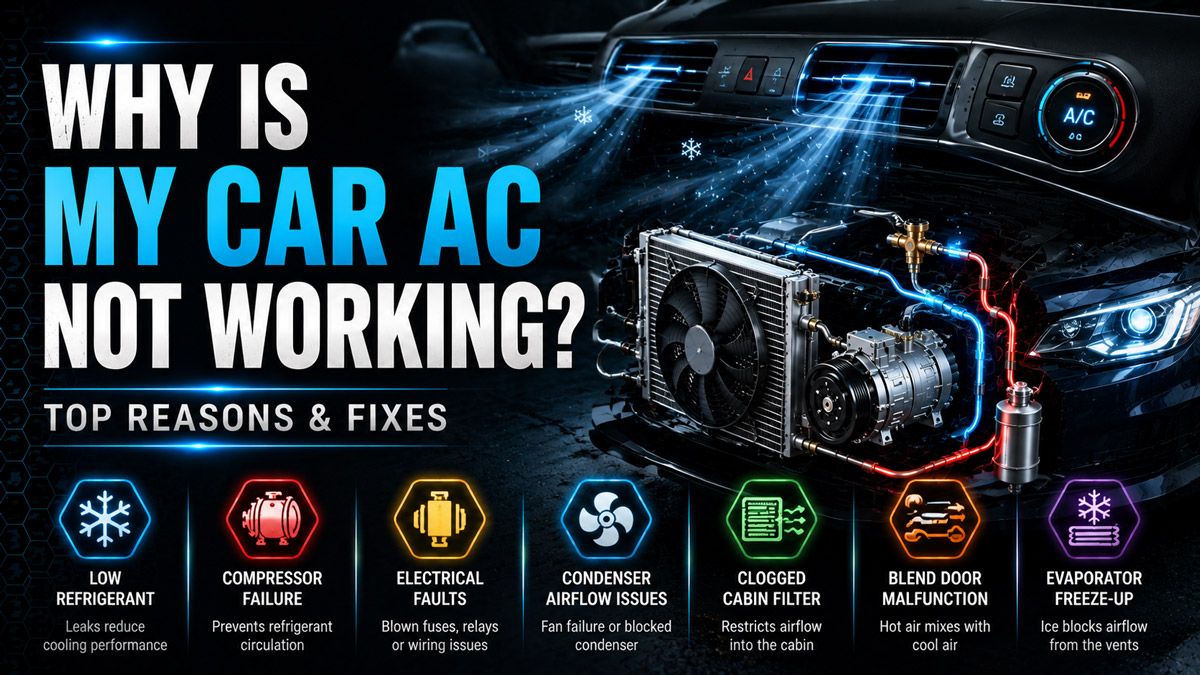
A car AC may stop working because of low refrigerant, a refrigerant leak, compressor failure, an electrical fault, restricted condenser airflow, a clogged cabin filter, or a malfunctioning blend door. The exact cause depends on whether the system has weak airflow, warm air, intermittent cooling, unusual noises, or a compressor that will not engage.
At a Glance
- Low refrigerant caused by a leak is one of the most common reasons a car AC stops cooling.
- A failed relay, fuse, pressure sensor, clutch coil, or wiring connection can prevent the compressor from operating.
- Weak vent airflow usually indicates a clogged cabin filter, blower problem, evaporator freeze-up, or blocked air passage.
- Cold AC lines with warm cabin air often indicate a blend door or actuator failure inside the dashboard.
- Adding refrigerant without measuring both system pressures can overcharge the system and make cooling worse.
- Professional diagnosis is recommended when the compressor will not engage, system pressure is abnormal, or refrigerant has leaked out.
What Are the Most Common Causes of Car AC Failure?
The most common causes of car AC failure are low refrigerant, electrical faults, compressor problems, blocked airflow, condenser damage, and HVAC door malfunctions. Low refrigerant is especially common because automotive AC systems do not normally consume refrigerant; a low charge usually indicates a leak.
Common failure points include:
- Refrigerant leak: O-rings, hoses, condensers, service valves, and compressor shaft seals can leak.
- Blown fuse or faulty relay: The compressor clutch or control module may receive no power.
- Failed compressor or clutch: The refrigerant cannot circulate through the system.
- Blocked condenser airflow: Dirt, debris, damaged fins, or an inoperative cooling fan can raise pressure.
- Clogged cabin air filter: Airflow through the vents becomes weak even when the refrigerant loop works.
- Blend door failure: Heated air mixes with cooled air before it reaches the vents.
- Evaporator freeze-up: Ice blocks airflow after several minutes of operation.
The symptom pattern matters more than simply noticing that the cabin is warm. Strong airflow with warm air points toward a refrigeration or blend-door problem, while weak airflow points toward the filter, blower motor, evaporator, or air ducts.
What Do Different Car AC Symptoms Mean?
Different car AC symptoms indicate different parts of the system, so diagnosing the symptom category can prevent unnecessary repairs. The first distinction is whether the vents have strong airflow, weak airflow, intermittent airflow, or no airflow.
A professional technician follows the symptom before connecting gauges. For example, refrigerant service will not fix a blower motor that does not move air, and replacing a compressor will not fix a blend door stuck in the heating position.
How Can I Tell Whether the Refrigerant Is Low?
Low refrigerant usually causes reduced cooling, compressor cycling, or complete compressor shutdown, but pressure testing and refrigerant weight are needed for confirmation. Looking at a low-side gauge alone cannot prove that the system has the correct charge.
Possible signs include:
- The vent air is cool but not cold.
- Cooling improves at higher engine speeds.
- The compressor clutch engages and disengages rapidly.
- The low-pressure switch prevents compressor engagement.
- Oil residue appears around a hose, fitting, condenser, or compressor seal.
- UV dye reveals fluorescent leakage.
Many passenger vehicles hold roughly 14–28 ounces of refrigerant, depending on the model and refrigerant type. A loss of only a few ounces can noticeably reduce cooling in a small-capacity system.
Pressure varies with outdoor temperature, humidity, engine speed, fan operation, and refrigerant type. An R-134a system operating in warm weather may show approximately 25–45 PSI on the low side and 150–250 PSI on the high side, but those figures are not universal specifications.
The correct diagnostic procedure is to recover and weigh the existing refrigerant, repair any leak, evacuate the system, and recharge the exact weight listed on the under-hood label.
Why Is the AC Compressor Not Turning On?
An AC compressor may not turn on because the system is low on refrigerant, system pressure is excessive, electrical power is missing, or the compressor clutch has failed. Modern vehicles may also disable the compressor when an engine, temperature, sensor, or control-module condition makes operation unsafe.
Common causes include:
- A blown compressor fuse.
- A failed clutch relay.
- Low refrigerant pressure.
- Excessive high-side pressure.
- A failed pressure transducer.
- A damaged clutch coil.
- Excessive clutch air gap.
- Broken wiring or a corroded connector.
- A faulty evaporator temperature sensor.
- An engine overheating condition.
Some modern vehicles use clutchless, variable-displacement compressors. These compressors may appear to spin constantly because the pulley is permanently driven, while an internal control valve changes refrigerant displacement. In that system, checking for a traditional clutch click can lead to the wrong diagnosis.
Before applying power directly to a compressor clutch, verify the wiring diagram and system pressure. Bypassing a pressure switch when the refrigerant is empty can run the compressor without adequate oil circulation and cause permanent damage.
Can an Electrical Problem Stop the Car AC From Working?
Yes, an electrical problem can completely disable a car AC system even when the refrigerant charge and mechanical components are healthy. The compressor, condenser fans, blower motor, pressure sensors, temperature sensors, actuators, and climate-control module all depend on electrical power and accurate signals.
Electrical faults commonly involve:
- Compressor clutch fuse or relay.
- Blower motor fuse.
- Blower motor resistor or electronic speed controller.
- High- or low-pressure sensor.
- Evaporator temperature sensor.
- Ambient temperature sensor.
- Engine coolant temperature sensor.
- Corroded wiring connectors.
- Broken ground connections.
- Climate-control control panel.
A failed relay may work while cold and stop after the engine compartment becomes hot. A weak clutch coil may also engage during a cool morning drive but fail in afternoon traffic as electrical resistance rises.
Start diagnosis by checking whether the blower operates, whether the compressor receives a command, and whether the condenser fan runs when the AC is requested. A scan tool can be especially useful because many vehicles store HVAC trouble codes and live sensor readings that cannot be identified with a basic test light.
Why Is the Airflow From My AC Vents Weak?
Weak AC airflow is usually caused by a clogged cabin air filter, a failing blower motor, an obstructed evaporator, evaporator icing, or a door inside the HVAC housing that is not opening correctly. Refrigerant problems normally change air temperature more than airflow strength.
Begin with the cabin air filter because it is accessible and commonly neglected. A filter packed with dust, leaves, pollen, or moisture can severely restrict air entering the blower. Replacement intervals are often between 12,000 and 30,000 miles, but dusty conditions may require earlier replacement.
Other possibilities include:
- Debris inside the blower housing.
- A weak blower motor.
- A failed blower resistor that removes certain fan speeds.
- A recirculation door stuck partially closed.
- A collapsed or disconnected air duct.
- Ice covering the evaporator fins.
- Mold, dirt, or debris coating the evaporator.
If airflow starts strong and gradually becomes weak, switch off the AC compressor but leave the fan running. Airflow that returns after the vehicle sits for 30–60 minutes strongly suggests evaporator freeze-up rather than a simple filter restriction.
Why Does the AC Work at First and Then Stop?
A car AC that works initially and then stops commonly has evaporator freeze-up, a heat-sensitive relay, an overheating clutch coil, excessive system pressure, or an engine-cooling fan problem. The timing and airflow pattern help distinguish these faults.
When the air begins ice-cold but airflow gradually decreases, moisture may be freezing on the evaporator. Common causes include a faulty evaporator temperature sensor, restricted airflow, a dirty cabin filter, or an expansion-control problem. After the vehicle is parked, the ice melts and the system works again.
When airflow stays strong but the air becomes warm, inspect the compressor command and engagement. A relay or clutch coil may stop working as under-hood temperature rises. Excessive high-side pressure can also trigger compressor shutdown, especially if a condenser fan is not operating.
Record three details during the failure:
- Whether vent airflow remains strong.
- Whether the compressor remains engaged.
- Whether the condenser fan is running.
Those observations can separate an iced evaporator from an electrical compressor shutdown without replacing parts unnecessarily.
Why Does the AC Work in the Morning but Fail in Hot Traffic?
An AC system that works in cool morning conditions but fails in hot traffic often has a weak compressor clutch coil, faulty relay, inoperative condenser fan, excessive clutch gap, or high-pressure shutdown. Heat exposes electrical and airflow weaknesses that may not appear while the vehicle is moving.
At highway speed, natural airflow passes through the condenser. During idling, the condenser depends almost entirely on electric or engine-driven fans. If the fan is weak or inoperative, high-side pressure rises and cooling deteriorates. The pressure sensor may then command the compressor off to protect the system.
Heat can also weaken the compressor clutch electromagnet. The clutch may engage when cold but fail after the engine compartment reaches full temperature. In some cases, the clutch air gap is slightly excessive, and the heated coil cannot pull the clutch plate across that distance.
A technician can test the system during the actual failure by measuring fan operation, clutch voltage, coil resistance, and high-side pressure. Testing only after the car has cooled may produce normal readings and hide the problem.
Why Does the AC Only Work While Driving?
A car AC that cools while driving but becomes warm at idle usually has insufficient airflow through the condenser. The most common causes are an inoperative condenser fan, weak radiator fan, blocked condenser fins, or excessive system pressure.
The condenser must release cabin heat into the outside air. At road speed, air naturally passes through the grille and condenser. At a stop, an electric fan must provide that airflow. Without it, refrigerant pressure rises, heat transfer falls, and the compressor may cycle off.
Check whether the cooling fans start when the AC is turned on. Depending on the vehicle, one or both fans may operate immediately, operate at a low speed, or respond according to pressure and coolant temperature.
Other possible causes include:
- Low refrigerant charge.
- A weak compressor at low engine speed.
- An overcharged system.
- Debris between the condenser and radiator.
- Bent or blocked condenser fins.
- A faulty fan relay or fan-control module.
Do not continue operating the AC if high-side pressure climbs excessively. Sustained high pressure can damage hoses, seals, the compressor, or the condenser.
Why Are the AC Lines Cold but the Vents Blow Warm Air?
Cold AC lines with warm vent air usually indicate that the refrigeration system is producing cooling but the HVAC housing is mixing in heated air. The most likely cause is a failed blend door, blend door actuator, temperature-control linkage, or climate-control command.
The blend door directs air through or around the heater core. If the door becomes stuck in the heating position, the heater core reheats air that was just cooled by the evaporator. A broken plastic gear inside the actuator may also produce repetitive clicking behind the dashboard.
Additional clues include:
- One side of a dual-zone system is cold while the other is warm.
- The temperature does not change when the control is adjusted.
- Clicking or tapping comes from behind the dashboard.
- Scan data shows the actuator command changing without corresponding movement.
- Cooling improves when a heater hose is temporarily restricted during diagnosis.
Replacing the blend door actuator may be straightforward on some vehicles and dashboard-intensive on others. Before dismantling the dashboard, verify that the evaporator outlet is cold and that the heater control system is not intentionally requesting heat.
Can I Fix the Problem With a DIY Refrigerant Recharge?
A DIY recharge may temporarily restore cooling when the system is slightly low, but it does not repair the leak and can cause damage if the system is already full, contaminated, or mechanically faulty. Recharge cans measure only low-side pressure and cannot show the complete operating condition.
DIY charging is especially risky when:
- The compressor is not engaging for an electrical reason.
- The condenser fan is not working.
- The system already contains the correct charge.
- Air or moisture has entered the system.
- The refrigerant type is unknown.
- The can contains leak-stop additive.
- The vehicle uses a sensitive variable-displacement compressor.
Many sealant products are marketed as quick leak repairs. However, leak-stop chemicals can react with moisture and restrict the expansion valve, condenser passages, service equipment, or recovery machine.
A proper recharge requires recovering the existing refrigerant, measuring how much was removed, vacuum-testing the system, confirming leak integrity, and charging the exact specified weight. A can with a pressure gauge cannot perform those steps.
Can Overcharging Refrigerant Make the AC Stop Working?
Yes, too much refrigerant can reduce cooling, raise high-side pressure, trigger compressor shutdown, and damage the compressor. Refrigerant quantity must match the vehicle specification by weight rather than being added until a gauge appears to reach a general “green” zone.
An overcharged system leaves less room for the refrigerant to change state properly inside the condenser. Pressure and temperature increase, especially during hot weather or idle operation. A high-pressure sensor may then switch off the compressor.
Possible signs of overcharging include:
- Cooling became worse immediately after adding refrigerant.
- High-side pressure rises rapidly.
- Compressor cycling becomes abnormal.
- Cooling works at speed but fails at idle.
- The condenser fan runs continuously.
- The compressor becomes noisy.
- Both the low- and high-side readings are higher than expected.
Severe overcharging can allow liquid refrigerant to return to the compressor. Because liquid cannot be compressed like vapor, the compressor may suffer hydraulic damage known as slugging.
The safe correction is to recover the refrigerant with approved equipment and recharge the exact quantity shown on the vehicle label.
How Can I Troubleshoot a Car AC System Safely?
Troubleshoot a car AC system by checking airflow, controls, compressor operation, fan operation, visible leaks, and system pressure in that order. This sequence separates simple airflow faults from refrigeration problems before any refrigerant is added.
- Set the controls correctly. Select maximum cooling, recirculation mode, and high blower speed.
- Check vent airflow. Compare all blower settings and inspect the cabin air filter.
- Measure vent temperature. Place a thermometer in the center vent after several minutes.
- Listen for unusual sounds. Note clicking, squealing, grinding, or rapid compressor cycling.
- Inspect the compressor. Determine whether the clutch engages or the electronic compressor receives a command.
- Check condenser fans. Confirm that required fans operate when the AC is requested.
- Inspect for leaks. Look for oily residue, damaged hoses, corrosion, or dye.
- Scan the vehicle. Read engine and HVAC fault codes and sensor data.
- Measure both pressures. Use the correct manifold equipment for the refrigerant type.
- Verify charge by weight. Recover, evacuate, and recharge according to the label.
Wear eye protection and gloves. Refrigerant can cause frostbite, and high-side pressure can exceed several hundred PSI.
How Much Does It Cost to Fix a Car AC?
Car AC repair commonly costs from about $20 for a simple cabin filter to more than $2,000 for an evaporator replacement. The final price depends on the failed component, refrigerant type, labor access, vehicle design, and whether contamination has spread through the system.
Typical approximate ranges include:
R-1234yf service often costs more than R-134a service because the refrigerant and service equipment are more expensive. Compressor failure can also increase the bill if metal debris contaminates the condenser, expansion device, hoses, and evaporator.
Ask for a diagnosis before authorizing a recharge. Recharging a leaking system without locating the leak may restore cooling only briefly.
Is It Safe to Drive When the Car AC Is Not Working?
Driving without cabin cooling is usually mechanically safe when the failure is limited to low refrigerant or an HVAC control problem. However, the AC should be switched off if the compressor is grinding, the belt is slipping, the engine is overheating, or refrigerant is escaping visibly.
Stop using the AC and arrange inspection when:
- The compressor makes grinding or knocking noises.
- A burning smell appears.
- The serpentine belt squeals continuously.
- Engine temperature rises when the AC is on.
- Refrigerant or oil is spraying from a hose.
- The condenser fan is not working.
- High system pressure is suspected.
The defrost system also relies on air conditioning to remove moisture from cabin air. A failed AC system can therefore reduce windshield-clearing performance during humid or rainy conditions, even when heat still works.
When the problem is only comfort-related, the vehicle can normally be driven with the windows open and the AC button switched off. Mechanical noises, overheating, or belt problems require faster attention because a seized compressor can damage or throw the accessory belt.
The Bottom Line
A car AC usually stops working because of refrigerant loss, compressor failure, an electrical fault, restricted condenser airflow, weak cabin airflow, or a malfunctioning blend door. Diagnose the symptom first: strong warm airflow, weak airflow, intermittent cooling, and idle-only failure point toward different components. Do not add refrigerant based only on a low-side can gauge because an overcharge can make cooling worse and damage the compressor. When pressure, refrigerant quantity, or compressor condition is uncertain, a recovery-and-recharge service with proper diagnostic equipment is the safest solution.