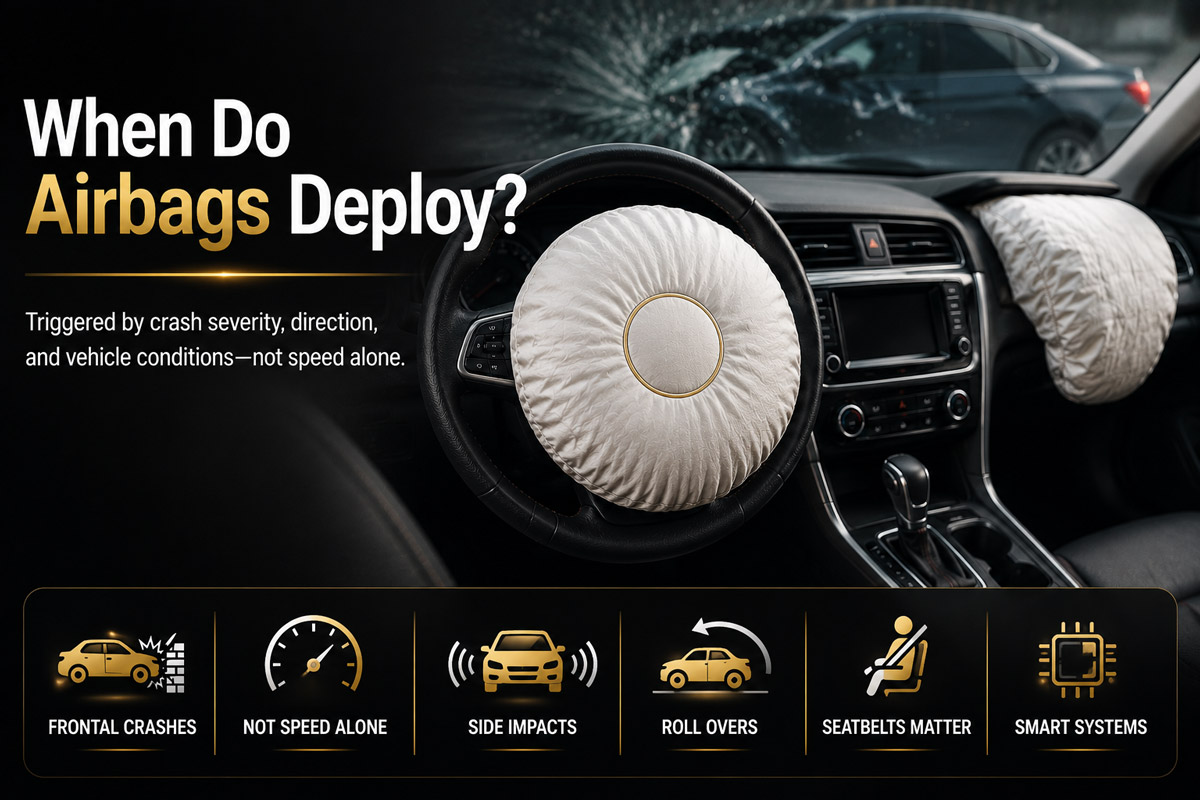
Airbags deploy when a vehicle’s restraint-control system identifies a crash severe enough that an inflated cushion would reduce the occupant’s risk of striking the steering wheel, dashboard, door, roof, or window. Deployment depends on the crash pulse, impact direction, structural deformation, occupant conditions, and airbag type—not vehicle speed alone.
Key Facts: At a Glance
- Frontal airbags generally deploy in moderate-to-severe frontal or near-frontal crashes.
- NHTSA describes the general frontal deployment range as a crash equivalent to striking a rigid barrier at approximately 8–14 mph or more.
- A faster vehicle does not automatically produce deployment; the change in velocity and how quickly that change occurs matter more.
- Side airbags may deploy at lower apparent speeds because occupants have less crush space separating them from the struck door.
- Curtain airbags can deploy in side impacts, rollovers, and some severe angled-frontal crashes.
- Airbags are supplemental restraints and provide their intended protection when occupants also wear seatbelts correctly.
NHTSA’s 8–14 mph figure is a fixed-barrier equivalent, not a promise that every airbag will open whenever the speedometer shows that range. Striking a parked vehicle of similar mass may require roughly twice that closing speed to create comparable deceleration because both vehicles can move and absorb energy.
What Actually Triggers an Airbag?
An airbag is triggered by a measured crash pattern, often called a crash pulse, that indicates rapid velocity change and a meaningful risk of occupant contact with the interior. The restraint-control module evaluates the magnitude, direction, duration, and progression of the impact before commanding specific airbags and seatbelt pretensioners.
The decision is not based on one simple switch. Depending on the vehicle, the restraint system may process information from:
- Accelerometers inside the restraint-control module
- Forward crash sensors
- Door-pressure or side-impact sensors
- Rollover-rate and lateral-acceleration sensors
- Seat-position sensors
- Seatbelt-buckle sensors
- Passenger occupant-classification sensors
- Seatbelt-load or tension sensors
Modern algorithms analyze how deceleration develops over time. A short vibration from a pothole can create a high instantaneous sensor reading without producing the sustained crash pulse, directional pattern, or structural response associated with a deployment-worthy collision.
Is There a Universal Airbag G-Force Threshold?
No universal g-force number determines when every airbag deploys. Claims that all systems begin calculating at 2 g and fire at 3–5 g oversimplify proprietary algorithms that differ by manufacturer, model, model year, seating position, crash direction, and restraint configuration.
A severe but extremely brief sensor spike may not require deployment, while a lower but sustained deceleration pulse can represent a serious crash. Engineers therefore evaluate acceleration against time rather than treating one peak-g value as an on/off threshold.
Must Two Crash Sensors Agree?
Not necessarily. Some systems use multiple sensing paths or plausibility checks to reduce unintended deployment, but “two independent sensors must agree” is not a universal operating rule.
A restraint-control module may contain an internal sensor while comparing it with remote sensors, door-pressure signals, rollover data, or algorithmic checks. The exact architecture belongs to the vehicle manufacturer and may differ even between models sold under the same brand.
At What Speed Do Frontal Airbags Deploy?
Frontal airbags are generally designed to deploy in crashes equivalent to striking a solid, fixed barrier at approximately 8–14 mph or higher, according to NHTSA. The real road speed can be higher or lower because the deployment decision depends on what the vehicle hits, how much each object moves, the contact angle, overlap, braking, and the vehicle’s crush characteristics.
Examples illustrate why speed alone is misleading:
| Crash scenario | Likely frontal-airbag outcome |
| 12 mph into a rigid concrete barrier | Deployment may be appropriate because the vehicle stops abruptly |
| 12 mph glancing contact with another car | Deployment may not be appropriate because the force is oblique and less energy reaches the frontal structure |
| 20 mph into a deformable object | Deployment depends on the resulting crash pulse and occupant risk |
| 25 mph underride beneath a truck | Deployment can be uncertain if the impact bypasses primary sensors or crush structures |
| 30 mph sideswipe | Frontal airbags may remain closed because the force is primarily lateral |
| 40 mph collision after heavy pre-impact braking | The system evaluates impact severity at contact, not the speed observed seconds earlier |
NHTSA also explains that the general 8–14 mph rigid-barrier equivalent may resemble striking a similarly sized parked vehicle at approximately 16–28 mph or more. That comparison is illustrative rather than a model-specific activation specification.
Do Belted and Unbelted Occupants Have Different Thresholds?
Some advanced restraint systems can consider seatbelt use when choosing whether, when, or how forcefully to deploy an airbag. However, there is no dependable rule that every unbelted threshold is 10–14 mph and every belted threshold is 16–18 mph.
Manufacturers calibrate the complete restraint package—seatbelt, pretensioner, load limiter, airbag size, inflator stages, seat position, and vehicle structure—as one system. Seatbelt status may affect deployment strategy, but the exact calibration is not published as a universal consumer threshold.
How Does the Vehicle Decide to Deploy?
The restraint-control module decides by comparing live sensor data with calibrated crash patterns. A simplified deployment sequence is:
- Impact begins. Vehicle structure starts deforming, and sensors measure longitudinal, lateral, vertical, pressure, or rotational changes.
- The crash pulse develops. The module evaluates whether the event resembles a pothole, curb strike, low-speed contact, frontal collision, side intrusion, or rollover.
- Occupant inputs are checked. Depending on the vehicle, the module may consider seat occupancy, passenger classification, buckle status, and seat position.
- Individual restraints are selected. The module may command pretensioners, one inflator stage, both frontal-airbag stages, a knee airbag, a seat-mounted side airbag, or one or both curtains.
- Inflators are fired. Electrical initiators start the inflator reaction or release stored gas.
- The cushions inflate and vent. Each airbag opens before the occupant reaches the corresponding interior surface.
The system may deploy different combinations for two crashes that appear similar from outside. Small differences in angle, overlap, occupant position, deformation, and crash-pulse timing can change the restraint decision.
How Quickly Do Airbags Deploy?
Airbag deployment occurs in milliseconds, with many frontal cushions reaching a protective state within roughly the first several tens of milliseconds of a serious impact. The complete event—from initial impact through occupant loading and cushion venting—continues as the crash develops.
A useful conceptual timeline is:
| Approximate phase | What happens |
| First milliseconds | Sensors begin recording acceleration and deformation |
| Early crash pulse | The control module classifies severity and direction |
| Deployment command | Selected inflators and pretensioners receive firing signals |
| Cushion emergence | Airbags break through designed cover seams |
| Occupant loading | The occupant contacts an already inflated, venting cushion |
| Controlled venting | Gas escapes so the airbag absorbs energy instead of acting like a rigid ball |
Exact millisecond values vary by airbag location, inflator design, crash pulse, vehicle structure, and algorithm. Treating “10 ms decision, 15 ms ignition, 40 ms inflation” as a universal schedule creates false precision.
Do Modern Airbags Use Sodium Azide?
Many early inflators used sodium azide chemistry, but it is inaccurate to describe sodium azide as the typical propellant in every modern airbag. Current inflators use several technologies, including alternative solid gas-generant formulations, stored gas, and hybrid systems.
The relevant consumer fact is that an inflator rapidly produces or releases gas into the cushion. The exact chemical formulation is model- and supplier-specific and should not be inferred from a generic explanation.
Which Airbags Deploy in Different Crashes?
Each airbag protects a particular body region and responds to particular crash directions. A vehicle does not need to deploy every installed airbag during one collision.
| Airbag or restraint | Typical deployment situation | Primary protection |
| Driver frontal airbag | Moderate-to-severe frontal or near-frontal crash | Head and chest |
| Passenger frontal airbag | Frontal crash when deployment is warranted and not suppressed | Head and chest |
| Knee airbag | Selected frontal crashes based on severity and occupant conditions | Knees, thighs, and lower-body positioning |
| Seat-mounted torso airbag | Moderate-to-severe impact on that side | Chest and pelvis |
| Side-curtain airbag | Side impact, rollover, or selected angled-frontal crash | Head and ejection mitigation |
| Center airbag | Selected side impacts in equipped vehicles | Reduces contact between front occupants |
| Seatbelt pretensioner | Frontal, side, rollover, or other calibrated event | Removes belt slack before major occupant movement |
Ford states that knee-airbag deployment can depend on crash severity and occupant conditions, while its Safety Canopy may activate in certain side impacts, rollovers, or other crashes involving sufficient lateral movement, deformation, or rollover likelihood.
When Do Frontal Airbags Deploy?
Frontal airbags deploy primarily in moderate-to-severe frontal and near-frontal crashes where the driver or passenger is moving toward the steering wheel or dashboard. They may remain closed in side impacts, rear impacts, minor frontal contact, and some unusual crashes where inflation would add little protection.
The impact does not have to be perfectly head-on. Offset and angled frontal crashes can produce deployment when sufficient frontal deceleration reaches the vehicle structure, but no universal 30-degree boundary applies to every model.
Will Frontal Airbags Deploy in an Offset Crash?
Frontal airbags can deploy in an offset crash when the impact produces a qualifying frontal crash pulse. Deployment becomes less predictable when only a small part of the bumper or structure is engaged because the force path can bypass major longitudinal rails or remote sensors.
A narrow-overlap crash may be physically severe while producing a different sensor signature from a full-width barrier impact. This is one reason visible vehicle damage cannot independently prove whether deployment should have occurred.
Will Airbags Deploy If the Car Goes Under a Truck?
Airbags may or may not deploy in an underride crash. When a passenger vehicle travels beneath a truck or trailer, the higher structure can bypass the passenger vehicle’s bumper, crash sensors, and intended front crumple zones.
An underride can therefore cause catastrophic windshield, pillar, or roof intrusion without creating the conventional frontal crash pulse expected from bumper-level contact. Non-deployment in such a crash requires engineering investigation; it cannot be judged from road speed alone.
When Do Side Airbags Deploy?
Side airbags deploy when lateral acceleration, door pressure, deformation, or intrusion indicates a moderate-to-severe impact on the corresponding side. Side systems often must react quickly because only a door, pillar, and limited crush space separate the occupant from the striking object.
A narrow pole striking near an occupant can create concentrated intrusion at a lower road speed than a broad vehicle-to-vehicle impact. For that reason, universal “8 mph for poles” or “18 mph for broad objects” rules should not be applied across all vehicles.
Does Only the Struck Side Deploy?
Often, the seat-mounted side airbag and curtain on the struck side deploy, but system behavior varies. Some vehicles deploy both curtains during a rollover or when the algorithm predicts movement that threatens occupants on both sides.
Honda documentation, for example, states that side curtains are designed for moderate-to-severe side impacts and rollovers, and that both curtains can deploy when the control unit senses an impending rollover. Honda also notes that a passenger-side curtain may deploy even when no one occupies that side.
Can Curtain Airbags Deploy in a Frontal Crash?
Curtain airbags can deploy in a sufficiently severe angled-frontal collision if lateral motion or occupant head protection warrants them. Honda identifies moderate-to-severe angled-frontal collisions as one situation in which one or both curtains may inflate.
This does not mean every frontal crash should trigger the curtains. The control module selects the restraints that match the measured direction and expected occupant movement.
Do Airbags Deploy in a Rollover?
Rollover-capable curtain airbags can deploy when sensors identify a rollover or a high likelihood of one. These curtains may remain inflated longer than ordinary frontal airbags to protect heads through multiple contacts and reduce partial or complete ejection through side windows.
Frontal airbags do not automatically deploy merely because the vehicle rolls. They may deploy if the rollover begins with a qualifying frontal impact, but the curtain airbags and pretensioners are usually the restraints specifically calibrated for rotational events.
Honda states that its rollover-capable curtains deploy on both sides when the SRS control unit senses that the vehicle is about to roll over. Ford similarly states that its Safety Canopy activates in certain rollovers and may activate when the vehicle experiences a sufficient likelihood of rollover.
Do Airbags Deploy When You Are Rear-Ended?
Frontal airbags normally do not deploy in a straightforward rear-end impact because the occupants initially move rearward into their seats rather than forward toward the dashboard. Seatbelts, head restraints, seat structures, and vehicle deformation provide the primary protection in that crash direction.
Deployment can still occur during a complex chain collision. A rear impact may push the vehicle into another object, producing a second frontal or side impact severe enough to trigger the corresponding airbags.
Do Airbags Deploy in Every Serious Crash?
No. A crash can be serious without requiring every airbag—or any particular airbag—to deploy. Deployment is appropriate only when the selected cushion is expected to improve protection for the measured direction, severity, and occupant conditions.
Examples of serious-looking crashes with possible non-deployment include:
- A rear impact without a secondary collision
- A vehicle rolling slowly onto its side without a rollover-capable system
- An underride that bypasses normal frontal load paths
- A high-speed sideswipe with limited inward intrusion
- Extensive cosmetic damage accumulated through scraping
- A collision occurring after most energy was dissipated by another impact
- A crash affecting an unoccupied seating position whose airbag is suppressible
Conversely, a vehicle can show modest exterior damage after deployment because bumpers and body panels do not reveal the complete deceleration pulse experienced during contact.
Why Did My Airbags Not Deploy?
Airbags may remain closed because the crash did not meet the calibrated threshold for that airbag, the impact direction did not match its protective purpose, the passenger airbag was intentionally suppressed, or the SRS had a fault. Previous unrepaired deployment, counterfeit components, wiring damage, sensor faults, and module problems are additional possibilities.
A proper investigation should review:
- The exact impact direction and sequence
- Vehicle deformation and intrusion
- Event-data-recorder information, when available
- Diagnostic trouble codes
- SRS warning-light history
- Seatbelt and pretensioner condition
- Occupant-classification status
- Previous crash and repair records
- Open recalls
- Airbag-module and inflator authenticity
NHTSA notes that a used vehicle may fail to deploy because a previously deployed airbag was never replaced. The agency recommends replacing airbags after deployment and reporting suspected non-deployment in an injury-producing crash for potential investigation.
Does Visible Damage Prove an Airbag Should Deploy?
Visible damage does not prove that deployment was required. Sheet metal, bumper covers, lamps, wheels, suspension parts, and doors can produce expensive damage without generating the occupant deceleration or intrusion that a particular airbag is designed to address.
The reverse is also true: a rigid barrier can produce a short, severe crash pulse while leaving a smaller-looking crush zone than a long scraping collision. Crash investigators examine force paths and recorded data rather than repair cost alone.
Can a Pothole or Curb Trigger an Airbag?
An ordinary pothole, speed bump, hard brake application, or door slam should not deploy a properly functioning airbag system. The control module is calibrated to distinguish routine shocks from crash pulses through signal direction, duration, magnitude, and corroborating sensor data.
An extreme underbody strike or curb impact can occasionally trigger a restraint if the event resembles a severe collision closely enough. Such deployment is unusual and should be documented and inspected for sensor, algorithm, structural, or component problems.
Will Airbags Deploy While a Car Is Parked?
Airbags generally do not deploy merely because a parked, unpowered vehicle is struck, although the answer depends on system design, impact timing, and available reserve power. Restraint modules can contain temporary energy reserves so that an airbag remains operable during the earliest part of a crash even if the main electrical supply is interrupted.
A parked vehicle with its ignition off may not have the same active sensing state as a running vehicle. The owner’s manual and manufacturer engineering information are the correct sources for a specific model.
Do Airbags Deploy Without Seatbelts?
Airbags can deploy when an occupant is not wearing a seatbelt. The word supplemental means airbags are designed to supplement belts, not that deployment always requires a buckled belt.
Advanced systems may use buckle status to adjust timing, stage selection, or restraint strategy. An unbelted occupant can move toward the inflating cushion too early, increasing injury risk and reducing the benefit of both the airbag and the vehicle’s controlled-crash structure.
NHTSA reports that the combination of seatbelts and frontal airbags is substantially more effective than either protection strategy used improperly or alone.
Do All Airbags Deploy With the Same Force?
No. Advanced frontal airbags can alter deployment according to crash severity and occupant-related inputs. A dual-stage inflator may fire one stage, both stages, or stages at calibrated intervals, while an occupant-classification system may suppress the passenger frontal airbag.
Relevant inputs may include:
- Crash severity and pulse shape
- Driver-seat position
- Passenger-seat classification
- Seatbelt buckle status
- Occupant presence
- Seatbelt loading
- Whether the seat appears to hold a small occupant or child restraint
These systems have limitations. A passenger leaning, placing weight on the seat edge, using certain cushions, storing heavy objects on the seat, or allowing liquid into the sensor area can affect classification on some vehicles. The passenger-airbag indicator and owner’s manual must be checked rather than assuming the system has classified the occupant correctly.
Why Did Only One Airbag Deploy?
Only one airbag may deploy because the system selected the restraint relevant to the impact direction and occupied seating position. A driver frontal airbag can deploy without the passenger airbag when the passenger seat is empty or suppressed; one side airbag can deploy when only that side experiences qualifying intrusion.
Similarly, pretensioners can activate without visible airbag deployment, and a curtain may deploy without a frontal cushion. Unequal deployment is therefore not automatically evidence of a malfunction.
Unexpected asymmetry should still be investigated when:
- An adult properly occupied the passenger seat
- The passenger-airbag indicator showed the airbag as active
- Severe intrusion occurred on a side whose airbag remained closed
- An SRS light was illuminated before the crash
- The vehicle had previous collision repairs
- A recall or service campaign applies
Does the Airbag Warning Light Stop Deployment?
An illuminated SRS warning light means the control module has detected a condition that may reduce or disable part of the restraint system. It does not prove that every airbag is disabled, but no occupant should rely on normal deployment until the fault has been diagnosed.
Depending on the code, the fault may affect one airbag, a pretensioner, an occupant sensor, a crash sensor, a clockspring circuit, a wiring connector, or the entire control module. A manufacturer recall notice documents, for example, that an illuminated warning caused by a seat-side connector problem could disable affected side airbags and prevent intended deployment.
The warning should be scanned with diagnostic equipment capable of accessing the SRS module. A basic engine-code reader usually cannot retrieve airbag-system codes.
How Should Occupants Sit Around Airbags?
Drivers should sit at least 10 inches from the center of the steering-wheel airbag when possible while maintaining full pedal and steering control. The belt should lie low across the hips and across the center of the chest, and the steering wheel should point toward the chest rather than the face.
Safe positioning includes:
- Sit upright with the seatback reasonably vertical.
- Keep the chest away from the steering-wheel hub.
- Do not lean against a door containing a side airbag.
- Do not place feet or legs on the dashboard.
- Do not attach objects to airbag covers, pillars, windows, or roof edges.
- Do not use unapproved seat covers over seat-mounted airbags.
- Keep hands on the wheel without crossing an arm over the airbag cover.
NHTSA advises maintaining at least 10 inches between the driver’s breastbone and the steering-wheel airbag and emphasizes that seatbelts remain essential.
When Is the Passenger Airbag Suppressed?
The passenger frontal airbag may be suppressed when the occupant-classification system detects an empty seat, a child-sized load, or another condition for which deployment could create more risk than benefit. The exact indicator behavior and classification limits differ by vehicle.
A passenger-airbag-off light is not the same as the general SRS warning light:
- Passenger airbag off: The vehicle may be intentionally suppressing selected passenger restraints.
- SRS warning: The system has detected a fault requiring diagnosis.
- Normal self-test: The SRS light briefly illuminates at startup and then turns off.
Ford documentation shows that its passenger frontal airbag may be disabled for an empty seat or a child-classified occupant and enabled for an adult classification.
When Are Airbags Dangerous to Children?
A deploying frontal passenger airbag is particularly dangerous to a rear-facing child seat because the child’s head is positioned close to the airbag cover and in the deployment path. A rear-facing seat must never be installed in front of an active frontal airbag.
Children under 13 should ride properly restrained in a rear seating position whenever one is available. Older children still need the correct child restraint or booster until the vehicle belt fits across the hips and chest rather than the abdomen and neck.
Do not rely solely on a passenger-classification sensor when a safer rear seat is available. Sensors can be affected by seating position, child-restraint installation, objects, moisture, and system faults.
What Happens After Airbags Deploy?
A deployed airbag is a single-use component and must be replaced according to manufacturer procedures. The repair may also involve pretensioners, trim panels, steering-wheel or dashboard components, impact sensors, wiring, seat components, the restraint-control module, and post-repair diagnostics.
After deployment:
- Move away from traffic and fire hazards when medically able.
- Call emergency services if anyone may be injured.
- Do not touch hot inflator components.
- Do not reconnect damaged low-voltage wiring.
- Have the vehicle towed rather than assuming it is safe to drive.
- Require a complete SRS scan and manufacturer-compliant inspection.
- Check the VIN for recalls.
- Use new, traceable, approved components rather than unknown inflators.
A universal replacement price is not reliable. Cost depends on the number and type of deployed restraints, dashboard construction, seat damage, pretensioners, structural repairs, calibration requirements, labor rates, and parts availability. Multi-airbag crashes can exceed the vehicle’s economic repair value even when the engine remains operable.
Can an Airbag Deploy Twice?
The same airbag cannot deploy twice. Once an inflator fires and the cushion opens, that module must be replaced.
A vehicle can experience additional deployment during the same collision sequence only from other unfired airbags. For example, a first side impact may deploy one curtain, followed by a severe frontal impact that triggers frontal restraints if the control module and electrical reserve remain functional.
Can You Drive a Car After Deployment?
A vehicle may physically move after deployment, but it should normally be towed and inspected rather than driven on public roads. The crash may have damaged steering, brakes, suspension, cooling systems, high-voltage components, sensors, seatbelts, wiring, glass, or structural load paths.
Airbag powder, smoke-like residue, warning lights, or a running engine do not establish roadworthiness. In an electric or hybrid vehicle, damaged high-voltage components add hazards that may not be visible.
How Can Used-Car Buyers Check the Airbags?
A used-car buyer should verify the SRS startup test, scan the airbag module, examine repair history, check the VIN for recalls, and inspect airbag-cover seams and seatbelts. A warning bulb that never illuminates at startup can be as suspicious as one that remains on.
Use this checklist:
- Confirm the SRS lamp illuminates during startup.
- Confirm it turns off after the self-test.
- Scan the SRS module, not just the engine computer.
- Look for crash-data or resistance-related codes.
- Inspect dashboard, steering-wheel, seat, and headliner seams.
- Check whether seatbelts retract and latch normally.
- Compare manufacturing labels and part numbers where accessible.
- Review salvage, insurance, and collision records.
- Check the VIN for unresolved recalls.
- Obtain a specialist inspection after any reported deployment.
NHTSA advises buyers unfamiliar with a vehicle’s history to obtain a history report and seek inspection when a previous deployment may have been repaired with questionable components.
NHTSA has also warned about dangerous replacement inflators and, in April 2026, announced a ban on certain defective imported inflators linked to deaths and serious injuries. Traceable, approved parts are therefore a safety requirement rather than a cosmetic preference.
Common Airbag Deployment Misconceptions
“Airbags deploy whenever a car reaches 15 mph.”
False. Road speed does not equal crash severity. A vehicle traveling 15 mph may stop gradually against a deformable object, glance off another vehicle, or strike a rigid wall almost instantly, producing three different crash pulses.
“All airbags should open in a major accident.”
False. Each cushion has a specific protective purpose. Deploying an irrelevant airbag adds injury risk and repair damage without improving occupant protection.
“No deployment means the system failed.”
False. Non-deployment may be correct when the crash direction, severity, occupancy, or expected occupant motion does not require that airbag. A possible defect should be determined through diagnostic and crash-data analysis.
“The airbag light means every airbag is off.”
Not always. The warning can identify a fault in one circuit or a broader module problem. Because the driver cannot know the remaining protection without reading the codes, the vehicle should be treated as having reduced restraint capability.
“Airbags replace seatbelts.”
False. Airbags are supplemental restraints. Seatbelts control occupant position, distribute forces, reduce ejection, and help the occupant reach the airbag at the correct time.
Expert Insights About Deployment
Crash Direction Is Often More Important Than Damage Cost
A $10,000 sideswipe repair can occur without a frontal deployment, while a lower-cost rigid frontal impact can trigger both frontal airbags and pretensioners. Repair cost measures damaged parts; the restraint module measures occupant-threatening motion.
Airbag Deployment Is a Timing Decision
The module must act before the occupant reaches the steering wheel, dashboard, door, or window. A restraint that opens too late offers little benefit, while one that opens unnecessarily exposes the occupant to deployment force. Calibration therefore balances false non-deployment against false deployment within a very short decision window.
The Safest Outcome Is Not Maximum Deployment
A well-calibrated system deploys the minimum combination of restraints needed for the crash. More opened airbags do not necessarily mean better protection; correct selection, timing, inflation level, belt loading, and occupant positioning matter more.
Frequently Asked Questions
Can airbags deploy if the battery is disconnected in a crash?
Airbag control modules commonly contain temporary reserve energy so they can complete a deployment decision if crash damage interrupts normal electrical power. Reserve energy is limited, however, and does not mean an airbag remains indefinitely active after the battery has been disconnected. Service procedures specify waiting periods before SRS work.
Do airbags deploy if a vehicle hits an animal?
Airbags can deploy after striking a large animal if the collision produces a qualifying crash pulse and impact direction. The animal’s mass, the vehicle’s speed, braking, contact height, structural engagement, and secondary impacts all matter. Striking a small animal generally does not create frontal deployment severity.
Can hard braking deploy the airbags?
Hard braking alone should not deploy airbags because braking produces a controlled, comparatively gradual deceleration rather than the short crash pulse associated with structural impact. Braking immediately before a collision can reduce impact severity, but the module bases its deployment decision on the developing collision event and related sensor inputs.
Can an airbag deploy underwater?
Submersion alone should not trigger an airbag. Deployment would require an earlier qualifying collision or rollover event while the restraint system remained active. After submersion, corrosion and electrical damage can make the SRS unreliable, so the vehicle requires specialized inspection even when no airbags opened.
Can airbags deploy accidentally while driving?
Uncommanded deployment is rare but possible because of component defects, severe underbody impacts, wiring problems, water intrusion, incorrect repairs, or defective inflators. Stop safely, seek medical evaluation when needed, preserve the vehicle for inspection, photograph the scene, and report suspected defects to the manufacturer and relevant safety authority.
Does an airbag always leave burns or powder?
Airbag deployment can leave abrasions, redness, heat injuries, hearing symptoms, and powder-like residue, but these effects are not universal. The residue may come from inflation materials and cushion-treatment compounds. Persistent pain, breathing difficulty, eye exposure, burns, numbness, or hearing changes warrant prompt medical evaluation.
The Bottom Line
When do airbags deploy? Airbags deploy when the restraint-control module identifies a crash pulse, direction, and occupant risk for which a particular cushion can improve protection. Frontal airbags generally activate in moderate-to-severe frontal or near-frontal crashes, while side and curtain airbags respond to qualifying lateral impacts, intrusion, angled crashes, and rollovers.
No single road speed, peak g-force, damage amount, or impact angle predicts deployment in every vehicle. The correct assessment combines crash direction, velocity change, deceleration timing, structural engagement, occupant classification, seatbelt status, diagnostic data, and the manufacturer’s calibration for each individual restraint.