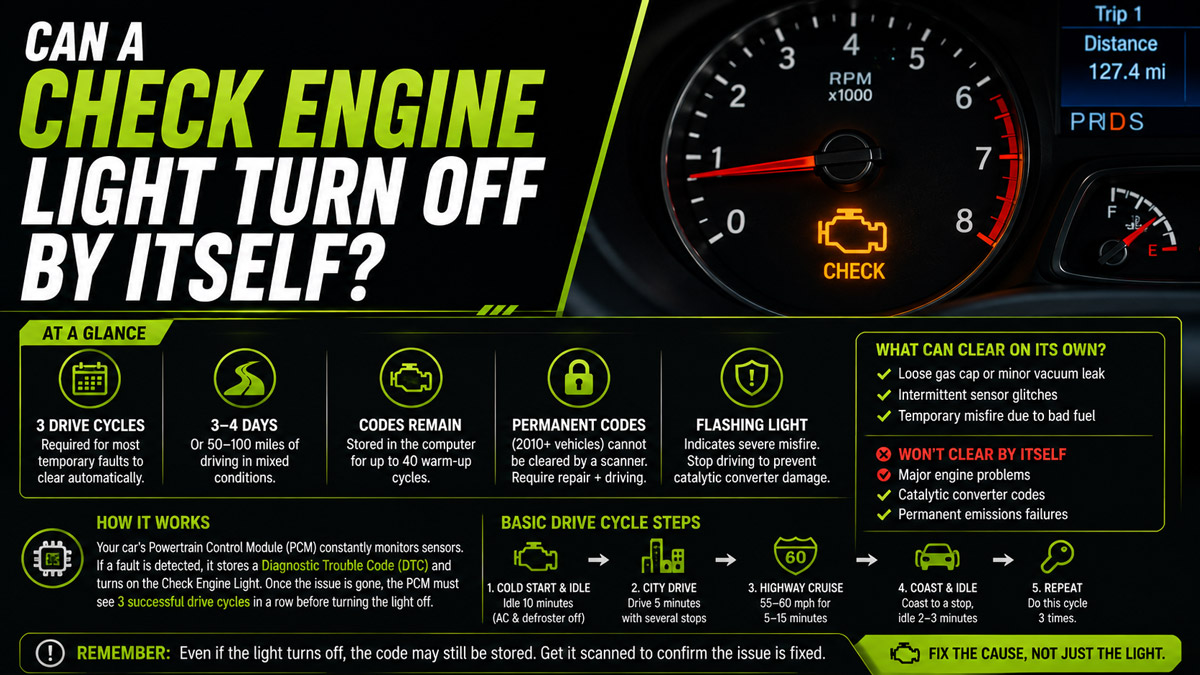
Yes, a check engine light can turn off by itself if the vehicle’s powertrain control module (PCM) verifies the underlying fault no longer exists. For most temporary malfunctions, the light will automatically deactivate after the vehicle completes three consecutive, successful drive cycles without detecting the original error.
Key Facts / At a Glance
- The check engine light—officially the Malfunction Indicator Lamp (MIL)—is triggered when a sensor logs data outside preset operational boundaries.
- Automatic clearing requires 3 to 4 days of driving (or 50 to 100 miles) to satisfy the computer’s “readiness monitor” testing phases.
- Even when the dashboard light turns off, the historical Diagnostic Trouble Code (DTC) remains stored in the computer’s memory for up to 40 warm-up cycles.
- Permanent diagnostic codes (on 2010+ vehicles) cannot be cleared by any scan tool; they require a physical repair followed by 200 miles of driving.
- A flashing red check engine light indicates a catastrophic cylinder misfire that is actively destroying the catalytic converter—it will never self-clear.
How Does the Powertrain Control Module Clear the Check Engine Light?
The Powertrain Control Module (PCM) clears a check engine light by running continuous automated tests called readiness monitors. The PCM acts as the central brain of the vehicle, constantly analyzing data from dozens of sensors (like O2 sensors, mass airflow sensors, and thermal gauges) to ensure the engine is operating efficiently and within federal emissions standards.
When a component fails one of these tests, the PCM logs a Diagnostic Trouble Code (DTC) and illuminates the dashboard light. To turn the light off, the PCM relies on the “Self-Clearing Rule.” If the component that initially failed subsequently passes its internal readiness monitor test for a specific number of consecutive drive cycles—usually three—the computer assumes the fault was a temporary glitch. The PCM then automatically deactivates the dashboard light.
Expert Insight: Automotive diagnostic computers use two types of monitors. Continuous monitors (which check for misfires and fuel system errors) run the entire time the engine is on. Non-continuous monitors (like the EVAP system, which checks for fuel vapor leaks) only run under highly specific conditions, such as after a cold soak overnight. This is why a loose gas cap code often takes days to clear on its own.
How Long Does It Take for a Check Engine Light to Turn Off by Itself?
A check engine light takes roughly 3 to 4 days, or between 50 and 100 miles of mixed city and highway driving, to turn off by itself. This timeframe allows the vehicle to complete the necessary three consecutive drive cycles required to verify the mechanical issue has been resolved.
The exact time varies based on your driving habits. A driver who commutes 5 miles a day in stop-and-go traffic may wait a week for the light to clear, because they never reach the highway speeds required to trigger the O2 sensor readiness monitors. Conversely, a driver taking a road trip might clear a temporary code in a single afternoon if they cycle the ignition a few times at rest stops.
What Types of Diagnostic Trouble Codes Will Clear Automatically?
The specific architecture of the engine code determines whether your car has the capability to self-clear. Some codes vanish immediately, while others are hard-coded into the ECU for safety compliance.
| Code Type | Dashboard Behavior | Typical Causes | Self-Clearing Capability |
| Pending Codes | Light stays off. | Intermittent misfires, temporary sensor voltage drops. | High. Clears immediately if the issue does not recur on the very next engine start. |
| Active / Stored Codes | Light stays steadily lit. | Loose gas cap, vacuum leak, degraded spark plug. | Medium. Clears automatically after 3 successful drive cycles, provided the physical fault is gone. |
| Permanent Codes | Light may turn off, but code stays in memory. | Severe emissions failures (mandatory on all post-2010 vehicles). | Strict. Cannot be wiped by a scanner. Requires physical repair plus up to 15 warm-up cycles and 200 miles. |
| Flashing Codes | Light blinks rapidly (often red). | Severe multi-cylinder misfires dumping raw fuel into the exhaust. | None. Immediate shutdown required to prevent $2,000+ in catalytic converter damage. |
How Do You Complete a Universal Drive Cycle?
To force the check engine light to evaluate a repair and turn off naturally, you must execute a structured drive cycle. A drive cycle is a specific sequence of starting, idling, accelerating, and decelerating that forces the vehicle’s computer to run through all of its non-continuous readiness monitors.
Follow this sequential process:
- Cold Start & Idle: Ensure the vehicle has sat for at least 8 hours (a “cold soak”). Start the engine and let it idle in Park or Neutral for exactly 10 minutes. Condition check: Keep the air conditioning and rear defroster completely off to reduce electrical load.
- City Acceleration: Transition to a city road. Accelerate smoothly to 25–35 mph and drive for 5 minutes, incorporating at least three complete stops where the vehicle idles in Drive for 30 seconds.
- Highway Cruise: Merge onto a highway and gradually accelerate to 55–60 mph. Hold this exact speed with a steady throttle for 5 to 15 minutes. Success checkpoint: You will know you’ve held the throttle steady enough if the transmission stays in its highest overdrive gear without downshifting.
- Natural Deceleration: Safely let off the accelerator pedal and allow the vehicle to coast down naturally to 20 mph. Common mistake: Do not touch the brake pedal or the clutch during this coasting phase; braking aborts the EGR monitor test.
- System Reset: Park the vehicle and turn off the ignition. Repeat this process for two more trips.
Expert Insight: The single biggest reason a drive cycle fails to run is fuel level. The EVAP readiness monitor will automatically abort its self-test if your gas tank is below 15% or above 85% full. Always perform a drive cycle with roughly a half-tank of gas.
Should You Let the Light Turn Off by Itself or Use a Scanner?
Deciding how to reset the Powertrain Control Module depends entirely on your immediate needs regarding state inspections and diagnostic accuracy. While letting the light turn off by itself costs $0 and proves the system is fixed, manually clearing it introduces data risks.
Option 1: The Natural Drive Cycle
Waiting for the light to clear itself is the safest and most accurate method.
- The Verdict: Choose this if you have an impending state smog inspection. Allowing the computer to self-clear keeps all internal emissions monitors in a “Ready” state, ensuring you pass inspection. The only drawback is the time commitment required (up to 100 miles).
Option 2: OBD-II Scan Tool Clear
Using a $20 to $60 Bluetooth or handheld OBD-II scanner allows you to wipe the code instantly from the dashboard.
- The Verdict: Choose this for post-repair validation if you are a DIY mechanic. However, clearing the code manually instantly reverts all emissions monitors to “Incomplete.” If you drive straight to a state inspection station after using a scan tool, your vehicle will automatically fail, regardless of how cleanly the engine is running.
Option 3: Battery Disconnect
Removing the negative battery terminal for 15 minutes drains the ECU’s capacitive memory, wiping active codes.
- The Verdict: Avoid this on modern vehicles. While it works on pre-2006 cars, disconnecting the battery on newer vehicles erases the throttle body’s idle relearn data, radio presets, and transmission shift adaptations. It can cause stalling and rough idling upon restart, and it will not clear post-2010 Permanent codes.
What Are the Most Common Mistakes When Dealing With Engine Codes?
When attempting to diagnose or clear a dashboard warning, vehicle owners frequently compound the original mechanical problem with poor diagnostic practices. Avoid these primary failure modes:
- Firing the “Parts Cannon”: The most common mistake is reading a code (e.g., P0137 O2 Sensor Low Voltage) and immediately replacing the sensor named in the code. A code does not mean a part has failed; it means the circuit is reporting bad data. A vacuum leak or a frayed wire will trigger an O2 code even if the sensor is perfect.
- Ignoring a Flashing Light: Assuming a blinking check engine light is just a sensor glitch is a catastrophic error. A flashing light is an active alert that unburned fuel is entering the exhaust. Driving just five miles in this condition can melt the internal honeycomb of your catalytic converter, turning a $100 spark plug replacement into a $2,500 exhaust repair.
- Assuming Auto-Clearing Means the Problem is Gone: Because the check engine light can turn off by itself, many drivers assume the car “fixed itself.” Mechanical parts do not heal. The light turning off usually indicates a thermal intermittent issue—such as a failing fuel pump relay that only acts up on hot days, or an O2 sensor that is slowly degrading but hasn’t fully failed yet.
Frequently Asked Questions
Will a loose gas cap cause a check engine light to turn on?
Yes, a loose, cracked, or missing gas cap introduces outside air into the fuel system, triggering a large EVAP leak code (often P0455). If you tighten the cap until it clicks three times, the light will typically turn off by itself after three days of normal driving.
How do I pass an emissions test if my check engine light is on?
You cannot pass a state emissions test with an active check engine light. Furthermore, you cannot “cheat” the test by clearing the code with a scanner in the parking lot, as the emissions machine will read your system monitors as “Not Ready” and reject the vehicle automatically.
What is the difference between a check engine light and a maintenance required light?
The check engine light is triggered by the engine computer detecting a real-time fault in emissions or performance sensors. The “Maintenance Required” (or Maint Reqd) light is simply a mileage countdown timer (usually every 5,000 miles) reminding you to change the oil and rotate the tires.
Does an auto parts store charge to check engine codes?
No, major automotive retailers like AutoZone, O’Reilly Auto Parts, and Advance Auto Parts will connect an OBD-II scanner to your vehicle and provide a printout of your diagnostic trouble codes for free. However, they cannot legally clear the codes for you due to liability regulations.
What is a warm-up cycle?
A warm-up cycle is a specific computer parameter used to clear historical code memory. For a trip to count as a “warm-up cycle,” the Engine Coolant Temperature (ECT) must rise at least 40°F from its starting temperature and cross a minimum threshold of 160°F.
Understanding whether a check engine light can turn off by itself ultimately comes down to patience and diagnostics. By allowing the powertrain control module to run its natural drive cycles, you ensure that the repair is verified by the vehicle’s own internal logic, keeping your emissions system compliant and your engine protected.