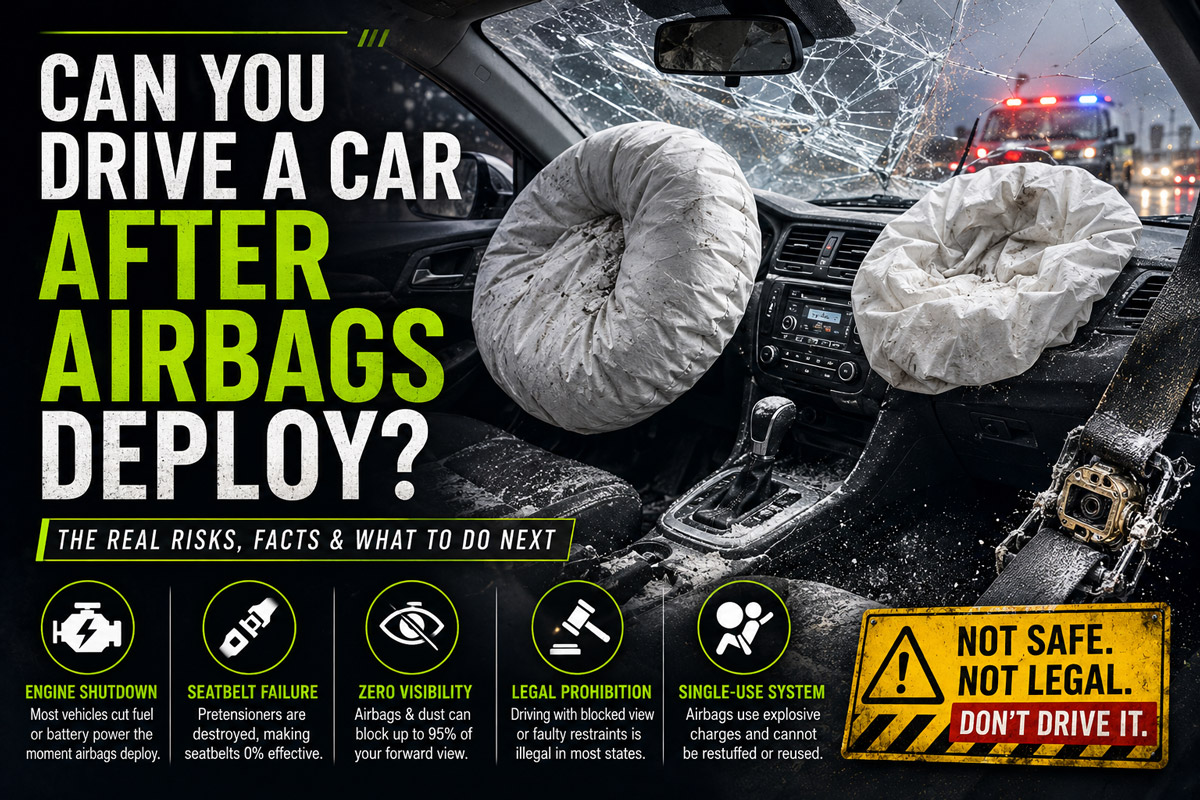
No, you cannot safely or legally drive a car after the airbags deploy. The deployment triggers built-in safety mechanisms that shut off the vehicle’s engine, permanently lock the seatbelt pretensioners, and severely block the driver’s forward vision. Driving a vehicle with deployed airbags risks catastrophic mechanical failure.
At a Glance: Post-Deployment Realities
- Engine Shutdown: Most modern vehicles sever fuel or battery power the millisecond an airbag deploys.
- Seatbelt Failure: Deployed airbags permanently ruin seatbelt retractors, rendering the belts 0% effective.
- Zero Visibility: Hanging nylon fabric and heavy cornstarch dust block up to 95% of driver visibility.
- Legal Prohibition: Driving with a blocked windshield or compromised safety restraint system violates state laws.
- Single-Use System: Airbags rely on a spent chemical explosion; they cannot be restuffed or reused.
What should you do immediately after the airbags deploy?
- Turn off the ignition. Even if the engine stalled automatically, turning the key or pushing the ignition button to the “Off” position stops the electrical system from sparking and shuts off the fuel pump.
- Evaluate for injuries. The chemical explosion that deploys an airbag at 150 to 185 mph frequently causes minor abrasions, bruising, or ringing in the ears. Check all passengers.
- Exit the vehicle if safe. A heavy cloud of white dust (cornstarch or talcum powder) will fill the cabin. This powder prevents the airbag from sticking during storage, but it can irritate the lungs.
- Move to safety and call 911. Do not attempt to clear the airbag out of the way or restart the vehicle while sitting in a live traffic lane.
Why does the engine shut down after an airbag deploys?
Modern automotive engineering deliberately forces an engine shutdown to prevent catastrophic fires following a collision. When the airbag control module detects an impact severe enough to fire the airbags, it simultaneously sends a kill signal to the vehicle’s powertrain.
If a driver steps on the gas pedal right after a deployment, the car will usually be completely dead. Pumping high-pressure gasoline through a ruptured fuel line near hot engine components is a massive fire hazard. To stop this, manufacturers use one of two specific cutoff mechanisms: mechanical inertia switches or electrical pyrotechnic fuses.
Which cars use pyrotechnic battery fuses versus inertia switches?
| Cutoff Mechanism | How It Works | Common Vehicle Types |
|---|---|---|
| Inertia Fuel Switch | A physical ball-in-cone mechanism trips upon impact, instantly cutting electrical power to the fuel pump. | Older gas vehicles, many Ford models, early 2000s trucks. |
| Pyrotechnic Fuse | A small explosive wedge detonates inside the main battery cable, physically severing the high-voltage electrical connection. | Tesla, BMW, Audi, and almost all modern electric/hybrid vehicles. |
How do you reset an inertia fuel cutoff switch to move the car?
- Locate the switch. Check the owner’s manual. The inertia switch is typically a small black box with a red or yellow button on top, located in the trunk behind the side lining, or in the passenger-side footwell behind the kick panel.
- Press the reset button. Push the red or yellow button down firmly until it clicks into place.
- Check for fuel leaks. Before starting the vehicle, inspect the ground underneath the engine bay and fuel tank. If you smell heavy gasoline or see a puddle, do not start the car.
- Turn the ignition. Turn the key to the “On” position for 10 seconds to prime the fuel pump, then attempt to crank the engine.
Note: You should only reset this switch to clear a stranded vehicle from a dangerous intersection or train track. You should not drive the vehicle home.
How do you move a car off the road if the engine won’t start?
- Shift into Neutral. If the vehicle has a mechanical gear shifter, press the brake and move the lever to Neutral (N).
- Use the shift-lock release. If the electronic shifter is locked because the battery pyrotechnic fuse blew, locate the small plastic cover near the shifter marked “Shift Lock.” Pry it off with a flathead screwdriver or key, push the hidden button down, and move the shifter to Neutral.
- Clear the steering wheel. Violently push or slash the hanging deflated airbag fabric out of your line of sight.
- Push the vehicle. Have passengers or bystanders push the car to the shoulder while the driver steers. Remember that power steering and power brakes will not function; turning the wheel and stopping the car will require significant physical force.
Do seatbelts still work after an airbag deploys?
No, seatbelts do not work after an airbag deploys. The Supplemental Restraint System (SRS) fires the airbags and the seatbelt pretensioners at the exact same time.
Seatbelt pretensioners are pyrotechnic devices located in the seatbelt buckle or retractor mechanism. Upon impact, a small explosive charge fires, violently pulling the seatbelt tight against the occupant’s chest to lock them into the seat before the airbag hits them. Once this explosive fires, the retractor mechanism permanently seizes. The seatbelts become entirely stretched out, rigid, and 0% effective. Driving with spent pretensioners leaves the driver completely unprotected in a secondary crash.
Can a deployed airbag catch on fire?
Yes, a deployed airbag and its steering wheel housing can catch on fire, though it is rare. Airbags deploy using a solid chemical propellant—typically sodium azide or guanidine nitrate—that rapidly burns to create nitrogen gas.
Immediately following deployment, the metal canister behind the steering wheel remains dangerously hot, often exceeding 150°F (65°C). If the explosive charge malfunctions, or if the intense heat melts surrounding plastic dashboard components and touches exposed wiring, a localized smoldering fire can start. Drivers should never touch the metal airbag components inside the torn steering column immediately after a crash.
Is it illegal to drive a vehicle with deployed airbags?
Yes, driving a vehicle with deployed airbags is implicitly illegal across all 50 US states and most international jurisdictions.
While federal law regulates the manufacturing of airbags, state laws dictate roadworthiness. Every state requires a driver to have an unobstructed view through the windshield. A deployed steering wheel airbag or shattered side-curtain airbag fundamentally blocks the driver’s vision. Furthermore, driving a vehicle with a compromised safety system guarantees an immediate failure during state safety inspections. A police officer will cite the driver for operating an unsafe vehicle and legally mandate a tow.
Can you just stuff the airbag back into the steering wheel?
No. Airbags are single-use, chemically driven explosive systems. They cannot be repacked, restuffed, or taped back together.
Once an airbag fires, the internal chemical propellant is completely spent, and the nylon fabric is structurally compromised by the extreme heat and force of the expansion. Furthermore, the plastic trim covers on the steering wheel or dashboard physically shatter to allow the bag to escape. The entire airbag module, along with the steering wheel clock spring and crash sensors, must be removed and replaced by a certified automotive technician using factory-new parts.
Can the airbag warning light be manually reset?
No, you cannot manually reset the SRS airbag warning light with a standard OBD2 scanner after a deployment.
When an airbag deploys, the Airbag Control Module (ACM) permanently writes the “crash data” into its internal hard drive. This is a deliberate manufacturer feature designed to prevent shady rebuilders from hiding major accidents. To turn the light off and restore functionality to the vehicle’s safety systems, the ACM itself must either be replaced entirely or removed and sent to a specialty programmer who can manually flash and rewrite the computer’s memory chip.
Will insurance cover damages if you drive after a deployment?
No, auto insurance providers will generally deny any secondary claims if you choose to drive a vehicle post-deployment.
If you drive a car away from an accident scene and destroy the engine because the radiator was secretly leaking coolant, the insurer will classify that as “driver negligence” and refuse to pay for the replacement engine. Similarly, if you cause a secondary crash because your vision was blocked by the deflated airbag or your brakes failed, you assume total financial and legal liability for the resulting damages.
How much does it cost to replace deployed airbags?
Replacing a single deployed airbag costs between $750 and $1,500 for parts and labor. However, airbags rarely deploy alone.
A standard frontal collision usually triggers the driver steering wheel airbag, the passenger dashboard airbag, and both front seatbelt pretensioners. When factoring in the required replacement of the Airbag Control Module ($400 to $800), the steering wheel clock spring ($200 to $400), and the physical repair to the shattered dashboard and windshield, a standard dual-airbag deployment repair typically ranges from $3,000 to $6,000 before addressing any exterior body damage.
Does an airbag deployment automatically total a car?
No, an airbag deployment does not automatically total a car, but it makes a total loss highly likely for vehicles older than five years.
Insurance companies total a vehicle when the combined cost of repairs exceeds a specific percentage of the car’s Actual Cash Value (ACV). This threshold is governed by state law, typically sitting between 70% and 80%. Because a full airbag system replacement easily costs upwards of $4,000, older vehicles simply do not have enough residual value to justify the repair. A $20,000 modern vehicle will easily survive a deployment financially; a $5,000 used car will be written off immediately.
The Bottom Line
You cannot drive a car after the airbags deploy because the vehicle is mechanically compromised, physically unsafe, and legally unroadworthy. Post-collision safety protocols proactively sever fuel lines and battery cables to kill the engine, while pyrotechnic seatbelt pretensioners permanently lock, stripping you of all crash protection. Unless you are moving the vehicle a few feet to escape immediate peril on a train track or blind highway curve, you must turn the ignition off, exit the vehicle, and call a tow truck.