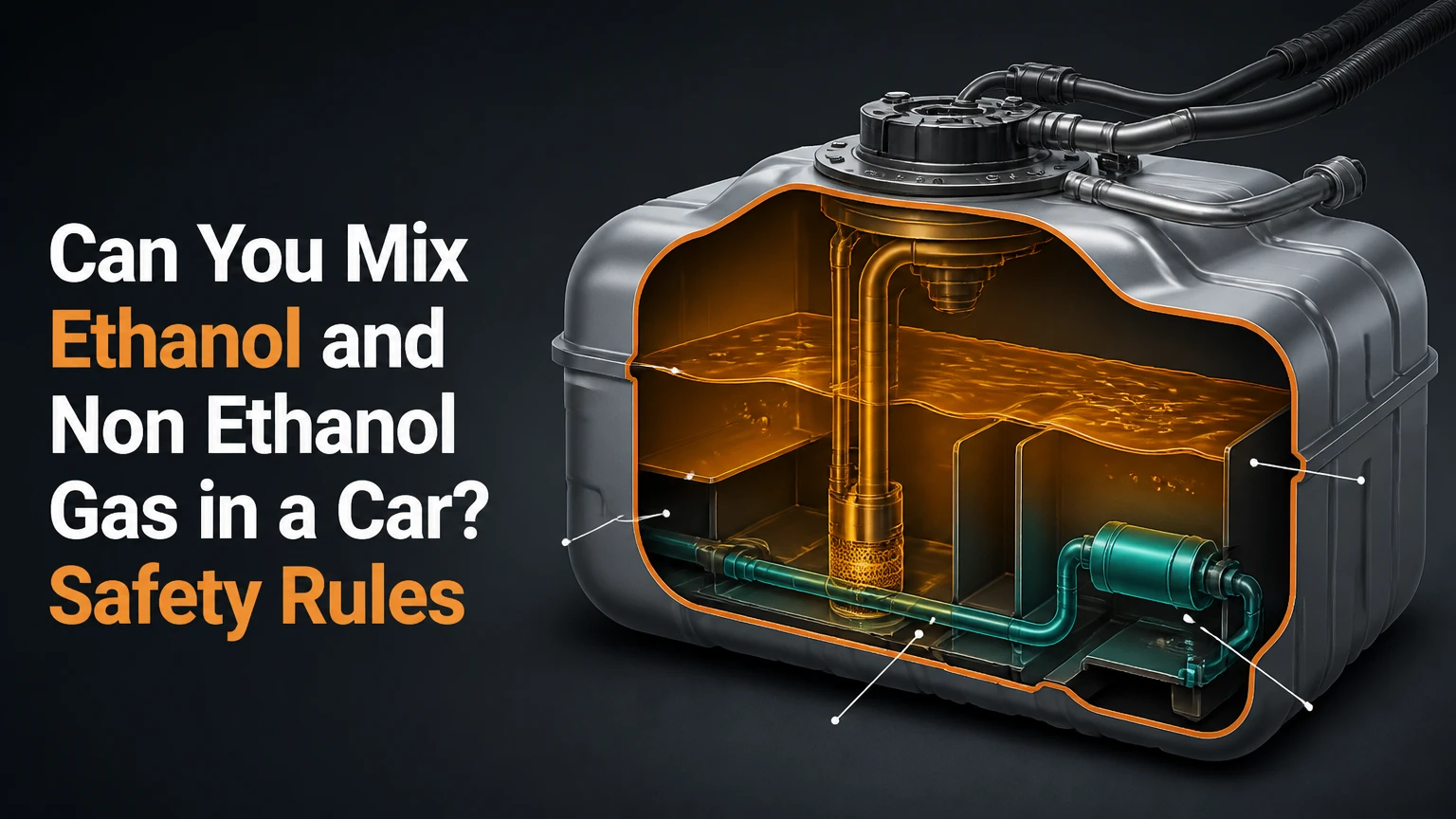
Yes, you can mix ethanol gasoline and non-ethanol gasoline in a car when both fuels are ordinary gasoline approved for that vehicle. E0 and E10 combine into a uniform blend, such as E5 when equal volumes are mixed, and a modern gasoline engine usually operates normally on it. Do not treat E85, diesel, or contaminated fuel as equivalent.
Key Facts at a Glance
- E0 contains 0% ethanol, while E10 contains up to 10% ethanol by volume.
- Equal volumes of E0 and E10 produce approximately E5, assuming accurate fuel labels and complete mixing.
- Mixing E0 and E10 does not damage a gasoline vehicle that is approved for E10.
- A vehicle’s oxygen sensors help correct air-fuel mixture changes, but most ordinary ECUs do not directly identify the exact ethanol percentage.
- E15 is permitted only for vehicles and equipment approved under applicable rules; E85 requires a flex-fuel vehicle.
- E0 can be useful for seasonal storage, but its higher price often exceeds the value of its small fuel-economy advantage.
Can You Mix Ethanol and Non Ethanol Gas in a Car?
You can mix E0, E10, and, where approved, E15 gasoline in the same gasoline tank without creating a harmful chemical reaction. The resulting ethanol concentration depends on the volume of each fuel, so half a tank of E0 topped with an equal amount of E10 creates approximately E5.
The important condition is compatibility. The fuel must be gasoline, the octane rating must meet the owner’s manual, and the ethanol percentage must remain within the vehicle’s approved limit. Mixing E0 with E10 is routine. Mixing E85 into a non-flex-fuel vehicle is a separate issue because E85 contains roughly 51-83% ethanol and requires different calibration and fuel-system capacity.
A normal E0/E10 mixture does not need to be drained. Drive normally, use the correct octane on the next refill, and monitor the vehicle only if symptoms appear.
What Happens When the Fuels Mix?
Ethanol and gasoline are normally miscible, so E0 and E10 blend throughout the tank rather than forming separate layers. The mixture reaches the fuel pump, injectors, and combustion chambers as a single fuel with an intermediate ethanol percentage.
The U.S. Department of Energy’s Alternative Fuels Data Center defines E10 as gasoline containing 10% ethanol and 90% gasoline. Ethanol contains oxygen within its molecular structure, which changes the amount of fuel required for a stoichiometric mixture. A modern engine compensates through fuel-trim corrections when its sensors detect combustion changes.
The oxygen sensor does not usually function as a dedicated ethanol-content meter. Instead, the sensor reports exhaust oxygen, and the engine control module adjusts injector pulse width within its programmed limits. Flexible-fuel vehicles add ethanol-content sensing or equivalent estimation strategies because they must handle much wider fuel variation.
How Do You Calculate the Resulting Ethanol Percentage?
Use a volume-weighted calculation:
Resulting ethanol percentage = total ethanol volume ÷ total fuel volume × 100
For example:
| Fuel added | Volume | Ethanol contribution | Result |
|---|---|---|---|
| 10 gallons E0 plus 10 gallons E10 | 20 gallons | 1 gallon | E5 |
| 8 gallons E0 plus 12 gallons E10 | 20 gallons | 1.2 gallons | E6 |
| 5 gallons E10 plus 5 gallons E15 | 10 gallons | 1.25 gallons | E12.5 |
| 10 gallons E10 plus 5 gallons E85 | 15 gallons | 5.25 gallons | E35 |
The calculation assumes the labeled ethanol percentages are accurate and ignores small differences in fuel volume caused by temperature. The final example is not automatically safe for a conventional vehicle, even though dilution reduces the E85 concentration.
Does Mixing Fuel Change the Octane Rating?
Mixing E0 and E10 generally produces an intermediate octane value, but octane should not be calculated as a perfectly linear average. The final rating depends on the specific gasoline blend, ethanol content, refinery formulation, and whether the posted number is Research Octane Number, Motor Octane Number, or the U.S. Anti-Knock Index.
For practical vehicle use, the mixture’s octane will usually remain near the grades being combined. Mixing 87-octane E0 with 93-octane E10 commonly produces a fuel near 90 octane, but the exact result requires laboratory testing or supplier data.
| Fuel example | Ethanol content | Typical U.S. pump octane | Main qualification |
|---|---|---|---|
| E0 regular | 0% | 87-89 AKI | Availability varies by state |
| E10 regular | 10% | 87 AKI | Standard fuel for most modern gasoline cars |
| E10 premium | 10% | 91-93 AKI | Use when the manual requires premium |
| E15 | 15% | Usually 88 AKI | Only for approved vehicles and equipment |
| E85 | 51-83% | Often 100-105 RON equivalent | Flex-fuel vehicles only |
Use the fuel grade specified by the manufacturer, not the average octane you hope the tank contains. Higher octane does not compensate for an ethanol concentration beyond the vehicle’s approved limit.
Is E0, E10, E15, or E85 Appropriate for Your Car?
E10 is the default choice for most gasoline cars sold in the United States because those vehicles were designed and certified to operate on it. E0 is compatible with most of those cars as well, but it usually delivers a modest energy-content benefit rather than a major mechanical improvement.
E15 requires more care. The U.S. Environmental Protection Agency allows E15 for light-duty vehicles from model year 2001 onward, but the rule does not make E15 suitable for every engine or every type of equipment. E15 is not approved for motorcycles, boats, aircraft, heavy-duty gasoline vehicles, or many off-road engines.
E85 is intended for flex-fuel vehicles identified by the manufacturer, fuel-door label, or owner’s manual. A conventional gasoline vehicle may run poorly, illuminate the check-engine light, or fail to start after substantial E85 exposure because its fuel system and calibration cannot provide the required enrichment.
| Vehicle situation | E0 | E10 | E15 | E85 |
|---|---|---|---|---|
| Modern gasoline sedan | Usually compatible | Usually approved | Check manual and label | Not approved |
| 2001-or-newer light-duty vehicle | Usually compatible | Usually approved | EPA vehicle eligibility applies | Not approved unless flex-fuel |
| Flex-fuel SUV | Compatible | Compatible | Usually compatible | Approved if labeled FFV |
| Motorcycle | Often preferred for storage | Check manual | Not approved in the United States | Not approved unless specially designed |
| Boat or personal watercraft | Often preferred where permitted | Manufacturer-dependent | Not approved in the United States | Not approved |
| Classic carbureted car | Check materials and manual | May require precautions | Generally avoid without approval | Avoid |
The model year is a useful screening point, not a complete compatibility test. Fuel-line materials, seals, carburetor design, emissions certification, and the manufacturer’s fuel instructions matter more than a simple pre-1980 or post-2001 rule.
Should a Daily Driver Use E0 Instead of E10?
A daily driver usually should use the least expensive approved fuel at the required octane, which is commonly E10. E0 contains more energy per gallon because ethanol has lower energy density, but the typical fuel-economy gain is only about 2-4%, and E0 often costs substantially more.
The U.S. Department of Energy explains that ethanol has approximately one-third less energy per gallon than gasoline. The real-world MPG effect varies with ethanol percentage, driving conditions, tire pressure, vehicle calibration, temperature, and traffic. A 3% improvement cannot justify a 25% higher fuel price.
| Assumption for a 10,000-mile year | E10 | E0 |
|---|---|---|
| Baseline fuel economy | 25.0 MPG | 25.75 MPG |
| Fuel required | 400.0 gallons | 388.3 gallons |
| Example price per gallon | $3.20 | $4.10 |
| Annual fuel cost | $1,280 | $1,592 |
| Difference | $0 | $312 more for E0 |
The break-even E0 price is approximately E10 price × E10 gallons ÷ E0 gallons. With the example above, E0 would need to cost about $3.30 per gallon to break even, not $4.10.
E0 may still make sense when a vehicle has a documented material-compatibility problem, operates in a marine environment, or will sit unused for an extended period.
Is E0 Better for Long-Term Storage?
E0 can reduce ethanol-related water-management concerns during storage, but it does not make stored gasoline permanent or eliminate all fuel-system risks. Gasoline can oxidize, form gums, lose volatility, and clog injectors or carburetor passages even without ethanol.
For a seasonal car, motorcycle, or boat, the storage procedure matters more than simply choosing E0. Fill the tank according to the manufacturer’s instructions, add a fuel stabilizer at the label dosage before the final refill, run the engine long enough to distribute treated fuel, and prevent repeated exposure to humid air.
The Fuel and Engine Manufacturers Association recommends following the equipment manufacturer’s storage instructions because fuel systems and tank designs differ. A nearly full tank reduces humid air space, but some modern vehicles have evaporative-emissions requirements that make overfilling unsafe.
| Storage period | Preferred action | Fuel consideration | Inspection point |
|---|---|---|---|
| 1-4 weeks | Drive normally | Approved E10 or E0 | No special treatment usually needed |
| 1-3 months | Add stabilizer before parking | E0 may be useful | Check battery and tire pressure |
| 3-6 months | Follow manual storage procedure | Use fresh fuel and stabilizer | Inspect for leaks and stale odor |
| More than 6 months | Professional or manufacturer procedure | Drain only when specifically directed | Service fuel system before driving |
Water does not automatically cause phase separation after a fixed number of months. Phase separation depends on water quantity, temperature, ethanol concentration, tank ventilation, and storage conditions. Treat “three months” as a planning trigger, not a guaranteed failure deadline.
What Should You Do If You Accidentally Mix E0 and E10?
If you accidentally mix E0 and E10, do nothing beyond driving normally and refueling with the correct grade when convenient. E0/E10 mixing is not an emergency because both fuels are ordinary gasoline and the resulting ethanol concentration remains within normal gasoline ranges.
Use this procedure:
- Confirm both products are gasoline. Check the receipt, pump label, and fuel grade.
- Confirm the ethanol blend. E0, E10, and approved E15 are different from E85.
- Check the octane requirement. Do not use a lower grade than the owner’s manual specifies.
- Avoid unnecessary additives. Fuel-system cleaners and “dry gas” products cannot correct an incorrect fuel type.
- Drive gently if the tank contains a questionable blend. Avoid towing or sustained high load until the next refill.
- Refill with the approved fuel. Dilution is useful only when the original fuel is a compatible gasoline blend.
- Stop driving if symptoms persist. Rough running after refueling can indicate contamination or a separate mechanical problem.
The success checkpoint is simple: the engine starts, idles, accelerates, and maintains normal fuel trims without warning lights.
When Should You Drain the Tank?
Drain the tank when the wrong fuel is materially incompatible, the fuel is contaminated, or the engine develops persistent symptoms after a known fueling error. Do not drain a tank merely because E0 and E10 were combined.
| Situation | Drain immediately? | Reason | Recommended response |
|---|---|---|---|
| E0 mixed with E10 | No | Compatible gasoline blend | Drive and refill normally |
| E10 mixed with approved E15 | Usually no | Intermediate blend may remain approved | Verify manual and local rules |
| E85 added to non-FFV car | Often yes if substantial | Ethanol percentage may exceed calibration | Contact a repair facility |
| Diesel added to gasoline tank | Yes | Diesel changes ignition and lubrication behavior | Do not start engine |
| Water-contaminated gasoline | Yes | Water can cause misfire and fuel-pump damage | Remove contaminated fuel |
| Small amount of gasoline in diesel | Usually service required | Gasoline reduces diesel lubricity | Do not continue driving |
Do not rely on “top off with E0” as a universal E85 remedy. A small accidental amount may be diluted, but a large quantity requires the vehicle manufacturer’s guidance or professional fuel removal.
Why Might a Car Run Roughly After Refueling?
A rough-running engine after refueling is not proof that E0 and E10 reacted badly. Compatible gasoline blends do not normally create misfires; likely causes include contaminated fuel, diesel or E85 misfueling, a loose fuel cap, an ignition fault, a failing sensor, or a pre-existing fuel-delivery problem.
Check the symptoms systematically:
- Immediate stalling or severe misfire: Stop driving and verify the fuel type.
- Check-engine code P0171 or P0174: A lean code can result from vacuum leaks, low fuel pressure, unmetered air, or excessive ethanol content, not only from E85.
- Water warning or repeated misfires: Have the fuel tested or removed rather than adding random chemicals.
- Only a small MPG change: Compare several tanks under similar driving conditions before diagnosing fuel.
- Fuel odor or visible leakage: Do not operate the vehicle until the leak is repaired.
A scan tool can show short-term and long-term fuel trims, but fuel-trim data requires context. A brief correction after a refill may be normal; fuel trims that remain strongly positive, combined with misfire codes, require diagnosis.
Practitioner Insight: Oxygen Sensors Do Not Identify Fuel Labels
A narrowband oxygen sensor primarily reports whether exhaust oxygen is above or below the target mixture. The sensor helps the ECU correct combustion, but it does not read a pump label and cannot always distinguish E0 from E10 directly.
Practitioner Insight: Octane and Ethanol Content Are Separate Variables
Ethanol can increase octane while reducing energy per gallon. A high-octane E85 blend is not interchangeable with premium E10 because engine calibration, fuel volume, cold-start enrichment, and material compatibility also change.
Practitioner Insight: Fuel-Tank Volume Is Not the Same as Fuel Used
A half-full gauge does not guarantee that half the tank’s actual volume remains. Fuel gauges are approximate, so exact E5 calculations require measured gallons or a known fill quantity.
Is Ethanol Gasoline Bad for Older Cars?
Ethanol is not automatically harmful to every older car, but some vintage fuel systems have materials and designs that tolerate ethanol poorly. Carburetor gaskets, rubber hoses, fuel-pump diaphragms, fiberglass tanks, cork floats, and certain seal compounds can swell, harden, or deteriorate.
A pre-1980 vehicle should not be assigned a universal fuel rule without checking its manufacturer guidance and fuel-system materials. Some restored classic cars use modern ethanol-resistant components and operate satisfactorily on E10, while original systems may suffer after repeated exposure.
Owners of vintage vehicles should:
- Verify fuel-hose and seal compatibility.
- Inspect for soft hoses, leaks, corrosion, and degraded gaskets.
- Use the lowest ethanol percentage reasonably available when the manual recommends it.
- Avoid long storage with untreated fuel.
- Confirm whether the engine requires lead replacement or a specific octane grade.
E0 is often a sensible storage or compatibility choice for a classic car, but it cannot repair deteriorated hoses or prevent stale gasoline.
Does Non-Ethanol Gas Improve Fuel Economy Enough to Pay?
Non-ethanol gasoline usually improves fuel economy by a small percentage, not enough to offset a large retail premium. E0 becomes financially sensible only when its price premium is smaller than the value of the gallons saved or when mechanical compatibility has priority over operating cost.
Use this comparison:
| E10 price | E0 price | Approximate MPG gain | Financial result |
|---|---|---|---|
| $3.20 | $3.30 | 3% | Near break-even |
| $3.20 | $3.60 | 3% | E0 costs more |
| $3.20 | $4.10 | 3% | E0 costs substantially more |
| $4.00 | $4.10 | 3% | E0 may approach break-even |
Cold weather, short trips, and heavy loads can obscure the fuel difference. Measure MPG over at least three tanks, calculate cost per mile, and compare fuel prices on the same day.
What Labels and Local Rules Should You Check?
Fuel compatibility depends on the pump label, vehicle manual, fuel-door sticker, and local regulations. In the United States, ethanol blend labeling is governed by federal requirements, but fuel availability and state programs vary.
Look for:
- E0 or ethanol-free: No intentionally added ethanol, subject to labeling rules.
- E10: Up to 10% ethanol, the common regular gasoline blend.
- E15 or Unleaded 88: 15% ethanol, restricted to approved applications.
- E85 or Flex Fuel: High-ethanol blend for flex-fuel vehicles.
- Minimum octane: The anti-knock index required by the vehicle.
- Not for motorcycles, boats, or small engines: Use restrictions displayed at the pump.
The vehicle owner’s manual controls when it conflicts with generic internet advice. A fuel station’s “premium” label identifies octane, not ethanol content, so premium gasoline may still be E10.
Frequently Asked Questions
Can I mix premium E10 with regular E0?
Yes, premium E10 and regular E0 can be mixed in a gasoline vehicle if the resulting octane meets the manufacturer’s minimum requirement. The blend’s ethanol percentage will fall below 10%, while its octane will fall somewhere between the two fuels. Mixing does not damage the engine, but it may reduce the knock protection provided by premium fuel.
Can I mix E10 and E15 in a newer car?
You can mix E10 and E15 only when the vehicle is approved for E15 under the owner’s manual and applicable fuel rules. Equal volumes create approximately E12.5. Model year alone is not a complete approval test, and E15 remains unsuitable for motorcycles, boats, aircraft, and many non-road engines.
How long can mixed ethanol gasoline sit in a tank?
A compatible E0/E10 mixture may remain usable for weeks or months, but storage life depends on fuel age, temperature, tank ventilation, and moisture exposure. For storage lasting several months, use fresh fuel, the manufacturer-approved stabilizer, and the vehicle’s storage procedure. E0 reduces ethanol-related water concerns but does not stop gasoline oxidation.
Will mixing E0 and E10 clean fuel injectors?
No. E0 and E10 mixing does not clean injectors, remove deposits, or repair a restricted fuel filter. Detergent packages vary by fuel supplier, and injector cleaning requires appropriate service when testing confirms a deposit problem. A sudden misfire after refueling should prompt fuel verification and diagnostic scanning.
Can I put ethanol-free gas in a flex-fuel vehicle?
Yes, a flex-fuel vehicle can generally run on E0, E10, E15 where approved, or E85 within the fuel types listed by its manufacturer. The engine management system adjusts for the available blend, although fuel economy and performance may change. Use the octane grade and fuel specifications stated in the owner’s manual.
The Bottom Line
Can you mix ethanol and non ethanol gas in a car? Yes, E0 and ordinary E10 gasoline can be mixed safely in a compatible gasoline vehicle, producing an intermediate ethanol blend without requiring a tank drain. Check the octane requirement, avoid confusing E10 with E85, and use E0 mainly when storage conditions, fuel-system materials, or manufacturer guidance justify its higher price.