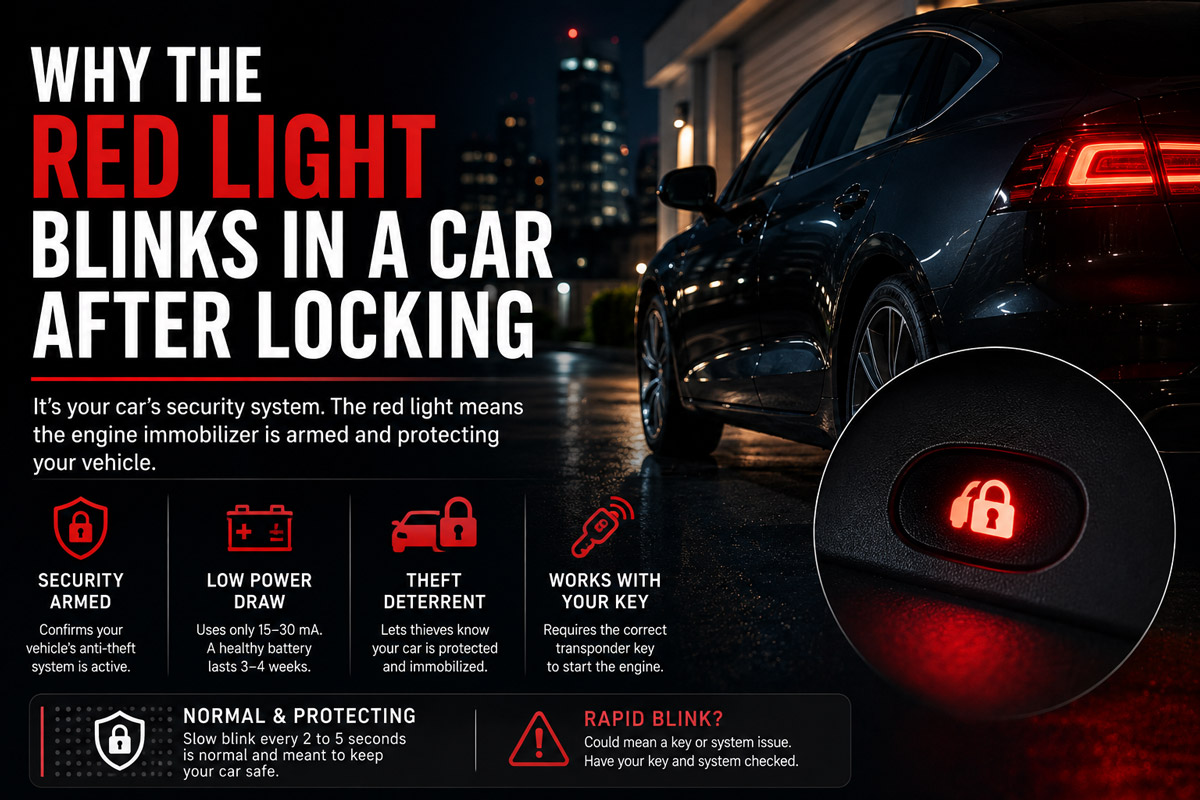
The red blinking light on your dashboard or door panel after locking is the Engine Immobilizer or Security Indicator. It signals that your vehicle’s factory-installed anti-theft system is actively armed and monitoring for an authorized transponder key. This slow blink is a normal, intended function designed to deter unauthorized entry and disable engine ignition.
Key Facts / At a Glance
- Normal Behavior: A slow red flash (every 2 to 5 seconds) indicates the security system is armed and functioning correctly.
- Power Draw: The blinking LED draws just 15 to 30 milliamperes (mA), allowing a healthy battery to sit for 3 to 4 weeks without dying.
- Warning Signs: A rapid, continuous blink when attempting to start the vehicle indicates the transponder key is unreadable or rejected.
- Component Connection: The light is controlled by the Body Control Module (BCM) working alongside the Engine Control Unit (ECU).
- Repair Costs: If the system fails, reprogramming a new transponder key typically costs between $75 and $250.
What Does the Security Indicator Light Actually Do?
The security indicator light serves as a two-fold anti-theft mechanism: a visual deterrent to potential thieves and a status monitor for the vehicle owner. When a driver removes the key and locks the doors, the indicator confirms that the electronic barriers protecting the fuel pump and starter motor are engaged.
Without this visual confirmation, drivers would have no way to verify if their Engine Immobilizer (known by various automaker acronyms like Ford’s PATS, Toyota’s Engine Immobilizer, or GM’s Passlock) successfully armed itself. A thief seeing this light instantly recognizes that hotwiring the ignition cylinder will not start the engine, as the ECU requires a cryptographic handshake from the correct key.
The Mechanics of the Engine Immobilizer System
An engine immobilizer relies on Radio Frequency Identification (RFID) and internal network communication to authorize engine startup. The blinking red light in a car after locking is simply the final stage of a precise, five-step arming sequence orchestrated by the Body Control Module (BCM).
- Ignition Cutoff: The driver switches off the ignition and removes the physical key or walks away with the smart fob.
- Lock Command Execution: The driver presses the lock button on the fob or exterior door handle.
- Perimeter Validation: The BCM polls all vehicle latches to ensure the doors, trunk, and hood are completely shut. If a door is ajar, the system typically sounds a warning chime or refuses to arm.
- Pre-Arming Phase: The red indicator light turns solid for 10 to 30 seconds. This grace period allows passengers to exit or the driver to reopen a door without triggering an active alarm.
- Active Arming: The solid light transitions to a slow, rhythmic blink (every 2 to 5 seconds). The fuel injectors and starter circuit are now electronically severed until the correct key returns.
Are All Blinking Red Dashboard Lights Normal?
Not all flashing red lights indicate a properly armed system. The frequency, duration, and color of the light communicate specific operational states or system faults.
| System Type | Indicator Behavior | Power Draw | Operational State |
|---|---|---|---|
| Standard Factory Immobilizer | Blinks slowly (every 2 to 5 seconds) | 15–20mA | Normal armed status. Vehicle is protected. |
| Aftermarket Alarm System | Rapid blinking, often multi-color or bright blue LED | 20–40mA | Armed. Perimeter sensors and shock sensors are active. |
| Valet / Service Mode | Solid red light or no light at all | Continuous draw | System is temporarily bypassed for mechanic access. |
| Transponder Rejection | Rapid blinking with the key turned to the ON position | Variable | Fault state. ECU rejects the key code; engine will crank but not start. |
Battery Drain Benchmarks for Security Lights
A primary concern among vehicle owners is whether the continuous blinking will drain the battery overnight. The short answer is no; a standard factory immobilizer draws an exceptionally small amount of current.
The typical power draw of a security LED ranges from 15 to 30 milliamperes (mA). A standard 50 Amp-hour (Ah) car battery holds 50,000 milliamp-hours of capacity. Mathematically, a 20mA draw would take 2,500 hours (over 100 days) to fully deplete a perfect battery. However, factoring in natural battery degradation and other parasitic draws from the vehicle’s memory modules, a car with a healthy battery and an actively blinking security light can safely park for 3 to 4 weeks before voltage drops below the critical 12.0V threshold required to start the engine.
Factory vs. Aftermarket Security Systems
Vehicle owners often debate whether the factory blinking light is sufficient protection, or if an aftermarket system is necessary. While factory immobilizers are excellent at preventing “drive-away” thefts, they have distinct limitations regarding physical break-ins.
- Factory Immobilizer Advantage: Zero extra cost, highly reliable, and deeply integrated into the ECU. The engine simply cannot run without the correct digital key.
- Factory Immobilizer Limitation: It lacks perimeter defense. The factory system will not sound a siren if a thief smashes a window to steal items from the cabin, nor will it alert the owner if the car is being towed away.
- Aftermarket System Advantage: Offers glass-break sensors, tilt sensors (anti-tow), loud sirens, and smartphone push notifications for active intrusions.
- Aftermarket System Limitation: Installation requires splicing into the vehicle’s wiring harness. Poor installation frequently corrupts the BCM, leading to high parasitic battery drain (exceeding 50mA) and false alarms.
Why Does the Red Light Blink Rapidly?
A rapidly blinking red light when you attempt to start the car indicates a communication failure between the transponder chip inside your key and the vehicle’s ignition receiver. When this happens, the ECU purposefully cuts off fuel and spark to prevent theft.
This issue typically stems from a dead battery inside the smart key fob, a physically damaged transponder chip (often caused by dropping the key on hard surfaces), or interference from other RFID devices on your keychain. To troubleshoot, immediately remove all other electronic fobs, speed-pass toll tags, and metal items from your keyring. If the rapid blinking persists, insert your secondary spare key; if the spare works, the primary key requires replacement and reprogramming by an automotive locksmith.
Troubleshooting a Dead Security Indicator
If you lock your car and the red security light fails to illuminate or blink, the system is not arming. Leaving the vehicle in this state exposes it to theft and indicates an underlying electrical fault.
First, physically check every door, the trunk, and the hood. The BCM will completely halt the arming sequence if it detects a latch is open. Next, inspect your vehicle’s dashboard or engine bay fuse box for a blown fuse labeled “Security,” “BCM,” or “Hazards.” If all doors are closed and fuses are intact, the hood pin switch is the most common culprit. The hood latch sensor frequently corrodes from engine heat and moisture, tricking the BCM into thinking the hood remains open, which permanently disables the immobilizer arming sequence.
Common Security System Mistakes
Automotive technicians frequently encounter security system faults caused directly by owner misunderstandings or improper modifications.
- Ignoring Key Battery Warnings: Drivers often ignore dashboard warnings for a low key-fob battery. While a dead fob battery won’t stop a physical key blade from turning, it can weaken the transponder signal enough to trigger a rapid-blink security lockout.
- RFID Clashing: Attaching two different smart keys (e.g., your car key and your spouse’s car key) to the same keyring creates competing frequencies. The vehicle’s immobilizer antenna reads both, gets confused, and defaults to lockdown mode.
- Cheap Remote Starters: Installing budget remote starters requires “bypassing” the factory immobilizer. Doing this with cheap hardware leaves the ECU permanently vulnerable and often causes erratic security light blinking while driving.
Frequently Asked Questions
Can I disable the blinking red security light?
No, you cannot disable the light without bypassing the entire Engine Immobilizer system, which leaves the vehicle highly vulnerable to theft. The light is hardwired into the BCM as a mandatory status indicator.
Why does the red light stay solid instead of blinking?
A solid red light usually indicates the system is in the “pre-arming” phase immediately after locking, or the vehicle has been placed into “Valet Mode” to allow mechanics to work on the car without triggering alarms.
Does a blinking red light mean my car battery is dying?
No, a slow blinking red light proves the battery has sufficient power to run the security module. However, if your dashboard lights flicker erratically alongside a clicking noise when you turn the key, your main 12V battery is depleted.
What should I do if my car cranks but won’t start, and the light is blinking?
This confirms an immobilizer lockout. Stop cranking the engine, as you will flood the cylinders or burn out the starter motor. Remove the key, wait 60 seconds to let the BCM reset, and try a different, previously authorized spare key.
How much does it cost to fix a broken immobilizer?
If the fault lies in a damaged key, replacement and reprogramming cost between $75 and $250. If the BCM or immobilizer receiver ring is damaged, dealership repairs typically range from $400 to $800.
The Bottom Line
The slowly blinking red light in your car after locking is not a malfunction or a significant drain on your battery—it is the factory engine immobilizer actively protecting your vehicle. Unless the light flashes rapidly while you attempt to turn the ignition, no action is required. Trust the system to deter theft, and rely on a battery maintainer only if you plan to park the vehicle untouched for more than four weeks.