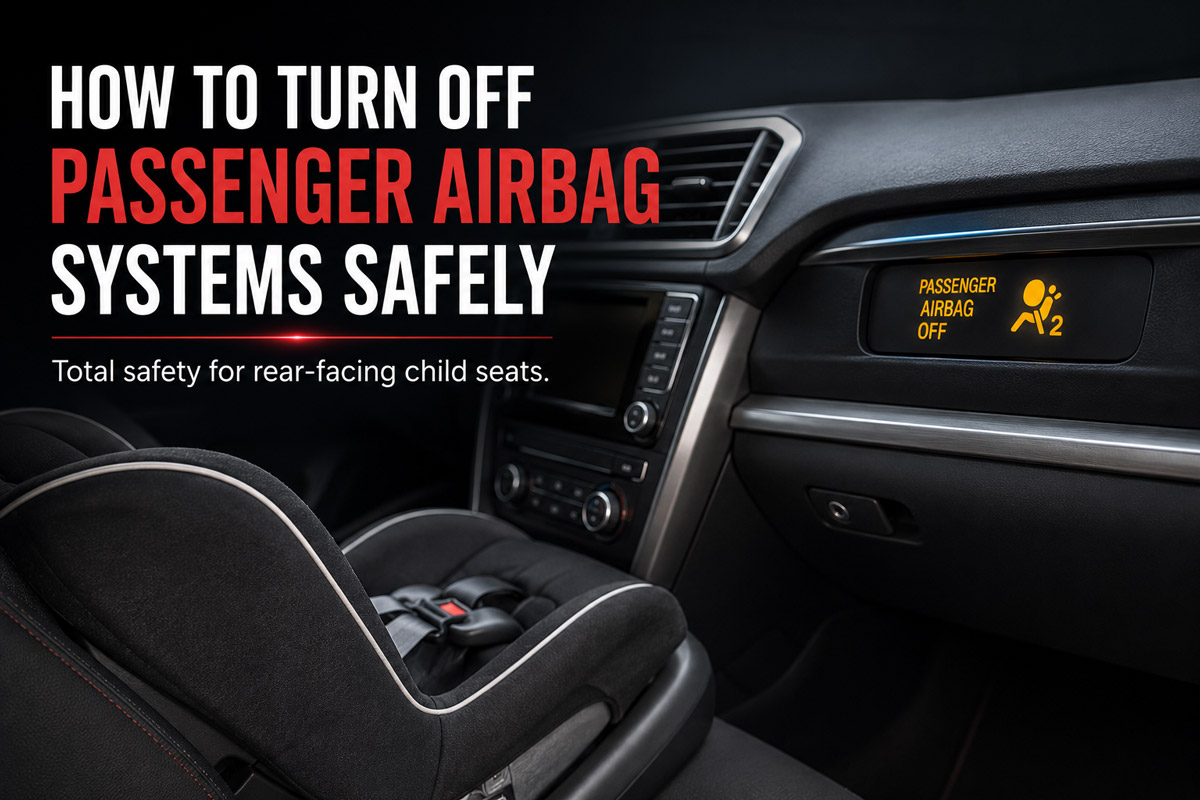
To learn how to turn off passenger airbag systems safely, you must first identify whether your vehicle uses a physical key switch or an automatic Occupant Classification System (OCS). You can complete this one-minute procedure by either turning a dashboard cylinder or managing seat weight, ensuring total safety for rear-facing infant seats.
Before You Start
- Time Required: 1 to 5 minutes.
- Difficulty: Beginner.
- Estimated Cost: $0 (DIY) to $150 (if dealer sensor calibration is required).
- Tools Required: 1 mechanical ignition key (for older vehicles), 1 bi-directional OBD-II scan tool (only for troubleshooting faults).
- Prerequisites: You must confirm your vehicle’s exact system via the owner’s manual. Note that disabling an airbag is strictly for accommodating rear-facing child safety seats or accommodating a passenger with a NHTSA-approved medical exemption.
Method 1: Using a Manual Key Switch (Pre-2006 Vehicles)
Older vehicles, particularly regular-cab pickup trucks or two-seater sports cars without a back seat, feature a physical override switch.
Step 1: Locate the Deactivation Keyhole
Find the passenger airbag deactivation cylinder on your vehicle’s dashboard. Look specifically on the passenger side of the center console, inside the glove compartment, or on the passenger-side dashboard panel visible only when the door is wide open. You will know you have found it when you see a small keyhole bracketed by text reading “PASS AIRBAG” with distinct “ON” and “OFF” positions. A common mistake here is confusing the trunk lockout switch inside the glovebox with the airbag switch; ensure the label specifically mentions the airbag or SRS system.
Step 2: Turn the Switch to the Off Position
Insert your vehicle’s mechanical ignition key completely into the deactivation cylinder, push inward slightly, and rotate the key to the “OFF” position. Pull the key straight out once the cylinder locks into the new position. You will know it worked when the key slot physically remains rotated toward the “OFF” text and the key releases smoothly. Do not force a valet key or a screwdriver into this slot; doing so will shatter the internal tumblers, requiring a costly module replacement.
Step 3: Verify the Status Indicator
Turn the vehicle’s ignition to the “ON” or “RUN” position to power up the dashboard without starting the engine. Look at the center console or rearview mirror array for the amber indicator light. You will know it worked when the amber light illuminating the words “PASS AIRBAG OFF” (or an icon of a child seat with an “X” through it) lights up and stays solidly lit. If the light flashes or fails to illuminate entirely, the bulb is dead or the switch is faulty, meaning the airbag may still deploy in a crash.
Method 2: Triggering Automatic OCS Systems (Modern Vehicles)
Vehicles built after 2006 use an Occupant Classification System (OCS) that relies on weight sensors embedded in the seat cushion to automatically toggle the airbag.
Step 1: Remove All Weight and Electronic Interference
Clear the front passenger seat completely of all objects, electronics, and debris. Remove heavy bags, unbuckle the seatbelt, and critically, remove all cell phones, laptops, and charging cables from the seat surface. You will know this is done when the seat cushion is entirely uncompressed and empty. A frequent mistake is leaving a smartphone on the passenger seat; the phone’s electromagnetic field can trick capacitive OCS mats into thinking an adult is sitting there, keeping the airbag armed.
Step 2: Perform an Ignition Cycle Reset
Turn the vehicle completely off, wait precisely 10 seconds to allow the vehicle’s computer modules to power down, and then turn the ignition back on. Once the system powers up, place your approved rear-facing infant seat onto the passenger seat and secure it. You will know it worked when the child seat is strapped in tightly without exceeding the system’s weight threshold (typically between 65 and 85 lbs combined weight). If you lean your own body weight heavily onto the seat while strapping the child in, the sensor will register an adult weight and lock the airbag into the “ON” position.
Step 3: Verify the Sensor Readout
Look at the central dashboard stack, usually above the radio or hazard light button, to check the OCS status. You will know it worked when the specific amber indicator reads “PASSENGER AIRBAG OFF” steadily. A common mistake is looking at the main gauge cluster behind the steering wheel; the red SRS warning light there indicates a system failure, while the amber center-console light indicates the current OCS status.
Common Mistakes and How to Fix Them
- Wet Seat Cushions: If a water bottle spills or rain gets onto a passenger seat equipped with a capacitive OCS sensor, the moisture alters the electrical capacitance, tricking the sensor into keeping the airbag ON. Fix: The seat must dry completely (which can take 24 to 48 hours). Use a wet/dry vacuum to extract the moisture, then verify the light resets.
- Items Trapped Under the Seat rails: Water bottles, ice scrapers, or shoes wedged tightly beneath the passenger seat push upward against the sensor track. Fix: Move the seat entirely forward and backward to check for obstructions. Remove all items touching the bottom of the seat pan and cycle the ignition.
- Using Thick Aftermarket Seat Covers: Tight-fitting, heavy leather or neoprene seat covers bridge across the side bolsters, suspending weight above the actual pressure mat. Fix: Remove the seat cover. If the “OFF” light behaves normally without the cover, the cover is incompatible with your vehicle’s OCS.
- SRS Warning Light Remains On: If a red airbag icon stays lit on your main speedometer cluster, the system is disabled due to a hard fault, not your intentional input. Fix: Plug an advanced OBD-II scanner (one capable of reading SRS/Airbag codes) into your OBD port to pull the specific failure code (e.g., a damaged clockspring or disconnected seat harness).
System Variations and Exceptions
- Medical Exemptions: If you have an adult passenger with a medical condition that requires the airbag to be off (and your car lacks a manual switch), you cannot simply unplug the airbag. You must apply for an exemption through the NHTSA (in the US). Upon approval, an authorized mechanic can legally splice an aftermarket manual ON/OFF switch into your vehicle’s wiring harness.
- Seatbelt Tension Sensors: In some modern vehicles, the OCS system relies on both a weight mat and a seatbelt tension sensor. If you crank a child seat down with extreme force using a locking clip, the high tension on the seatbelt can trick the computer into thinking a heavy adult is buckled in. Always check the OCS light after doing final tensioning on a car seat.
How Long Does It Take and What Does It Cost?
Checking your indicator light and operating a manual switch or clearing a seat takes less than 1 minute and is completely free.
However, if your OCS sensors lose their calibration (often happening after a minor fender-bender or if the seat was removed for detailing), the system will default to keeping the airbag off. Fixing this requires a Zero-Point Calibration. You cannot do this at home with a basic code reader; it requires a mechanic with dealership-level diagnostic software. This typically takes 30 to 45 minutes and costs between $100 and $150.
Frequently Asked Questions
Can I just pull the airbag fuse to turn it off? No. Pulling the SRS or airbag fuse will disable the entire airbag system for every passenger and the driver, not just the front passenger. It also triggers a permanent dashboard warning light and disables your seatbelt pretensioners.
Why does my passenger airbag light say OFF when the seat is empty? This is normal operating behavior for modern OCS vehicles. To save repair costs in the event of an accident, the vehicle automatically turns off the passenger airbag when it detects no weight, preventing it from deploying into an empty seat.
Is it safe for an adult to ride if the airbag is turned off? No. If a full-sized adult is sitting in the passenger seat and the “PASS AIRBAG OFF” light remains illuminated, the occupant has zero supplemental restraint protection. You must stop, have them adjust their posture, or troubleshoot the sensor before driving.
How heavy does a child need to be to trigger the airbag ON? While exact calibrations vary by manufacturer, the threshold for OCS weight sensors to arm the airbag is generally between 65 and 85 lbs. Always consult your vehicle’s specific manual, and keep children under 13 in the back seat whenever possible.
To master how to turn off passenger airbag systems is to master the specific hardware in your exact vehicle. By reading the OCS indicators accurately and keeping sensors clear of interference, you ensure your restraint systems deploy only when and how they are supposed to.
Conclusion: Verifying Your Passenger Airbag Status
Successfully managing your vehicle’s supplemental restraint system comes down to accurately identifying your hardware and respecting the sensor constraints. Whether you are rotating a manual dashboard cylinder to the “OFF” position for a pre-2006 vehicle, or clearing a modern capacitive OCS seat of electronic interference and trapped objects, the final step remains absolute: visual confirmation.
Never assume the system is disabled based on physical actions or occupant weight alone. You must verify that the amber center-console “PASSENGER AIRBAG OFF” indicator is steadily illuminated before securing a rear-facing child seat in the front row. By following these precise operational steps and troubleshooting common sensor faults, you ensure compliance with safety protocols and completely eliminate the risk of an unintended airbag deployment.