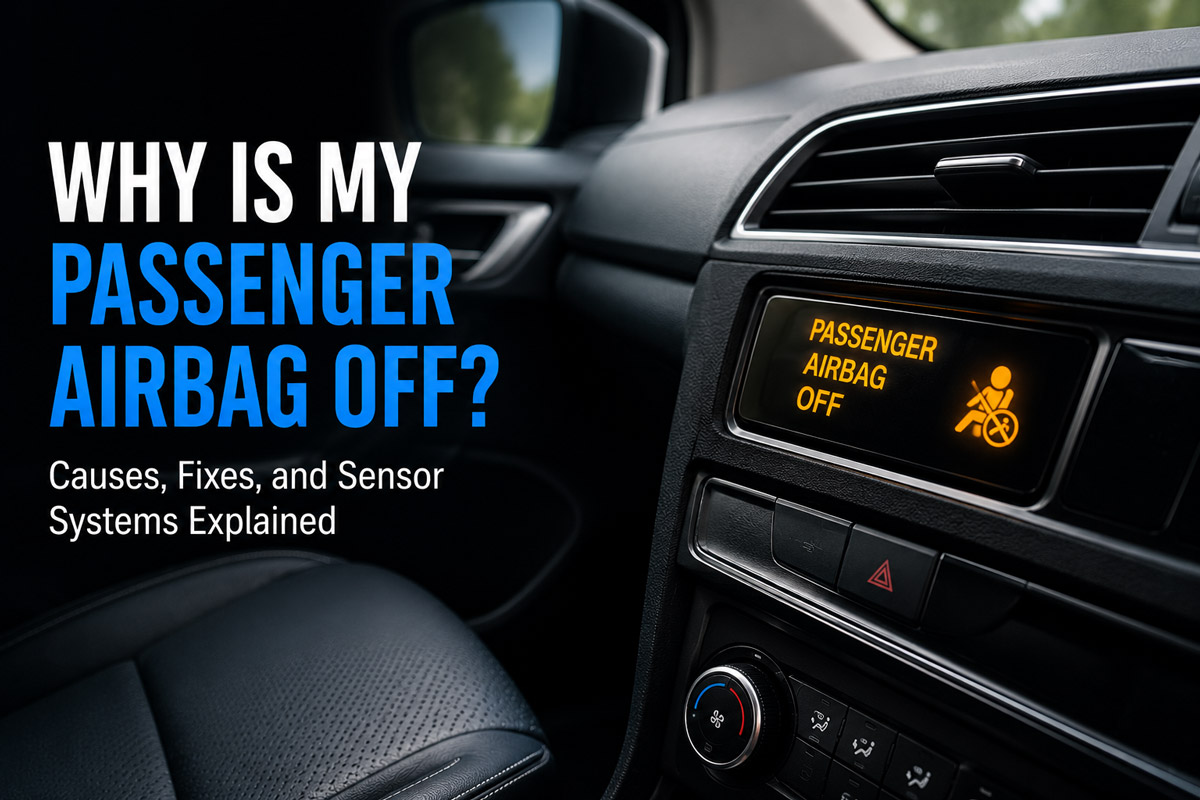
Your passenger airbag is off because your vehicle’s Occupant Classification System (OCS) has deliberately deactivated it to prevent injury to a lightweight passenger, or because a physical obstruction, electronic interference, or hardware failure is disrupting the seat sensors. Frontal airbags deploy at speeds exceeding 100 mph, a force that can be fatal to infants, children, and small-stature adults.
Key Facts / At a Glance:
- Normal Operation: The “Airbag Off” indicator should remain illuminated when the front passenger seat is empty, holding light cargo, or occupied by a child under 65 lbs.
- The 100-Pound Rule: Most modern vehicles require at least 99 lbs of downward physical mass to activate the full-force deployment loop for the front passenger airbag.
- Electronics Interference: Laptops, phones, or charging cables resting on the passenger seat can disrupt capacitive weight sensors, triggering a false “Off” reading.
- Dashboard vs. Console: A yellow “Passenger Airbag Off” light on the center console is a status indicator; a red “SRS” or airbag icon on the driver’s gauge cluster indicates a system malfunction requiring a scanner.
How the Occupant Classification System (OCS) Controls the Airbag
The Occupant Classification System (OCS) relies on a network of sensors embedded in the passenger seat to continuously measure the physical characteristics of whoever—or whatever—is sitting there. The Supplemental Restraint System (SRS) control module processes this sensor data in real-time to decide whether to arm the passenger airbag, fire it at low force, or disable it entirely.
The 5-Step Ignition Cycle
Every time you turn your vehicle’s ignition key or press the start button, the OCS executes a strict diagnostic and measurement sequence:
- System Self-Check: The SRS module performs an internal continuity and resistance sweep of all safety circuits. You will see all airbag lights illuminate for roughly 4 to 6 seconds before turning off.
- Occupant Sensing: The primary under-seat sensor measures either the downward pressure vector, the electrical capacitance of the object, or the structural strain on the seat rails.
- Seatbelt Tension Verification: A cinch sensor located in the seatbelt buckle detects if the belt is pulled tightly. A locked-down belt usually indicates a properly installed child safety seat, signaling the system to disable the airbag regardless of total weight.
- Logic Processing: The vehicle’s computer compares the combined weight, posture, and tension data against hardcoded safety algorithms.
- State Execution: The SRS module either completes the firing circuit (Airbag ON) or opens the circuit (Airbag OFF), illuminating the corresponding indicator light on the dashboard.
Passenger Weight Thresholds and Dual-Stage Deployment
Automakers program the OCS with specific weight thresholds to classify occupants. While exact numbers vary slightly by manufacturer, the industry standard follows these categories:
- 0 to 10 lbs (Empty/Light Object): The system detects an empty seat or minor cargo like a jacket. The airbag is OFF.
- 11 to 65 lbs (Child/Car Seat): The system detects the mass of a child or an infant carrier. The airbag is OFF to prevent deployment-induced trauma.
- 66 to 98 lbs (Small Adult/Teenager): The system detects a lightweight occupant. In vehicles with dual-stage airbags, the system arms the airbag for a low-force deployment (typically firing only one of the two internal squibs).
- 99+ lbs (Standard Adult): The system verifies a full-sized adult is properly seated. The airbag is ON and primed for full-force deployment.
5 Common Reasons the Passenger Airbag Light is Off
If your passenger airbag is off when an adult is sitting in the seat—or turning on and off randomly—everyday user habits are the most likely culprit.
1. Inanimate Objects and Heavy Cargo
Placing a heavy purse, gym bag, or backpack weighing between 10 and 40 lbs on the passenger seat tricks the OCS into believing a small child is present. Because the mass falls into the “child” threshold, the computer deliberately forces the airbag off and triggers the dashboard indicator to warn the driver.
2. Improper Seating Posture
Occupant classification requires centralized downward pressure on the seat cushion. If a passenger slouches, leans heavily against the door window, reclines the seatback excessively, or rests their feet on the dashboard, their center of gravity shifts off the main sensor. This unweights the bottom cushion, dropping their measured mass below the 99-lb threshold and turning the airbag off.
3. Electronic Interference (EMI)
Resting a plugged-in laptop, tablet, or smartphone directly on the passenger seat cushion can create Electromagnetic Interference (EMI). Vehicles equipped with capacitive sensor mats (which measure moisture and electrical conductivity rather than pure weight) cannot distinguish between organic human tissue and the electromagnetic field emitted by lithium-ion batteries and chargers. The system defaults to OFF as a failsafe.
4. Under-Seat Obstructions
Shoving umbrellas, water bottles, toolboxes, or ice scrapers underneath the front passenger seat can physically wedge against the OCS wiring harnesses or the seat frame. When an adult sits down, the seat cannot compress naturally. The obstruction absorbs the downward force, causing the strain gauges to register a much lighter weight than what is actually in the seat.
5. Aftermarket Seat Covers and Cushions
Thick neoprene seat covers, heated massage pads, or orthopedic gel cushions redistribute a passenger’s weight across a wider surface area. This bridging effect prevents the localized pressure required to trigger bladder-style sensors, resulting in a false “Airbag Off” light despite an adult being present.
Types of Passenger Weight Sensors
Automakers utilize three primary engineering methods to classify front-seat occupants. Identifying which system your vehicle uses is critical for accurate troubleshooting.
Silicone Fluid Bladder Systems
The most common system in modern vehicles utilizes a heavy-duty, silicone-filled bladder positioned directly beneath the seat cushion fabric. When an occupant sits, their body weight forces the silicone fluid against a highly sensitive pressure transducer.
- Failure Mode: These bladders can develop micro-leaks over time, especially if a passenger kneels sharply on the seat, concentrating hundreds of pounds of pressure onto a single square inch and rupturing the seam.
Capacitive Sensor Mats
A capacitive sensor is a thin electronic grid woven into the seat foam. Rather than measuring weight, it measures the electrical capacitance of the object sitting on it. Because the human body contains a high volume of water, it conducts electricity differently than a box of groceries.
- Failure Mode: Capacitive mats are highly vulnerable to liquid damage. Spilling coffee or leaving a window open during a rainstorm can short-circuit the mat’s micro-wiring, requiring a complete seat teardown to fix.
Strain Gauge Systems
Strain gauge systems bypass the cushion entirely. Instead, sensors are bolted directly to the four metallic feet (or rails) of the seat frame. They calculate the total downward structural force applied to the chassis.
- Failure Mode: Strain gauges are incredibly durable but require precise calibration. If the seat mounting bolts are over-torqued during a repair, or if debris gets wedged in the seat tracks, the gauges will output skewed resistance values.
Automatic OCS vs. Manual Key-Switches
While almost all modern passenger vehicles use automatic classification, certain commercial and specialty vehicles still utilize manual overrides.
| System Type | Mechanism | Pros | Cons | Ideal Application |
|---|---|---|---|---|
| Automatic OCS | Sensors dynamically calculate weight/posture to toggle airbag state. | Eliminates human error; adjusts deployment force based on exact occupant size. | Highly sensitive to electronic interference, liquids, and poor seating posture. | Daily drivers, family SUVs, sedans, and minivans. |
| Manual Key-Switch | Driver inserts the ignition key into a dashboard slot to manually turn the airbag ON or OFF. | Absolute mechanical control; immune to electronic sensor calibration drift or liquid damage. | Extremely dangerous if the driver forgets to turn it back on for a full-sized adult passenger. | Regular single-cab pickup trucks and two-seater sports cars without rear seats. |
Which Should You Choose? You do not get a choice when purchasing a standard vehicle; federal regulations mandate automatic OCS for passenger cars. Manual switches are strictly reserved for vehicles with no rear seat, allowing drivers to legally transport a rear-facing infant seat in the front row.
How to Troubleshoot a Passenger Airbag Light
If your airbag light remains off with an adult seated, follow this diagnostic protocol to isolate the issue before paying for a dealership diagnostic fee.
Step 1: Clear the Seat and Cycle the Ignition
Remove all cargo, electronic devices, and charging cables from the passenger seat. Turn the engine completely off, open the passenger door (to reset the module logic), and turn the engine back on. Check if the light resets.
Step 2: Correct Occupant Posture
Have the adult passenger sit completely upright with their back flat against the seatback and both feet resting flat on the floorboard. Have them hold this position for two full minutes. The OCS module requires sustained, uninterrupted pressure readings to reclassify an occupant.
Step 3: Inspect for Physical Obstructions
Look directly underneath the passenger seat with a flashlight. Remove any water bottles, umbrellas, or trash wedged between the seat bottom and the floorboard. Verify that the bright yellow wiring harnesses (the universal color for SRS wiring) are securely clipped together and not snagged on the seat tracks.
Step 4: Check the Main Gauge Cluster for SRS Codes
Look at your steering wheel gauge cluster. If you see a secondary red light depicting a deployed airbag or the letters “SRS,” you have a hard system fault, not a posture issue.
- You’ll know it worked when: The center console light behaves normally (Off when empty, On when occupied) and the gauge cluster light disappears.
Common Mistakes and How to Fix Them: Standard OBD-II engine scanners cannot communicate with safety restraint modules. Do not assume your system is fine just because your $20 code reader shows “0 Codes.” You must use an advanced diagnostic scanner (like an Autel or Innova) capable of reading SRS/Airbag modules to pull the exact Diagnostic Trouble Code (e.g., Code B1764 for OCS Sensor Malfunction).
How Much Does It Cost to Fix an Airbag Sensor?
If a component has truly failed, expect to pay dealership or specialized auto-electric rates, as most independent mechanics will not assume liability for safety restraint repairs.
- Diagnostic Fee: $100 – $150 (Typically 1 hour of labor).
- Zero-Point OCS Recalibration: $150 – $300 (1 to 2 hours). If a seat is removed for cleaning or the battery dies, the OCS must be recalibrated using specific dealership weights to reset the “zero” point.
- Under-Seat Wiring Harness Repair: $200 – $450 (2 hours). Common in vehicles where rear passengers repeatedly kick the under-seat wiring, breaking the yellow SRS connectors.
- Full OCS Mat Replacement: $600 – $1,200 (3 to 4 hours). Replacing a ruptured bladder or shorted capacitive mat requires removing the seat from the vehicle, stripping the upholstery fabric, replacing the sensor, restitching the seat, and performing a zero-point calibration.
Expert Safety Rules and DIY Warnings
When dealing with Supplemental Restraint Systems, the margin for error is zero.
For Parents & Caregivers: Always install child car seats in the rear row, regardless of whether your OCS turns the front airbag off. If you absolutely must use a single-cab truck with a manual switch, verify that you physically hear the mechanical lock click into the “OFF” position and visually confirm the light.
For Rideshare Drivers: Instruct your passengers to sit upright. Never allow a passenger to ride in the front seat if the “Airbag OFF” light remains stuck on while they are seated. In the event of a collision, their medical liability falls on you if they were seated in a deactivated zone.
For DIY Mechanics: Never probe a yellow SRS wire with a standard multimeter or test light; the trace voltage from the multimeter is enough to trigger the airbag squib and deploy the airbag into your face. Always disconnect the negative battery terminal and wait a mandatory 15 minutes to deplete the backup capacitors before touching any under-seat wiring.
Frequently Asked Questions (FAQ)
Can I manually turn off the passenger airbag in a normal sedan?
No. Modern sedans, SUVs, and minivans do not feature manual override switches. The Occupant Classification System (OCS) manages the airbag autonomously based on weight and electrical capacitance. You cannot legally or safely install an aftermarket kill switch in a standard passenger vehicle.
Why does my passenger airbag light randomly turn on and off while driving?
Intermittent airbag light toggling is usually caused by a passenger shifting their weight, slouching, or resting their feet on the dash. It can also be caused by a loose yellow SRS wiring harness underneath the seat that temporarily loses connection when hitting a bump.
Is it safe to drive if the airbag off light is illuminated?
If the seat is empty or holds a light bag, driving is perfectly safe and the light is functioning normally. However, if a full-sized adult is in the seat and the light reads “OFF,” they are completely unprotected. They must move to the back seat until the sensor is diagnosed.
Will an airbag deploy if the seatbelt is unbuckled?
Yes, but with caveats. If the OCS detects an adult in the seat, the airbag will deploy during a severe crash even if the seatbelt is unbuckled. However, because seatbelts and airbags are designed to work together, an unbuckled passenger will be thrown into the rapidly expanding airbag, severely increasing the risk of fatal neck and chest trauma.