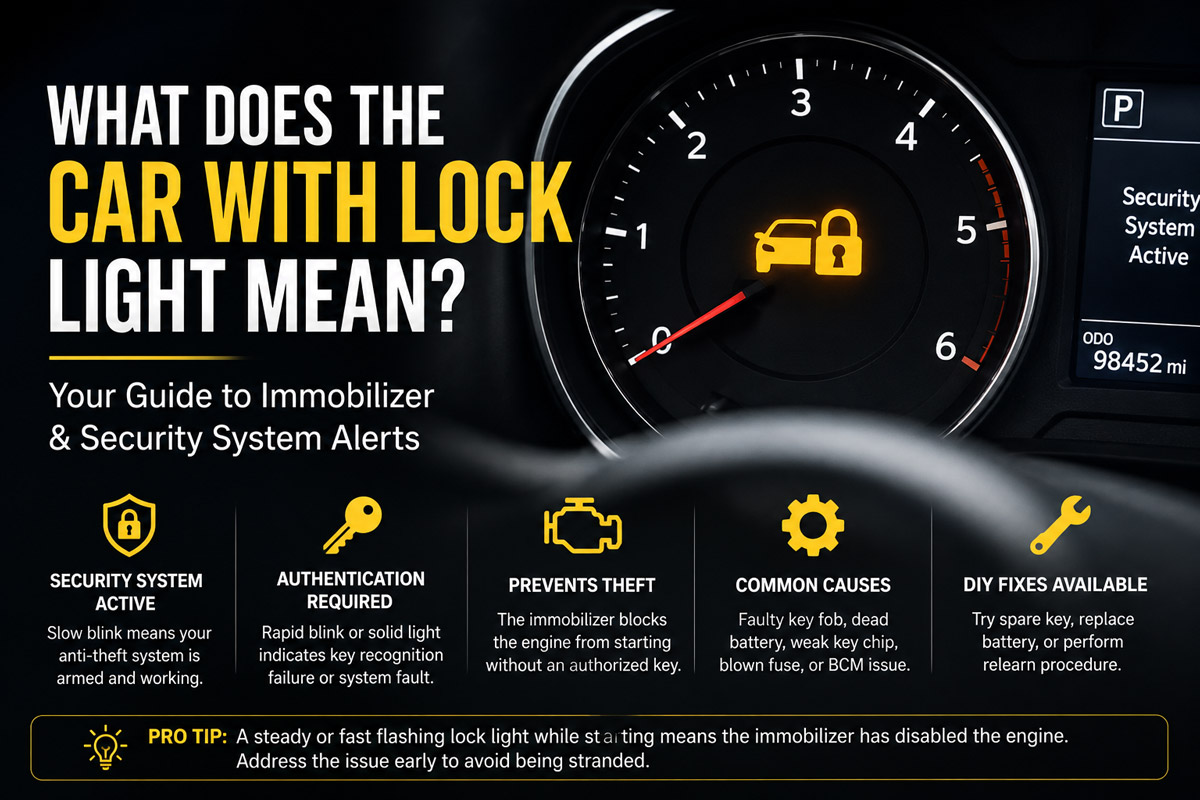
The car with a lock light means your vehicle’s engine immobilizer and Passive Anti-Theft System (PATS) is active. A slow blink with the ignition off confirms the security system is armed. If the light flashes rapidly or stays solid during startup, it means key authentication failed, triggering an engine security lockout.
Key Facts / At a Glance
- Normal State: A rhythmic blink every 2-3 seconds while the car is off indicates normal armed standby mode.
- Fault State: A rapid, chaotic blink or solid light while turning the key means the immobilizer has disabled the fuel injectors or starter motor.
- Common Culprits: Dead key fob batteries, damaged internal RFID chips, or blown Body Control Module (BCM) fuses cause 80% of accidental lockouts.
- Parasitic Draw: A normally functioning security light draws less than 5 milliamperes (mA) and will not drain a healthy car battery, even over months of storage.
- DIY Fix: Many domestic vehicles (GM, Ford, Chrysler) feature a built-in 10-to-30-minute key relearn sequence that bypasses minor module glitches without tools.
What Is the Car With a Lock Indicator Light?
The car with a lock dashboard indicator—sometimes displaying a vehicle chassis overlaid with a padlock or a simple key silhouette—is the primary visual interface for your factory-installed engine immobilizer. Its core function is to convey the armed status of the vehicle and alert the driver to key authentication failures.
Unlike aftermarket alarms that rely on loud sirens and shock sensors, factory immobilizers operate silently. They prevent the engine from starting unless a digitally verified key is physically present in the ignition cylinder or cabin. If a thief attempts to hotwire the ignition switch, the immobilizer physically blocks the Engine Control Unit (ECU) from delivering fuel or spark.
Why Is the Car With Lock Light Flashing?
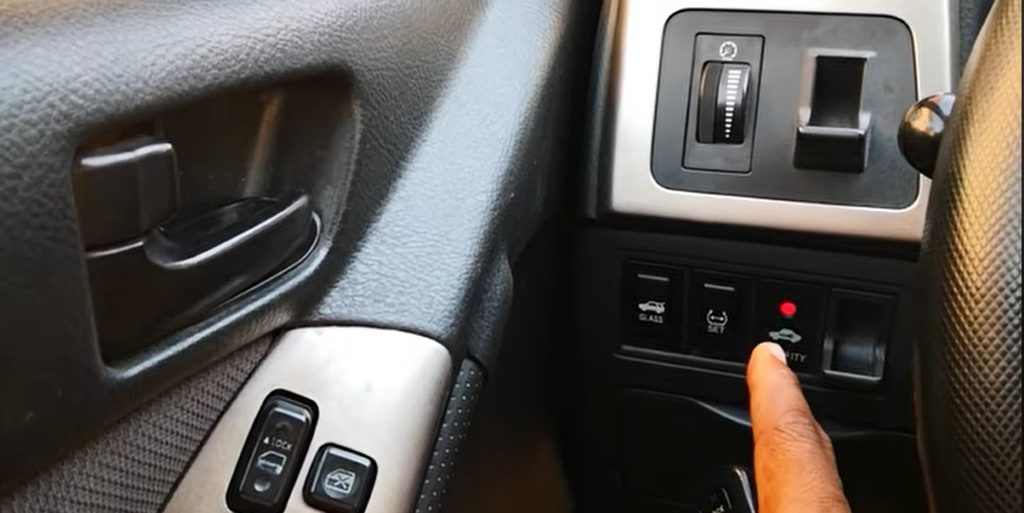
The operational state of the anti-theft warning light shifts dramatically based on the ignition position and the health of the immobilizer network. Diagnosing a lockout requires observing these three primary behaviors.
1. Slow, Rhythmic Blinking (Ignition OFF)
A slow, pulsing blink while the vehicle is parked and locked is normal standby operation. The engine immobilizer is armed and actively monitoring the ignition circuit. This acts as a visual deterrent to notify outside observers that the car cannot be hotwired. Because the system utilizes microscopic amounts of power (typically under $5\text{ mA}$), this blinking state will not drain a healthy 12V battery.
2. Rapid, Chaotic Flashing (Ignition ON / Cranking)
A rapid, erratic blink when attempting to start the vehicle indicates an authentication fault condition. The car’s security system is actively blocking a start attempt because it cannot read or validate the key’s internal chip. The vehicle immediately enters Security Lockdown Mode. Depending on the manufacturer, the starter motor may crank continuously without the engine catching, or the engine may fire up for one to two seconds and abruptly stall out as the ECU severs the fuel delivery.
3. Steady, Solid Illumination (Ignition ON / Driving)
A solid, non-blinking anti-theft light points directly to a system hardware malfunction. The anti-theft controller has detected an internal logic board fault, a CAN-bus communication failure, or a corrupted database registration. If this solid light illuminates while driving, the vehicle will usually continue to run until turned off to prevent an unsafe sudden loss of power. However, the vehicle will almost certainly fail to restart on subsequent attempts.
How Does the Immobilizer Handshake Work?
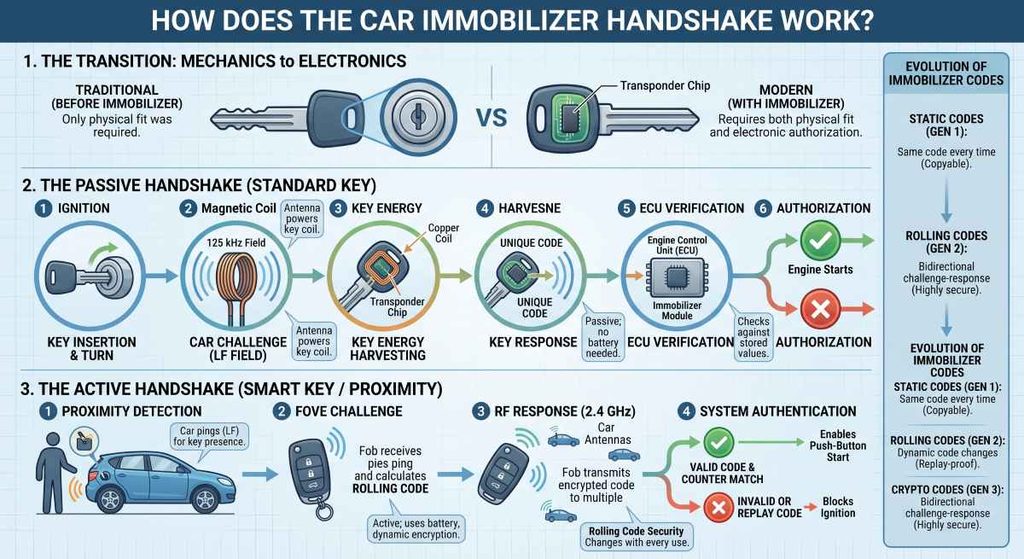
Modern immobilizers utilize a closed-loop Radio Frequency Identification (RFID) handshake protocol to authorize engine operation in four milliseconds.
- Interrogation: Inserting a physical key into the ignition cylinder (or bringing a proximity fob into the cabin) triggers an electromagnetic induction coil wrapped around the ignition housing.
- Transmission: This coil generates a localized, low-power radio frequency field. This field physically powers a passive transponder chip embedded within the plastic head of the key.
- Authentication: Once powered, the key’s transponder broadcasts a unique digital alphanumeric signature code back to the immobilizer control module.
- Validation: The immobilizer matches this incoming payload against encrypted registration strings stored in its EEPROM memory. If verified, a permission payload travels via the Controller Area Network (CAN-bus) to the Powertrain Control Module (PCM), which activates the fuel pump and ignition coils.
How Can You Fix a Car Lockout Security Issue?
If you are stranded because your vehicle is locked out by a flashing anti-theft light, execute these corrective measures sequentially. This protocol prevents permanent module damage while systematically ruling out simple hardware failures.
Step 1: Use the Factory Master Key
Immediately source and attempt to start the vehicle using your factory spare master key. Avoid using gray valet keys, which frequently experience synchronization dropouts over time. If the spare key starts the vehicle normally, the primary key’s transponder substrate has fractured internally, or its proximity battery has fallen below the 3.0-volt operational threshold.
Step 2: Perform the 10-to-30-Minute Relearn Procedure
Many legacy domestic manufacturers (particularly General Motors, Ford, and Chrysler) integrate an onboard mechanical bypass sequence to resynchronize dropping keys.
- Insert the problematic key into the ignition.
- Switch the ignition to the ON/RUN position. Do not crank the starter.
- Observe the flashing lock indicator. Leave the ignition in this state for exactly 10 to 15 minutes until the security light transitions to solid or turns off completely.
- Switch the ignition back to OFF for 30 seconds.
- Expert Note: If the light continues flashing after the first cycle, you must repeat steps 1–4 two additional times (a total 30-minute procedure) to override deep security lockouts.
Step 3: Execute an ECU Hard Reboot
A “hard reboot” clears localized memory glitches, forcing the CAN-bus modules to start fresh and re-interrogate peripheral security chips. Pop the hood and isolate the vehicle’s 12V lead-acid battery. Using a 10mm wrench, detach the Negative (–) battery terminal clamp. Let the car sit completely unpowered for 15 minutes to drain residual capacitive energy from the module logic boards. Reconnect securely and attempt a start.
Step 4: Validate Immobilizer Fuses
Locate the internal and engine bay fuse distribution blocks using your owner’s manual. Search for fuse designations labeled IMMOBILIZER, ANTI-THEFT, SEC, or BCM. Use a fuse puller to extract them and verify if the internal metal conductor filament has severed. Replace any broken fuses with identical amperage ratings.
What System Archetype Does Your Car Use?
Understanding which generation of anti-theft hardware your vehicle utilizes changes how you approach diagnostics and repair.
| System Archetype | Mechanics & Technology | Diagnostic Advantage | Critical Vulnerability |
|---|---|---|---|
| Traditional Transponder Key | Physical metal blade with a hidden internal passive RFID chip in the plastic head. | Highly reliable, physically durable, and immune to key battery drain. | Mechanical keyways wear down; cloning requires physical cutting machinery. |
| Proximity Key Fob (Push-to-Start) | Active low-frequency rolling-code transceivers powered by internal lithium batteries. | High user convenience with advanced proximity tracking. | Susceptible to relay attacks and completely vulnerable to dead fob batteries. |
| Smart App / Telematic Key | Cellular or Bluetooth (BLE) authentication via paired smartphone tokens. | Infinite range; allows over-the-air sharing and detailed telemetry. | Heavily dependent on cell grids, phone battery life, and software stability. |
What Are Common Anti-Theft Diagnostic Mistakes?
Diagnosing immobilizer issues incorrectly can instantly transition a $10 fix into a $1,000 tow-and-repair scenario. Avoid these specific pitfalls:
- Interference Overlap: Attaching multiple transponder car keys, proximity entry cards, or RFID workplace badges to a single keychain creates electromagnetic interference. This garbles the RFID handshake signals between the key and the ignition coil.
- Cutting/Splicing Wiring Harnesses: Attempting to bypass the immobilizer light by physically severing dashboard wires will permanently brick modern ECUs. Immobilizers communicate via encrypted digital data lines, not analog electrical voltages.
- Ignoring the Weak Fob Battery Warning: Operating a proximity key system on a fading battery forces the vehicle to lose communication intermittently. This triggers random security lockouts in parking lots.
- Blaming the Immobilizer for a Dead Car Battery: If the car with lock light flashes rapidly and the dashboard lights dim severely when you turn the key, your 12V car battery is dead, not your security system. A low voltage state forces the BCM offline, triggering a false-positive security light.
How Much Does Immobilizer Repair Cost?
If simple manual reset cycles fail to restore system operation, professional repair metrics typically scale across three distinct baselines.
- Key Fob Battery Replacement: $5 – $15. Taking 5 minutes, this is a highly accessible DIY project requiring only a small screwdriver and a CR2032 battery found at any hardware store.
- Mobile Automotive Locksmith Reprogramming: $150 – $300. Taking 30–45 minutes, this is the most strategic option if you are stranded. A licensed mobile locksmith has the OBD2 scan tools required to wipe and pair new keys on-site.
- Dealership Module Replacement (BCM/ECU): $500 – $1,200+. Requiring 1 to 3 business days, this route is mandatory if the internal security EEPROM chips suffer terminal component hardware failure, necessitating a brand-new, factory-flashed Body Control Module.
Frequently Asked Questions
Does the blinking red car light drain the battery?
No. The factory immobilizer indicator draws an infinitesimal amount of parasitic current—generally under 5 milliamperes. A healthy automotive battery can sustain this specific draw for several months without compromising engine cranking voltage.
Can you bypass the engine immobilizer permanently?
Modern CAN-bus immobilizers cannot be permanently bypassed by splicing wires or removing fuses. The engine computer requires a continuous encrypted digital “permission” signal to fire the injectors. Bypassing requires specialized aftermarket software tuning to rewrite the ECU’s core logic.
Will a dead key fob battery trigger the anti-theft light?
Yes, but only on push-to-start vehicles. Proximity key systems require an active battery to broadcast the security token to the cabin antennas. If you have a traditional physical key that turns in a cylinder, a dead fob battery will stop the remote door locks from working, but the internal passive RFID chip will still start the car.
Why does the security light come on while driving?
If the car with a lock light illuminates steadily while you are driving, the vehicle’s Body Control Module has lost communication with the ignition transceiver or detected a localized hardware fault. The engine will not shut off in traffic, but it will likely trigger a security lockdown the moment you park and turn off the ignition.
What does the car with lock light mean on a Ford or Chevy?
On Ford vehicles, this represents the PATS (Passive Anti-Theft System), while General Motors (Chevy/GMC) utilizes the Passlock or Passkey systems. While the trademarked names differ, both behave identically: a flashing light indicates a failed RFID handshake that will physically prevent the fuel pump or starter from engaging.