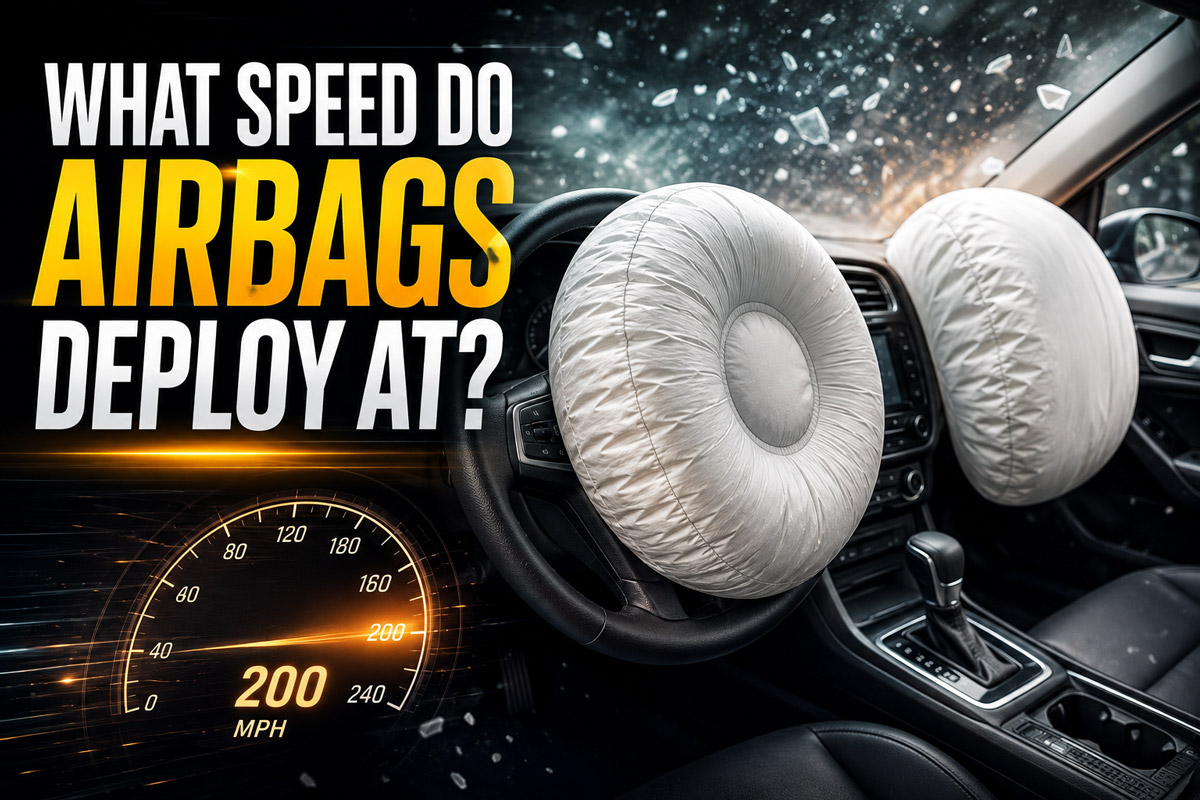
Vehicle airbags deploy at internal speeds of up to 200 mph (320 km/h). The entire inflation process takes just 20 to 50 milliseconds—roughly one-twentieth of a second, which is significantly faster than a human blink. This explosive speed is required to fully inflate the cushion before the occupant’s body moves forward during a collision.
Key Facts / At a Glance
- Peak Deployment Speed: ~200 mph (320 km/h).
- Deployment Duration: 20 to 50 milliseconds (0.02 to 0.05 seconds).
- Frontal Crash Threshold: 8 to 14 mph (13 to 22 km/h) for unbelted occupants; 16 mph (26 km/h) for belted occupants.
- Trigger Metric: Airbags trigger based on abrupt deceleration (Delta-V), not the vehicle’s cruising speed.
- Chemical Propellant: Modern systems use solid propellants like guanidine nitrate to instantly generate non-toxic nitrogen gas.
How Fast Do Airbags Actually Deploy?
Airbags must deploy fast enough to establish a physical barrier before the occupant’s head and chest strike the steering column or dashboard. To achieve this, the Supplemental Restraint System (SRS) forces nitrogen gas into the nylon fabric bag, causing it to burst through the interior trim at speeds reaching 200 mph.
Side-impact and torso airbags deploy even faster than frontal airbags. Because a vehicle’s side doors offer minimal crumple zones compared to a front engine bay, side-curtain airbags often fully inflate in just 10 to 20 milliseconds to protect fragile rib cages and prevent window ejection.
The Physics of Impulse Expansion
An airbag’s primary function is not to act as a soft pillow, but to manipulate the physics of force. The core operational principle relies on impulse expansion, represented by the equation $\Delta p = F \cdot \Delta t$.
By introducing a gas-filled barrier, the airbag increases the time ($\Delta t$) it takes for an occupant’s body to come to a complete halt. Because the time interval scales upward, the peak force ($F$) exerted on the skeletal structure drops significantly, preventing fatal trauma. As the occupant strikes the fully inflated bag, the gas rapidly vents out of exhaust ports in the back, absorbing the kinetic energy dynamically.
What Triggers an Airbag to Deploy?
Contrary to popular belief, airbag deployment is not tied to how fast the car is driving. It is triggered by the deceleration rate (known as Delta-V) and the direction of the impact. A vehicle traveling at 80 mph that brakes heavily will not trigger an airbag. Conversely, a vehicle coasting at 12 mph that strikes a concrete pillar dead-on will trigger instant deployment because the deceleration is instantaneous.
The National Highway Traffic Safety Administration (NHTSA) mandates specific collision thresholds. For unbelted occupants, frontal airbags must deploy in crashes equivalent to hitting a solid barrier at 8 to 14 mph. For belted occupants, the threshold rises to 16 mph and higher, because the seatbelt handles the primary restraint at lower force levels.
The Step-by-Step Deployment Timeline
The entire lifespan of an airbag deployment is categorized into five distinct micro-phases, all occurring within a fraction of a second:
- Crash Detection (0–10 ms): Micro-electromechanical systems (MEMS) accelerometers detect extreme G-force changes.
- Evaluation (10–15 ms): The Airbag Control Unit (ACU) cross-references sensor data against minimum Delta-V thresholds. If exceeded, it triggers the firing sequence and logs the event in the vehicle’s Event Data Recorder (black box).
- Chemical Ignition (15–20 ms): An electrical signal heats an igniter wire, sparking solid propellants (like guanidine nitrate) to instantly convert into nitrogen gas.
- Inflation & Burst (20–40 ms): High-pressure gas fills the 60-liter (driver) or 120-liter (passenger) nylon bag, bursting through engineered tear seams at 200 mph.
- Cushioning & Deflation (40–100+ ms): The occupant strikes the bag, and the gas immediately vents out the back ports to prevent ricochet.
Do Different Types of Airbags Deploy at Different Speeds?
Yes. Modern vehicles utilize an array of targeted airbags, each engineered with distinct volumes, trigger thresholds, and deployment velocities based on their proximity to the occupant.
| Airbag Type | Speed of Expansion | Minimum Trigger Threshold | Primary Benefit | Notable Drawback |
|---|---|---|---|---|
| Frontal (Driver/Passenger) | ~200 mph | 8–16 mph Delta-V | Prevents fatal steering wheel and dashboard impacts. | Can cause friction burns or abrasions on the face and arms. |
| Side Torso | ~200+ mph | 8–18 mph Delta-V | Protects internal organs from direct door intrusion. | Highly sensitive sensors can occasionally be triggered by extreme potholes. |
| Side Curtain | ~150–200 mph | Rollover angle / 8–14 mph | Prevents head trauma and stops cabin ejection during rollovers. | High replacement cost; requires full interior headliner removal. |
| Knee Airbags | ~150 mph | 10–16 mph Delta-V | Stops femurs from shattering against the lower steering column. | Restricts lower leg room for vehicle interior designers. |
Expert Insight: Modern vehicles use Dual-Stage (Smart) Airbags for frontal impacts. Using weight sensors in the seats, the ACU can scale the deployment force down to roughly 70% capacity for smaller occupants, or disable the passenger airbag entirely if it detects a weight under 65 lbs (indicating a child).
What Are the Safety Rules for High-Speed Deployments?
Because an airbag is essentially a controlled explosive device expanding at 200 mph, improper seating can turn this life-saving mechanism into a source of severe blunt-force trauma.
- Maintain a 10-Inch Clearance: Drivers should sit at least 10 inches (25 cm) away from the center of the steering wheel. Sitting closer puts your chest in the “deployment zone” while the bag is still actively exploding outward.
- Never Rest Feet on the Dashboard: This is a highly dangerous habit for passengers. A 200-mph deployment will forcefully drive the occupant’s knees backward into their chest, skull, or eye sockets, routinely causing permanent spinal damage or blindness.
- Avoid Aftermarket Steering Wheel Covers: Placing custom dash covers or bedazzled gems over the steering wheel emblem places loose objects directly over the airbag tear seams. Upon deployment, these items become high-speed shrapnel.
- Secure Children in the Rear: Children under 13 must ride in the back seat. Frontal airbags are dimensionally engineered for adult anatomy; their rapid deployment force can cause catastrophic cervical spine injuries in young children.
Expert Insight for Short-Stature Drivers: If you are under 5’2″, slide your seat as far back as you can while still safely depressing the pedals. If your vehicle features a tilting steering column, angle the wheel downward toward your breastbone rather than upward toward your neck.
Common Troubleshooting: Why Is My Airbag Light On?
The Airbag Dashboard Light (the SRS Icon) is the vehicle’s self-diagnostic warning. If this light stays illuminated, the entire airbag system is automatically deactivated. None of the airbags will deploy in a crash.
The most common causes for an SRS light include:
- Faulty Clock Spring: The electrical ribbon inside the steering wheel column frays over years of turning, breaking the connection to the driver’s airbag.
- Under-Seat Wire Strain: Shoving items under the front seats can unplug the delicate wiring harnesses for seat-belt pretensioners or occupancy weight sensors.
- Corroded Impact Sensors: Sensors behind the front bumper are exposed to road salt and moisture, degrading the wiring over time.
Diagnostic Warning: Never use a standard electrical multimeter to probe airbag wiring circuits. The small testing current emitted by a multimeter can accidentally detonate the inflator module. Always use a dedicated OBD-II scanner with SRS capabilities to read fault codes safely.
Frequently Asked Questions (FAQ)
Can an airbag deploy if the car is turned off?
Generally, no. Airbags rely on the vehicle’s electrical system and the Airbag Control Unit (ACU). If the ignition is completely off and the key is removed, the system is powered down. However, some modern vehicles maintain standby power for side-curtain airbags to detect parking-lot side impacts for a short duration after the car is turned off.
How much does it cost to replace deployed airbags?
Airbags cannot be repacked or reused. A full post-crash replacement averages $1,000 to $4,000 or more, encompassing the modules, clock springs, impact sensors, and dashboard repairs. Because of this, insurance companies frequently total older vehicles if multiple airbags deploy.
Does airbag deployment total a car automatically?
No, airbag deployment does not legally or automatically total a car. A vehicle is declared a total loss only when the combined cost of the airbag replacement and the structural collision repair exceeds the vehicle’s actual cash value (usually around the 70% to 80% threshold).
Do airbags expire or need to be replaced after a certain time?
Modern SRS systems (post-1996) are engineered to last the full operational life of the vehicle—typically 15 to 20 years—without scheduled servicing. As long as the vehicle’s internal diagnostic system reports no faults (the SRS light is off), the propellants and sensors remain viable.
Why do airbags smell like smoke after they deploy?
The “smoke” seen and smelled after deployment is actually cornstarch or talcum powder used to lubricate the nylon bag, mixed with harmless nitrogen gas and trace amounts of chemical byproducts from the solid propellant ignition. While it smells metallic or burnt, it is generally non-toxic, though it can trigger minor respiratory irritation.
The Bottom Line
When asking what speed do airbags deploy at, the answer highlights the extreme physics required for crash survival. Expanding at roughly 200 mph in just 20 to 50 milliseconds, modern airbag systems rely on rapid chemical ignition to build a physical barrier faster than a human blink. By maintaining a safe 10-inch seating distance, keeping your feet off the dashboard, and never ignoring an illuminated SRS warning light, you ensure this violent but life-saving mechanism can perform exactly as engineered when every millisecond counts.