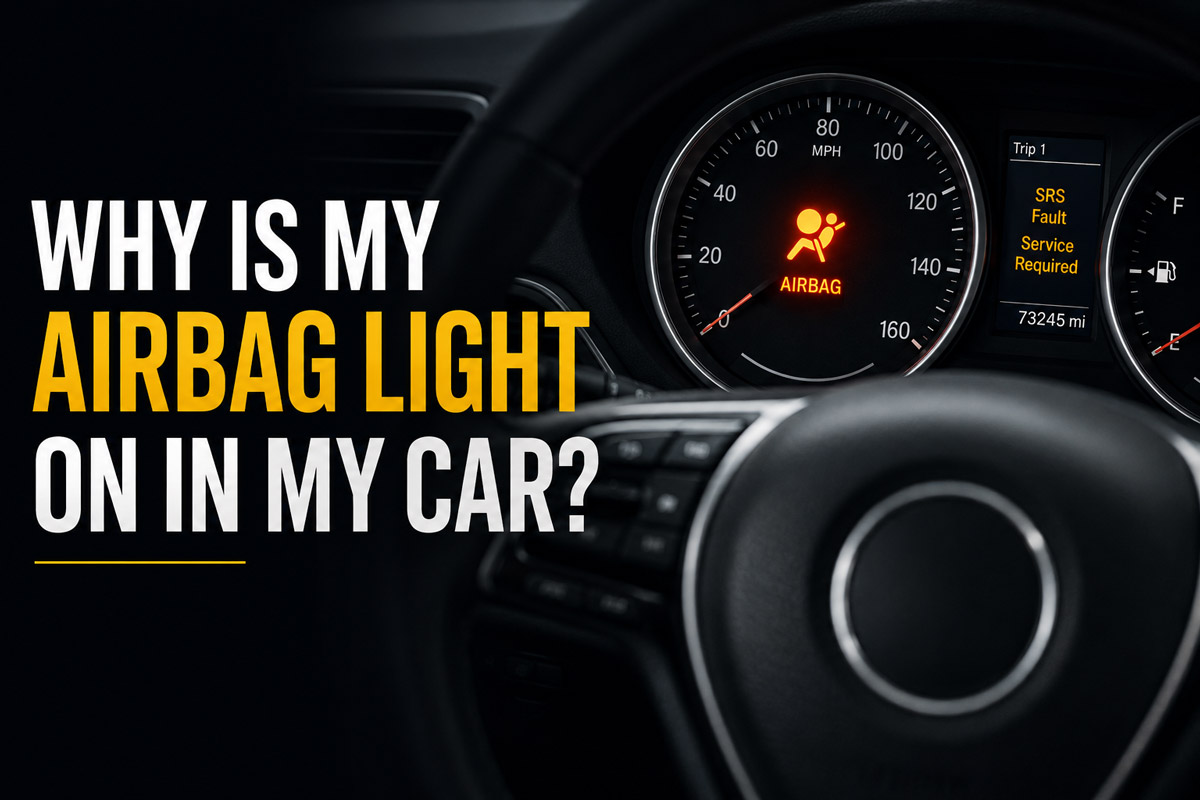
The airbag light illuminates because the Supplemental Restraint System (SRS) detected an electrical fault or component failure. Upon detecting an anomaly, the SRS Control Module instantly disables the affected airbag circuits to prevent accidental deployment, leaving vehicle occupants without airbag protection until a mechanic clears the specific diagnostic codes.
At a Glance: Key Airbag System Facts
- The Supplemental Restraint System disables airbags completely when the warning light activates.
- Under-seat connector jarring causes 40% of intermittent SRS light activations.
- Clock spring failures account for roughly 25-30% of steering wheel airbag issues.
- System voltage dropping below 10.5 volts frequently triggers false SRS error codes.
- Disconnecting the car battery cannot clear hard-coded SRS faults stored in EEPROM memory.
Will the airbags deploy when the warning light is on?
No, the airbags will not deploy during a collision if the dashboard warning light remains illuminated. The Supplemental Restraint System module actively disables the compromised electrical circuit to prevent an accidental firing while you are driving.
Modern vehicles utilize squib resistance to monitor airbag readiness. If the internal computer detects squib resistance dropping below 1.5 ohms or exceeding 3.2 ohms, the system safely shuts down the deployment mechanism. Because the system cannot guarantee the airbag will deploy at the exact millisecond required during a crash, engineers program the module to default to a disabled state. Occupants must assume they have zero supplemental restraint protection until the specific fault is repaired.
Is it safe to drive a car with the airbag light illuminated?
Driving with an illuminated airbag light is highly unsafe because the vehicle provides zero airbag protection in a collision. While the car’s engine, brakes, transmission, and steering remain perfectly functional and driveable, the occupant safety rating effectively drops to pre-airbag era standards.
Mechanically, the vehicle will not break down or stall due to an SRS fault. However, the risk of severe injury in a low-speed impact increases exponentially. Automotive safety systems rely on seatbelts and airbags working sequentially; seatbelts stretch slightly during an impact to allow the occupant to meet the deploying airbag. Without the airbag, the occupant risks severe whiplash or steering wheel impact. The vehicle should only be driven directly to a repair facility.
What are the most common mechanical causes of an airbag light?
The most frequent mechanical causes of an airbag warning light include damaged clock springs, disconnected under-seat wiring, and critical module hardware failures. When scanning for faults, mechanics look for specific trigger patterns.
- Under-Seat Connectors: Jarring seat adjustments cause 40% of intermittent airbag light activations by stretching the yellow wiring harnesses.
- Clock Spring Failure: A broken ribbon cable behind the steering wheel accounts for roughly 25-30% of steering wheel airbag illumination issues.
- Module Hardware Failure: Code B1000 indicates a fatal internal SRS Control Module hardware failure, meaning the computer itself requires total replacement.
How does a faulty clock spring trigger the SRS light?
A faulty clock spring triggers the SRS light by breaking the electrical continuity between the steering wheel airbag and the main computer. The clock spring is a wound ribbon cable that allows the steering wheel to turn while maintaining a constant electrical connection to the driver’s airbag squib.
Clock spring failures often present as a diagnostic mirage. A failing clock spring might only break continuity when the steering wheel is turned past 180 degrees. This leaves the airbag light completely off while driving straight down a highway, only for it to flash unexpectedly during tight parking maneuvers. Furthermore, a clock spring can pass a visual inspection and exhibit perfect steering wheel button functionality while still harboring a microscopic hairline fracture on the ribbon cable dedicated strictly to the airbag.
Why do under-seat connectors cause intermittent airbag warnings?
Under-seat connectors cause intermittent airbag warnings because repeated seat adjustments stretch and loosen the wiring harnesses connecting the side-impact airbags and seatbelt pretensioners. These connections utilize bright yellow plastic plugs located directly beneath the driver and passenger seats.
When a driver moves a seat violently backward, the tension pulls at the pins inside the connector. Over time, this movement causes momentary continuity breaks. The SRS module detects this micro-second loss of connection as a deployment failure risk and triggers the light. Because the seat may settle back into a position where the connection is restored, the light often behaves intermittently, turning off and on based on road vibrations or occupant weight shifts.
What edge cases and environmental factors activate SRS codes?
Environmental factors like liquid spills, specific cargo weights, and low electrical voltage routinely activate false or complex SRS codes that baffle standard diagnostics.
Can a dying car battery turn on the airbag warning light?
Yes, a dying car battery will trigger false airbag codes if the system voltage drops below 10.5 volts. The SRS module requires stable, continuous high voltage to run its internal diagnostic checks upon vehicle startup.
When a battery is weak, the starter motor draws massive amperage, causing the overall system voltage to temporarily dip below the 10.5-volt threshold. The highly sensitive SRS computer interprets this sudden voltage drop as a sensor failure or a short circuit. Even if the alternator immediately recharges the system back to 14 volts once the engine is running, the SRS module has already logged the low-voltage event and locked the dashboard warning light in the “on” position.
How does cargo weight confuse the Occupant Classification System?
Cargo weight confuses the Occupant Classification System (OCS) when objects weighing between 5 and 9 pounds sit on the front passenger seat. Front passenger OCS sensors require exactly 10 to 15 pounds of weight to register a small human and cleanly trigger the “Airbag Off” light.
When drivers place heavy purses, groceries, or backpacks weighing 5 to 9 pounds on the seat, the pressure bladder inside the cushion becomes confused. The weight is too heavy to register as an empty seat, but too light to definitively trigger the shut-off protocol. This specific weight window causes erratic dashboard light flashing as the system continuously attempts to classify the unknown object during driving vibrations.
Can spilled liquids in the center console trigger airbag codes?
Yes, spilling drinks into a vehicle’s center console can instantly short out the exposed SRS module pins located beneath the cup holders. Automotive manufacturers frequently mount the central airbag control computer on the transmission tunnel, directly under the center console plastics, to keep it near the vehicle’s true center of gravity.
When coffee or soda spills through the console seams, the liquid bypasses standard wiring protections and pools on the module’s connectors. This moisture bridges the electrical pins, causing an instant short circuit. This often results in a permanent, fatal internal module failure—frequently logging a B1000 diagnostic code—that requires a complete computer replacement rather than a simple wiring fix.
How do dummy resistors cause airbag faults in rebuilt cars?
Dummy resistors cause airbag faults in rebuilt title vehicles when cheap 2.2-ohm bypass components degrade and fail under extreme cabin temperature swings. Scam mechanics frequently install these resistors to trick the vehicle’s computer into turning the airbag light off after an undisclosed deployment.
Instead of spending thousands of dollars replacing blown airbags, fraudulent rebuilders jam a 2.2-ohm resistor into the empty airbag wiring harness. Because the SRS computer is simply looking for squib resistance between 1.5 and 3.2 ohms, the resistor successfully fakes a healthy system. However, these cheap electronic components are not automotive-grade. Summer heat and winter freezing eventually alter the resistor’s electrical properties, pushing it outside the acceptable ohm limit and triggering the warning light months after the vehicle was purchased.
Will disconnecting the vehicle battery reset the airbag light?
No, disconnecting the negative battery terminal for 15 minutes fails completely for clearing SRS systems. Standard internet advice suggests a battery drain resets dashboard lights, but federal safety mandates require automotive manufacturers to write airbag codes to non-volatile EEPROM memory.
Non-volatile EEPROM (Electrically Erasable Programmable Read-Only Memory) retains data even when entirely deprived of electrical power. Engineers designed the system this way so investigators can retrieve crash data and failure codes even if a vehicle’s battery is destroyed in an accident. Because the fault is hard-coded into the memory chip, no amount of battery disconnection, terminal touching, or fuse pulling will turn the warning light off.
How do mechanics clear hard-coded SRS EEPROM memory?
Mechanics clear hard-coded SRS EEPROM memory by utilizing a dedicated OBD-II (On-Board Diagnostics) scanner equipped with bi-directional SRS capabilities. Standard $20 code readers from auto parts stores can only read engine emissions codes; they cannot communicate with the separate airbag control module.
Once a professional technician physically repairs the underlying fault (such as replacing a clock spring or soldering a broken wire), they connect a high-end diagnostic tablet to the OBD-II port. The scanner sends a specific digital handshake to the SRS module, commanding the EEPROM to erase the stored fault block. Only after the computer verifies the hardware fix and receives the digital erase command will the dashboard light finally extinguish.
Why does cleaning yellow airbag plugs fail to fix the light?
Cleaning yellow under-seat plugs with electrical contact cleaner often fails because the harness suffers from terminal fret corrosion rather than simple dirt accumulation. Terminal fret corrosion involves microscopic metal wear on the connector pins that chemical cleaners cannot restore.
When the seat shakes during driving, the metal pins inside the connector rub against each other. Over years of friction, the protective metal plating wears away, creating microscopic debris and a poor connection that raises electrical resistance. Because the physical metal is missing, spraying contact cleaner provides no permanent fix. Resolving fret corrosion requires a mechanic to cut out the failing connector and splice in a full manufacturer bypass harness kit with fresh, tightly fitting pins.
How much does airbag system diagnosis and repair cost?
Airbag system diagnosis and repair typically costs between $350 and $850 total, depending on the specific component failure. The repair bill is split between mandatory specialized computer diagnostics and physical hardware replacement.
- Diagnostic Scans: Run $100 to $150. Because SRS codes are locked in specialized modules, shops charge a premium for the specialized scanners required to read them.
- Component Replacement: Replacing a broken clock spring or a faulty seat sensor generally costs $250 to $700 in parts and labor.
- Module Replacement: If the system suffered a fatal B1000 short circuit, replacing and reprogramming a new SRS Control Module can easily exceed $800.
The Bottom Line
An illuminated airbag light indicates that the Supplemental Restraint System has detected a critical fault and completely disabled your airbags for safety. While the car remains mechanically driveable, occupants face severe risk in a collision because the system provides zero supplemental protection. Because federal mandates require airbag faults to be stored in permanent EEPROM memory, DIY battery resets will not work; the system requires professional diagnosis with an SRS-capable scanner to pinpoint whether a clock spring, under-seat connector, or voltage drop is responsible.