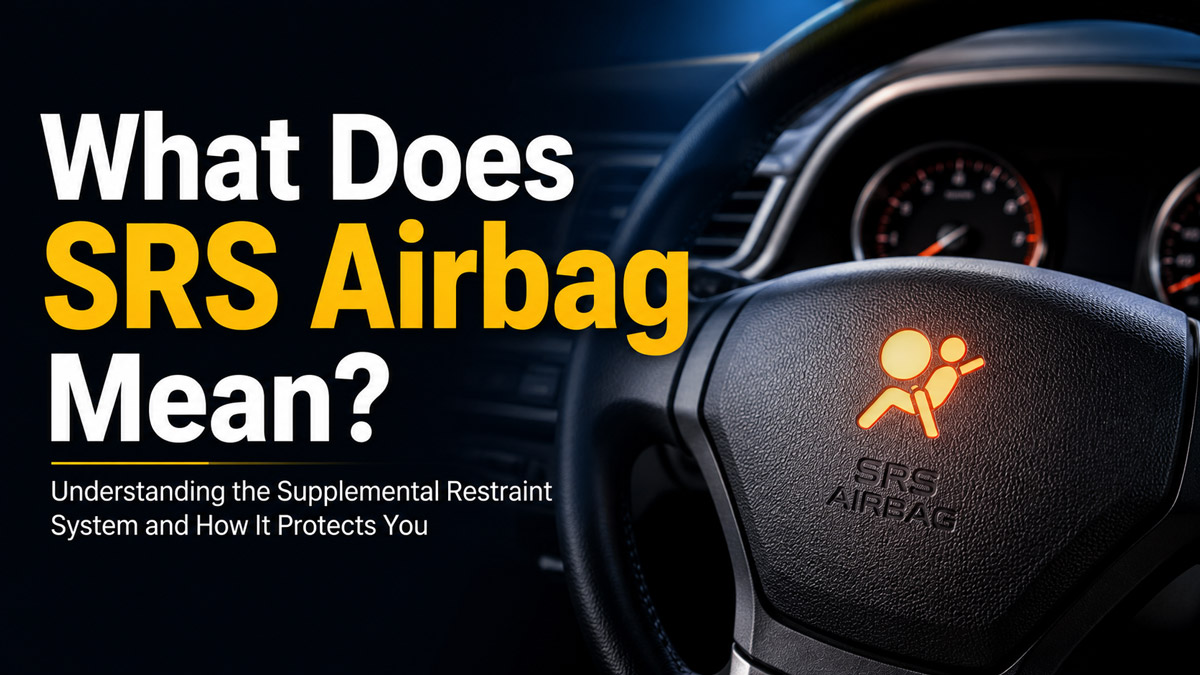
SRS Airbag means Supplemental Restraint System Airbag. It is a coordinated vehicle safety network that uses airbags, crash sensors, seatbelt pretensioners, control modules, and occupant sensors to reduce injuries during certain collisions. The word “supplemental” is important because the system supports seatbelts rather than replacing them.
Key Facts at a Glance
- SRS stands for Supplemental Restraint System.
- The SRS network includes more than the visible airbags.
- Airbags typically inflate within approximately 20–50 milliseconds.
- Seatbelts remain the primary restraint system in most crashes.
- A persistent SRS warning light indicates a stored safety-system fault.
- SRS repairs require a diagnostic scanner capable of reading airbag codes.
What Is an SRS Airbag System?
An SRS airbag system is an electronically controlled occupant-protection network designed to reduce contact with the steering wheel, dashboard, doors, pillars, glass, and other hard surfaces during a qualifying collision.
Although drivers commonly call it the “airbag system,” the SRS normally includes several connected devices:
- Driver and passenger airbags
- Side-torso and curtain airbags
- Crash and acceleration sensors
- Airbag control module
- Seatbelt pretensioners
- Seatbelt buckle switches
- Passenger occupancy sensor
- Steering-wheel clockspring
- SRS wiring and connectors
- Backup power capacitor
These components communicate continuously while the ignition is on. A fault in one component can illuminate the SRS warning light even when every airbag appears physically intact.
Why Is It Called a Supplemental Restraint System?
The system is called supplemental because airbags are designed to work with seatbelts. A seatbelt restrains the body earlier in a collision, while an airbag creates a temporary cushion between the occupant and the vehicle interior.
An airbag alone cannot hold an occupant in the correct position throughout a crash. Without a seatbelt, a person may move too close to the airbag before it inflates, slide underneath it, be partially ejected, or strike another part of the cabin.
The safest sequence is:
- The seatbelt limits forward or sideways movement.
- The pretensioner removes belt slack.
- The airbag deploys when the crash meets programmed criteria.
- The occupant contacts the inflated cushion.
- The airbag vents gas and deflates.
How Does the SRS Airbag System Work?
The SRS completes its main deployment decision within milliseconds. The process begins before the occupant has moved far enough to strike the vehicle interior.
1. Sensors Detect the Collision
Crash sensors measure rapid deceleration, acceleration changes, vehicle rotation, pressure changes, or physical deformation. Modern vehicles may use several sensors positioned at the front, sides, doors, pillars, and central floor area.
2. The Control Module Evaluates the Data
The airbag control module compares sensor information with programmed deployment thresholds. It evaluates factors such as:
- Direction of impact
- Severity of deceleration
- Duration of the force
- Seat occupancy
- Seatbelt use
- Vehicle movement
- Rollover conditions
The module may deploy different restraints for different crashes. A frontal collision may activate front airbags and belt pretensioners, while a severe side impact may activate a side-torso airbag and curtain airbag.
3. The Inflator Receives an Electrical Signal
When deployment criteria are met, the control module sends current through the appropriate igniter circuit. The inflator rapidly generates gas that fills the folded airbag.
Older systems may use different propellant chemistry from newer inflators, so the exact gas-generation method varies by manufacturer and model year.
4. The Airbag Inflates
Most airbags inflate within roughly 20–50 milliseconds. Frontal airbags may expand at an initial speed commonly described as approximately 100–200 mph, although the meaningful measurement is inflation time rather than a constant travel speed.
5. The Airbag Deflates
Vents in the airbag release gas as the occupant contacts it. Controlled deflation absorbs energy and prevents the bag from behaving like a rigid surface. The visible bag usually collapses quickly after deployment.
What Components Make Up the SRS?
| Component | Primary Function | Common Failure |
| Airbag control module | Evaluates sensor data and commands deployment | Internal fault, low voltage or stored crash data |
| Crash sensors | Detect impact forces and vehicle movement | Corrosion, collision damage or wiring faults |
| Airbag module | Contains the folded bag and inflator | Deployment, damaged connector or recalled inflator |
| Clockspring | Maintains wiring contact through steering rotation | Broken internal ribbon cable |
| Pretensioner | Tightens the seatbelt during a crash | Deployment or electrical resistance fault |
| Buckle switch | Reports whether the seatbelt is fastened | Worn or contaminated internal switch |
| Occupancy sensor | Determines passenger presence and classification | Calibration failure or damaged seat sensor |
| SRS wiring | Connects modules, sensors and restraints | Loose connector, corrosion or damaged harness |
Yellow connectors or yellow-wrapped wiring commonly identify SRS circuits. Their appearance varies, but they should not be tested with an ordinary test light or resistance meter unless the manufacturer’s procedure specifically permits it.
What Types of SRS Airbags Are Used?
Frontal Airbags
Frontal airbags are normally installed in the steering wheel and passenger-side dashboard. They are designed mainly for moderate-to-severe frontal or near-frontal impacts.
Advanced frontal systems can adjust deployment based on crash severity, seat position, seatbelt use, and passenger classification.
Side-Torso Airbags
Side-torso airbags are usually installed in the seatback or door area. They protect the chest, ribs, abdomen, and pelvis during side impacts where there is little space between the occupant and the striking object.
Side-Curtain Airbags
Curtain airbags deploy downward from the roof rail or headliner. They help protect the head during side impacts and may remain inflated longer in rollover situations to reduce the risk of occupant ejection.
Knee Airbags
Knee airbags deploy from the lower dashboard area. Their purpose is to manage lower-body movement and help keep the occupant positioned correctly for the frontal airbag and seatbelt.
Seat-Cushion Airbags
A seat-cushion airbag raises or supports part of the seat during a collision. It can reduce submarining, which occurs when an occupant slides underneath the lap portion of the seatbelt.
Pedestrian Airbags
Some vehicles use exterior airbags near the windshield base. These systems are designed to reduce pedestrian contact with rigid structures around the hood, windshield, and pillars.
What Does the SRS Warning Light Mean?
An illuminated SRS warning light means the vehicle has detected a fault in the supplemental restraint network. Depending on the vehicle and fault, one airbag, several restraints, or a larger part of the system may be unavailable until the problem is repaired.
The warning may appear as:
- “SRS”
- “AIRBAG”
- “SERVICE AIRBAG”
- A seated-person-and-airbag symbol
- A flashing airbag symbol
- A passenger airbag status message
The exact symbol and behavior depend on the manufacturer.
What Should the SRS Light Do at Startup?
The SRS light should normally illuminate for several seconds when the ignition is switched on and then turn off. This is the system’s self-check.
Common warning patterns include:
- Turns on, then goes off: Normal self-test completed.
- Stays on: A current or stored fault is present.
- Flashes repeatedly: The vehicle may be displaying a fault sequence.
- Never illuminates: The bulb, LED, instrument cluster, or warning circuit may be faulty or altered.
- Comes on intermittently: A loose connection, voltage problem, or movement-related wiring fault may be present.
A warning light that never appears during startup should not automatically be treated as proof that the system is healthy.
Why Does the SRS Airbag Light Come On?
Low Battery Voltage
A weak battery, jump-start event, alternator problem, or battery replacement can create an undervoltage code. The warning may remain after voltage returns to normal because the code is stored in the control module.
Loose Under-Seat Connectors
Seat movement can strain wiring for side airbags, pretensioners, buckle switches, and passenger occupancy sensors. Objects stored under the seat can also damage connectors or harnesses.
Do not repeatedly unplug and reconnect SRS connectors while the battery is connected.
Faulty Steering-Wheel Clockspring
The clockspring carries electrical signals between the fixed steering column and rotating steering wheel. A damaged clockspring can trigger the airbag light and may also affect the horn, steering-wheel buttons, or cruise control.
Seatbelt Buckle or Pretensioner Fault
A failed buckle switch may not report belt status correctly. A pretensioner may also show excessive resistance, an open circuit, or deployment history.
Passenger Occupancy Sensor Failure
The passenger seat uses weight or pressure information to decide whether the passenger airbag should be active. Seat removal, water exposure, wiring damage, or incorrect calibration can cause a fault.
Water or Corrosion Damage
Water entering through a leaking sunroof, windshield, door seal, or flooded floor can corrode low-mounted SRS connectors and side-impact sensors.
Previous Collision or Deployment
After a crash, the control module may record deployment data. Deployed airbags and pretensioners must be replaced, and the control module may require replacement or authorized restoration according to the manufacturer’s procedure.
Does an SRS Light Mean the Airbags Will Not Deploy?
An SRS warning light means deployment performance cannot be trusted. Some vehicles disable only the affected circuit, while others may deactivate multiple restraints when a critical communication or control-module fault is present.
A scanner is required to identify the affected circuit. Visual inspection alone cannot confirm whether the airbags will deploy correctly.
The practical rule is simple: treat a persistent SRS light as a safety fault and arrange diagnosis as soon as possible.
Can You Drive With the SRS Light On?
A vehicle may continue to run normally with the SRS light on because the fault usually does not affect the engine, transmission, steering, or brakes. However, normal drivability does not mean the occupant-protection system is functioning correctly.
Driving should be limited until the system is diagnosed, especially when:
- The light appeared after a collision
- A seatbelt does not latch correctly
- The passenger airbag status is incorrect
- Water entered the cabin
- Steering-wheel controls failed at the same time
- Airbag or seat wiring has been disturbed
Seatbelts should still be worn on every trip, even when an SRS fault exists.
How Is an SRS Fault Diagnosed?
Step 1: Record the Warning Behavior
Note whether the light remains solid, flashes, appears intermittently, or started after battery, seat, steering, or collision work.
Step 2: Check Battery Condition
Measure battery voltage and inspect the charging system. Low voltage should be corrected before deeper diagnosis because unstable voltage can create misleading codes.
Step 3: Scan the SRS Module
Use a diagnostic scanner that specifically supports the vehicle’s airbag system. A basic engine-code reader may communicate only with the powertrain control module and cannot retrieve SRS codes.
Step 4: Follow the Code-Specific Procedure
An SRS code identifies a circuit or detected condition, not always the failed part. For example, a driver-airbag resistance code could result from the airbag module, clockspring, connector, harness, or control unit.
Step 5: Repair Before Clearing the Code
Clearing the code without repairing the cause usually results in the warning returning during the next self-check.
Step 6: Confirm the Repair
After repairs, clear permitted codes, cycle the ignition, verify that the warning light completes its normal self-check, and rescan the system.
How Much Does SRS Repair Cost?
Typical costs vary significantly by vehicle, fault, parts availability, and whether deployment occurred.
| Service | Typical Cost |
| SRS diagnostic scan | $100–$200 |
| Under-seat wiring repair | $100–$400 |
| Seatbelt buckle replacement | $150–$450 |
| Clockspring replacement | $250–$600 |
| Occupancy sensor repair | $300–$1,500 |
| Airbag module replacement | $1,000–$4,000+ |
| Multi-airbag crash repair | $3,000–$10,000+ |
Diagnosis commonly takes 30–90 minutes. Component replacement may require one to three hours, while post-collision restoration can take considerably longer because trim, dashboards, seatbelts, sensors, and control modules may all require attention.
Important SRS Safety Rules
- Sit at least approximately 10 inches from the steering-wheel airbag when practical.
- Wear the seatbelt correctly across the shoulder and hips.
- Never place a rear-facing child seat in front of an active passenger airbag.
- Do not place feet on the dashboard.
- Keep phone mounts, decorations, and accessories away from airbag deployment covers.
- Do not probe SRS connectors with an ordinary test light.
- Do not install resistors to imitate functioning airbags.
- Replace deployed parts with compatible components specified for the exact vehicle.
- Follow the manufacturer’s battery-disconnection and waiting procedure before SRS work.
Disconnecting the battery does not automatically make every procedure safe. The SRS control unit contains backup energy storage, and some vehicles require additional manufacturer-specific steps.
Common SRS Misunderstandings
“SRS Means Only the Steering-Wheel Airbag”
SRS includes multiple restraints, sensors, wiring circuits, and control systems. A fault in a seatbelt pretensioner can illuminate the same warning used for an airbag fault.
“Disconnecting the Battery Resets the SRS Light”
Battery disconnection may remove power temporarily, but it usually does not erase a stored hard fault. The light will return when the system detects the unresolved problem.
“The Passenger Airbag-Off Light Means the System Is Broken”
The passenger airbag-off indicator may be normal when the seat is empty or occupied by a person or object below the activation threshold. The owner’s manual explains the expected status for that vehicle.
“Airbags Deploy in Every Accident”
Airbags deploy only when sensor data and control-module logic meet programmed conditions. A low-speed impact, rear collision, minor side impact, or certain angled collision may not require the same restraints.
Frequently Asked Questions
Is SRS the Same as an Airbag?
SRS is not a single airbag. It is the complete Supplemental Restraint System, which may include airbags, seatbelt pretensioners, crash sensors, occupancy sensors, buckle switches, wiring, and an airbag control module.
What Is the Difference Between SRS and ABS?
SRS protects occupants during qualifying collisions, while ABS helps prevent wheel lock during braking. The two systems use different sensors, control modules, warning lights, and repair procedures.
Can a Weak Battery Cause the SRS Light?
Yes. Low system voltage can store an undervoltage or communication code in the SRS module. The battery and charging system should be tested, but the code must still be read to confirm that low voltage is the actual cause.
Can an SRS Light Be Reset Without a Scanner?
Some older vehicles support limited manual procedures, but most modern vehicles require an SRS-capable scanner. Resetting the warning without correcting the fault does not restore system safety.
How Long Do Airbags Last?
Many modern airbags are designed to remain installed for the vehicle’s service life. However, deployed, damaged, recalled, contaminated, or fault-coded components require inspection or replacement regardless of age.
Will an SRS Light Fail a Vehicle Inspection?
Inspection rules depend on the jurisdiction. Some areas treat an illuminated SRS warning as a safety failure, while others do not include airbags in routine inspection. The system should still be repaired because inspection status does not determine crash protection.
The Bottom Line
SRS Airbag means Supplemental Restraint System Airbag, but the term refers to far more than the visible airbag cushion. The system combines airbags, seatbelt pretensioners, sensors, wiring, occupant detection, and an electronic control module to reduce injury during qualifying crashes.
When the SRS warning light stays on, flashes, or fails to complete its normal startup check, the system requires diagnosis with a compatible scanner. Correcting the underlying fault—not merely clearing the warning—is the only reliable way to restore proper SRS operation.