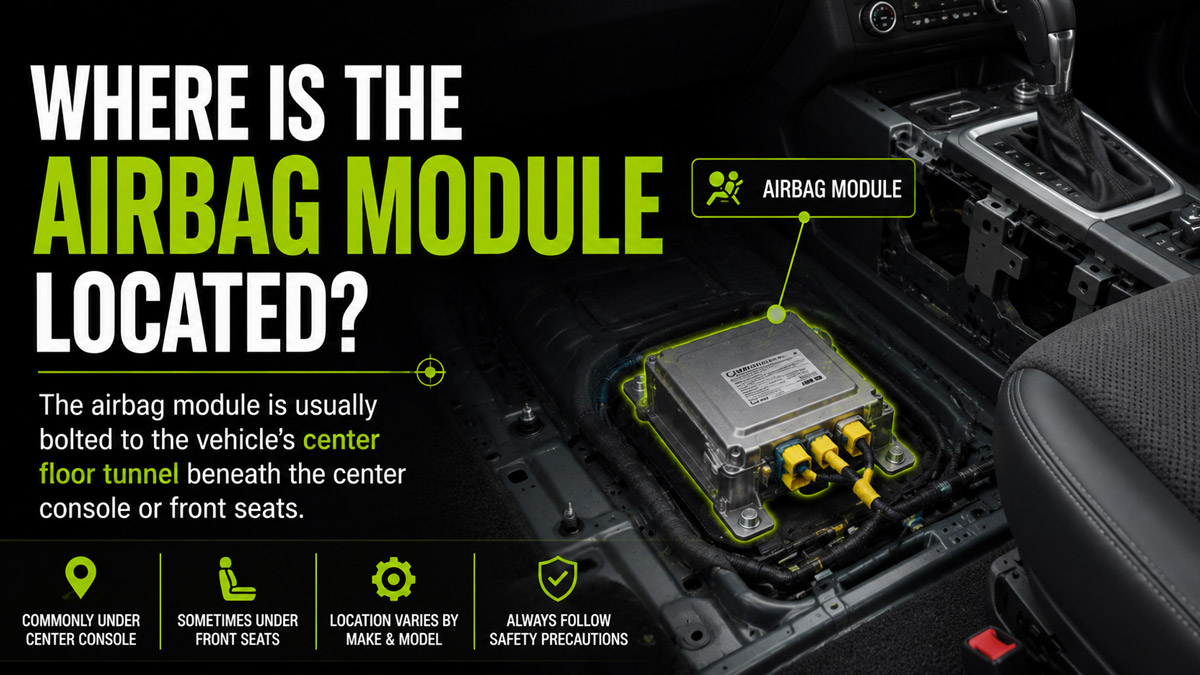
The airbag module is usually bolted to the vehicle’s center floor tunnel beneath the center console, radio area, or front seats. However, its exact position depends on the vehicle’s make, model, year, and body design, so the manufacturer’s service information should always be checked before removing interior panels.
Key Facts at a Glance
- The airbag module is commonly located near the vehicle’s longitudinal centerline.
- Most modules are installed beneath the center console or on the center floor tunnel.
- Some vehicles place the module beneath a front seat or lower dashboard.
- Yellow connectors normally identify Supplemental Restraint System wiring.
- The battery must be disconnected before disturbing airbag-system components.
- A replacement module may require programming, calibration, and fault-code clearing.
What Is an Airbag Module?
An airbag module is the main electronic controller for a vehicle’s Supplemental Restraint System. It receives information from impact sensors, seat-position sensors, seat-belt switches, occupant-classification systems, and internal accelerometers.
Manufacturers use several names for this component, including:
- Airbag Control Module, or ACM
- Supplemental Restraint System module, or SRS module
- Restraints Control Module, or RCM
- Sensing and Diagnostic Module, or SDM
- Airbag Electronic Control Unit, or airbag ECU
Despite the different names, the module performs the same core function: it determines whether a collision meets the programmed conditions for deploying one or more airbags and activating seat-belt pretensioners.
Where Is the Airbag Module Usually Located?
The most common airbag module location is on the center floor tunnel beneath the center console. This area gives the module a rigid mounting point close to the vehicle’s centerline, where its internal motion sensors can measure crash forces consistently.
Typical locations include:
| Possible location | Where to inspect |
| Beneath the center console | Below the cupholders, gear selector, storage compartment, or armrest |
| Center floor tunnel | Between the driver and front passenger seats |
| Beneath the dashboard | Below the radio, climate controls, or center stack |
| Under a front seat | Attached to the floor beneath the driver or passenger seat |
| Rear of the center console | Beneath rear console trim or carpeting |
| Beneath the carpet | On the transmission tunnel or central floor section |
The module is not always positioned at the exact geometric center of the vehicle. Packaging limitations, drivetrain layout, interior design, water protection, and crash-sensing requirements can change its location.
Why Is the Module Mounted Near the Vehicle’s Center?
The airbag control module is often mounted near the vehicle’s center because that location provides a stable reference point for measuring acceleration, deceleration, and rotational movement. It also helps protect the controller from minor front, rear, and side impacts.
The module must be rigidly bolted to the body. Its internal sensors depend on the module’s mounting angle and orientation to interpret crash movement correctly.
Placing the module inside the passenger compartment can also protect it from engine heat, road debris, direct impact damage, and environmental exposure. However, a floor-mounted module remains vulnerable to water entering through floods, blocked drains, heater-core leaks, or damaged door and windshield seals.
How Can You Find the Exact Module Location?
The safest way to find the exact airbag module location is to consult service information for the vehicle’s specific year, make, model, body style, and equipment package.
Check the Repair Manual
A factory service manual normally identifies the component location, trim-removal sequence, fastener specifications, connector-locking method, and required waiting period after battery disconnection.
Search the manual for terms such as:
- Airbag control module
- SRS control unit
- Restraints control module
- Sensing and diagnostic module
- Airbag ECU
- Supplemental restraint controller
Use a Vehicle-Specific Parts Diagram
Online manufacturer diagrams and dealership parts catalogs can show the module’s approximate mounting position. A diagram may not provide safe removal instructions, but it can confirm whether the module is under the console, dashboard, carpet, or seat.
Follow the SRS Wiring Carefully
Airbag-system connectors and harness coverings are commonly yellow. Following them may help identify the module, but SRS wiring should never be pierced, tested with an ordinary test light, or handled while the system is energized.
Scan the Vehicle
An SRS-capable diagnostic scanner may identify the controller by its manufacturer-specific name. This does not physically locate the unit, but it provides the correct terminology to use when searching technical information.
What Does the Airbag Module Look Like?
An airbag control module is generally a compact rectangular metal or reinforced-plastic unit secured directly to the vehicle body with three or four bolts. It often has one or more large connectors with secondary locking devices.
Common identifying features include:
- A warning label mentioning airbags or SRS
- Yellow electrical connectors
- Directional arrows
- “Front” or “Forward” markings
- A manufacturer part number
- A vehicle-brand or supplier label
- A rigid metal mounting bracket
Do not confuse the control module with an impact sensor. Crash sensors are usually smaller and may be mounted near the radiator support, door structure, B-pillars, or rear body panels.
Is the Module Under the Driver’s Seat?
Some airbag modules are installed beneath the driver’s or front passenger’s seat, but this is less universal than the center-console location. A device under the seat may instead be a seat-memory controller, amplifier, occupant-detection module, parking-brake controller, or seat-airbag connector.
Check the part number or service diagram before assuming an under-seat box is the main SRS controller.
Under-seat areas also contain wiring for:
- Side airbags
- Seat-belt pretensioners
- Seat-position sensors
- Occupant-classification sensors
- Heated and powered seats
Disconnecting the wrong connector can create new warning codes or disable part of the restraint system.
Is the Airbag Module Behind the Dashboard?
An airbag module may be mounted beneath the center of the dashboard, often below the radio or climate-control assembly. It is less commonly mounted directly behind the instrument cluster or glove compartment.
The passenger airbag itself is normally located inside the upper dashboard, but the passenger airbag assembly is not the same component as the airbag control module.
A vehicle may contain separate controllers for occupant detection, rollover sensing, pedestrian protection, or seat systems. Therefore, finding an airbag-related component behind the dashboard does not necessarily mean it is the primary SRS module.
How Does the Airbag Control Module Work?
The airbag control module continuously monitors the restraint system whenever the ignition is switched on. It runs a self-test, checks circuit resistance, evaluates sensor inputs, and illuminates the airbag warning light when it detects a fault.
During a collision, the module performs four main functions:
- Sensing: Internal and external sensors measure rapid changes in speed and direction.
- Evaluation: The controller compares the sensor data with programmed deployment thresholds.
- Activation: The module sends electrical firing commands to selected airbags and pretensioners.
- Recording: The system may store collision data, fault information, and deployment history.
The module does not deploy every airbag during every crash. Deployment decisions may depend on impact direction, severity, seat occupancy, seat-belt use, rollover detection, and vehicle-specific programming.
Can You Access the Airbag Module Safely?
Accessing the module requires restraint-system precautions because airbags and pretensioners contain pyrotechnic devices. Accidental deployment can cause severe injury and expensive interior damage.
Before Accessing the Module
Follow the manufacturer’s procedure, but the general preparation sequence is:
- Park the vehicle on a level surface.
- Turn the ignition off and remove the key.
- Preserve any required radio or security codes.
- Disconnect the negative battery terminal.
- Isolate the cable so it cannot reconnect accidentally.
- Wait for the manufacturer-specified discharge period.
- Remove the necessary trim, seat, console, or carpet sections.
Waiting periods vary. Many procedures specify several minutes, while some require longer because the SRS may contain a reserve-energy capacitor that allows deployment when battery power is interrupted during a crash.
Never rely on one universal waiting time when service information is available.
Should You Remove the Module Yourself?
Removing interior trim may be manageable for an experienced technician or skilled vehicle owner, but diagnosing, replacing, or programming an airbag control module is not an ideal beginner repair.
Professional service is advisable when:
- The vehicle has deployed airbags
- Seat-belt pretensioners have activated
- The module contains crash data
- The vehicle has flood or water damage
- Programming or configuration is required
- The scanner cannot communicate with the SRS
- Structural collision repairs were performed
- Occupant sensors need calibration
A module that is physically easy to reach may still require specialized scan tools, manufacturer software, security access, initialization, or variant coding.
What Happens If the Module Is Installed Incorrectly?
An incorrectly installed module may record inaccurate motion data or fail the restraint-system self-test. The controller must normally be installed in its original direction using the correct fasteners and mounting points.
Common installation errors include:
- Installing the module backward
- Mounting it at an incorrect angle
- Leaving bolts loose
- Placing washers or insulation beneath the module
- Damaging connector locks
- Trapping wiring beneath the mounting bracket
- Reconnecting the battery before all components are installed
Some mounting bolts also provide grounding. Corrosion, paint, sealant, or loose fasteners can therefore create communication or circuit problems.
Where Is the Module After Airbags Deploy?
The physical location of the module does not change after deployment. However, the controller may store deployment records or crash data and may set hard fault codes that ordinary scanners cannot clear.
Post-collision repairs can involve more than replacing the visible airbag. Depending on the vehicle and impact, the repair may include:
- Airbag assemblies
- Seat-belt pretensioners
- Impact sensors
- Steering-wheel clockspring
- Dashboard components
- Occupant-detection sensors
- Damaged wiring
- The airbag control module
- Module programming or resetting
All deployed and damaged components should be identified using diagnostic codes and manufacturer repair procedures.
Can an Airbag Module Be Reset?
Some modules can be professionally reset after crash data has been stored, while others must be replaced. Whether resetting is permitted depends on module design, vehicle manufacturer procedures, collision damage, and local regulations.
A reset service usually removes stored deployment information from an undamaged original module. It does not repair:
- Corrosion
- Water intrusion
- Broken circuit boards
- Burned deployment drivers
- Damaged connectors
- Incorrect vehicle coding
- Faulty airbags or pretensioners
A reset controller should not be treated as a complete airbag-system repair. Every underlying fault must still be diagnosed and corrected.
New, Used, or Reset Module: Which Is Better?
| Module option | Main advantage | Main limitation |
| New OEM module | New hardware and correct manufacturer specification | Highest purchase cost and may require programming |
| Original reset module | Retains the vehicle’s original hardware and configuration | Only suitable when the module is undamaged and resettable |
| Used module | Lower initial purchase price | May contain crash data, incompatible coding, or hidden damage |
| Remanufactured module | Tested or repaired by a specialist | Quality and compatibility depend on the provider |
The original reset module is often preferable to a random used unit when the original hardware is intact and the manufacturer permits reuse. A new OEM module is generally the safest choice when the original controller has physical, electrical, or water damage.
How Much Does an Airbag Module Cost?
A new airbag control module typically costs approximately $200 to $800 for the part, although luxury, performance, electric, and low-volume vehicles may cost more. Programming, diagnosis, interior removal, and calibration can significantly increase the final bill.
Typical cost ranges include:
| Service | Typical range |
| SRS diagnostic scan | $80–$200 |
| Module reset service | $50–$150 |
| Used module | $75–$300 |
| New OEM module | $200–$800+ |
| Programming or coding | $100–$300 |
| Removal and installation labor | 1–3 hours |
These figures are broad estimates. The total cost depends on accessibility, regional labor rates, manufacturer requirements, and whether additional restraint components were damaged.
Why Is the Airbag Light Still On?
The airbag light remains illuminated when the SRS controller detects an active or stored problem. Replacing or resetting the module will not turn off the warning if another fault remains.
Common causes include:
- Disconnected under-seat wiring
- Failed clockspring
- Seat-belt buckle or pretensioner faults
- Low system voltage
- Damaged impact sensors
- Occupant-classification errors
- Incorrect module programming
- Open or shorted deployment circuits
- Water-damaged connectors
- Communication-network faults
An SRS-capable scanner is required to read the relevant diagnostic trouble codes. A basic engine-code reader normally cannot access the airbag system.
What Causes No Communication With the Module?
No communication with the airbag module usually results from lost power, poor grounding, network wiring damage, an incorrect module, or internal controller failure. A blown fuse is possible, but replacing a fuse without diagnosing why it failed can leave an electrical fault unresolved.
A technician typically checks:
- Battery voltage
- Relevant fuses
- Module power feeds
- Ground circuits
- Communication-bus wiring
- Connector condition
- Water or corrosion damage
- Module compatibility and programming
Probing airbag deployment circuits with inappropriate equipment can damage components or create a deployment risk. Circuit testing should follow manufacturer-approved procedures.
Common Airbag Module Location Mistakes
Assuming Every Module Is Under the Console
The center console is the most common starting point, not a universal location. Confirm the vehicle-specific position before dismantling the interior.
Confusing a Sensor With the Main Controller
Impact sensors are smaller and distributed around the vehicle. The central module is usually larger and connected to multiple restraint-system circuits.
Disconnecting Yellow Connectors With Power Connected
Yellow connectors generally indicate SRS circuits. Disconnecting them while the system is powered can set codes and create a safety hazard.
Ignoring Water Under the Carpet
A module may look intact while its connector pins and circuit board are corroded. Water-damaged modules and harnesses require careful inspection before reuse.
Installing a Used Module Without Verification
Matching the physical connector does not guarantee compatibility. Part numbers, software, vehicle options, VIN data, and deployment history may differ.
Expert Recommendations
Use the vehicle identification number and factory service information to locate the controller rather than relying only on a generic diagram. Two vehicles with similar names may use different module positions or access procedures across model years.
Inspect for moisture before replacing any floor-mounted controller. Installing a new module without repairing a leaking windshield, sunroof drain, heater core, or body seam may destroy the replacement.
Treat module orientation as a functional requirement, not a cosmetic detail. Internal accelerometers depend on the controller being firmly mounted in the specified direction.
Frequently Asked Questions
Is the airbag module always beneath the center console?
No. The airbag module is commonly beneath the center console, but it may also be beneath a seat, lower dashboard, carpet, or rear-console area. The exact location should be verified through a vehicle-specific service manual or manufacturer parts diagram.
Can I drive with a faulty airbag module?
The vehicle may continue to operate, but the airbags or pretensioners may not function correctly while the warning light is illuminated. Because the fault affects occupant protection, the system should be diagnosed and repaired as soon as practical.
Does disconnecting the battery reset the airbag module?
Disconnecting the battery generally does not erase hard SRS fault codes, crash records, or deployment data. It may temporarily remove power, but the warning usually returns after the self-test if the underlying fault remains.
Does every vehicle have one airbag control module?
Most vehicles use one primary restraint-system controller, but they may also contain separate occupant-classification, rollover, pedestrian-protection, seat, or satellite sensor modules. The number and arrangement depend on the vehicle’s safety architecture.
Can a basic OBD-II scanner locate an airbag fault?
Most basic OBD-II scanners read only powertrain codes. An SRS-capable scanner with coverage for the specific vehicle is normally needed to communicate with the airbag module, identify fault codes, and perform programming or calibration functions.
Where is the airbag module located in an SUV or truck?
SUVs and trucks commonly place the module on the center floor tunnel beneath the console, dashboard, or front-seat area. However, body-on-frame construction, four-wheel-drive components, and interior layouts can lead to different mounting positions.
The Bottom Line
The answer to “where is the airbag module located?” is usually beneath the center console or on the center floor tunnel, but no single position applies to every vehicle. Confirm the exact location using the model-specific service manual, disconnect the battery according to manufacturer instructions, and avoid replacing or resetting the module without diagnosing the complete SRS system.