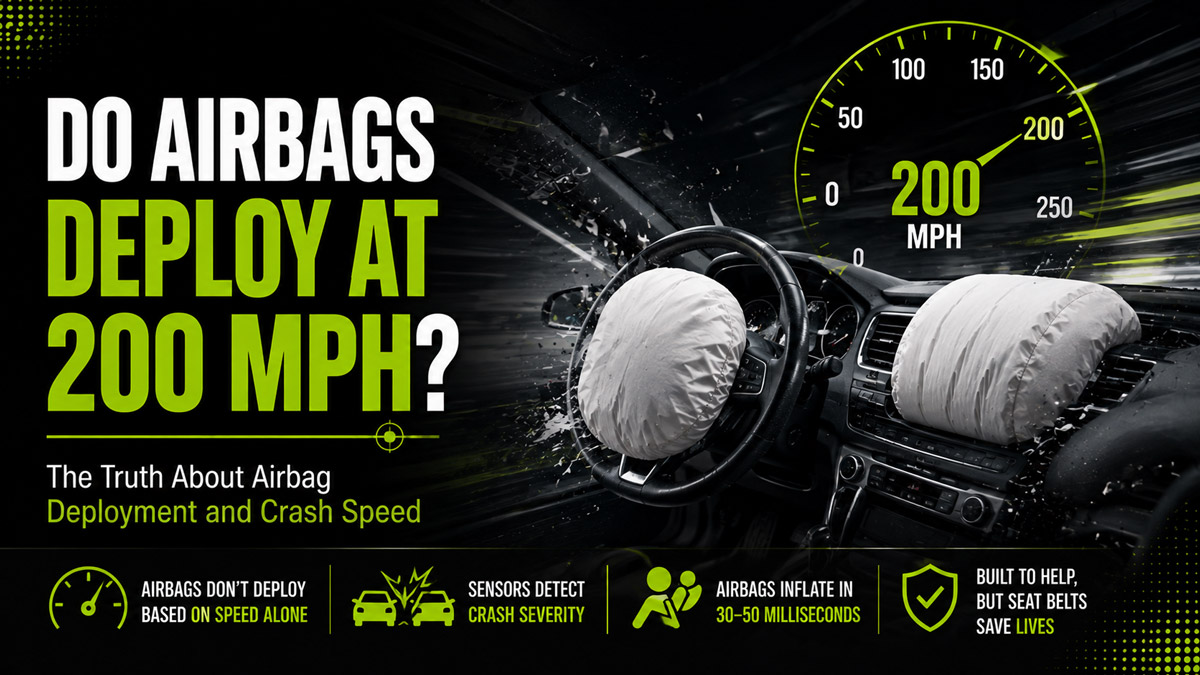
Airbags can deploy during a crash at 200 mph, but vehicle speed alone does not trigger them. The “200 mph” figure usually describes how quickly an airbag expands from its compartment, not the minimum or maximum driving speed required for deployment.
Key Facts at a Glance
- Airbags can inflate outward at speeds approaching 200 mph.
- Vehicle speed alone does not determine whether an airbag deploys.
- Crash sensors measure rapid deceleration, impact direction, and collision severity.
- Frontal airbags commonly inflate within approximately 30–50 milliseconds.
- Side airbags may inflate within 10–20 milliseconds because occupants are closer to the impact.
- Seat belts remain the primary restraint; airbags are supplemental protection.
What Does “Airbags Deploy at 200 MPH” Mean?
The phrase usually means that an airbag may expand from the steering wheel, dashboard, seat, or roof rail at approximately 100–200 mph. It does not mean a car must be traveling at 200 mph for its airbags to activate.
This rapid inflation is necessary because occupants begin moving toward the steering wheel or dashboard almost immediately after a collision starts. The bag must be fully positioned before the occupant reaches it.
A vehicle traveling at 25 mph may experience airbag deployment during a severe frontal collision. A vehicle traveling at 70 mph may not deploy its frontal airbags if the impact direction, deceleration pattern, or sensor data does not meet the programmed threshold.
Will Airbags Deploy in a 200 MPH Crash?
Airbags will probably deploy in a serious 200-mph collision when the crash forces reach the sensors and the restraint control module remains operational. However, deployment cannot be guaranteed in every 200-mph crash.
At that speed, several factors can interfere with normal operation:
- The first impact may damage electrical wiring.
- The battery or restraint control module may be destroyed.
- The vehicle may break apart before every sensor reports correctly.
- The collision may begin with a rollover or glancing impact.
- Certain airbags may deploy while others remain inactive.
A 200-mph impact also produces forces far beyond what an airbag alone can manage. Airbags reduce contact with hard interior surfaces, but they cannot eliminate the extreme risk of fatal trauma, vehicle intrusion, ejection, fire, or structural collapse.
Does Driving Speed Trigger an Airbag?
Driving speed does not directly trigger an airbag. The airbag control module responds primarily to changes in acceleration and deceleration recorded during a collision.
The system evaluates several inputs:
- How rapidly the vehicle slows down
- Whether the impact is frontal, angled, side, rear, or rollover-related
- Which crash sensors detected the event
- Whether the seat is occupied
- Whether the occupant is wearing a seat belt
- The occupant’s seating position or estimated weight
- Whether the system has an active fault
A car can therefore be traveling quickly without deploying an airbag if no qualifying collision occurs. Airbags do not activate merely because the vehicle reaches a specific speed.
What Actually Causes an Airbag to Deploy?
An airbag deploys when the restraint control module identifies a collision severe enough to require supplemental protection. The decision is based on programmed crash algorithms rather than one universal speed threshold.
Impact severity
The system looks for a sudden deceleration pattern comparable to a moderate or severe collision. The exact threshold varies by vehicle, restraint design, occupant status, and impact direction.
Impact direction
Frontal airbags are designed mainly for frontal and near-frontal crashes. Side airbags respond to qualifying lateral impacts, while curtain airbags may activate during side collisions or rollover events.
Sensor agreement
Modern vehicles use multiple accelerometers and impact sensors. The module compares their signals to reduce the risk of accidental deployment from potholes, curb strikes, hard braking, or minor bumps.
Occupant information
Passenger classification sensors may suppress or modify passenger-airbag deployment when the seat is empty, occupied by a small child, or carrying a lightweight object.
Seat-belt use
Dual-stage systems may adjust deployment timing or intensity according to whether the occupant is belted and how severe the impact appears.
How Fast Does an Airbag Inflate?
A frontal airbag commonly inflates within roughly 30–50 milliseconds. Side airbags may need to inflate in only 10–20 milliseconds because there is less space between the occupant and the side of the vehicle.
A simplified deployment timeline looks like this:
- 0–10 milliseconds: Crash sensors detect sudden deceleration.
- 10–20 milliseconds: The restraint module evaluates the collision.
- 20–30 milliseconds: The inflator ignites and begins producing gas.
- 30–50 milliseconds: The airbag expands into position.
- After contact: Gas escapes through vents so the bag cushions rather than rebounds against the occupant.
The bag is not intended to remain firm for long. Controlled deflation absorbs energy and gives the occupant room to move after the collision.
Is 200 MPH the Exact Inflation Speed?
No single inflation speed applies to every airbag. The widely quoted 200-mph figure is an approximate upper-end description of how rapidly some airbags expand.
Inflation speed depends on:
- Airbag size
- Inflator design
- Deployment stage
- Gas-generation rate
- Cabin temperature
- Crash severity
- Airbag location
- Vehicle generation
A small side-torso airbag travels a shorter distance than a large passenger frontal airbag. Curtain airbags also follow a different deployment path because they unfold downward from the roof rail.
The practical point is not whether the exact velocity is 150, 180, or 200 mph. The important fact is that deployment occurs violently and within milliseconds, making correct seating position essential.
Can Airbags Injure Someone at That Speed?
Airbags can cause injuries because they inflate with considerable speed and force. Most deployment injuries are minor compared with the injuries the airbag is designed to prevent, but severe injuries can occur when an occupant is too close, unrestrained, incorrectly positioned, or unusually vulnerable.
Possible injuries include:
- Facial abrasions
- Bruising
- Burns from hot gases or friction
- Wrist, hand, or forearm injuries
- Hearing discomfort
- Chest injuries
- Eye injuries
The greatest risk occurs inside the airbag’s deployment zone. An occupant who sits too close may be struck while the bag is still expanding rather than being cushioned after it has fully formed.
How Far Should You Sit From the Steering Wheel?
Drivers should generally maintain at least 10 inches between the center of the chest and the steering-wheel airbag whenever practical. The seat should be moved rearward while still allowing safe control of the pedals, steering wheel, and dashboard.
For safer positioning:
- Sit upright against the seatback.
- Keep the lap belt low across the hips.
- Position the shoulder belt across the chest.
- Tilt the steering wheel toward the chest rather than the face.
- Avoid leaning over the wheel.
- Keep hands near the 9-and-3 positions rather than across the airbag cover.
Smaller drivers may need adjustable pedals, telescoping steering wheels, or professional vehicle adaptations to maintain control without sitting too close.
Can Dashboard Objects Become Dangerous?
Objects placed on the passenger dashboard can become dangerous projectiles when the airbag deploys. Phones, mounts, decorations, tablets, tools, and even a passenger’s feet may be forced toward the occupant.
The passenger airbag often exits through a panel on the upper dashboard. That entire deployment path must remain clear.
Passengers should never:
- Rest their feet on the dashboard
- Hold a child or pet in front of an airbag
- Attach accessories to an airbag cover
- Place heavy objects against the dashboard
- Use adhesive decorations over deployment seams
An airbag cover is engineered to split in a controlled pattern. Modifying or covering it may change how the bag emerges.
Do All Airbags Deploy in the Same Crash?
No. The restraint control module activates only the airbags considered useful for the detected crash direction and severity.
| Crash type | Airbags most likely to deploy |
| Moderate-to-severe frontal impact | Driver and passenger frontal airbags |
| Driver-side impact | Driver-side torso and curtain airbags |
| Passenger-side impact | Passenger-side torso and curtain airbags |
| Rollover | Curtain airbags in vehicles with rollover sensing |
| Rear-end impact | Often no frontal-airbag deployment |
| Minor parking collision | Usually no deployment |
A frontal collision does not automatically require every curtain, knee, or side airbag to fire. Selective deployment reduces unnecessary injuries and replacement costs while reserving protection for the occupants who need it.
Do Airbags Deploy During a Rollover?
Frontal airbags may not deploy during a rollover unless the vehicle also experiences a qualifying frontal impact. Rollover-capable curtain airbags are more likely to activate because they help protect the head and reduce the chance of partial ejection.
Vehicles with rollover sensing monitor changes in roll angle and rotational movement. Curtain airbags designed for rollover protection may remain inflated longer than standard side-impact airbags.
Older vehicles may not have rollover sensors or extended-inflation curtains. Airbag behavior therefore depends heavily on model year and system design.
Can Airbags Deploy While the Car Is Parked?
Airbags can deploy in a parked vehicle if another vehicle strikes it with sufficient force and the restraint system is powered or designed to retain deployment capability briefly after power loss. However, deployment is less predictable when the ignition is off.
Some modules retain electrical energy in capacitors so the airbags can function if the battery connection is severed during the first moments of a collision. That reserve is temporary and is not intended to keep the system active indefinitely.
A minor parking-lot impact normally will not create the required deceleration signature.
Why Might Airbags Not Deploy in a Severe Crash?
A serious-looking crash does not always meet the conditions for a particular airbag. Visible vehicle damage and airbag deployment are not perfectly correlated.
Common reasons include:
- The main impact occurred outside the sensor zone.
- The vehicle absorbed energy through crumple structures.
- The collision involved a gradual deceleration rather than an abrupt stop.
- The impact was primarily rearward or offset.
- The seat was classified as unoccupied.
- An SRS warning light indicated a pre-existing fault.
- Wiring, sensors, or control modules were damaged.
- The vehicle had previous improper airbag repairs.
Non-deployment does not automatically prove that the system failed. Crash data, control-module records, physical damage, and manufacturer specifications must be examined before reaching that conclusion.
What Does the SRS Warning Light Mean?
An illuminated SRS or airbag warning light means the system has detected a fault. Depending on the vehicle and fault, one or more airbags or seat-belt pretensioners may be unavailable during a crash.
Common causes include:
- Loose connectors beneath a front seat
- A damaged steering-wheel clock spring
- Faulty seat-occupancy sensors
- Low system voltage
- Previous crash data stored in the module
- Damaged impact sensors
- Corroded wiring
- Failed seat-belt buckle switches
Do not probe airbag wiring with an ordinary test light or multimeter unless the manufacturer’s service procedure specifically permits it. Small electrical currents can damage sensitive circuits or create a deployment hazard.
A qualified technician should scan the SRS module with a diagnostic device capable of reading manufacturer-specific airbag codes.
Single-Stage vs. Dual-Stage Airbags
Modern dual-stage airbags can vary their response according to crash severity and occupant information. Older single-stage systems generally have fewer deployment options.
| Feature | Single-stage airbag | Dual-stage or adaptive airbag |
| Inflator charges | One | Two or more stages |
| Deployment variation | Limited | Can vary timing or output |
| Occupant inputs | Fewer | May use belt and seat sensors |
| Complexity | Lower | Higher |
| Replacement diagnosis | Simpler | More components and data |
| Injury reduction potential | Less adaptable | Better adaptation to some crashes |
Dual-stage does not necessarily mean that every deployment occurs gently. A severe collision may still require the system’s higher-output response.
What Happens After an Airbag Deploys?
A deployed airbag cannot simply be folded and reused. The vehicle requires a complete inspection of the supplemental restraint system and surrounding components.
Repairs may include:
- New airbag modules
- Seat-belt pretensioners
- Impact sensors
- Steering-wheel clock spring
- Dashboard or trim panels
- Airbag control module replacement or authorized reset
- Wiring repairs
- Seat components
- Diagnostic scanning and calibration
Deployment residue may look like smoke, but it is commonly a mixture of inflator byproducts, dust, and powder. Occupants should exit the vehicle when safe, move away from traffic, and seek medical evaluation after a significant crash.
Do not continue driving when deployed airbags, damaged steering components, locked seat belts, leaking fluids, or structural damage are present.
Can a 200 MPH Airbag Save You in Any Crash?
No airbag can guarantee survival, particularly in an extremely high-speed collision. Airbags are engineered to reduce specific injuries within a limited crash-survival space, not to overcome unlimited collision energy.
Protection depends on several systems working together:
- The vehicle structure absorbs energy.
- Seat belts restrain the occupant.
- Pretensioners remove belt slack.
- Load limiters manage belt force.
- Airbags cushion contact with interior surfaces.
- Head restraints and seats control body movement.
At 200 mph, collision energy is enormous. Even if every airbag deploys correctly, the passenger compartment may experience intrusion or deceleration beyond human tolerance.
Expert Safety Recommendations
Wear the seat belt correctly
An airbag is a supplemental restraint, not a seat-belt replacement. An unbelted occupant may move into the deployment zone too early or be thrown around the airbag.
Keep children in the rear seat
Children aged 12 and younger should normally ride properly restrained in the rear seat. A rear-facing child seat should never be placed in front of an active passenger airbag.
Inspect used vehicles carefully
A normal SRS light should illuminate briefly when the ignition is switched on and then turn off after the self-test. A light that never appears may have been removed, covered, or bypassed.
Do not install used airbags casually
Airbag components must match the vehicle’s system, part numbers, deployment stages, connectors, and control-module programming. Improvised resistors or mismatched modules may hide warning lights without restoring protection.
Frequently Asked Questions
At what speed do airbags normally deploy?
There is no universal vehicle speed. Frontal airbags may deploy in collisions producing deceleration comparable to striking a rigid barrier at a relatively moderate speed, but thresholds vary. Impact direction, seat-belt status, occupant sensing, crash duration, and vehicle design matter more than the speedometer reading alone.
Can hard braking deploy an airbag?
Normal emergency braking should not deploy airbags. The control module distinguishes braking from a collision by analyzing the magnitude, direction, duration, and pattern of sensor signals. A severe impact occurring during braking can still trigger deployment.
Can hitting a pothole deploy an airbag?
A pothole normally does not produce the crash signature required for airbag deployment. Extremely unusual events involving severe underbody impact or damaged sensors may create faults, but properly functioning systems are designed to reject ordinary road shocks.
Why does an airbag smell after deployment?
Deployment may produce a burnt, dusty, or chemical odor from the inflator reaction, heated components, and lubricating powder. Occupants may also notice airborne particles. Move to fresh air and obtain medical help for breathing difficulty, eye irritation, chest pain, or other concerning symptoms.
Can an airbag deploy twice?
A specific airbag module can deploy only once. After firing, the module and related one-time-use components must be replaced. A vehicle may contain several separate airbags, so one module may deploy while another remains unused and potentially operational.
Are airbags effective without seat belts?
Airbags provide substantially less predictable protection without seat belts. The belt controls occupant movement and keeps the body properly positioned for contact with the inflated bag. An unbelted occupant may strike the airbag too early, move around it, or be ejected.
The Bottom Line
Airbags can deploy during a 200-mph crash, but they do not activate simply because a vehicle reaches 200 mph. The commonly quoted figure refers to how rapidly an airbag may inflate.
Deployment is determined by crash deceleration, direction, sensor data, occupant status, and the restraint module’s programming. Even at extreme speeds, airbags remain supplemental devices that work with seat belts and a survivable vehicle structure; they cannot make every collision survivable.