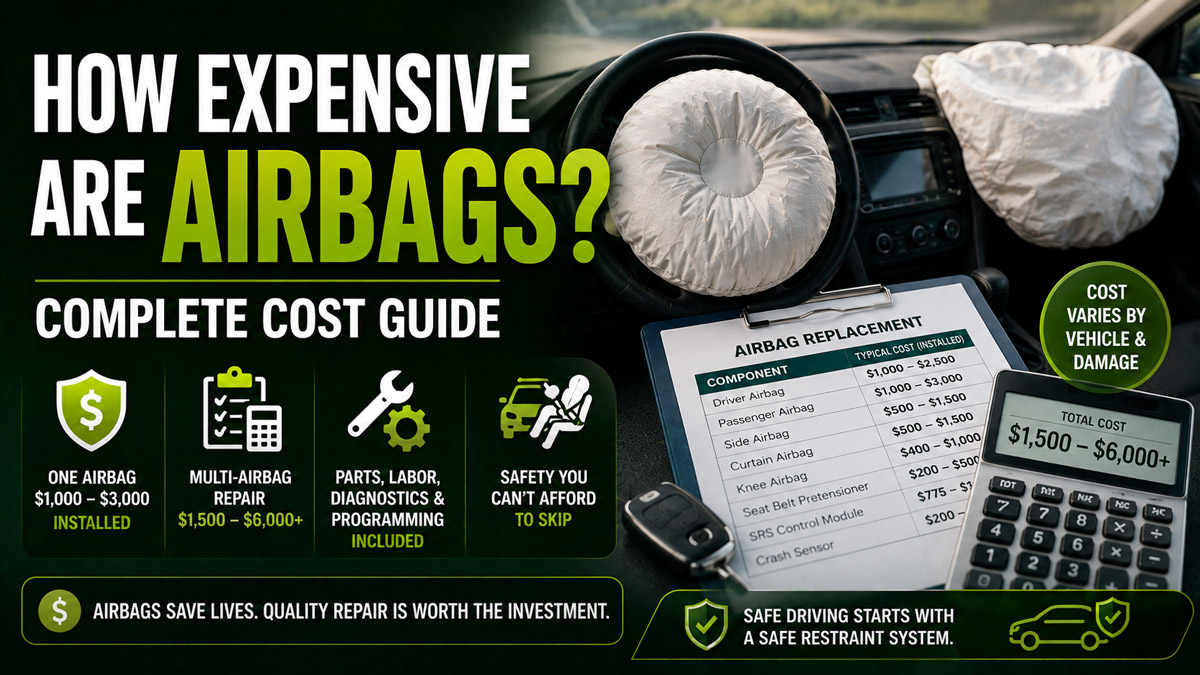
Airbags are expensive to replace because a deployed airbag is only one part of a larger Supplemental Restraint System, or SRS. Replacing one deployed airbag typically costs $1,000 to $3,000, while restoring several airbags and related safety components can cost $1,500 to more than $6,000.
Key Facts at a Glance
- A single frontal airbag commonly costs $1,000 to $3,000 installed.
- Side, curtain, and knee airbags may cost $400 to $1,500 each.
- A multi-airbag collision repair can exceed $6,000.
- Deployed airbags cannot be folded up, refilled, or safely reused.
- Seat belt pretensioners, crash sensors, and the SRS module may also require repair or replacement.
- Airbag-related damage can cause an older vehicle to be declared a total loss.
How Much Does One Airbag Cost?
One replacement airbag usually costs between $1,000 and $3,000 after parts and labor, although the price varies significantly by vehicle and airbag location.
The airbag assembly itself may cost only a few hundred dollars. The final repair bill becomes much higher when it includes diagnostics, removal of interior panels, replacement trim, module programming, system testing, and other collision-related components.
| Airbag or Component | Typical Parts Cost | Typical Installed Cost |
| Driver frontal airbag | $200–$700 | $1,000–$2,500 |
| Passenger frontal airbag | $300–$1,000 | $1,000–$3,000 |
| Side torso airbag | $200–$600 | $500–$1,500 |
| Side curtain airbag | $200–$800 | $500–$1,500 per side |
| Knee airbag | $150–$500 | $400–$1,000 |
| Seat-mounted airbag | $300–$900 | $700–$1,800 |
| SRS control module | $400–$1,200 | $775–$1,500 |
| Crash sensor | $70–$350 | $200–$600 each |
| Seat belt pretensioner | $150–$350 | $200–$500 per belt |
| Steering wheel clock spring | $100–$300 | $300–$600 |
These figures are typical estimates rather than guaranteed prices. Luxury vehicles, rare models, imported vehicles, and cars with advanced occupant-detection systems may cost considerably more.
Why Are Airbags So Expensive?
Airbags are expensive because they are factory-sealed, one-use safety devices that must deploy correctly within milliseconds. A repair shop is not simply replacing a fabric cushion; it is restoring a coordinated electronic and pyrotechnic safety system.
The cost usually includes several categories:
- Airbag assembly: The inflator, folded cushion, housing, igniter, and electrical connector are sold as a complete unit.
- Specialized labor: Technicians may need to remove the steering wheel, dashboard, seats, pillars, roof trim, or center console.
- SRS diagnostics: A professional scan tool must read airbag-specific fault codes.
- Programming or calibration: Some replacement modules and sensors must be coded to the vehicle.
- Related collision damage: The dashboard, windshield, steering wheel cover, headliner, seats, and trim may be damaged during deployment.
- Safety liability: Repair facilities must follow strict procedures because an incorrect repair can prevent deployment or cause accidental activation.
An airbag repair that looks inexpensive on the invoice may be incomplete if the shop has not inspected the entire SRS network.
What Happens When an Airbag Deploys?
An airbag deploys when crash sensors detect an impact severe enough to threaten an occupant. The SRS control module analyzes the sensor information and activates the appropriate airbag inflators and seat belt pretensioners.
The process occurs in a fraction of a second:
- Crash sensors detect rapid deceleration or side-impact forces.
- The SRS module determines the direction and severity of the collision.
- The module sends current to the selected inflator.
- The inflator rapidly produces gas.
- The airbag cushion expands between the occupant and the vehicle interior.
- Gas escapes through vents as the occupant contacts the cushion.
After deployment, the inflator has been consumed and the airbag assembly is no longer serviceable. It must be replaced rather than repacked.
How Much Does a Complete Airbag System Repair Cost?
A complete airbag-system repair commonly costs $3,000 to $6,000, but severe collisions can produce bills well above that range.
A multi-airbag repair may include:
- Driver airbag
- Passenger airbag
- One or two curtain airbags
- Seat-mounted side airbags
- Knee airbags
- Locked seat belts
- Seat belt pretensioners
- Crash sensors
- SRS control module
- Dashboard or steering wheel trim
- Headliner and pillar trim
- Windshield replacement
- Diagnostic labor and programming
Example Repair Scenarios
| Collision Scenario | Possible Cost |
| Driver airbag only | $1,000–$2,500 |
| Driver airbag and seat belt pretensioner | $1,500–$3,000 |
| Driver and passenger frontal airbags | $2,500–$5,000 |
| Frontal airbags plus dashboard damage | $3,500–$7,000 |
| Curtain airbags and headliner repair | $2,000–$5,000 |
| Multiple airbags, belts, sensors, and module | $4,000–$10,000+ |
The airbag bill is separate from structural, suspension, body, paint, cooling-system, and drivetrain repairs caused by the same crash.
Which Airbag Is Most Expensive to Replace?
Passenger frontal airbags are often among the most expensive because they are mounted inside the dashboard. Deployment may split or damage the dashboard panel, vents, trim, wiring, windshield, and surrounding interior components.
Side curtain airbags can also be expensive because replacing them may require removal of:
- Headliner
- Door seals
- Grab handles
- Pillar trim
- Sun visors
- Interior lighting
- Roof-mounted wiring
A driver airbag may be less disruptive to the interior, but the repair can still require a new steering wheel cover, clock spring, wiring connector, and control-module service.
Does the Entire Dashboard Need Replacement?
The entire dashboard does not always need replacement, but many vehicles use a passenger-airbag door that is integrated into the dashboard surface. When that airbag deploys, the panel may tear open and require replacement of the complete upper dashboard assembly.
Dashboard replacement can add $1,000 to $3,000 or more because the repair may require extensive interior disassembly. Labor can involve removing the center console, infotainment components, instrument cluster, glovebox, ventilation ducts, wiring harnesses, and steering-column trim.
Some specialist shops repair dashboard covers, but the underlying airbag mounting structure must remain intact and meet the vehicle manufacturer’s specifications.
Must the SRS Control Module Be Replaced?
The SRS control module may need to be replaced or professionally reset after a crash. Many modules store permanent collision information known as crash data or hard codes after deployment.
Replacing the physical airbag without addressing the module can leave the warning light illuminated and the restraint system disabled.
A qualified repair generally requires the technician to:
- Scan the SRS system.
- Identify deployment records and active faults.
- Inspect the module for physical damage.
- Replace or reset the module where legally and technically permitted.
- Program the module when required.
- Clear faults and complete a final system check.
A mail-in reset may be appropriate for certain undamaged modules, but it cannot repair destroyed airbags, damaged wiring, failed sensors, bent mounting structures, or defective occupant-detection components.
Do Seat Belts Need Replacement After Airbag Deployment?
Seat belts frequently require repair or replacement after airbag deployment because many vehicles use pyrotechnic pretensioners. These devices tighten the belts during a collision to hold occupants in the correct position before the airbags fully inflate.
Signs of a deployed pretensioner may include:
- Seat belt will not retract
- Belt remains locked
- Buckle sits lower than normal
- SRS warning light remains on
- Pretensioner fault code appears during scanning
Each affected seat belt or pretensioner may add approximately $200 to $500 to the repair. Some vehicles use pretensioners in both the retractor and buckle, increasing the total.
How Does Vehicle Type Affect Airbag Cost?
Vehicle make, model, age, trim level, and technology package can change airbag replacement costs dramatically.
Economy Vehicles
Common economy cars usually have lower parts prices and better availability. A basic driver-airbag replacement may remain near the lower end of the typical range.
Luxury Vehicles
Luxury cars may use expensive leather-covered steering wheels, complex dashboards, multiple knee airbags, seat-mounted airbags, advanced seat sensors, and brand-specific programming. A single repair can exceed several thousand dollars.
Electric Vehicles
Electric vehicles may require additional high-voltage safety procedures before interior or SRS work begins. The airbag itself may not be uniquely expensive, but labor and calibration requirements can increase the bill.
Rare or Discontinued Vehicles
Parts scarcity can make older or uncommon vehicles surprisingly expensive. A new OEM airbag may be unavailable, forcing owners and repairers to search for approved alternatives or verified salvage components where permitted.
Are Dealership Airbag Repairs More Expensive?
Dealership repairs are usually the most expensive because dealerships typically use new OEM parts, manufacturer procedures, model-specific diagnostic equipment, and factory programming.
A dealership may be the better choice when the vehicle has:
- Advanced occupant-classification sensors
- Complex dashboard electronics
- Manufacturer-specific module coding
- Active safety-system integration
- Warranty coverage
- Outstanding safety recalls
- Limited independent repair information
An independent collision or automotive electrical shop may charge less, but the shop should have documented SRS training, appropriate diagnostic equipment, and access to correct repair procedures.
Are Used Airbags Safe?
A genuine, undeployed salvage airbag may sometimes be usable where local laws, insurance rules, and manufacturer procedures permit it. However, the part must be correctly matched, undamaged, properly stored, and traceable to a legitimate source.
Used airbags create several risks:
- Hidden water or fire damage
- Incorrect part number
- Unknown collision history
- Damaged connectors
- Improper storage
- Counterfeit labels
- Expired or unresolved recalls
- Missing documentation
Cheap online airbags should never be purchased solely because the cover looks correct. Counterfeit or altered airbag assemblies may fail to deploy or release dangerous fragments.
Can a Deployed Airbag Be Repaired or Repacked?
A deployed airbag cannot be safely repaired, refilled, sewn closed, or repacked for reuse. The inflator has fired, the cushion may be heat-damaged, and the housing or mounting points may be distorted.
Some SRS-related components can potentially be reset or rebuilt by qualified specialists, including certain control modules and seat belt pretensioners. That does not make a deployed airbag reusable. The airbag assembly itself must be replaced with an appropriate undeployed unit.
Will Airbag Deployment Total a Car?
Airbag deployment does not automatically total a car. Insurance companies generally declare a total loss when the full repair cost approaches or exceeds the vehicle’s pre-accident value under the insurer’s formula and local regulations.
Consider a vehicle worth $8,000 before a crash:
- Body and paint repair: $3,500
- Two airbags: $3,000
- Dashboard replacement: $1,500
- Seat belts and module: $1,000
- Suspension and alignment: $1,000
The estimated repair total reaches $10,000, making a total-loss decision likely even if the vehicle is technically repairable.
Newer high-value vehicles are more likely to justify a complete SRS restoration. Older vehicles with low market value may be totaled after relatively moderate damage.
Does Insurance Cover Airbag Replacement?
Collision insurance generally covers airbag replacement when the airbags deployed during a covered crash, minus the policy deductible. Liability insurance alone usually does not cover damage to the policyholder’s own vehicle.
Coverage may depend on:
- Who caused the crash
- Whether collision coverage is active
- Vehicle value
- Policy exclusions
- Repair estimate
- Deductible
- Availability of replacement parts
- Whether the vehicle is declared a total loss
Before authorizing work, ask the insurer whether it requires OEM components, accepts salvage components, or has specific rules for SRS-module service.
How Can You Estimate the Real Repair Cost?
The most accurate estimate comes from an SRS scan combined with a physical inspection. A visual estimate alone may miss locked pretensioners, damaged wiring, stored crash data, seat-sensor faults, and hidden dashboard damage.
Ask the repair shop to itemize:
- Every deployed airbag
- Every seat belt or pretensioner
- Crash sensors
- SRS control module
- Steering wheel clock spring
- Dashboard and trim
- Headliner and pillar covers
- Windshield damage
- Diagnostic labor
- Programming
- Calibration
- Taxes and shop supplies
A low estimate that excludes programming, interior trim, or seat belts may increase substantially after disassembly.
Common Airbag Repair Mistakes
Replacing Only the Visible Airbag
Installing a new steering wheel airbag does not restore the system if the module contains crash data or the seat belt pretensioners remain deployed.
Clearing Codes Without Repairing the Fault
Deleting an SRS code does not fix damaged wiring, sensors, airbags, or pretensioners. The light will return, or the system may remain unsafe.
Installing Resistors to Turn Off the Light
Resistors may imitate an electrical load and conceal a missing airbag. This practice defeats the restraint system and can expose occupants to severe injury.
Buying Counterfeit Airbags
Counterfeit covers and inflators may look genuine but fail under real collision conditions. Airbag identity, part number, source, and recall status should be verified.
Ignoring the Airbag Warning Light
An illuminated SRS light means the system has identified a fault. Some or all airbags and pretensioners may be unavailable until the problem is diagnosed.
How to Reduce Airbag Replacement Costs Safely
Airbag repair costs can sometimes be reduced without compromising safety, but savings should come from labor choices and verified component sourcing rather than bypassing the system.
Practical options include:
- Obtain estimates from both a dealership and a qualified independent SRS shop.
- Check the vehicle identification number for open airbag recalls.
- Ask whether the undamaged original SRS module qualifies for professional resetting.
- Request itemized prices for airbags, belts, sensors, trim, and programming.
- Compare new OEM, approved replacement, and legally permitted verified salvage parts.
- Confirm whether insurance will pay for OEM components.
- Avoid shops that suggest warning-light deletion or resistor bypasses.
The cheapest safe repair is the one that restores every required restraint component and passes a complete diagnostic check.
Expert Recommendations
For New or High-Value Vehicles
Use new OEM airbags and follow manufacturer repair procedures. Dealer or manufacturer-certified collision repair is often justified when advanced seat sensors, dashboard electronics, and driver-assistance systems are involved.
For Older Vehicles
Compare the complete repair cost with the car’s pre-accident market value before authorizing work. Spending $5,000 on an SRS restoration may not be financially sensible on a vehicle worth $6,000.
For Used-Car Buyers
Treat any prior airbag deployment as a major inspection issue. Confirm that the airbags, seat belts, module, sensors, trim, and warning-light functions have been professionally restored. A dashboard light that turns off is not proof that airbags are installed.
Frequently Asked Questions
How much is a steering wheel airbag?
A steering wheel airbag typically costs $200 to $700 for the part, with the total installed price commonly reaching $1,000 to $2,500. The estimate may also include a clock spring, steering wheel cover, SRS-module service, diagnostics, and replacement seat belt components.
Can airbags be replaced after an accident?
Yes. Airbags can be replaced after an accident, provided the vehicle’s structural damage is repairable and every affected SRS component is restored. The repair may include airbags, pretensioners, sensors, wiring, control modules, dashboards, seats, trim panels, and programming.
How long does airbag replacement take?
A straightforward single-airbag replacement may require several hours. A complete multi-airbag restoration can take several days because the shop may need to order parts, remove the dashboard or headliner, repair interior damage, program modules, and complete system testing.
Is it safe to drive with the airbag light on?
Driving with the airbag light on is unsafe because the SRS has detected a fault. One or more airbags or pretensioners may not activate during a collision. The vehicle may still operate normally, but its supplemental restraint protection cannot be considered reliable.
Can an airbag deploy twice?
No. A conventional automotive airbag assembly is a single-use component. Once its inflator activates, the assembly must be replaced. Vehicles contain multiple airbags, so another undeployed airbag may still activate in a later event, but the previously deployed unit cannot deploy again.
Are airbags covered by manufacturer recalls?
Some airbags and inflators are covered by safety recalls. Owners should check the vehicle identification number through the manufacturer or relevant government recall database. A recall repair is normally completed without charge when the vehicle and component qualify.
The Bottom Line
How expensive are airbags? Replacing one airbag normally costs $1,000 to $3,000, while a complete repair involving multiple airbags, seat belts, sensors, dashboards, and the SRS module can cost $3,000 to more than $10,000.
The final price depends less on the fabric airbag itself than on the complete safety system surrounding it. Obtain a full SRS diagnostic report, request an itemized estimate, and never reduce costs by bypassing sensors, installing resistors, or reusing a deployed airbag.