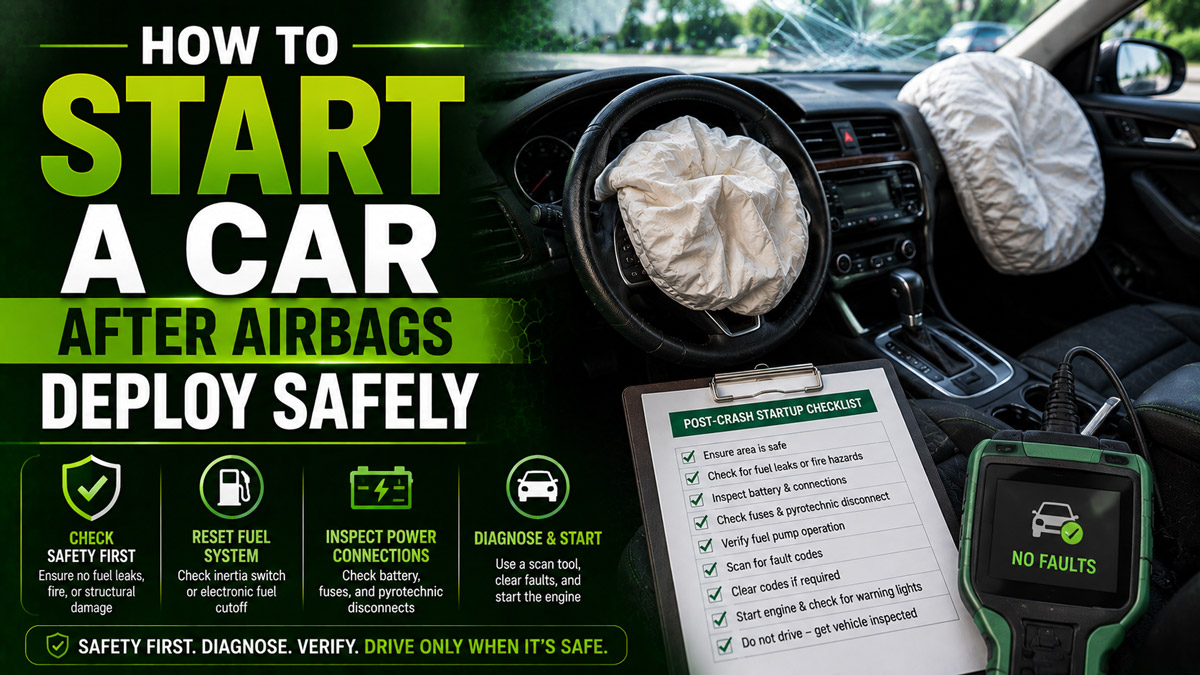
To start a car after airbags deploy, first confirm that the vehicle has no fuel leak, electrical damage, fluid loss, fire risk, or structural damage. A restart may then require resetting a manufacturer-installed fuel cutoff, replacing a pyrotechnic battery safety terminal, repairing collision damage, or clearing an electronic crash shutdown with a capable diagnostic tool.
Airbag deployment is evidence of a significant collision. Restarting the engine does not prove that the vehicle is safe to drive.
Key Facts at a Glance
- Do not attempt to start a crashed vehicle when fuel, oil, coolant, smoke, sparks, or exposed high-voltage components are present.
- Some older vehicles use a manually resettable fuel-pump inertia switch.
- Many modern vehicles store crash data and shut down fuel, starter, or high-current electrical circuits electronically.
- A deployed pyrotechnic battery disconnect must normally be replaced, not pushed together, bridged, or bypassed.
- Seat-belt pretensioners may deploy even when their damage is not immediately visible.
- A vehicle that starts after a collision should usually be transported by flatbed until its restraint and structural systems are inspected.
Before You Start
| Requirement | Typical Detail |
| Time | 10–20 minutes for inspection; longer if diagnosis is needed |
| Difficulty | Moderate to professional |
| Basic tools | Flashlight, gloves, owner’s manual and basic hand tools |
| Diagnostic equipment | Vehicle-specific scan tool capable of reading SRS, BCM and powertrain modules |
| Safe location | Away from traffic, fire, standing water and leaking fluids |
| Main prerequisite | The vehicle must be physically stable and free from immediate fire or electrical hazards |
Do not work directly in front of an undeployed airbag, curtain-airbag area, seat-mounted airbag, or deployed seat-belt pretensioner. Supplemental restraint components can retain electrical energy after the ignition is switched off.
Why Won’t a Car Start After the Airbags Deploy?
A car may not start after airbag deployment because the collision activated a fuel cutoff, electrical safety disconnect, crash-data command or immobilization function. Physical damage to the battery, starter cable, fuse box, wiring harness, sensors, engine, cooling system or fuel system can create the same symptom.
The shutdown method depends on the manufacturer, model, model year and impact severity.
Fuel-Pump Shutdown
The restraint or body control system may stop the electric fuel pump after detecting a collision. This limits the possibility of pressurized fuel continuing to circulate through a damaged line.
The engine may crank normally but fail to start. In some vehicles, the fuel pump will also remain silent when the ignition is switched on.
Mechanical Inertia Switch
Some older vehicles use a physical inertia switch that opens the fuel-pump circuit during an impact. Manufacturers commonly placed these switches behind a kick panel, in a passenger footwell, near the rear cargo area or behind interior trim.
A reset button may restore the circuit, but only after the vehicle has been checked for leaks and the owner’s manual confirms the location and procedure.
Electronic Crash Shutdown
Modern vehicles often use the restraint control module, body control module and engine control module to coordinate a crash response. The modules may disable fuel delivery, starter operation or other functions without using a manual reset button.
Some systems recover after an approved ignition sequence. Others require collision repairs and a diagnostic scan before normal operation returns.
Pyrotechnic Battery Disconnect
A pyrotechnic battery safety terminal uses a small explosive device to separate a high-current cable during a severe collision. Depending on the design, lower-current systems such as hazard lights or cabin electronics may continue working while power to the starter or alternator is interrupted.
A deployed terminal is a one-time component. It generally requires replacement with the correct part and inspection of the battery cable assembly.
Collision Damage
A no-start condition is not always an intentional safety lockout. The impact may have damaged:
- The battery or battery terminals
- Main fuses or fusible links
- Starter or alternator cables
- Engine grounds
- Fuel-pump wiring
- The engine-bay fuse box
- The crankshaft or camshaft sensor circuit
- The ignition switch or steering column
- The cooling system
- The fuel tank or fuel lines
- The engine, transmission or drivetrain
Trying repeated starts can worsen a fuel leak, short circuit, internal engine problem or cooling-system failure.
How to Start a Car After Airbags Deploy
Follow these steps only to determine whether a manufacturer-approved restart is possible. Do not bypass damaged restraint, battery or fuel-system components.
Step 1: Move Away From Immediate Traffic Danger
Exit the vehicle when it is safe to do so and move occupants away from traffic. Turn on the hazard lights if they still function.
Call emergency services when anyone may be injured, fuel is leaking, smoke is present, the vehicle is unstable, or the collision has damaged utility equipment.
Success checkpoint: Everyone is in a safe location, and the vehicle is not exposed to moving traffic or an immediate fire risk.
Common mistake: Remaining inside a damaged vehicle in an active traffic lane merely to test whether it will restart.
Step 2: Turn the Ignition Completely Off
Switch the ignition off and remove the key when applicable. Do not repeatedly press the start button or crank the engine.
Allow the vehicle’s systems to stop operating while you perform the exterior inspection.
Success checkpoint: The engine, ignition and accessories are off.
Common mistake: Cycling the ignition repeatedly before checking for leaking fuel or damaged wiring.
Step 3: Inspect for Fire and Fluid Hazards
Walk around the vehicle without crawling underneath it. Look and smell for:
- Fuel or a strong gasoline odor
- Smoke, heat or sparks
- Oil, coolant or transmission-fluid loss
- A crushed battery
- Torn electrical cables
- A damaged fuel tank
- A punctured radiator
- Material hanging beneath the vehicle
- Severe wheel, suspension or axle displacement
Do not attempt a restart when any hazard is present. Move away and arrange emergency assistance or professional recovery.
Success checkpoint: No visible leak, smoke, spark, unusual heat or severe mechanical damage is found.
Common mistake: Assuming every puddle is harmless air-conditioning water after a collision.
Step 4: Check the Cabin and Restraint Components
Confirm that deployed airbags are not blocking the steering wheel, pedals, shifter, windshield or driver’s view. Check whether seat belts are locked or their pretensioners have fired.
Do not cut, remove or fold an airbag in a way that exposes wiring or inflator components. Airbag residue can irritate the skin, eyes and respiratory system, so ventilate the cabin and avoid unnecessary contact.
Success checkpoint: The driver controls can be reached without touching damaged restraint components.
Common mistake: Treating a deflated airbag as an ordinary fabric bag that can be removed without precautions.
Step 5: Determine Whether the Engine Cranks
From a safe position, make one brief starting attempt only after the inspections are complete.
The result narrows the fault:
| Symptom | More Likely Causes |
| Engine cranks but does not start | Fuel cutoff, disabled fuel pump, damaged sensor, blown fuse or crash command |
| No crank but dashboard lights work | Pyrotechnic disconnect, starter circuit fault, transmission interlock or damaged cable |
| No electrical power | Battery damage, disconnected terminal, main fuse failure or severed power cable |
| Starts and immediately stops | Immobilizer, fuel shutdown, severe sensor fault or damaged intake system |
| Harsh noise while cranking | Mechanical engine or accessory damage; stop immediately |
Do not continue cranking when the engine makes grinding, knocking, scraping or unusually fast cranking sounds.
Success checkpoint: You have identified the exact starting symptom without repeatedly stressing the system.
Step 6: Consult the Owner’s Manual
Search the manual for terms such as:
- Fuel cutoff
- Inertia switch
- Post-collision
- Emergency restart
- Battery safety terminal
- Crash shutdown
- Fuel-pump reset
Use only the instructions published for the exact make, model and model year. Procedures copied from another vehicle may activate unrelated functions or fail to restore the system.
Success checkpoint: The manual confirms whether the vehicle has a user-resettable system.
Common mistake: Using a turn-signal, pedal or ignition sequence found online for a different manufacturer.
Step 7: Reset a Mechanical Fuel Switch When Applicable
Reset a mechanical inertia switch only when all of the following are true:
- The owner’s manual confirms that the vehicle has one.
- The correct switch has been positively identified.
- No fuel leak or fuel-system damage is visible.
- The ignition is off.
- The vehicle is in a safe location.
Press the reset button as directed by the manufacturer. Then switch the ignition on without cranking and listen briefly for normal fuel-pump operation. Check again for fuel leakage before attempting one short start.
Success checkpoint: The switch clicks or resets, the pump operates normally, and no leak appears.
Common mistake: Resetting the switch immediately after a collision without inspecting the tank and fuel lines.
Step 8: Do Not Bypass a Pyrotechnic Battery Terminal
Do not press a separated conductor back into place, clamp it together, bridge it with metal or install a temporary jumper. A pyrotechnic battery disconnect is designed to permanently isolate a high-current circuit after a crash.
Bypassing it can energize damaged starter cables, alternator wiring or crushed metal components. The correct repair normally involves replacing the deployed safety terminal or cable assembly and inspecting associated fuses, wiring and battery components.
Success checkpoint: A deployed safety terminal is left undisturbed for professional replacement.
Common mistake: Assuming that restoring starter power is safe because the dashboard lights still operate.
Step 9: Scan All Relevant Control Modules
A basic engine-code reader may not identify a collision shutdown. Diagnosis may require a scan tool capable of communicating with:
- The SRS or restraint control module
- The body control module
- The engine control module
- The battery-management module
- The gateway module
- The immobilizer
- The hybrid or EV control system
Technicians should document the codes before clearing anything. Erasing codes before recording them can remove useful evidence while leaving the underlying damage unresolved.
Crash data stored in a restraint module may require module replacement, manufacturer-approved programming or specialist service. Clearing a warning light does not repair deployed airbags, sensors or pretensioners.
Success checkpoint: All relevant modules have been scanned and the cause of the shutdown has been identified.
Common mistake: Using a generic OBD2 reader, finding no engine code and concluding that no electronic lockout exists.
Step 10: Start the Engine Only After the Fault Is Resolved
After the approved reset or repair, start the engine while watching for warning lights, smoke, leaks, abnormal noise and unstable operation. Shut it down immediately when anything unusual appears.
Do not rev the engine. A damaged cooling system can lose coolant quickly, and a damaged oil pan can leave the engine without adequate lubrication.
Success checkpoint: The engine starts normally, idles smoothly and shows no immediate leak, smoke, overheating or abnormal mechanical noise.
Common mistake: Letting the engine run for several minutes without checking underneath and around the engine bay.
Step 11: Arrange a Flatbed Inspection
Even when the engine starts, the vehicle may have disabled airbags, deployed pretensioners, bent suspension components, hidden structural damage or compromised crash sensors. A flatbed tow is normally safer than driving.
The inspection should include the restraint system, battery circuits, fuel system, steering, brakes, tires, suspension, cooling system, underbody and structural alignment.
Success checkpoint: The vehicle is transported without relying on potentially damaged steering, braking or suspension components.
Can You Drive After the Airbags Deploy?
You generally should not drive a car after airbags deploy. The restraint system may no longer protect occupants correctly, while collision damage can affect steering, braking, visibility, seat belts, electrical power and fuel containment.
Driving may be particularly unsafe when:
- The steering-wheel airbag has damaged the wheel or controls
- Curtain airbags block side visibility
- A seat belt will not extend, retract or latch
- The airbag warning light remains on
- The horn, indicators or brake lights do not work
- A wheel is displaced or rubbing
- The vehicle pulls strongly to one side
- The radiator, condenser or cooling fan is damaged
- The windshield or dashboard is displaced
- Fuel or another fluid is leaking
Moving the car a few metres away from an immediate danger is different from driving it home or to a repair shop. When movement is essential, emergency personnel or a recovery operator should direct the decision.
What If the Engine Cranks but Does Not Start?
A crank-no-start condition after airbag deployment commonly points to disabled fuel delivery, a crash command, blown fuel-system protection, damaged wiring or a failed engine-position sensor.
A technician will typically check:
- Stored codes in the restraint, body and engine modules
- Fuel-pump operation
- Fuel-pump relay command
- Relevant fuses and fusible links
- Fuel pressure
- Spark or injector command
- Crankshaft and camshaft sensor signals
- Immobilizer authorization
- Wiring damage near the impact area
Do not spray starting fluid into a collision-damaged vehicle. Introducing a flammable vapor can create a fire or backfire risk, particularly when wiring, intake components or fuel lines are damaged.
What If the Car Has Power but Will Not Crank?
Dashboard power with no starter operation can indicate a deployed battery safety terminal, damaged starter cable, blown high-current fuse, gear-position problem, immobilizer command or module-controlled starter lockout.
Check whether the transmission is firmly in Park, then try Neutral only when the vehicle is stable and the manual permits it. Do not bridge the starter terminals or bypass the starter relay because the engine could crank unexpectedly while damaged circuits are energized.
A scan of the body, powertrain and battery-management modules can help distinguish an electronic command from a physical open circuit.
What If the Car Has No Electrical Power?
Complete electrical loss may result from battery damage, a disconnected ground, severed positive cable, deployed isolation device or blown main fuse. Do not reconnect a crushed, leaking, swollen or hot battery.
A technician should inspect the battery case, terminals, main power distribution, grounds and high-current protection. Connecting a booster pack without identifying the open circuit can energize damaged wiring or create an arc near leaking fuel.
How Are Electric and Hybrid Vehicles Different?
Electric and hybrid vehicles require additional precautions because the collision may damage a high-voltage battery, orange high-voltage cables, inverter or isolation system. A vehicle that appears switched off may still contain hazardous stored energy.
Do not touch orange cables, a damaged traction battery, exposed connectors or leaking battery material. Warning signs include hissing, popping, unusual heat, sweet or chemical odors, smoke, sparks and delayed fire.
An EV or hybrid should be assessed and transported according to the manufacturer’s emergency-response guidance. Ordinary jump-starting or battery-terminal work does not restore a disabled high-voltage system.
Common Mistakes and How to Fix Them
Repeatedly Cranking the Engine
Repeated cranking can operate a damaged fuel system, overheat starter wiring or worsen mechanical damage.
Correction: Make one brief diagnostic attempt after inspection, record the symptom and stop.
Clearing Codes Before Recording Them
Premature code clearing can erase information needed to identify which module commanded the shutdown.
Correction: Scan every accessible module, save the complete report and diagnose the original cause first.
Resetting the Fuel Supply Without Checking for Leaks
A fuel cutoff exists partly to limit fire risk after a collision.
Correction: Inspect the tank, visible lines, engine bay and ground beneath the vehicle before restoring pump operation.
Bypassing a Battery Safety Terminal
A temporary bridge defeats a designed crash-isolation feature and can energize damaged high-current wiring.
Correction: Replace the deployed component with the specified part and inspect the complete circuit.
Assuming a Running Engine Means a Safe Vehicle
An engine can run while airbags, pretensioners, suspension, steering or structural components remain unsafe.
Correction: Use a flatbed and obtain a post-collision inspection before road use.
Ignoring Seat-Belt Pretensioners
Pretensioners can deploy during the same event as the airbags and may leave a belt locked, loose or internally damaged.
Correction: Scan the restraint system and inspect every occupied seating position.
Typical Diagnosis and Repair Costs
Costs vary substantially by make, model, parts availability, impact location and the number of deployed components.
| Service | Typical Range |
| Initial diagnostic scan | $100–$250 |
| Fuel-cutoff diagnosis or simple reset | $0–$200 |
| Battery safety terminal or cable replacement | $200–$800+ |
| SRS module programming or replacement | $300–$1,200+ |
| Seat-belt pretensioner replacement | $250–$1,000+ per position |
| Individual airbag replacement | $1,000–$3,000+ |
| Multi-airbag collision repair | Several thousand dollars or more |
These ranges are general estimates, not quotes. Luxury vehicles, limited-production parts, dashboard replacement, structural repairs and multiple deployed restraints can increase the total considerably.
Frequently Asked Questions
Will Disconnecting the Battery Reset the Crash System?
Disconnecting the battery normally does not repair a crash shutdown or erase permanent collision data. It may temporarily reboot certain modules, but deployed airbags, pretensioners, safety terminals and stored faults remain. Battery disconnection can also create programming, window, steering-angle or security issues on some vehicles.
Can a Basic OBD2 Scanner Clear an Airbag Crash Code?
Most basic OBD2 readers access only powertrain emissions data and cannot communicate with the SRS or body control system. A compatible enhanced scanner may read restraint codes, but some crash records cannot be removed through ordinary code clearing and require approved module repair, replacement or programming.
Can Airbags Be Put Back Into the Dashboard?
A deployed airbag cannot simply be folded and placed back into its cover. The inflator has fired, the airbag assembly has been used and surrounding trim may be damaged. The correct repair uses specified replacement components and includes diagnosis of sensors, wiring, control modules and seat-belt pretensioners.
Does Airbag Deployment Automatically Total a Car?
Airbag deployment does not automatically make a vehicle a total loss. Insurers compare the vehicle’s value with the complete repair cost, including structural work, airbags, seat belts, modules, interior panels, paint, mechanical damage and calibration. Multiple deployed restraints can make repair economically impractical.
Why Is the Airbag Light Still On After the Car Starts?
The airbag light remains on because the restraint control module detects a current or stored fault. Possible causes include deployed components, crash data, damaged wiring, disconnected seats, failed sensors or a low-voltage event. The system must be scanned and repaired before the warning can be properly cleared.
Can I Move the Vehicle Out of the Road?
A vehicle may be moved only when remaining in place presents a greater immediate danger and it can be moved without exposing occupants or others to additional risk. Do not attempt movement when fuel is leaking, smoke is present, steering or brakes are damaged, or emergency personnel have instructed everyone to stay clear.
The Bottom Line
The safe way to start a car after airbags deploy is to inspect the vehicle for hazards, identify whether the problem is a resettable fuel cutoff, electronic crash command, deployed battery disconnect or collision-damaged component, and complete the manufacturer-approved repair. Never bypass a pyrotechnic terminal, restraint module or fuel-safety device merely to make the engine run.
Even when the engine restarts, the vehicle should normally be transported by flatbed for a complete structural, mechanical and restraint-system inspection before it returns to the road.