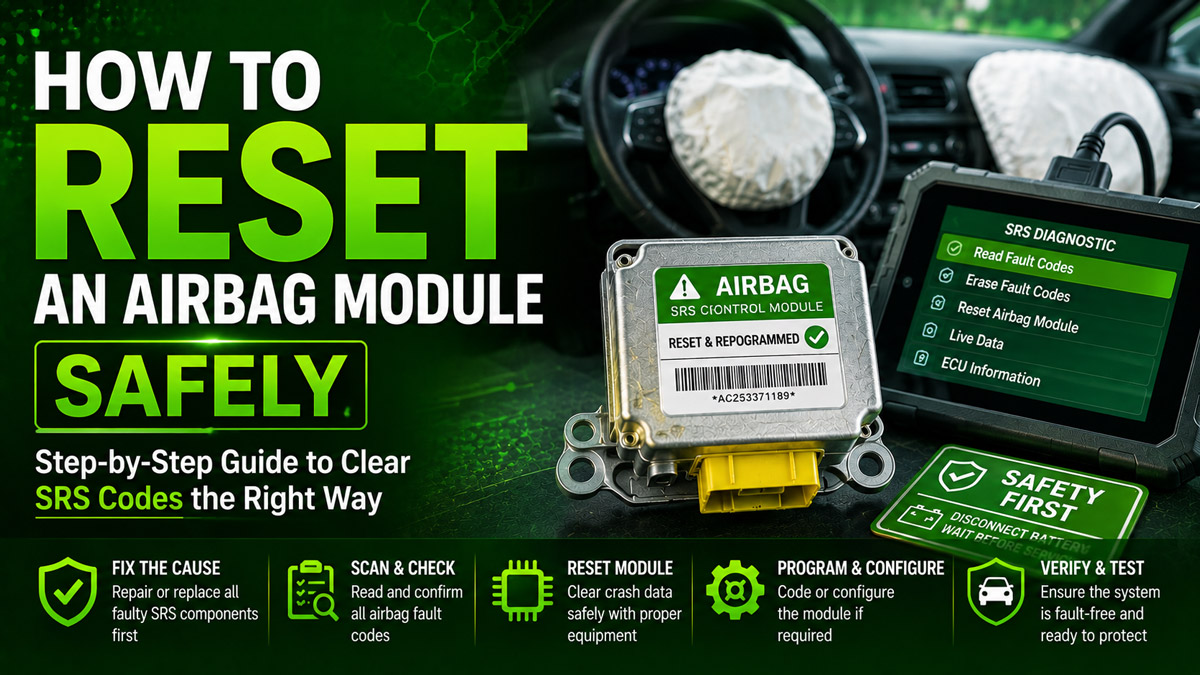
To reset an airbag module, first repair or replace every deployed or damaged Supplemental Restraint System component, then have the original module’s stored crash data cleared by a qualified SRS specialist. Reinstalling a reset module without fixing airbags, pretensioners, sensors, wiring, or power faults will leave the warning light on and may keep the restraint system disabled.
Important safety warning: An airbag system contains pyrotechnic devices that can deploy with enough force to cause serious injury. Airbag-module removal, programming, and installation should be handled by a trained automotive technician unless the vehicle manufacturer’s service procedure specifically supports owner-level work.
Key Facts at a Glance
- An airbag module is also called an SRS control unit, restraint control module, sensing and diagnostic module, or airbag control unit.
- A standard engine-code reader usually cannot erase stored airbag crash data.
- Clearing the warning light does not repair deployed airbags, fired seatbelt pretensioners, damaged sensors, or broken wiring.
- The original module can often be professionally reset if it has no internal electrical or physical damage.
- Replacement modules frequently require VIN programming, configuration, or vehicle-specific coding.
- The SRS system must be scanned again after installation to confirm that no current faults remain.
What Is an Airbag Module?
An airbag module is the electronic controller responsible for monitoring crash sensors, restraint circuits, occupant inputs, airbags, and seatbelt pretensioners. During a qualifying collision, the module decides whether to activate one or more restraint devices.
The module normally performs a self-check whenever the ignition is switched on. It monitors electrical resistance, supply voltage, sensor communication, connector condition, and the availability of connected safety devices.
Depending on the manufacturer, the component may be called:
- SRS control module
- Airbag control module
- Restraint control module
- Sensing and Diagnostic Module, or SDM
- Occupant Restraint Controller, or ORC
- Restraints Control Module, or RCM
These names describe similar functions, but the programming and replacement requirements differ by vehicle.
Why Does an Airbag Module Need Resetting?
An airbag module may need resetting after it records a collision or deployment event in nonvolatile memory. The stored event can remain after the damaged physical components have been replaced.
Crash information may include:
- Impact severity
- Deployment commands
- Seatbelt status
- Pretensioner activation
- Brake application
- Throttle position
- Vehicle speed
- Fault status before or during impact
A generic scan tool may display a deployment-related code but still be unable to erase it. In many vehicles, the event is stored in memory that requires bench-level programming or manufacturer-approved replacement.
However, an illuminated airbag light does not automatically mean the module contains crash data. The warning may instead be caused by a disconnected seat connector, weak battery, failed clockspring, damaged impact sensor, wiring fault, occupant-classification problem, or communication error.
Can Every Airbag Module Be Reset?
No. An airbag module can only be reset when its hardware remains functional and the vehicle manufacturer’s design allows the stored event data to be cleared.
Replacement is usually necessary when the module has:
- Water intrusion or corrosion
- Burned circuitry
- Internal communication failure
- Damaged connector pins
- Physical impact damage
- Failed power or ground circuits inside the unit
- A manufacturer requirement prohibiting reuse
- Repeated internal-control-unit fault codes
A professional reset service should inspect the module identification number and test whether its memory can be restored safely. A reset cannot repair damaged circuit boards or incompatible firmware.
Before You Start
| Requirement | Typical details |
| Difficulty | Advanced automotive electrical work |
| Vehicle downtime | Several hours to several days |
| Basic diagnostic time | 30–90 minutes |
| Mail-in reset turnaround | Commonly 2–7 business days plus shipping |
| Reset service cost | Often about $50–$150 |
| Replacement and programming | Commonly $300–$1,500 or more |
| Essential equipment | SRS-capable scanner, service information, hand tools and electrical test equipment |
| Main prerequisite | Every deployed or damaged SRS component must be identified |
Use the exact factory service information for the vehicle’s year, make, model, trim, and restraint configuration. Module location, battery waiting time, bolt torque, programming steps, and initialization requirements vary.
Safety Preparations
Before touching an SRS connector:
- Park the vehicle on a level surface.
- Switch off the ignition.
- Keep the key or keyless transmitter away from the vehicle.
- Disconnect the battery according to the manufacturer’s procedure.
- Wait the specified capacitor-discharge period.
- Do not probe airbag deployment circuits with a conventional test light.
- Do not apply electrical power directly to yellow SRS connectors.
- Store removed airbag units with the trim side facing upward.
Waiting periods commonly range from several minutes to 30 minutes, but the factory procedure must take priority.
How to Reset an Airbag Module
Step 1: Scan the Complete SRS System
Connect a diagnostic scanner that specifically supports the vehicle’s airbag system. Read all stored, current, history, communication, and deployment-related trouble codes before disconnecting anything.
Record every code and its status. A current circuit fault must be repaired before a module reset can restore normal operation.
You will know this step is complete when: You have a written or saved pre-repair scan showing every SRS code.
Common mistake: Assuming the module is locked because the warning light is illuminated.
Step 2: Confirm Whether Crash Data Is Stored
Determine whether the module reports a deployment event, crash-record status, control-unit lock, or non-clearable internal code. The wording varies by manufacturer.
Some vehicles allow certain event codes to be cleared with manufacturer-level diagnostic software. Others require bench resetting or complete module replacement.
Do not repeatedly erase ordinary codes hoping a hard deployment record will disappear. That approach can hide useful diagnostic information without repairing the system.
You will know this step is complete when: The scan results or service documentation confirm whether resetting is permitted.
Step 3: Identify Every Deployed or Damaged Component
Inspect all components affected by the collision. The list may extend beyond the visibly deployed steering-wheel or dashboard airbag.
Possible replacement items include:
- Driver airbag
- Passenger airbag
- Side or curtain airbags
- Knee airbags
- Seat-mounted airbags
- Seatbelt pretensioners
- Seatbelt buckle tensioners
- Impact sensors
- Clockspring
- Dashboard or trim panels
- SRS wiring and connectors
- Occupant-classification components
- Battery safety terminal
- Rollover sensor
- Module mounting bracket
A reset module cannot compensate for an open deployment circuit. If a pretensioner has fired, for example, the module may communicate normally but immediately set a resistance or deployment code.
You will know this step is complete when: Every active SRS fault has a documented repair plan.
Step 4: Repair the SRS System Before Resetting
Replace deployed restraint devices with correct, approved components. Repair damaged wiring only according to the manufacturer’s permitted procedure.
Do not install resistors, simulators, bypass plugs, or dummy devices to make the warning light switch off. These methods can prevent a real airbag from operating during a later crash.
Verify part numbers carefully. Airbags and modules that appear identical may use different deployment stages, sensor logic, connectors, or regional specifications.
You will know this step is complete when: All physical repairs are finished and the remaining fault is limited to stored module data or required programming.
Step 5: Disconnect Power and Locate the Module
Follow the manufacturer’s battery-disconnection sequence and wait the specified discharge period. Remove interior trim only after the backup power supply has discharged.
The module is commonly mounted near the center of the vehicle, where it can measure impact forces accurately. Possible locations include:
- Beneath the center console
- Under the dashboard
- Below the radio or HVAC controls
- Under a front seat
- On the transmission tunnel
- Beneath carpet or interior trim
Do not rely on a generic location guide. Confirm the exact position through service information.
Common mistake: Removing seats or consoles before checking for connected seat airbags, pretensioners, or occupant sensors.
Step 6: Remove and Label the Original Module
Photograph the installation position, connector routing, module label, orientation arrow, and mounting hardware. Then disconnect the approved SRS connectors using their locking tabs.
Remove the mounting bolts without striking or dropping the unit. Keep hardware organized because mounting position and torque may affect sensor operation.
Record:
- OEM part number
- Hardware revision
- Software or calibration number
- VIN shown by the scanner
- Connector count
- Vehicle year, make and model
You will know this step is complete when: The module is removed without connector, housing, or wiring damage.
Step 7: Send the Module to a Qualified Reset Service
A professional reset provider can read the module memory, preserve the original vehicle configuration, clear supported crash records, verify communication, and return the unit for reinstallation.
Before choosing a provider, ask whether it:
- Supports the exact module part number
- Preserves VIN and original coding
- Bench-tests the module
- Provides a written warranty
- Identifies modules that cannot be repaired
- Returns the original unit rather than an exchange module
Professional resetting is generally preferable to attempting to edit raw EEPROM data without module-specific knowledge. A wrong memory file can corrupt calibration information, create communication errors, or render the controller unusable.
Step 8: Reinstall the Reset Module
Position the module in its original orientation. Tighten its mounting bolts to the manufacturer’s torque specification and reconnect every locking connector completely.
Inspect the surrounding area for moisture, damaged wiring, trapped carpet, loose grounds, or evidence that collision repairs altered the mounting surface.
Reconnect the battery only after all SRS components and connectors are secured.
You will know this step is complete when: The module is firmly mounted, all connectors are locked, and no loose SRS wiring remains.
Step 9: Clear Repairable Codes and Perform Setup Procedures
Switch on the ignition from outside the deployment path whenever practical. Observe the airbag warning-light sequence and connect the SRS-capable scanner.
Depending on the vehicle, required procedures may include:
- VIN verification
- Module configuration
- Variant coding
- Proxi alignment
- Occupant-classification calibration
- Passenger-seat zero-point reset
- Steering-angle calibration
- Impact-sensor initialization
- Module replacement routine
The original reset module often retains its configuration, but this should never be assumed.
Step 10: Complete a Post-Repair Safety Scan
Run a full vehicle scan, not only an engine-code scan. Confirm that the SRS module communicates and that no current, pending, internal, or configuration codes remain.
Switch the ignition off and restart the vehicle. The warning light should illuminate briefly as a bulb check and then turn off according to the manufacturer’s normal sequence.
A lamp that never illuminates is not proof of a successful repair. The bulb, instrument cluster, or warning circuit may have been altered.
Final checkpoint: The module communicates, the bulb check works, required calibrations are complete, and the SRS system reports no active faults.
Reset, Replace, or Diagnose Another Fault?
| Situation | Best course of action |
| Original module stores supported crash data but communicates normally | Professional reset |
| Module has corrosion, electrical damage or no communication | Replace and program |
| Warning light appeared without a crash | Diagnose the active fault first |
| Used donor module has a different part number | Do not install it |
| Matching donor module triggers VIN mismatch | Perform approved coding or use the correct original module |
| Deployed airbags or pretensioners remain installed | Replace the affected components before module work |
| Manufacturer prohibits reuse after deployment | Install the specified new module |
Can You Reset an Airbag Module With an OBD2 Scanner?
A standard OBD2 scanner generally cannot reset deployment data stored in an airbag module. Basic readers are designed mainly for emissions-related powertrain codes and may not communicate with the SRS controller at all.
An advanced bidirectional scanner may clear ordinary SRS codes after the underlying problem is repaired. It may also perform coding and calibration functions. However, scanner access does not guarantee that it can erase permanent collision data from internal module memory.
Why Is DIY EEPROM Flashing Risky?
DIY EEPROM flashing involves reading and rewriting memory inside the control module. It requires electronics experience, the correct programmer, verified memory data, module-specific pinouts, stable power, antistatic precautions, and reliable backups.
Common failure modes include:
- Writing a file from the wrong module version
- Erasing VIN or configuration information
- Corrupting the boot section
- Damaging the memory chip
- Lifting circuit-board pads
- Reversing programmer connections
- Creating a module that no longer communicates
- Clearing evidence without repairing the safety system
This method is unsuitable for a first-time DIY repair. Saving the price of a professional reset is not worth creating uncertainty in a crash-protection system.
How Much Does Airbag Module Resetting Cost?
Professional module resetting commonly costs approximately $50 to $150, excluding removal, shipping, diagnostics, and repairs to other restraint components. Total collision-related SRS repairs can cost far more because airbags, pretensioners, trim, sensors, and programming may also be required.
| Service | Typical range |
| Initial SRS diagnostic scan | $75–$200 |
| Mail-in module reset | $50–$150 |
| Module removal and installation | $100–$400 |
| New module | $300–$1,200+ |
| Module coding or programming | $100–$350 |
| Individual airbag replacement | $500–$2,000+ |
| Seatbelt pretensioner replacement | $150–$500 each |
Vehicle brand, parts availability, dashboard damage, labor rates, and the number of deployed restraints determine the final price.
Common Mistakes and How to Fix Them
Resetting the Module Before Repairing the Vehicle
A reset should be one of the final stages of SRS repair. Replace deployed components and correct wiring faults first.
Reconnecting the Battery With Loose Connectors
An unsecured connector can create new faults and may require disassembly again. Check every SRS lock before restoring power.
Buying a Module Based Only on Appearance
Match the complete OEM part number, hardware level, vehicle equipment and regional specification. Similar housings do not guarantee compatibility.
Expecting the Warning Light to Clear Automatically
Some vehicles retain history or configuration codes until an approved scan routine is completed. Run a full SRS scan after installation.
Ignoring Low-Voltage Problems
A weak battery, poor ground, blown fuse, or charging-system fault can create misleading SRS codes. Stabilize system voltage before programming or calibrating modules.
Treating the Warning Light as the Only Test
A disabled bulb can hide an active failure. Verify module communication, trouble-code status, startup bulb check, and required calibrations.
When Should the Module Be Replaced Instead?
Replace the airbag module when it is electrically damaged, physically damaged, unsupported by reset services, incompatible with the repaired vehicle, or designated as non-reusable by the manufacturer.
A new module may require dealer-level or manufacturer-level software. A used module can be less expensive, but it may contain another vehicle’s crash history, VIN, configuration, or component-protection data. Used units should only be installed when their compatibility and programming path are confirmed in advance.
Expert Recommendations
For a vehicle owner, the safest route is to have a qualified repair facility diagnose the entire SRS system and send the original module to a reputable reset provider when resetting is permitted.
For an independent repair shop, the most reliable workflow is to save the pre-repair scan, document every deployed device, verify part numbers, repair all active circuits, reset or replace the module, perform required calibrations, and archive the post-repair scan.
For an electronics specialist, bench programming should only be attempted with verified module data and a process for validating the controller afterward. Successful communication alone does not prove that deployment logic, sensor calibration, and vehicle configuration are correct.
Frequently Asked Questions
Will Disconnecting the Battery Reset the Airbag Module?
No. Disconnecting the battery may clear temporary voltage conditions on some vehicles, but it does not normally erase permanent deployment data. Battery isolation is a safety preparation for SRS repairs, not a crash-data reset method.
Can I Drive With a Faulty Airbag Module?
The vehicle may still move, but the airbags or seatbelt pretensioners may not operate correctly while the SRS warning is active. Treat the vehicle as having compromised crash protection and arrange diagnosis rather than continuing normal use.
Does a Reset Module Need Programming?
The original reset module often retains its VIN and vehicle configuration, but some vehicles still require initialization or calibration. A new or donor module is more likely to need VIN programming, variant coding, component pairing, or proxi alignment.
Why Is the Airbag Light Still On After a Reset?
The most common causes are an unrepaired pretensioner, deployed airbag, loose connector, damaged clockspring, sensor fault, low-voltage code, occupant-classification problem, or configuration error. Scan the module again and repair the current code instead of repeating the reset.
Can Crash Data Return After It Is Cleared?
Crash data should not return unless the module experiences another qualifying collision, the reset was unsuccessful, or the displayed fault is actually an active circuit or internal-module problem. A post-installation scan distinguishes stored history from current failure.
Is an Airbag Module Reset Legal?
Requirements depend on the jurisdiction, manufacturer procedure, repair documentation, vehicle title status, and inspection rules. A module should only be reset as part of a complete, properly documented SRS repair using compatible components and approved diagnostic procedures.
The Bottom Line
The correct way to reset an airbag module is to diagnose the entire SRS system, replace every deployed or damaged restraint component, remove the original controller safely, have supported crash data professionally cleared, reinstall the unit, complete required programming, and verify the repair with an SRS-capable scanner.
Resetting memory alone does not restore crash protection. The repair is complete only when the physical restraint system is correctly rebuilt, the module communicates normally, all calibrations are finished, and no active SRS faults remain.