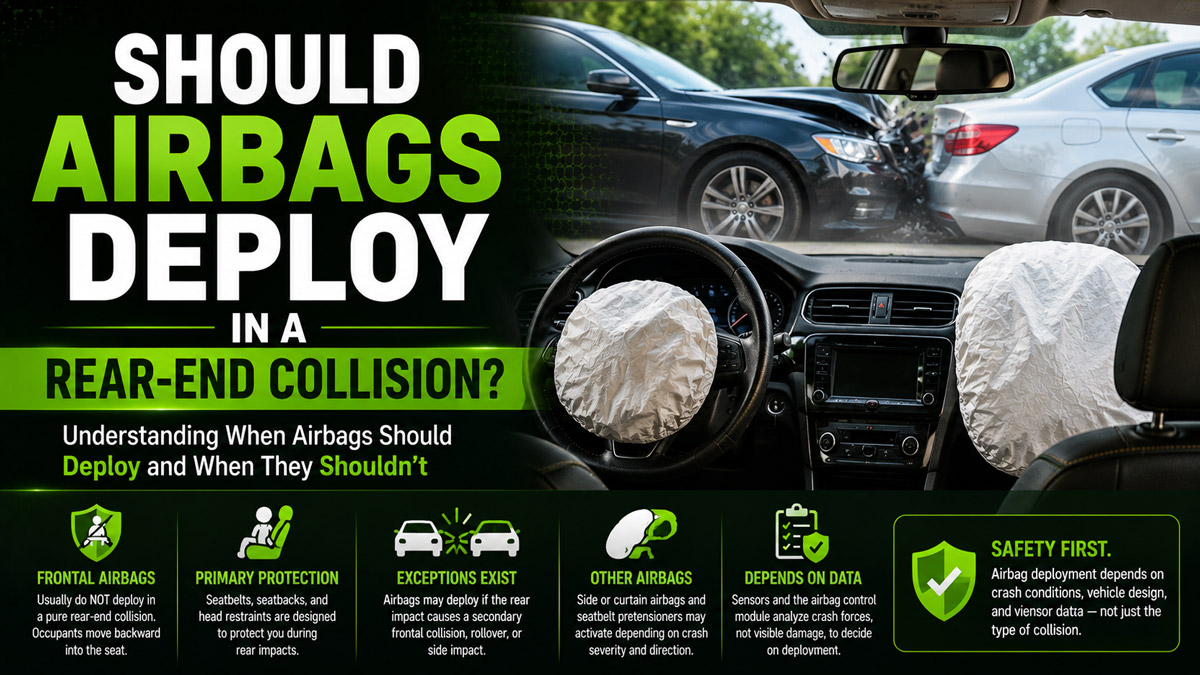
Frontal airbags should not normally deploy in a pure rear-end collision because occupants initially move backward into their seats rather than forward toward the steering wheel or dashboard. However, side, curtain or frontal airbags may deploy when the crash includes substantial sideways movement, a rollover or a secondary frontal impact.
Key Facts at a Glance
- Frontal airbags are primarily designed for moderate-to-severe frontal or near-frontal impacts.
- Non-deployment in a straightforward rear-end crash is usually normal.
- Seatbacks, head restraints and seatbelts provide the primary protection during a rear impact.
- Seatbelt pretensioners may activate even when no airbag deploys.
- Frontal airbags may deploy if the rear impact pushes the vehicle into another car, wall or object.
- Airbag deployment depends on sensor data and crash forces, not visible vehicle damage alone.
Should Frontal Airbags Deploy in a Rear-End Collision?
No. Driver and front-passenger frontal airbags generally should not deploy when a vehicle is struck directly from behind without any additional impact.
Frontal airbags protect occupants who are moving rapidly toward the steering wheel, dashboard or windshield. During the first phase of a rear-end collision, the struck vehicle accelerates forward beneath its occupants. The occupants are therefore pressed backward into their seatbacks.
Deploying a frontal airbag at that moment would provide little benefit because the occupants are moving away from the dashboard. The inflated bag could also interfere with their natural rebound movement after the initial impact.
Non-deployment is therefore usually a deliberate result of the Supplemental Restraint System’s crash-detection logic rather than evidence that the airbags failed.
Why Do Frontal Airbags Stay Inactive?
Frontal airbags stay inactive because the Airbag Control Module evaluates the direction, duration and severity of acceleration forces before issuing a deployment command.
The module receives data from accelerometers, impact sensors, seatbelt sensors and, in many vehicles, occupant-classification sensors. It compares the incoming data with deployment algorithms developed for that vehicle.
A rear impact normally produces an acceleration pattern that does not match the frontal-airbag deployment criteria. Although a vehicle can sustain extensive trunk, bumper or frame damage, the direction of the force may still provide no reason to deploy the steering-wheel or dashboard airbags.
Visible damage alone does not determine deployment. A low-speed collision with concentrated structural damage may not trigger an airbag, while a higher-energy crash with less obvious exterior damage may produce a qualifying sensor pattern.
How Does Occupant Movement Differ by Crash Direction?
Occupant movement determines which restraint systems can provide meaningful protection.
| Crash direction | Initial occupant movement | Primary protection |
| Frontal impact | Forward toward the dashboard | Seatbelt and frontal airbags |
| Rear impact | Backward into the seat | Seatback, head restraint and seatbelt |
| Side impact | Toward the struck side | Side torso and curtain airbags |
| Rollover | Sideways and toward the roof | Seatbelt and rollover curtain airbags |
| Rear impact followed by frontal impact | Backward, then forward | Multiple systems may activate |
During a rear-end crash, the seatback supports the torso while the head restraint helps control rearward head movement. Proper head-restraint positioning is therefore especially important.
The top of the restraint should generally be level with the top of the occupant’s head, and the restraint should be positioned as close to the back of the head as the seat design allows. A low or distant head restraint may allow greater neck movement and increase the risk of whiplash.
Can Frontal Airbags Deploy After a Rear Impact?
Yes. Frontal airbags can deploy when a rear-end collision causes a sufficiently severe secondary frontal impact.
For example, a vehicle stopped at a traffic light may be struck from behind and pushed into the vehicle ahead. The first impact produces rearward occupant movement, but the second impact rapidly decelerates the vehicle and throws the occupants forward.
If the secondary collision exceeds the vehicle’s frontal deployment threshold, the driver and passenger frontal airbags may deploy. The system responds to the measured crash forces rather than simply identifying which vehicle initiated the collision.
A frontal airbag may also deploy when a rear impact pushes a vehicle into:
- A concrete barrier
- A parked truck
- A utility pole
- A building
- Another vehicle
- A ditch or embankment
The frontal airbags would be responding to the second impact, not the original contact at the rear bumper.
Which Airbags May Deploy in a Rear-End Crash?
Different airbag types use different deployment criteria.
| Safety component | Likely behavior in a pure rear impact | Possible exception |
| Driver frontal airbag | Usually remains inactive | Secondary frontal impact |
| Passenger frontal airbag | Usually remains inactive | Secondary frontal impact |
| Knee airbag | Usually remains inactive | Severe qualifying frontal impact |
| Seat-mounted side airbag | Usually remains inactive | Significant lateral component |
| Side-curtain airbag | Usually remains inactive | Side impact or rollover |
| Rear-seat airbag system | Vehicle-specific | Designed rear-occupant protection |
| Seatbelt pretensioner | May activate | Depends on vehicle and crash severity |
Airbag systems vary considerably by manufacturer, model year and seating position. Some newer vehicles have center airbags, rear-seat frontal airbags or specialized rear-window protection systems.
The owner’s manual provides the most accurate description of the installed airbag types and the general crashes in which they are designed to operate.
Can Side Airbags Deploy During a Rear Collision?
Side airbags may deploy if the collision includes a meaningful lateral force.
A crash may appear to be a rear-end accident but still include side-loading. This can happen when another vehicle strikes one rear corner, rotates the car or pushes it sideways into a guardrail.
Seat-mounted torso airbags generally respond to severe side impacts. Curtain airbags may deploy during side collisions and, in vehicles equipped with rollover sensing, when the system detects an impending rollover.
A straight impact to the center of the rear bumper normally does not create the lateral acceleration required to deploy side airbags. An offset rear-corner impact is more likely to generate complex sensor readings.
Do Seatbelt Pretensioners Activate in Rear-End Collisions?
Seatbelt pretensioners may activate during a sufficiently severe rear impact even when the airbags remain undeployed.
A pretensioner uses a pyrotechnic or mechanical device to remove slack from the belt. This helps hold the occupant against the seat so that the seatback and head restraint can control body movement more effectively.
A fired pretensioner is not always visually obvious. Warning signs may include:
- An SRS or airbag warning light
- A seatbelt that no longer retracts properly
- A buckle or retractor fault code
- A belt that remains tightly locked
- Evidence of heat or deployment residue near the retractor
Pretensioners are generally single-use components. A qualified technician should inspect the restraint system after a substantial crash, even if no airbag opened.
How Quickly Does an Airbag System Make a Decision?
An airbag system evaluates a severe crash within milliseconds.
Sensors begin measuring acceleration as soon as the impact starts. The control module then examines the severity, direction and duration of the signal. When the deployment criteria are satisfied, the module sends an electrical current to the inflator.
The bag inflates and begins cushioning the occupant before immediately venting gas through designed openings. The deployment and initial deflation process occurs within a fraction of a second.
This speed explains why the system cannot wait to observe the final vehicle damage. It must predict occupant movement from the earliest crash data and activate only the restraint devices likely to provide a benefit.
Does Severe Rear Damage Mean the Airbags Should Have Deployed?
No. Severe rear structural damage does not automatically mean the frontal airbags should have deployed.
Vehicle structures and airbags perform different functions. Bumpers, crush zones and body structures absorb and redirect crash energy. Airbags address specific occupant-contact risks inside the cabin.
A rear bumper, trunk floor or rear body panel can deform extensively while the passenger compartment experiences no qualifying frontal deceleration. In that situation, deploying the frontal airbags could create unnecessary injuries and increase repair costs without improving protection.
The correct question is not, “How damaged is the vehicle?” It is, “What forces did the occupants experience, and in which direction?”
When Could Non-Deployment Indicate a Problem?
Non-deployment may indicate a problem when the vehicle experienced a severe qualifying impact and the airbag system should reasonably have activated.
Possible warning signs include:
- The airbag warning light was illuminated before the crash.
- The vehicle had unrepaired prior airbag deployment.
- An airbag module was missing or replaced improperly.
- The vehicle had damaged crash sensors or wiring.
- The secondary frontal impact was severe, but no frontal restraints activated.
- The occupant sustained dashboard or steering-wheel contact consistent with failed protection.
- Diagnostic records show stored SRS faults that existed before the collision.
Determining whether an airbag should have deployed requires more than looking at photographs. A qualified investigator may need crash measurements, Event Data Recorder information, diagnostic trouble codes, repair history and vehicle-specific deployment criteria.
What Does the Airbag Warning Light Mean After the Crash?
An airbag warning light after a collision means the Supplemental Restraint System has detected a fault and requires diagnosis.
The fault could involve:
- A deployed seatbelt pretensioner
- Damaged impact-sensor wiring
- A disconnected seat connector
- A stored crash event
- Low battery voltage during the impact
- A damaged control module
- A faulty airbag circuit
An ordinary engine-code scanner may not read these faults. The technician needs a diagnostic tool capable of communicating with the vehicle’s SRS module.
Clearing the warning light without repairing the cause does not restore protection. The fault may immediately return, and parts of the airbag system may remain disabled.
What Should You Inspect After a Rear-End Collision?
Have the complete restraint and seating system inspected after any substantial rear-end collision.
1. Scan the SRS Module
Ask the repair facility to retrieve all current, stored and history codes before disconnecting the battery or replacing components. These codes can provide evidence about pretensioners, impact sensors and circuit faults.
2. Inspect the Seatbelts
Check the retractors, buckles, webbing, anchors and pretensioners. Replace any deployed or damaged single-use component according to the manufacturer’s procedures.
3. Inspect the Seats
A rear impact loads the seatbacks heavily. A bent seat frame, damaged recliner or loose track can reduce protection in another crash.
4. Check the Head Restraints
Confirm that the head restraints remain secure, adjustable and correctly aligned. Some vehicles use active head restraints that move during a rear impact and may require inspection or replacement afterward.
5. Examine the Electrical System
Under-seat wiring can be stretched, pinched or disconnected during a collision. Damaged connectors should be repaired using approved procedures rather than twisted wires or improvised resistors.
6. Review the Instrument Panel
The airbag light should illuminate briefly during startup and then turn off. A light that remains on, flashes or never appears requires investigation.
Should You Drive the Vehicle After the Airbags Do Not Deploy?
Do not assume a vehicle is safe to drive solely because the airbags did not deploy.
A rear collision can damage the fuel system, exhaust, suspension, trunk structure, battery, electrical wiring, seats and restraint components. The vehicle may also have hidden frame or unibody distortion.
Avoid driving when:
- The airbag warning light remains on
- A seatbelt will not latch or retract
- A seatback is loose or twisted
- The trunk will not close securely
- Fuel or fluid is leaking
- Tires contact damaged bodywork
- Brake or steering behavior has changed
- Broken glass or loose trim creates a hazard
A minor cosmetic bumper impact may not require towing, but a professional inspection remains advisable when the force was strong enough to cause occupant pain or structural deformation.
Can Event Data Show Why the Airbags Stayed Inactive?
The Event Data Recorder may help explain the system’s response in a serious or disputed collision.
Depending on the vehicle, recorded information may include:
- Vehicle speed
- Accelerator position
- Brake application
- Seatbelt status
- Change in velocity
- Airbag deployment commands
- Deployment timing
- Recorded crash events
Not every vehicle records the same information, and an EDR does not provide a complete reconstruction by itself. However, its data can help determine whether the control module detected a qualifying frontal, side or rollover event.
Preserving this information may be important when an insurance claim, injury case or alleged airbag defect is disputed. Avoid allowing modules to be discarded before the relevant data is evaluated.
Can Airbags Be Reused After Deployment?
No. Deployed airbag modules and fired pyrotechnic pretensioners are single-use safety components.
A proper repair may require replacement of the deployed airbags, pretensioners, sensors, trim panels and other manufacturer-specified parts. The control module may also require replacement or manufacturer-approved programming, depending on the vehicle.
Never install counterfeit airbags, bypass resistors or unknown salvage modules. These parts can hide warning lights while leaving occupants without functional protection.
Common Mistakes After a Rear-End Collision
Assuming Every Serious Crash Requires Frontal Airbags
Deployment depends on occupant movement and measured crash forces, not repair cost or visible damage.
Ignoring the Airbag Warning Light
A warning light can mean the entire system or specific circuits are unavailable for the next crash.
Replacing Only the Bumper
Seats, head restraints, pretensioners and SRS wiring may also be damaged.
Using Cheap Seat Covers
Unapproved covers can obstruct seat-mounted side-airbag seams.
Sitting Too Close to the Steering Wheel
Drivers should maintain as much practical distance from the steering-wheel airbag as possible while preserving full control of the pedals and steering wheel.
Failing to Preserve Crash Data
Diagnostic codes, EDR information and damaged components can be valuable when deployment is disputed.
Frequently Asked Questions
Can airbags deploy when a parked car is hit from behind?
Yes, but frontal airbags usually remain inactive unless the parked vehicle is pushed into another object with enough force to create a qualifying frontal impact. Pretensioners or other restraint components may activate depending on the vehicle and collision severity.
Is it normal for no airbags to deploy in a rear-end crash?
Yes. It is normal for no airbags to deploy in a straightforward rear-end collision because the seatback, head restraint and seatbelt are the primary protective systems. An SRS inspection is still appropriate after a substantial impact.
Can a rear-corner impact trigger curtain airbags?
It can. A forceful rear-corner impact may rotate the vehicle or create significant lateral acceleration. Curtain or side airbags may deploy when the resulting sensor data meets the vehicle’s side-impact or rollover criteria.
Does the absence of airbags mean the crash was minor?
No. A crash can cause serious injuries and extensive structural damage without deploying an airbag. Deployment only indicates that a specific sensor threshold and crash direction were detected.
Will an insurance company inspect the airbag system?
Insurance procedures vary, but a proper collision estimate should include restraint-system diagnostics when the impact could have damaged airbags, sensors, pretensioners, seats or wiring. Request an SRS scan and written documentation when the airbag response is disputed.
Can whiplash occur when airbags do not deploy?
Yes. Frontal airbags are not designed to prevent most rear-impact whiplash injuries. The head restraint, seatback, seatbelt, seating posture and crash pulse have a greater influence on neck movement in a rear-end collision.
The Bottom Line
Frontal airbags should not normally deploy in a pure rear-end collision. The system intentionally keeps them inactive because the occupants initially move backward into the seats rather than forward toward the dashboard.
Airbags may deploy when the crash includes a secondary frontal impact, a strong side component or a rollover. Even when no bag opens, the vehicle should be inspected for damaged pretensioners, seats, head restraints, sensors and SRS wiring. Non-deployment becomes suspicious only when the vehicle experienced a qualifying impact or had evidence of a pre-existing airbag-system fault.