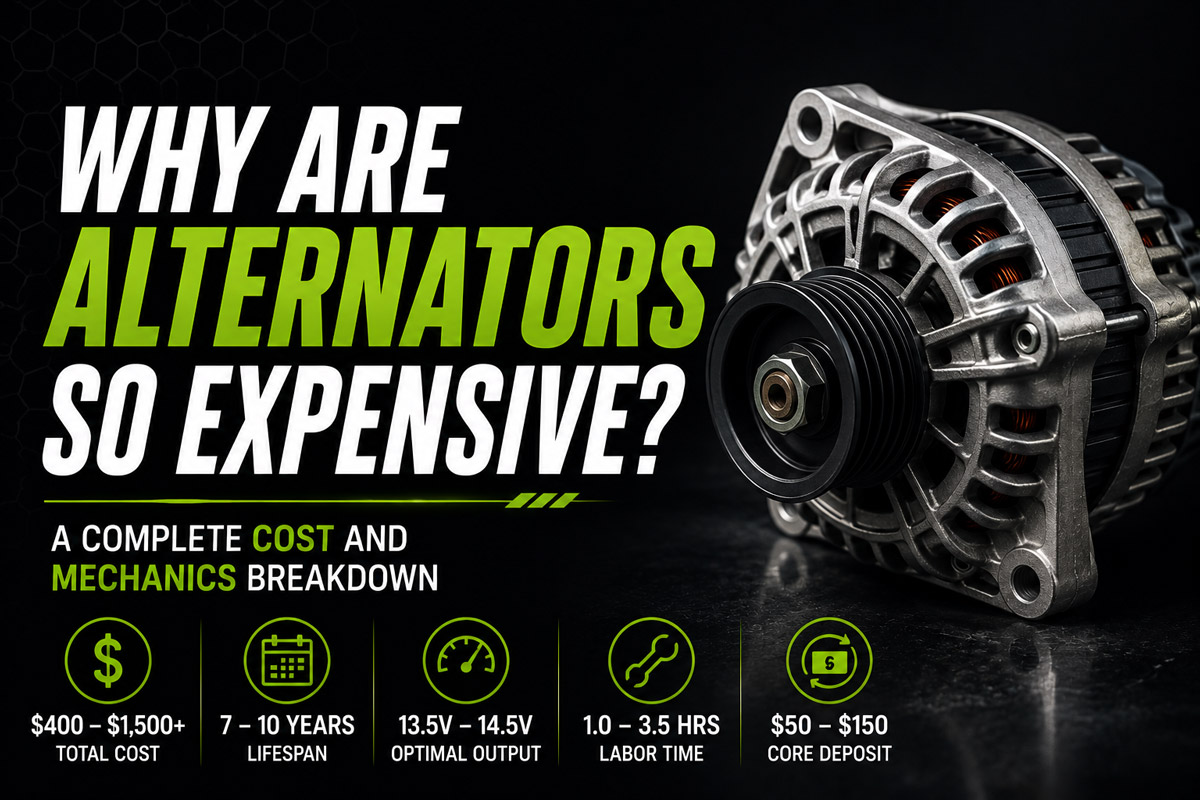
Alternators are expensive because they are no longer simple mechanical generators; modern units are complex electromechanical devices packed with dense copper windings, precision bearings, and solid-state electronics. Furthermore, the tight packaging of modern engine bays has drastically increased the professional labor hours required to replace them, pushing total repair bills higher.
Key Facts / At a Glance
- Total Replacement Cost: Typically ranges from $400 to $1,500+, depending heavily on vehicle make and engine layout.
- Average Lifespan: 7 to 10 years, or roughly 100,000 to 150,000 miles.
- Optimal Voltage Output: A healthy alternator should consistently output between 13.5V and 14.5V DC.
- Labor Time: Varies from 1.0 hour (accessible inline-4 engines) to over 3.5 hours (transverse V6 or luxury European layouts).
- Core Deposit: Most retailers charge a $50–$150 core fee, refundable when you return the broken unit.
The Factors Driving Up Alternator Prices
The cost of replacing an alternator is split between the physical part and the labor required to install it. Both have seen significant increases over the last decade.
1. The Cost of Raw Materials and Precision Electronics
An alternator is heavily reliant on premium, heat-resistant raw materials.
Inside the aluminum housing, a massive stator is wound with high-grade copper wire. Copper prices fluctuate, but the sheer volume required for a high-output alternator establishes a high baseline cost. Additionally, the internal rectifier uses solid-state diodes to convert alternating current (AC) to direct current (DC). These diodes must withstand extreme thermal cycling (engine heat plus electrical resistance) without failing.
2. The Shift to “Smart” Alternators
In older vehicles, an alternator simply spun and produced power. Today, nearly all modern vehicles use “smart” or variable-voltage alternators.
These units communicate directly with the vehicle’s Engine Control Unit (ECU) via complex data networks (like the LIN or CAN bus). They dynamically adjust their output based on electrical demand and driving conditions—sometimes dropping output during acceleration to reduce engine drag and improve fuel economy. This integration requires onboard microcontrollers, making the component significantly more expensive to manufacture and calibrate than traditional units.
3. Skyrocketing Labor Costs Due to Engine Packaging
The part itself is only half the equation. The single largest variable in alternator replacement cost is what you drive.
In older or simpler vehicles (like a Honda Civic), the alternator sits on top of the engine and can be swapped in under an hour. In many modern SUVs and luxury vehicles, engineers prioritize cabin space and aerodynamics over serviceability. The alternator might be buried under the intake manifold, integrated into the cooling system (water-cooled alternators in some BMWs), or require the removal of the front bumper or subframe. This turns a $200 part into a $1,200 repair bill purely due to labor.
How an Alternator Actually Works
Understanding the cost requires understanding the process. An alternator converts mechanical energy from the engine into electrical energy to power the vehicle and recharge the battery.
- Mechanical Input: The engine’s crankshaft spins a serpentine belt, which turns the alternator’s pulley.
- Magnetic Excitation: Initial battery current flows through carbon brushes into the rotor, creating a rotating electromagnet.
- Electromagnetic Induction: As the magnetized rotor spins inside the stationary copper coils (the stator), it induces a three-phase AC voltage.
- Rectification: The vehicle’s electrical grid cannot use AC power. The current passes through a rectifier (a bridge of diodes), which converts it into a stable DC output.
- Voltage Regulation: An electronic regulator ensures the output remains strictly between 13.5V and 14.5V, protecting sensitive onboard electronics.
Why Alternators Fail
Alternators do not last forever. They operate in a hostile environment characterized by extreme heat, vibration, and continuous mechanical rotation.
- Bearing Failure: The internal rotor spins on precision steel bearings. Over billions of revolutions, the grease dries out. When bearings fail, they produce a distinct, high-pitched whining or grinding noise that rises and falls with engine RPM.
- Thermal Fatigue: The aluminum housing expands faster than the internal steel and copper components when heated. Thousands of thermal cycles eventually cause structural micro-fractures in the delicate solder joints.
- Diode Burnout: The rectifier diodes are fragile. Continuous peak-amperage draws (like powering a heavy winch) or incorrect use of jumper cables (reversing polarity) can instantly cook the diodes, destroying the unit’s ability to output DC power.
- Fluid Contamination: A leaky valve cover gasket or power steering pump can drip fluid directly into the alternator, destroying the brushes and shorting the electronics.
OEM vs. Aftermarket: Where Should You Spend Your Money?
When replacing an alternator, you must choose between Original Equipment Manufacturer (OEM) parts, premium aftermarket, or budget remanufactured units.
| Feature | OEM (Dealership) | Premium Aftermarket / Remanufactured | Budget Aftermarket |
| Price Range | $500 – $1,000+ | $200 – $400 | $100 – $200 |
| Fitment | Guaranteed perfect match. | Generally excellent, minor bracket variances. | Hit or miss. |
| Electronics | Exact ECU communication protocols. | Usually matches OEM specs. | Often triggers false dashboard warning lights. |
| Efficiency | Highest fuel economy (high-efficiency diodes). | Varies by manufacturer. | Lowest (cheap diodes create mechanical drag). |
| Best For | Luxury, European, and complex Smart-charge systems. | Daily commuters, older domestic/Asian vehicles. | Quick-flips or extreme budget constraints. |
Expert Insight: Do not buy a cheap aftermarket alternator for a modern European car (BMW, Audi, Mercedes). The ECUs in these vehicles are incredibly sensitive to voltage fluctuations. A cheap unit will often mechanically work but fail to communicate properly via the LIN bus, resulting in a permanent “Battery Malfunction” light on your dashboard, even if the car is charging.
Which Should You Choose?
Your choice of alternator should be dictated by your vehicle type and your long-term plans for the car.
The Daily Commuter (Standard Vehicles)
If you drive a standard Toyota, Ford, or Honda, opt for a premium remanufactured unit from a reputable brand (like Denso or Bosch). These offer the best balance of price and reliability. Remanufactured units reuse the durable outer aluminum casing but replace all the critical internal wear items (bearings, brushes, diodes).
The European / Luxury Owner
If you drive a modern luxury vehicle with a complex smart-charging system, you must pay the premium for an OEM alternator. The proprietary communication protocols and sensitive voltage requirements mean aftermarket units have a high failure rate in these applications.
The Off-Roader or Audio Enthusiast
If you run heavy winches, extensive off-road lighting, or a massive aftermarket audio system, a stock alternator will burn out quickly. You need to upgrade to a High-Output Alternator (producing 250+ Amps). These feature larger stators and heavy-duty rectifiers designed to handle continuous high-amperage draws without overheating.
Frequently Asked Questions
Can I drive my car with a failing alternator?
Only for a very short distance. Once the alternator stops charging, the vehicle runs entirely on reserve battery power. Depending on the electrical load (headlights, radio, climate control), the engine will stall completely within 15 to 45 minutes, leaving you stranded.
How do I test if my alternator is bad?
Use a digital multimeter across the battery terminals. With the engine off, a healthy battery reads about 12.6V. Start the engine. The voltage should jump to between 13.5V and 14.5V. If the voltage stays at 12.6V or slowly drops while the engine is running, the alternator is not charging.
Is it better to rebuild or replace an alternator?
In the past, rebuilding an alternator at a local specialty shop was common. Today, labor rates make this cost-prohibitive for most consumer vehicles. It is almost always more cost-effective to buy a factory-remanufactured unit that comes with a warranty than to pay a technician to rebuild your old one.
Do I need to replace the battery when I replace the alternator?
Not always, but a failing alternator forces the battery to work much harder, often deeply discharging it. If the battery is more than three years old, or if it has been completely drained multiple times due to the bad alternator, it is highly recommended to replace both to prevent the old battery from overworking the new alternator.