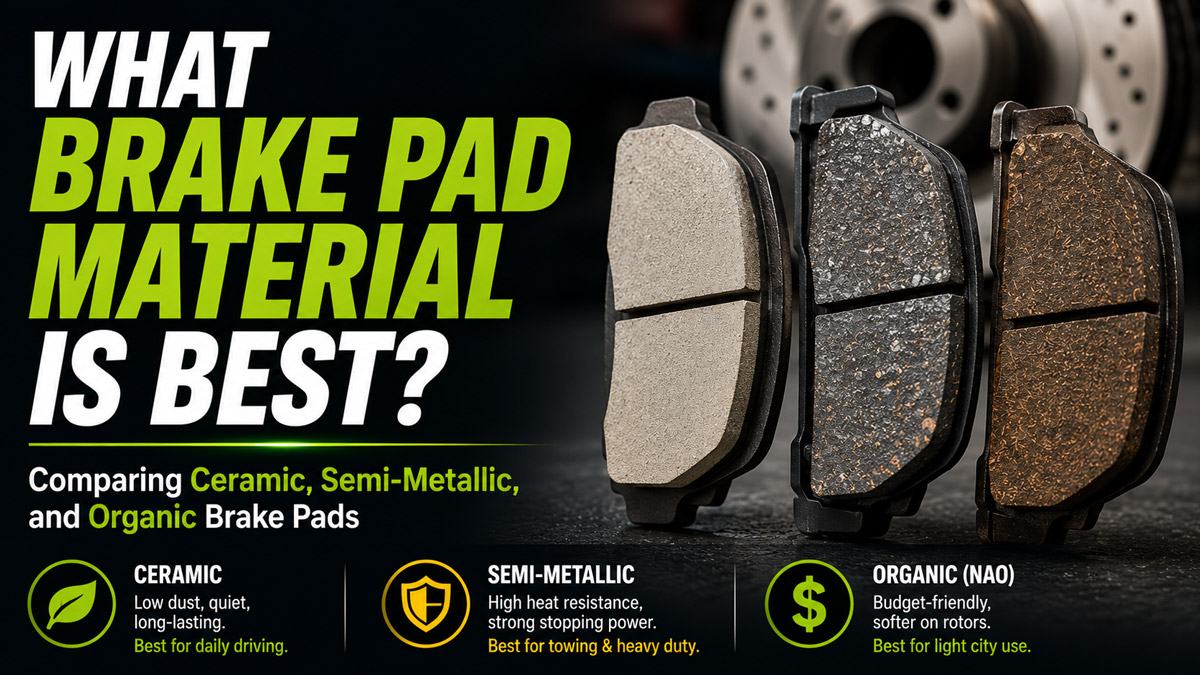
Ceramic brake pads are the best material for the vast majority of daily drivers due to their low dust, quiet operation, and 70,000 to 120,000-kilometer lifespan. However, heavy-duty trucks, towing vehicles, and track cars require semi-metallic brake pads to prevent dangerous heat fade and brake fluid boiling.
At a Glance: Brake Pad Material Facts
- Ceramic brake pads offer the quietest operation and lowest dust accumulation for daily commuting and light city driving.
- Semi-metallic brake pads provide the highest heat resistance (500°C+) and strongest cold bite for towing, racing, and extreme winter conditions.
- Organic (NAO) brake pads are budget-friendly, low-lifespan options suitable primarily for lease returns and light-duty city vehicles.
- Ceramic friction materials act as insulators, meaning they can cause dangerous rotor glazing if used for heavy mountain towing.
- Electric vehicles (EVs) require brake pads with galvanized backing plates to prevent rust caused by regenerative braking disuse.
What are the three main types of brake pads?
The automotive industry relies on three primary brake pad materials: Ceramic, Semi-Metallic, and Organic (Non-Asbestos Organic or NAO). Each material compound dictates the friction coefficient, maximum operating temperature, and acoustic properties of the braking system.
Ceramic Brake Pads: Manufactured from dense ceramic clay and copper fibers. Ceramic compounds typically offer a stable friction coefficient between 0.30 and 0.40. These pads manage heat up to 450°C and prioritize longevity and quiet operation over aggressive stopping power.
Semi-Metallic Brake Pads: Constructed using 30% to 70% metals, including steel, iron, and copper, bound by graphite lubricant. Semi-metallic compounds generate an aggressive friction coefficient (often 0.40 to 0.50+) and handle extreme temperatures exceeding 500°C without fading.
Organic (NAO) Brake Pads: Made from a mixture of glass, rubber, Kevlar, and resin. Organic brake pads operate at a lower friction coefficient (0.30 to 0.35) and fade quickly at temperatures above 250°C. Mechanics generally reserve organic pads for budget repairs or lightweight commuter cars.
Do ceramic brake pads produce less brake dust?
Yes, ceramic brake pads produce significantly less visible brake dust compared to semi-metallic alternatives. The fundamental difference lies in the chemical composition of the friction material and how it breaks down under thermal stress.
When ceramic brake pads wear down against a rotor, the compound sheds a fine, light-colored dust. This dust lacks the magnetic properties of iron or steel, preventing it from bonding to aluminum alloy wheels. As a result, the fine powder simply washes away in the rain or during a basic car wash.
Conversely, semi-metallic brake pads shed jagged, microscopic iron particles. These ferrous particles carry a static charge and physically embed themselves into wheel clear coats. If owners do not remove semi-metallic brake dust promptly with an iron-decontaminating chemical, the metallic dust will oxidize, causing permanent rust stains and pitting on the wheel surface.
Will semi-metallic brake pads wear out my rotors faster?
Yes, semi-metallic brake pads will wear out cast iron brake rotors at a substantially faster rate than ceramic or organic brake pads. The abrasive nature of the steel wool and iron fibers within the semi-metallic compound directly sacrifices the rotor to generate stopping power.
Braking systems operate on a principle of sacrifice: either the pad wears rapidly, or the rotor wears rapidly. Because semi-metallic pads are structurally harder than the standard G3000 cast iron used in most passenger car rotors, the pad actively shaves microscopic layers off the rotor face during every stop. Mechanics often find that vehicles running aggressive semi-metallic pads require complete rotor replacement during every brake job, rather than allowing the rotors to be machined or reused. Ceramic pads, being softer and gentler, often allow a single set of rotors to survive through two complete sets of brake pads.
What is the difference in lifespan between brake pad materials?
Ceramic brake pads last between 70,000 and 120,000 kilometers, making them the longest-lasting option on the market. Semi-metallic brake pads typically last between 60,000 and 100,000 kilometers, while organic (NAO) brake pads wear out the fastest, lasting only 40,000 to 70,000 kilometers.
Actual lifespan depends entirely on thermal management and driving habits. Ceramic pads achieve their high mileage because the dense material resists shedding under standard commuting temperatures (under 300°C). However, if a driver takes ceramic pads to a racetrack and pushes them past 450°C, the ceramic material will crumble and wear out in a matter of days. Semi-metallic pads offer lower overall mileage in city conditions but will vastly outlast ceramic pads in high-temperature environments, such as towing heavy equipment, because the metal matrix maintains structural integrity at 500°C+.
What is the best brake pad for towing and hauling?
Semi-metallic brake pads are strictly the best and safest choice for towing heavy trailers or hauling maximum payloads. The metal content within semi-metallic pads actively conducts heat away from the friction interface and transfers it into the backing plate and surrounding air.
When a driver tows a 5,000-pound trailer down a 6% mountain grade, the braking system generates massive kinetic heat. Ceramic pads fail in this scenario because ceramic is a thermal insulator. Instead of dissipating the heat, ceramic pads trap the heat against the rotor. This trapped heat leads to two catastrophic failure modes: either the brake fluid boils inside the caliper (causing the brake pedal to drop to the floor), or the ceramic pad glazes the rotor. Glazing turns the rotor surface into glass, dropping the friction coefficient to near 0.1 and completely eliminating the vehicle’s stopping ability.
Can I use ceramic brake pads on a heavy-duty truck?
You can safely use ceramic brake pads on a heavy-duty truck only if the vehicle operates purely as an unloaded commuter vehicle. If a truck owner regularly hauls heavy payloads in the bed or tows trailers, installing ceramic brake pads introduces a severe risk of brake fade. Heavy-duty applications require the thermal conductivity of semi-metallic pads to remain safe on long descents.
What is the best brake pad for electric vehicles (EVs)?
The best brake pads for electric vehicles feature galvanized steel backing plates paired with ceramic friction material. While the ceramic compound provides the quiet operation EV drivers expect, the galvanized backing plate solves the specific failure mode unique to electric vehicles: rust from disuse.
Vehicles like the Tesla Model 3 or Chevrolet Bolt rely heavily on one-pedal driving through regenerative braking, meaning the electric motors handle 90% of the stopping force. Because the mechanical brake calipers sit idle for weeks at a time, standard painted backing plates accumulate moisture and aggressively rust. As the rust expands, it causes the friction material to delaminate and literally fall off the backing plate long before the pad actually wears down. Galvanized zinc backing plates resist this corrosion, ensuring the brake pad remains structurally intact during years of inactivity.
Which brake pads perform best in extreme winter cold?
Semi-metallic brake pads perform significantly better than ceramic pads in extreme winter cold, offering vastly superior “cold bite.” Cold bite refers to the pad’s ability to generate immediate stopping friction when the ambient temperature is well below freezing and the brakes have not been used.
When a driver backs out of a driveway at -20°C (-4°F), ceramic brake pads remain incredibly hard. Ceramic compounds require thermal energy to soften and generate their optimal 0.35 friction coefficient. During the first two or three stops on a freezing morning, ceramic brakes will feel “wooden,” and the stopping distance will noticeably increase. Semi-metallic pads, relying on jagged metal fibers physically scraping the rotor, provide instant mechanical grip regardless of the ambient temperature, making them the superior safety choice for harsh winter climates.
How do I read DOT Edge Codes on brake pads?
You read DOT Edge Codes by looking for the two-letter designation printed directly on the steel edge or back of the brake pad (e.g., FF, FG, or GG). These two letters represent standardized friction coefficients tested by the Department of Transportation.
The first letter indicates the pad’s friction coefficient when cold (measured at 250°F). The second letter indicates the friction coefficient when hot (measured at 600°F). The letters correspond to specific friction ranges: E (0.25 to 0.35), F (0.35 to 0.45), G (0.45 to 0.55), and H (over 0.55). By reading these codes, consumers can bypass marketing terminology like “Premium” or “Gold” and evaluate the exact stopping power the brake pad will deliver.
How do I choose between FF, FG, and GG friction codes?
Drivers should choose an FF or FG edge code for standard daily driving, as these codes offer a stable, predictable pedal feel across normal operating temperatures. Drivers towing heavy loads, driving in mountains, or doing track days should select GG or GH pads, which actually increase their grip as the temperature rises. Drivers must actively avoid any pad where the second letter is lower than the first (e.g., FE), as this indicates the brake pad will lose stopping power (fade) when it gets hot.
What happens if I mix different brake pad materials front and rear?
Mixing different brake pad materials between the front and rear axles directly alters the vehicle’s brake bias and can cause dangerous instability during emergency stops. Because front brakes handle roughly 70% of a vehicle’s stopping force, manufacturers engineer the front and rear friction coefficients to work in absolute harmony.
If a mechanic installs aggressive semi-metallic pads (GG code) on the rear axle, and less aggressive ceramic pads (FF code) on the front axle, the rear brakes will grab much harder than designed. During heavy braking in the rain, this mismatch can cause the rear wheels to lock up before the fronts, potentially throwing the vehicle into an uncontrollable spin. If mixing materials is absolutely necessary, the more aggressive compound with the higher edge code must always be installed on the front axle.
Why do semi-metallic brakes squeal after installation?
Semi-metallic brakes squeal after installation because the hard metal fibers within the pad vibrate against the steel rotor at an extremely high frequency. This high-frequency vibration resonates through the brake caliper and the suspension knuckles, producing an audible squeak or squeal.
Mechanics cannot entirely eliminate the noise inherent to metallic friction, as it is a mandatory trade-off for the increased stopping power and heat resistance. However, technicians can minimize this vibration by applying “brake quiet” elastomeric paste to the steel backing plate (never the friction surface) and ensuring all stainless steel abutment shims are properly lubricated with high-temperature silicone grease.
Why do new brake pads feel worse than old ones?
New brake pads feel worse and stop poorly compared to old ones because the mechanic or driver has not properly “bedded-in” the friction material. Out of the box, both new brake pads and new cast iron rotors possess microscopic high spots and imperfections, meaning the pad is only making 50% to 60% contact with the rotor face.
To fix this dangerous lack of stopping power, the driver must perform a strict bed-in procedure. This involves accelerating the vehicle to 60 mph, braking firmly and continuously down to 10 mph, and releasing the pedal before the vehicle completely stops. Repeating this process five to ten times superheats the brake pad, transferring a perfectly even, microscopic layer of pad material directly onto the rotor face, which instantly restores maximum friction and pedal feel.
The Bottom Line
Choosing the best brake pad material requires aligning the friction compound with the vehicle’s primary operating environment. Ceramic brake pads remain the definitive choice for daily commuting due to their 100,000-kilometer lifespan, silent operation, and dust-free characteristics. However, the exact moment a vehicle is used for towing, hauling, or extreme winter driving, drivers must switch to semi-metallic pads to guarantee cold bite and eliminate the risk of catastrophic heat fade.