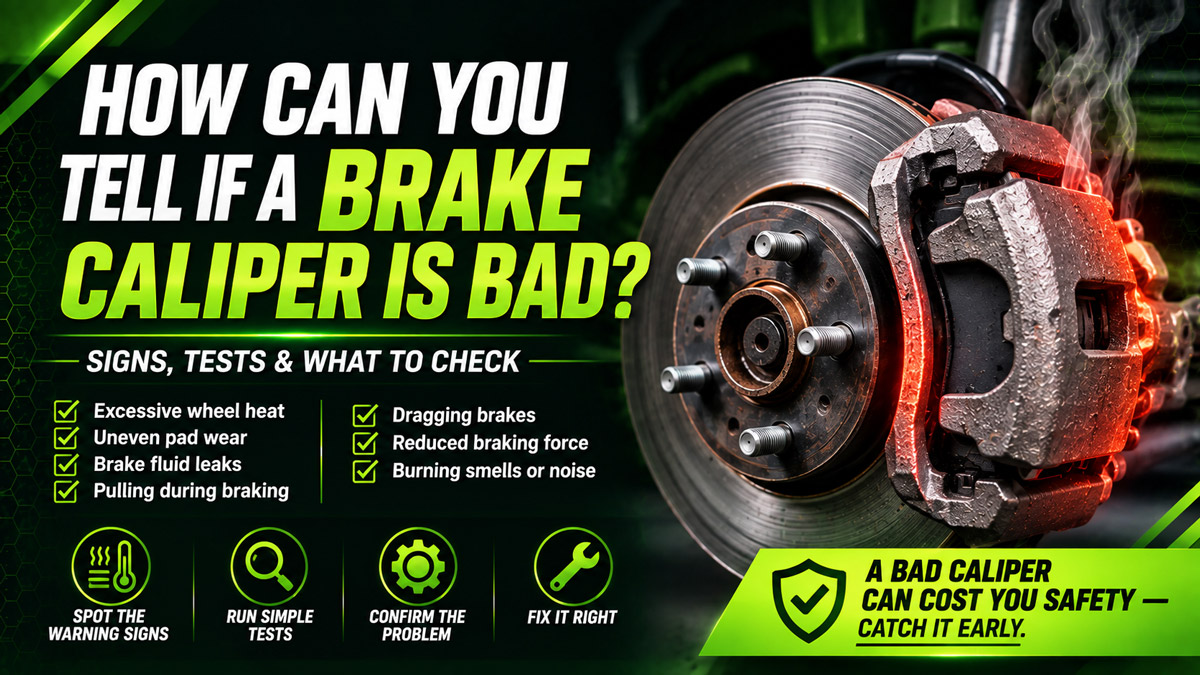
You can tell a brake caliper is bad when one wheel develops excessive heat, abnormal pad wear, brake-fluid leakage, dragging, reduced braking force, or pulling during braking. Confirm the diagnosis by inspecting the pads, testing wheel rotation, checking slide-pin and piston movement, and ruling out a collapsed brake hose or corroded mounting bracket.
At a Glance
- A sticking brake caliper commonly causes one wheel to become hotter than the wheel on the opposite side.
- Uneven inner-to-outer pad wear indicates restricted caliper, slide-pin, or pad movement.
- A fluid leak around the piston boot or hose connection requires immediate repair.
- Opening the bleeder and releasing a dragging wheel points toward trapped hydraulic pressure rather than a mechanically seized piston.
- Electronic parking-brake calipers must enter the specified service mode before piston retraction.
- A smoking, severely pulling, or leaking brake should not be driven.
What Does a Brake Caliper Do?
A brake caliper converts hydraulic pressure from the brake pedal into clamping force at the wheel. The caliper piston pushes the brake pads against the rotating brake disc, creating the friction needed to slow or stop the vehicle.
Most passenger vehicles use floating calipers. A floating caliper has one or more pistons on the inboard side and slides laterally on guide pins so both pads contact the rotor. A seized piston, dry guide pin, torn boot, or rust-bound pad can stop that movement.
Performance vehicles may use fixed calipers with pistons on both sides of the rotor. Fixed calipers do not slide, but one piston can still bind and create tapered or localized pad wear.
The caliper is therefore only one part of the wheel-end brake assembly. A dragging brake may also be caused by a collapsed flexible hose, stuck pads, an electronic parking-brake fault, contaminated hardware, or residual hydraulic pressure elsewhere in the system.
What Are the Most Common Bad Caliper Symptoms?
The most common signs of a bad brake caliper are pulling, uneven pad wear, excessive wheel heat, burning smells, fluid leaks, dragging, reduced fuel economy, and abnormal braking noise. Several symptoms appearing at the same wheel make a caliper fault more likely.
Watch for these warning signs:
- The vehicle pulls during braking. Unequal clamping force causes one front wheel to brake harder than the other.
- One wheel is unusually hot. A dragging pad continuously converts motion into heat.
- One pad wears much faster. Piston, slider, or bracket problems prevent equal pad movement.
- The car feels restrained after releasing the pedal. Severe drag may feel like driving with the parking brake partly applied.
- A burning odor or smoke appears near a wheel. This indicates dangerous friction and heat.
- Brake fluid appears around the caliper. A damaged piston seal, bleeder, hose connection, or caliper casting may be leaking.
- Grinding or scraping comes from one corner. A stuck pad can wear through its friction material and contact the rotor with its backing plate.
Noise alone does not prove the caliper is defective. Worn pads, rotor rust, a bent dust shield, trapped debris, and loose hardware can produce similar sounds.
How Does a Bad Caliper Affect Brake Pad Wear?
A bad brake caliper can wear one pad faster than the other, wear both pads prematurely, or create tapered wear across a pad. The wear pattern often reveals which part of the assembly is restricted.
On a floating caliper:
- A seized or slow piston often leaves the inboard pad more worn.
- Seized slide pins may leave the outboard pad more worn or prevent even clamping.
- Pads rusted into the bracket may wear unevenly despite a freely moving piston and caliper.
- Constant trapped hydraulic pressure may wear both pads on that wheel rapidly.
A measurable thickness difference is more useful than appearance alone. General Motors has used an inboard-to-outboard difference of at least 3 mm as an uneven-wear threshold in one vehicle-specific service bulletin, although the correct diagnostic limit depends on the model, brake design, load, and driving conditions.
Fixed multi-piston calipers may produce top-to-bottom tapering when one piston moves less than the others. Always compare the inner and outer pads, both ends of each pad, and the corresponding pads on the opposite wheel.
Why Does a Bad Brake Caliper Make the Car Pull?
A bad caliper makes a vehicle pull because the left and right wheels are producing unequal braking force or unequal drag. The direction of the pull depends on whether the defective brake is applying too much force or too little.
When a caliper is stuck applied, the vehicle may drift toward that wheel during normal driving because the dragging brake continuously slows that side. Under braking, the direction can become inconsistent as heat and friction change.
When a piston is stuck retracted or cannot apply enough force, the vehicle usually pulls toward the stronger brake on the opposite side while the pedal is pressed.
A pull is not automatic proof of caliper failure. Unequal tire pressure, contaminated pads, mismatched friction material, suspension wear, alignment problems, a restricted hose, or a tire defect can produce a similar complaint.
Professional diagnosis compares both sides rather than replacing the caliper on the side that merely “feels wrong.” The hottest wheel, pad-wear pattern, piston movement, and hydraulic-pressure test provide stronger evidence than pull direction alone.
Can a Sticking Caliper Cause Heat, Smoke, or Odors?
Yes. A sticking caliper can make the rotor, pads, wheel, and nearby components dangerously hot because the brake remains partly applied while the vehicle is moving. Severe drag can create smoke, discolor the rotor, damage the wheel bearing, and boil moisture-contaminated brake fluid.
After a brief drive with minimal braking, a dragging wheel may be substantially hotter than the opposite wheel on the same axle. Measure temperature with an infrared thermometer aimed at comparable rotor or wheel locations. Do not touch the rotor or caliper with bare skin.
Rotor temperatures vary widely with vehicle weight, speed, terrain, and braking intensity, so a single universal temperature does not diagnose a caliper. The more meaningful finding is a large side-to-side difference after both wheels experienced the same drive.
Brake-fluid heat is especially dangerous. FMVSS No. 116 sets minimum wet boiling points of 140°C or 284°F for DOT 3 fluid and 155°C or 311°F for DOT 4 fluid. Fluid condition and product specifications can exceed those minimums.
Stop driving if a wheel smokes, glows, smells strongly of burning material, or causes noticeable braking resistance.
How Can You Test a Brake Caliper at Home?
Test a suspected brake caliper by comparing wheel temperatures, lifting the vehicle safely, checking wheel rotation, inspecting pad wear, and isolating mechanical drag from trapped hydraulic pressure.
- Park on level ground. Allow hot brakes to cool before disassembly.
- Inspect the fluid level. Low fluid may indicate a leak or severely worn pads.
- Compare wheel temperatures. After a controlled drive, check both sides of the axle with an infrared thermometer.
- Raise and support the vehicle. Use the approved lifting points, wheel chocks, and jack stands. Never work under a vehicle supported only by a jack.
- Spin the suspected wheel. Slight pad contact can be normal, but the wheel should not require extreme effort or stop abruptly.
- Remove the wheel. Look for leakage, torn boots, blue rotor discoloration, damaged hoses, and abnormal pad wear.
- Check pad movement. The pads should not be rusted solid in their bracket channels.
- Inspect the slide pins. Floating-caliper pins should move smoothly without binding.
- Test for trapped pressure. A qualified person can briefly open the bleeder while safely containing the fluid.
- Service and bleed correctly. Any opened hydraulic system must be closed, inspected, refilled with the specified fluid, and bled as required.
Do not press the brake pedal while a caliper is removed unless a proper piston-retaining block is installed.
How Do You Test the Piston and Slide Pins?
Test a caliper piston by attempting to retract it with the correct tool, and test slide pins by moving the unloaded caliper or pins through their normal travel. Both should move smoothly without grinding, sudden binding, severe corrosion, or torn protective boots.
Remove the caliper only after confirming the vehicle’s service procedure. Support the caliper with wire or a hook so its weight does not hang from the flexible hose.
For a conventional floating caliper, remove the pads and inspect the guide pins. A pin should slide smoothly through lubricated bushings. A dry, bent, rusted, or swollen pin can create the same uneven wear commonly blamed on the piston.
Use a piston compressor, C-clamp, or wind-back tool approved for the caliper. Smooth, steady resistance is expected because fluid is being returned toward the reservoir. A piston that will not retract after verifying the correct method may be corroded, contaminated, mechanically damaged, or hydraulically pressurized.
There is no universal “50-pound rule” that applies to every caliper. Piston diameter, seal design, rear parking-brake mechanisms, tool leverage, and hydraulic restrictions change the required force. Diagnose movement quality and follow the vehicle manufacturer’s procedure rather than relying on hand-force estimates.
Is the Caliper Bad or Is the Brake Hose Collapsed?
A dragging brake that releases when the bleeder screw is opened usually has trapped hydraulic pressure, not a purely mechanical caliper seizure. A deteriorated flexible hose can act like a one-way valve, allowing pressure into the caliper but restricting its return.
Use this diagnostic sequence:
- Confirm that the wheel remains difficult to rotate after the brake pedal is released.
- Ensure the parking brake is fully released.
- Carefully open the caliper bleeder screw while capturing the fluid.
- Observe whether pressurized fluid escapes.
- Check whether the wheel immediately rotates more freely.
If opening the bleeder releases the brake, inspect the flexible hose, brake line, ABS hydraulic unit, master cylinder, pedal free play, and upstream components. Replacing the caliper alone may not solve the problem.
If opening the bleeder does not release the brake, suspect a mechanically stuck piston, seized guide pins, rust-bound pads, parking-brake mechanism, or damaged hardware.
This test opens the hydraulic system. The bleeder must be retightened correctly, the fluid reservoir must remain full, and the system may require bleeding before the vehicle is operated.
Can Rusty Pad Brackets Mimic a Seized Caliper?
Yes. Brake pads can seize inside corroded bracket channels and create dragging, uneven wear, heat, and poor release even when the caliper piston and slide pins are functional.
Rust often grows beneath stainless-steel abutment clips, reducing the space available for the pad ears. The new pad may seem to fit during installation but remain too tight to slide as heat expands the components.
A proper inspection includes removing the pads and checking whether they can move through the bracket without hammering or prying. Clean the bracket’s pad-support surfaces without removing excessive metal. Replace badly pitted brackets and damaged or distorted hardware.
Apply only the lubricant specified for the vehicle and friction system. Lubricant must never contact the pad friction material or rotor face.
One common repair mistake is grinding the pad ears until the pads become loose. Excessive clearance can cause clicking, vibration, uneven loading, or hardware failure. Correct the corrosion and use accurately manufactured pads rather than modifying friction components to compensate for a damaged bracket.
What Symptoms Suggest a Leaking Brake Caliper?
A leaking brake caliper may leave wet fluid around the piston dust boot, bleeder screw, hose connection, or caliper body. The brake pedal may also become soft, the reservoir level may drop, and the vehicle may pull because the contaminated wheel produces less friction.
Fresh brake fluid usually feels slippery and appears clear, amber, or dark brown depending on age. It can spread across the caliper, run down the backing plate, and wet the inside of the wheel.
Inspect these points:
- The piston seal behind the dust boot
- The bleeder screw and its seat
- The banjo bolt or hose fitting
- The flexible hose near its crimp
- The caliper casting for impact damage or cracks
Do not confuse brake fluid with grease from a damaged CV boot, suspension lubricant, penetrating oil, or water. Check the reservoir and trace the liquid to its highest wet point.
A leaking caliper is not repairable through tightening alone unless the leak is specifically traced to an incorrectly torqued service connection. Replace or professionally rebuild the defective component, replace fluid-soaked pads, clean or replace the rotor as appropriate, and bleed the system.
Can a Bearing or Rotor Feel Like a Bad Caliper?
Yes. A failing wheel bearing, distorted rotor, bent splash shield, worn suspension joint, or contaminated pad can create heat, vibration, noise, or pulling that resembles caliper failure. Diagnosis requires matching the symptom to the condition under which it occurs.
A bad wheel bearing commonly produces humming or growling that changes with road speed or cornering load. Bearing heat is usually concentrated near the hub rather than caused by obvious pad drag.
Rotor thickness variation or lateral runout can cause pedal pulsation and steering-wheel vibration during braking. A caliper may contribute to rotor overheating, but replacing the caliper will not correct a rotor that is already below specification or severely distorted.
A bent dust shield or trapped stone can scrape continuously without creating hydraulic drag. Some manufacturer bulletins specifically identify debris between a rotor and splash shield as a source of brake-area scraping.
Before condemning the caliper, check wheel play, rotor condition, shield clearance, pad contamination, tire pressure, suspension components, and whether the wheel turns freely with the pads removed.
How Are Fixed and Floating Caliper Failures Different?
Floating calipers commonly fail through seized guide pins, restricted pad movement, or a sticking inboard piston. Fixed calipers do not use guide pins, so their failures more often involve one or more pistons moving differently from the others.
| Caliper type | Typical fault | Common wear pattern |
|---|---|---|
| Floating caliper | Seized piston | Heavy inboard-pad wear |
| Floating caliper | Stuck guide pins | Unequal inner and outer wear |
| Floating caliper | Rusted pad channels | One pad or one end binds |
| Fixed caliper | One seized piston | Localized or tapered pad wear |
| Fixed caliper | Cross-seal or piston issue | Uneven pressure across the pad |
A fixed caliper may contain two, four, six, or more pistons. One restricted piston can be difficult to identify because the other pistons still apply enough force to stop the vehicle.
Inspect each exposed dust boot, compare pad thickness at several points, and watch piston movement only with proper retaining blocks installed. Never allow an unrestricted piston to extend out of its bore.
The practical rule is simple: floating calipers must slide evenly, while fixed-caliper pistons must advance and retract in a balanced manner.
How Do Electronic Parking Brakes Affect Testing?
Electronic parking-brake calipers often require a vehicle-specific maintenance or brake-service mode before rear piston retraction. Forcing the piston without the correct procedure can damage the actuator, gears, pressure sensors, or caliper mechanism.
The correct method varies. Some vehicles enter service mode through a scan tool, some use a dashboard menu, and others require a sequence involving the ignition, accelerator pedal, brake pedal, or parking-brake switch.
Manufacturer procedures confirm that certain EPB systems require brake-pad-change mode before caliper removal or piston retraction.
Rear pistons may push straight inward, rotate while retracting, retract electrically, or use a combination of methods. The presence of grooves in the piston face does not prove that it should be manually rotated.
Before testing an EPB caliper, identify the exact year, make, model, brake option, and service procedure. Disconnecting the actuator and applying power directly is not a universal diagnostic method and may set faults or damage the unit.
Is It Safe to Drive With a Bad Brake Caliper?
No, driving with a confirmed bad brake caliper is not considered safe. A defective caliper can reduce braking on one wheel, make the vehicle pull, overheat the brake assembly, damage nearby parts, or allow brake fluid to escape.
Arrange towing when any of these conditions exist:
- Smoke or a strong burning smell
- A wheel too hot to approach safely
- Visible brake-fluid leakage
- A soft, sinking, or unusually low pedal
- Severe pulling or steering instability
- Grinding caused by metal-to-metal contact
- A wheel that remains heavily locked after pedal release
A mildly sticking slide pin may not produce an immediate loss of braking, but continued driving can destroy the pads and rotor within a relatively short distance. Heat damage can also affect the hose, bearing, ABS sensor, seals, and brake fluid.
Cooling the brake does not repair the cause. A dragging wheel may spin normally when cold and bind again as the components heat and expand.
Should Brake Calipers Be Replaced in Pairs?
Brake calipers do not always have to be replaced in pairs, but both calipers on the axle should be inspected and compared. Replacing one caliper is acceptable when the opposite unit moves correctly, remains dry, and has serviceable boots, pins, and hardware.
Pair replacement becomes more reasonable when:
- Both calipers are the same age and heavily corroded.
- The opposite caliper also shows restricted movement.
- Contaminated fluid has damaged multiple components.
- The vehicle has very high mileage or severe rust exposure.
- Remanufactured units have significant design differences.
- Balanced appearance or performance is important on a high-performance brake system.
Brake pads should generally be replaced as an axle set, even when only one caliper failed. Replace or machine rotors according to manufacturer limits and the condition of both sides.
After installation, bleed the hydraulic system using the prescribed sequence, restore EPB operation where applicable, verify the pedal before moving, and perform a controlled road test.
How Much Does Brake Caliper Replacement Cost?
Brake caliper replacement commonly costs about $250 to $600 per wheel, including parts and labor, but luxury, performance, heavy-duty, and electronic parking-brake calipers can cost substantially more.
The final price depends on:
- New versus remanufactured caliper
- Front versus rear location
- Fixed multi-piston versus floating design
- Integrated electronic parking-brake actuator
- Labor time and regional rates
- Broken bleeders, fittings, or heavily corroded hardware
- Required pads, rotors, hoses, and brake fluid
A basic remanufactured floating caliper may cost less than $150 for the part, while an original-equipment multi-piston or EPB caliper can cost several hundred dollars before labor.
A complete repair often costs more than the caliper estimate because fluid-soaked or heat-damaged pads must be replaced across the axle. A severely overheated rotor, collapsed hose, damaged wheel bearing, or unusable bracket can add further expense.
Request an itemized estimate identifying the diagnosed cause. A quote that lists only “caliper replacement” without checking the hose, sliders, bracket, pads, and rotor may leave the original fault unresolved.
The Bottom Line
A bad brake caliper is most reliably identified through a combination of abnormal heat, uneven pad wear, leakage, dragging, restricted piston or slider movement, and unequal braking force. The most important diagnostic nuance is that a collapsed brake hose or rust-bound pad bracket can closely imitate a seized caliper. Electronic parking-brake systems require the exact service-mode procedure before piston testing. Do not drive a vehicle with smoke, severe pulling, fluid leakage, heavy drag, or an unsafe brake pedal.