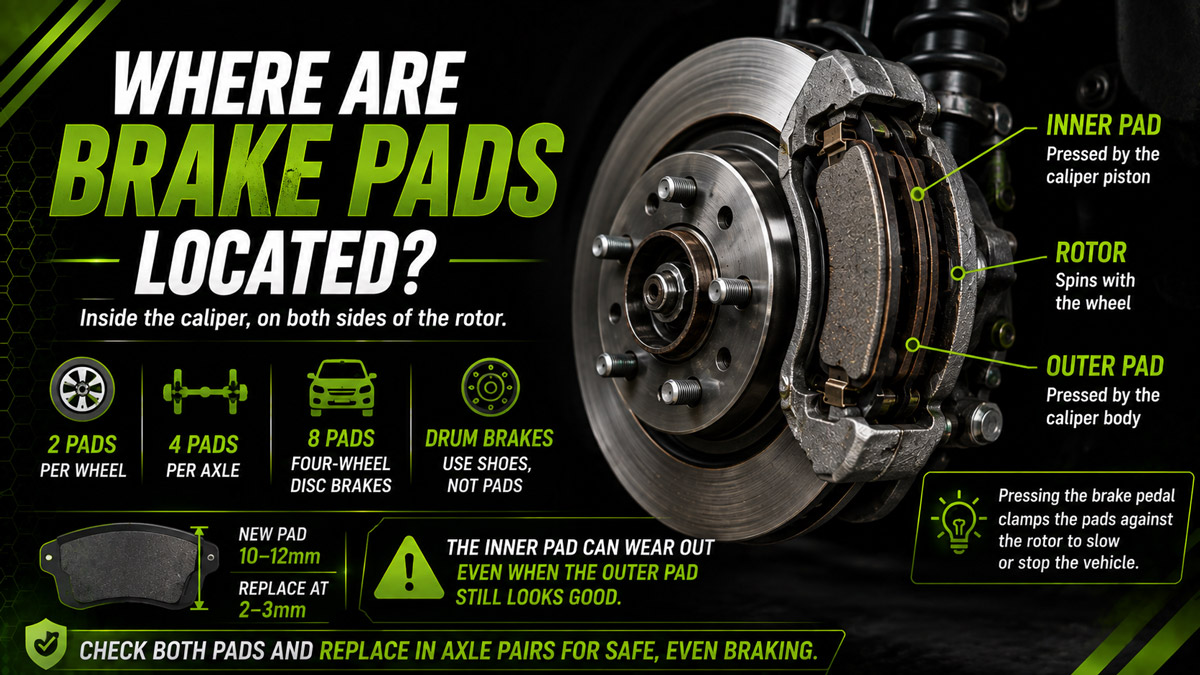
Brake pads are located inside each disc-brake caliper, positioned on opposite sides of the brake rotor. One pad sits between the caliper piston and the rotor, while the other sits between the outer caliper body and the rotor. Pressing the brake pedal forces both pads against the rotating rotor to slow the vehicle.
At a Glance
- A conventional disc-brake wheel normally contains one inner pad and one outer pad.
- A disc-brake axle normally uses four brake pads across its two wheels.
- A vehicle with four-wheel disc brakes commonly has eight individual brake pads.
- Rear drum brakes use brake shoes rather than brake pads.
- New brake pads are commonly about 10–12 mm thick and usually require replacement near 2–3 mm.
- The inner brake pad can wear out even when the visible outer pad still looks usable.
How Do Brake Pads Sit Inside a Disc Brake Assembly?
Brake pads sit inside the brake caliper with their friction surfaces facing the two flat sides of the brake rotor. The rotor passes through the middle of the caliper, creating a pad-rotor-pad arrangement.
A typical floating caliper contains one hydraulic piston on the inner side. When hydraulic pressure reaches the caliper, the piston pushes the inner brake pad against the rotor. The caliper body then slides on guide pins and pulls the outer pad against the opposite side.
The brake pad consists of friction material bonded or riveted to a steel backing plate. The backing plate rests against the piston, caliper fingers, abutment clips, or retaining hardware. The friction material must face the rotor; installing a pad backward would place steel against the rotor and cause immediate grinding and damage.
Professionals also inspect the small contact points where the pad ears slide in the caliper bracket. Corrosion in those areas can prevent a pad from releasing correctly, even when the pad itself is installed in the correct location.
How Many Brake Pads Are on Each Wheel and Axle?
Most passenger vehicles with conventional disc brakes use two brake pads per wheel and four brake pads per axle. One is called the inner pad, and the other is called the outer pad.
The usual quantities are:
| Brake arrangement | Typical pad count |
|---|---|
| One disc-brake wheel | 2 pads |
| One disc-brake axle | 4 pads |
| Four-wheel disc-brake vehicle | 8 pads |
| Front disc/rear drum vehicle | 4 pads and 4 brake shoes |
Brake pads are normally sold as an axle set. A front brake-pad box usually contains four individual pads: two for the left front caliper and two for the right front caliper.
Some fixed multi-piston calipers use more than two separate friction pieces per wheel. A high-performance caliper may contain four individual pads, although two large pads remain more common. The correct count depends on the caliper design, not simply the vehicle’s size or number of pistons.
Are Brake Pads Located on All Four Wheels?
Brake pads are located on all four wheels only when the vehicle has four-wheel disc brakes. Vehicles with rear drum brakes have brake pads at the front wheels but brake shoes at the rear wheels.
Four-wheel disc brakes are common on modern cars, crossovers, performance vehicles, and many trucks. However, rear drum brakes remain common on some compact cars, base-model vehicles, pickups, and commercial vehicles because drum systems can be inexpensive and provide an effective mechanical parking brake.
A quick visual check can identify the rear system:
- A visible flat rotor and caliper indicate disc brakes and brake pads.
- A closed round metal drum indicates drum brakes and brake shoes.
Hybrid and electric vehicles may use four-wheel disc brakes while relying heavily on regenerative braking. Their physical brake pads remain located inside the calipers, but the pads may wear more slowly because the electric motor performs part of the vehicle’s deceleration.
Where Are the Front Brake Pads Located?
Front brake pads are located inside the calipers mounted around the front brake rotors, directly behind the front wheels. The calipers are attached to the steering knuckles or caliper brackets and move with the wheels as the driver turns.
Front brake components are often easier to inspect because turning the steering wheel exposes more of the caliper. Turning the wheel outward may provide a clearer view through the wheel spokes or from behind the tire.
Front brake pads are usually larger than rear pads because the front axle handles most of the braking load. During hard braking, forward weight transfer can make the front brakes perform approximately 60%–80% of the stopping work.
The exact caliper position varies. A front caliper may sit toward the rear of the rotor on one vehicle and toward the front on another. That difference does not affect normal operation; mounting position is determined by suspension geometry, steering clearance, brake-hose routing, and engineering layout.
Where Are the Rear Brake Pads Located?
Rear brake pads are located inside the rear calipers on vehicles equipped with rear disc brakes. The calipers surround the rear rotors behind the rear wheels, using one inner and one outer pad per conventional caliper.
Rear calipers may also incorporate the parking-brake mechanism. Common designs include:
- A mechanical lever connected to a parking-brake cable.
- A screw-type piston that rotates as it retracts.
- An electronic parking-brake motor attached to the caliper.
Electronic parking-brake calipers require special attention during pad replacement. Many vehicles must be placed into a brake-service or maintenance mode before the rear pistons can be retracted. Forcing an electronic piston backward with a clamp can damage the motor, spindle, gears, or caliper.
Some vehicles use a separate “drum-in-hat” parking brake. The service brake pads remain in the rear disc caliper, while small parking-brake shoes sit inside the raised center section of the rear rotor.
Do Drum Brakes Have Brake Pads?
No. Drum brakes use curved brake shoes rather than flat brake pads. The shoes are located inside a hollow brake drum and press outward against the drum’s inner surface.
Disc and drum friction components perform the same basic job but work in different locations:
| Disc brake | Drum brake |
|---|---|
| Pads sit outside the rotor surfaces | Shoes sit inside the drum |
| Caliper squeezes inward | Wheel cylinder pushes outward |
| Rotor is usually visible | Shoes are enclosed by the drum |
| Typically easier to inspect | Drum usually requires removal |
A common beginner mistake is ordering rear brake pads without confirming whether the rear axle uses discs or drums. A parts catalogue can identify the system, but a visual inspection is often faster.
Some vehicles were sold with different rear brake configurations depending on trim level, engine, axle package, or model year. Vehicle identification number data or the existing components should be checked before ordering parts.
Can You See Brake Pads Without Removing the Wheel?
Yes, brake pads can often be partially inspected through open wheel spokes, but a complete inspection usually requires wheel removal. The visible outer pad does not reliably represent the condition of the hidden inner pad.
To perform a basic visual check:
- Park on a level surface and allow the brakes to cool.
- Look through the wheel openings for the brake rotor and caliper.
- Locate the pad between the caliper and the rotor.
- Estimate only the friction-material thickness, excluding the steel backing plate.
- Repeat the check at several wheels.
Some calipers include an inspection opening that provides a better view. A flashlight and small inspection mirror may help, but wheel design can block visibility.
Removing the wheel is the safer inspection method when uneven wear, grinding, pulling, overheating, or a sticking caliper is suspected. A vehicle can have 8 mm remaining on the outer pad and almost no friction material on the inner pad if the slide pins or piston are sticking.
How Can You Identify the Inner and Outer Brake Pads?
The inner brake pad is positioned against the caliper piston, while the outer brake pad sits against the outer caliper fingers or housing. On a floating caliper, the inner pad is on the inboard side of the rotor, closer to the vehicle’s center.
Inner and outer pads may not be interchangeable. The inner pad may include:
- A spring clip that fits inside the piston.
- A wear-sensor tab.
- An electrical wear-sensor connection.
- A different backing-plate shape.
- Directional markings.
The outer pad may use retaining clips that attach to the caliper body. Pads marked “IN,” “OUT,” “PISTON,” or with directional arrows must be installed according to those markings.
Professionals lay the old pads beside the new pads before installation and compare clip position, sensor location, chamfers, and backing-plate shape. Assuming all four pads in a box are identical can lead to rattling, uneven wear, incorrect sensor placement, or difficulty reinstalling the caliper.
How Close Are Brake Pads to the Rotor?
Released brake pads sit extremely close to the rotor, commonly within approximately 0.005–0.015 inch, or 0.12–0.38 mm. Disc brakes do not use a large visible air gap.
After the driver releases the brake pedal, square-cut piston seals flex back slightly and rotor movement can help move the pads just far enough away to reduce clamping force. The pads may continue to make light contact with the rotor without creating harmful drag.
Because the normal clearance is so small, mild brushing sounds while rotating a raised wheel can be normal. Heavy resistance, rapid wheel heating, smoke, a burning smell, or a vehicle that pulls may indicate that the pads are not releasing.
Excessive clearance is also undesirable. Rotor runout, worn wheel bearings, or caliper movement can knock the pads too far back, producing a low pedal or requiring an extra pedal press before firm braking returns.
How Thick Should Brake Pads Be?
New passenger-vehicle brake pads are commonly 10–12 mm thick, measured only across the friction material. Replacement is generally recommended when the material reaches about 2–3 mm, although the vehicle manufacturer’s specification takes priority.
A practical condition guide is:
| Friction material | Typical condition |
|---|---|
| 8–12 mm | Good or nearly new |
| 5–7 mm | Usable; monitor during service |
| 3–4 mm | Replacement planning recommended |
| 2–3 mm | Replace soon or at the specified limit |
| Below 2 mm | Unsafe risk of backing-plate contact |
Brake-pad measurements should be taken at both ends of every inner and outer pad. A pad may be 6 mm at one edge and 2 mm at the other due to seized slides, bracket corrosion, caliper misalignment, or tapered wear.
The steel backing plate is not included in the friction-material measurement. Mistaking total pad thickness for usable lining thickness can make a badly worn pad appear serviceable.
Why Can the Inner Pad Wear Faster Than the Outer Pad?
The inner pad can wear faster when the caliper piston fails to retract, the slide pins seize, or the pad binds in a corroded bracket. The piston applies force directly to the inner pad, making the inner side especially vulnerable to hidden wear.
Common wear patterns include:
- Inner pad thinner: sticking piston or restricted brake hose.
- Outer pad thinner: seized caliper slides preventing caliper movement.
- Both pads worn on one wheel: dragging caliper, hose restriction, or mechanical parking-brake fault.
- Tapered pad wear: loose hardware, seized slides, bracket corrosion, or caliper misalignment.
Checking only the outer pad through the wheel is therefore unreliable. The outer pad can look nearly new while the inner pad has reached its steel backing plate and damaged the rotor.
A temperature comparison can reveal drag. After normal driving without heavy braking, one wheel that is substantially hotter than the opposite wheel on the same axle may have a sticking brake. The rotor and caliper should never be touched directly because temperatures can exceed several hundred degrees.
Where Are Brake Pad Wear Sensors Located?
Brake-pad wear sensors are attached to or built into selected brake pads, usually on the inner pad of one wheel per axle. Many vehicles do not monitor every brake pad individually.
Two common sensor types are used:
- Mechanical wear tabs: A small metal tab contacts the rotor and produces a high-pitched squeal when the pad becomes thin.
- Electronic sensors: A wire embedded in the pad wears through or contacts the rotor, triggering a dashboard warning.
A vehicle may have an electronic sensor only at the left front wheel, the right rear wheel, or another manufacturer-selected position. The sensor assumes reasonably even pad wear across the axle.
That assumption fails when a caliper sticks. A non-sensored pad can wear to bare metal while the monitored pad remains thick enough to prevent a warning. Dashboard indicators should supplement physical inspection, not replace it.
Some electronic sensors are single-use components and must be replaced with the pads. Reusing a damaged or worn sensor may leave the warning light on after the brake service.
Are Brake Pads Located Differently on Performance Cars?
Performance-car brake pads remain positioned on both sides of the rotor, but they may sit inside larger fixed multi-piston calipers. Fixed calipers use pistons on both sides rather than sliding the entire caliper body.
A fixed caliper may use four, six, eight, or more pistons. Piston count does not always equal pad count. Many six-piston calipers still use one large inner pad and one large outer pad, while some racing or specialty systems use several smaller pads per caliper.
Performance pads may be retained by pins, clips, or a bridge bolt and can sometimes be removed without unbolting the complete caliper. The larger caliper and rotor improve heat capacity and distribute clamping force more evenly.
Carbon-ceramic brake systems use the same basic pad location but require system-specific pad compounds, handling procedures, and inspection limits. Installing ordinary pads against a carbon-ceramic rotor can create poor braking performance and extremely expensive damage.
What Are Inboard Brakes, and Where Are Their Pads?
Inboard brake pads are located near the differential or transmission rather than directly behind the wheels. The calipers still squeeze rotors, but the rotors are mounted on the inner ends of the axle shafts or half-shafts.
Inboard brakes were used on certain classic, racing, and specialized vehicles, including versions of the Jaguar E-Type. Moving the brake assembly inward reduces unsprung weight at the wheel, which can improve suspension response and ride quality.
The disadvantage is access. Inspecting or replacing inboard brake pads may require working beneath the vehicle near the differential, exhaust system, driveshafts, or suspension components. Heat buildup and fluid contamination can also be more difficult to manage.
A visual inspection behind the wheel may not reveal an inboard system because no conventional rotor-and-caliper assembly is present at the hub. Service information should be consulted before assuming that missing wheel-mounted calipers indicate drum brakes or an incomplete brake system.
Do Front and Rear Brake Pads Wear at the Same Rate?
No. Front brake pads usually wear faster because the front brakes commonly handle about 60%–80% of the braking force during deceleration. Forward weight transfer increases the load on the front tires and brakes.
A common rule of thumb is that front pads may require replacement roughly twice as often as rear pads, but this is not universal. Rear pads can wear faster on vehicles that use the rear brakes heavily for stability control, traction control, adaptive cruise control, hill-hold functions, or electronic parking-brake operation.
Driving conditions also change the pattern. Stop-and-go city driving, towing, mountainous roads, aggressive braking, and heavy vehicle loads accelerate wear. Hybrid and electric vehicles may show unusually long pad life because regenerative braking reduces friction-brake use.
Pad life should therefore be based on physical measurement, not a fixed mileage. Depending on vehicle design and driving conditions, brake pads may last from roughly 20,000 to more than 70,000 miles.
Can Brake Pads Be Replaced Without Replacing Rotors?
Yes. Brake pads can be replaced without new rotors when the rotors are smooth, flat, free from serious heat damage, and thicker than the manufacturer’s minimum specification.
The rotor should be measured with a micrometer at several points around its braking surface. The minimum thickness is often stamped on the rotor hat or listed in service information.
Rotors generally require replacement or machining when they have:
- Thickness below specification.
- Deep grooves or scoring.
- Cracks or severe rust scaling.
- Heat spots or blue discoloration.
- Excessive thickness variation.
- Lateral runout that causes pedal pulsation.
Installing pads on unsuitable rotors may create noise, vibration, poor bedding, uneven contact, and shortened pad life. The informal term “pad slap” describes replacing pads without properly evaluating the rotors and hardware.
Rotors should normally be serviced in axle pairs. Replacing only one rotor can create unequal friction or braking response between the left and right wheels.
Why Do Correctly Installed Brake Pads Still Squeak?
Correctly positioned brake pads can squeak because of vibration, glazing, contamination, unsuitable friction material, missing hardware, or improper bedding. Correct location alone does not guarantee quiet operation.
Brake squeal occurs when the pad, rotor, caliper, or hardware vibrates at an audible frequency. Common causes include:
- Dry pad contact points.
- Missing or damaged shims.
- Corroded abutment clips.
- Glazed friction surfaces.
- Uneven rotor finish.
- Pads installed without proper bedding.
- Performance compounds used below their intended temperature.
- Grease or brake-fluid contamination.
Brake lubricant should be applied only to manufacturer-approved metal-to-metal contact points, such as pad ears, backing-plate contact areas, and slide pins. Grease must never touch the rotor or friction material.
New pads often need a controlled bedding procedure involving several moderate stops followed by cooling. The exact process depends on the pad manufacturer. Persistent squeaking accompanied by grinding, pulling, overheating, or reduced braking requires immediate inspection rather than additional lubricant.
The Bottom Line
Brake pads are located inside disc-brake calipers on both sides of each brake rotor. A conventional disc-brake wheel uses one inner and one outer pad, while rear drum-brake systems use shoes instead of pads. The most important inspection lesson is that the visible outer pad may not reveal severe hidden wear on the inner pad. Brake condition should be judged by measuring every pad and checking the rotors, caliper slides, pistons, sensors, and hardware.