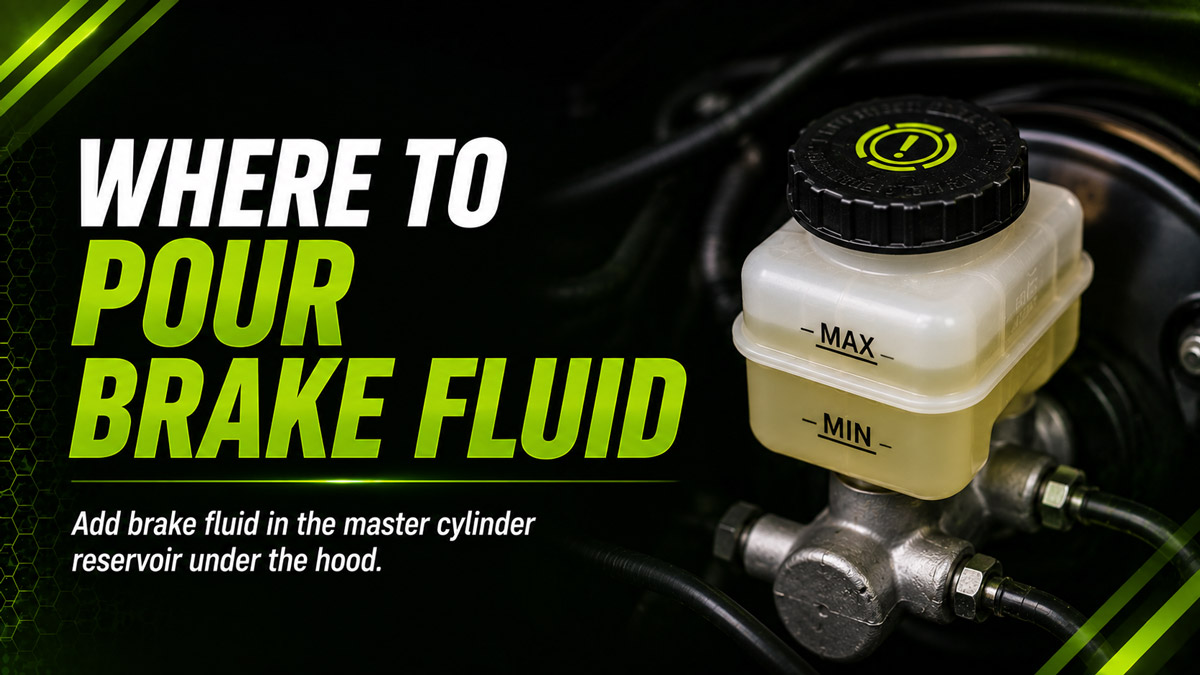
Pour brake fluid into the brake master cylinder reservoir under the hood, not directly into the brake lines, calipers, or ABS unit. The reservoir is usually a translucent plastic container near the firewall on the driver’s side. Clean the cap, confirm the required DOT fluid, and fill only to the MAX line.
At a Glance
- Brake fluid goes into the master cylinder reservoir under the hood.
- The reservoir is usually near the driver-side firewall.
- The required DOT specification is printed on the cap or listed in the owner’s manual.
- The fluid level should remain between the MIN and MAX marks.
- A rapidly falling level indicates a leak that requires immediate inspection.
- Silicone-based DOT 5 must not be mixed with DOT 3, DOT 4, or DOT 5.1.
How Do You Find the Brake Fluid Reservoir?
The brake fluid reservoir is normally mounted on top of the brake master cylinder near the rear of the engine compartment. In left-hand-drive vehicles, it is commonly located near the firewall on the driver’s side.
Look for a small translucent or white plastic container with a black, yellow, or dark-colored cap. The cap may display words such as “Brake Fluid,” “Use Only DOT 3,” “DOT 4,” or a brake warning symbol consisting of a circle inside curved brackets.
The reservoir often has visible MIN and MAX level markings molded into its side. A typical passenger-car reservoir holds only a few hundred milliliters, so it is much smaller than the coolant expansion tank or windshield-washer container.
Some vehicles place a plastic cowl cover, cabin-filter housing, or leaf screen over the reservoir. Certain BMW, Mercedes-Benz, and other European models may require removal of a service panel before the reservoir becomes visible.
The owner’s manual provides the exact location when the reservoir cannot be identified confidently. Do not open a container based only on its shape because several under-hood reservoirs may look similar.
How Can You Distinguish It From Other Reservoirs?
The brake fluid reservoir can be distinguished by its position, size, cap markings, and connection to the master cylinder. The container usually sits near the firewall rather than at the front of the engine bay.
Common under-hood reservoirs differ in several ways:
| Reservoir | Typical identifying feature |
|---|---|
| Brake fluid | Small container near firewall with DOT specification |
| Engine coolant | Larger tank with hot-pressure warning |
| Windshield washer fluid | Cap normally shows a windshield-spray symbol |
| Power steering fluid | Cap may show a steering-wheel symbol |
| Clutch fluid | Small reservoir near brake reservoir or shared with it |
Never pour brake fluid into the coolant, washer-fluid, or power-steering reservoir. Petroleum-based power-steering fluid or engine oil can damage brake-system rubber seals if introduced into the braking system.
A practical rule is to read the cap before opening anything. The correct brake reservoir usually states the required fluid class explicitly, such as DOT 3 or DOT 4. If the cap is unmarked or difficult to read, confirm the location in the vehicle manual before adding fluid.
Why Should You Clean Around the Reservoir Cap First?
Clean the reservoir cap and surrounding area before opening it because dirt, sand, water, and petroleum residue can contaminate the hydraulic braking system. Even a small amount of debris may damage seals or block narrow hydraulic passages.
Use a clean lint-free cloth to wipe the cap, reservoir seam, and nearby surfaces. A soft brush can loosen dry dust, but avoid blowing compressed air directly toward an open reservoir because airborne particles may enter the fluid.
Brake systems rely on tightly controlled hydraulic pressure. The ABS hydraulic control unit contains small valves and channels that are less tolerant of contamination than many beginners expect. A dirty funnel is therefore also unsafe.
Do not use a funnel previously used for motor oil, transmission fluid, coolant, or fuel. If a funnel is necessary, use a clean funnel reserved exclusively for brake fluid.
The professional habit is simple: clean first, open second. That extra minute reduces the risk of introducing contaminants that cannot be removed without bleeding or flushing the system.
Which Brake Fluid Should You Put in Your Car?
Use only the brake fluid specification printed on the reservoir cap or stated in the owner’s manual. Common passenger vehicles require DOT 3 or DOT 4, while some specify DOT 4 Low Viscosity or DOT 5.1.
The DOT rating affects boiling performance, viscosity, and compatibility. A vehicle designed for electronic stability control may require a low-viscosity fluid that flows properly through the ABS system at low temperatures.
| Fluid type | Base type | Common use |
| DOT 3 | Glycol-based | Many older and everyday vehicles |
| DOT 4 | Glycol-based | Many modern, European, and performance vehicles |
| DOT 4 LV | Glycol-based | ABS and stability-control systems |
| DOT 5 | Silicone-based | Specialized applications |
| DOT 5.1 | Glycol-based | Higher-performance hydraulic systems |
The number alone does not mean every higher-numbered fluid is a suitable upgrade. For example, DOT 5 is chemically different from DOT 3, DOT 4, and DOT 5.1.
Manufacturer approval matters more than choosing the fluid with the highest advertised boiling point. When the cap and manual disagree, follow the latest manufacturer service information for the specific model and production year.
Can You Mix DOT 3, DOT 4, DOT 5, and DOT 5.1?
DOT 3, DOT 4, and DOT 5.1 are generally glycol-based and chemically compatible, but they should only be combined when the vehicle manufacturer permits it. Silicone-based DOT 5 must not be mixed with those glycol-based fluids.
Adding DOT 4 to a system that specifies DOT 3 may be acceptable in some vehicles, but the reverse can reduce the system’s intended boiling-point performance. DOT 4 Low Viscosity should not automatically be replaced with standard DOT 4 because ABS performance can depend on viscosity.
DOT 5 is the critical exception. Mixing silicone DOT 5 with glycol fluid may cause inconsistent fluid behavior, seal concerns, aeration, or braking problems. A system contaminated by the wrong fluid may require complete disassembly, cleaning, seal replacement, and flushing.
Do not judge fluid compatibility by color. Brake-fluid colors can change with age, contamination, and brand formulation.
The safest rule is to add the exact specification listed on the cap. When the existing fluid type is unknown, do not guess; have the system identified and serviced professionally.
How Do You Add Brake Fluid Correctly?
Add brake fluid by parking safely, cleaning the reservoir, confirming the specification, and pouring slowly to the MAX line. The process usually takes five to ten minutes.
- Park on level ground. Apply the parking brake and switch off the engine.
- Open the hood. Secure it fully before working underneath.
- Locate the reservoir. Confirm that the cap identifies brake fluid and the correct DOT type.
- Check the current level. Read the MIN and MAX markings through the reservoir wall.
- Clean the area. Remove dust and debris from the cap and surrounding surface.
- Open a suitable fluid container. Use fresh brake fluid from a clean, correctly labeled bottle.
- Remove the reservoir cap. Avoid touching the underside or setting it on a dirty surface.
- Pour slowly. Add small amounts and pause frequently to recheck the level.
- Stop at the MAX mark. Do not fill into the neck of the reservoir.
- Reinstall the cap securely. Wipe away any drips and close the hood.
After filling, press the brake pedal before moving the vehicle. A pedal that sinks, feels unusually soft, or remains spongy indicates a problem that topping up alone will not repair.
How Much Brake Fluid Should You Add?
Add only enough brake fluid to bring the reservoir level between the MIN and MAX marks. A normal top-up may require only 30–100 milliliters, although the amount depends on the reservoir and how low the level has fallen.
Do not add an entire bottle unless the system is being flushed or filled after repair. Most brake reservoirs have limited capacity, and the difference between MIN and MAX is relatively small.
Brake fluid levels can decline gradually as disc-brake pads wear. As the caliper pistons extend to compensate for thinner pads, more fluid remains in the calipers and slightly less remains in the reservoir. A small reduction over thousands of miles can therefore be normal.
A level below MIN requires investigation before adding a large amount. If the reservoir is nearly empty, the system may contain a leak or may have drawn air into the hydraulic lines.
Add fluid in small increments, such as a few tablespoons at a time, and recheck the level after each pour. The MAX line—not the reservoir opening—is the correct stopping point.
Can You Overfill the Brake Fluid Reservoir?
Yes, the brake fluid reservoir can be overfilled. Stop at the MAX line and leave the designed air space above the fluid.
Overfilling can cause fluid to leak past the cap or vent as the fluid expands. Escaping brake fluid may damage painted surfaces, rubber components, or nearby wiring finishes.
Overfilling also creates a problem during future brake service. When worn brake pads are replaced, the caliper pistons are pushed back into their bores, returning fluid to the reservoir. A reservoir already filled above MAX may overflow at that point.
If the reservoir is accidentally overfilled, remove the excess with a clean brake-fluid syringe, suction bulb, or other tool reserved for hydraulic fluid. Do not use a tool contaminated with oil or petroleum products.
Never siphon brake fluid by mouth. Brake fluid is toxic and should not contact the skin, eyes, or digestive system. Wear gloves and eye protection, then dispose of removed fluid according to local hazardous-waste requirements.
Should the Engine Be Running When Adding Brake Fluid?
No, the engine should normally be switched off when checking or adding brake fluid. Park the vehicle on level ground, engage the parking brake, and allow hot engine-bay components to cool if necessary.
An engine does not need to run for the brake fluid level to be read accurately. Keeping the engine off also reduces the risk of contact with moving belts, fans, pulleys, and hot exhaust components.
Some diagnostic or bleeding procedures require the ignition to be switched on or a scan tool to activate the ABS pump. Those procedures are different from a simple reservoir top-up and should follow manufacturer-specific service instructions.
Do not repeatedly pump the brake pedal while the reservoir cap is removed. Pedal movement can disturb the fluid, and forceful operation may splash it from an overfilled container.
After reinstalling the cap, start the engine and check the brake warning light. Press the pedal firmly before selecting a gear. The brake pedal should feel stable rather than sinking toward the floor.
Can You Add Brake Fluid Without Bleeding the Brakes?
Yes, brake fluid can be added without bleeding the brakes when the reservoir level is merely low and no air has entered the hydraulic system. Topping up does not automatically require opening a bleeder screw.
Bleeding is required when air enters the brake lines, a hydraulic component is replaced, a line is opened, or the reservoir runs empty. Air compresses under pressure, which can create a soft or spongy pedal.
Adding fluid will not remove air already trapped in the system. A vehicle with a spongy pedal, excessive pedal travel, or poor braking response needs inspection and likely bleeding.
Many ABS-equipped vehicles can be bled with conventional procedures when no air has entered the ABS modulator. However, air trapped inside certain ABS hydraulic units may require a bidirectional scan tool to cycle the pump and valves.
Do not treat brake-fluid top-up as a cure for pedal problems. Fluid level and pedal feel are separate diagnostic clues: low fluid suggests wear or leakage, while a soft pedal suggests air, leakage, hose expansion, or an internal hydraulic fault.
Do Manual Cars Use Brake Fluid for the Clutch?
Many manual-transmission vehicles use brake fluid in the hydraulic clutch system. The clutch may share the brake master-cylinder reservoir or use a separate smaller reservoir nearby.
A shared reservoir often has an outlet feeding the clutch master cylinder. Manufacturers may position that outlet above the brake-system outlet so a clutch leak affects clutch operation before the brakes lose all available fluid.
A separate clutch reservoir normally specifies the same glycol-based DOT fluid used by the braking system, but the cap or manual must still be checked. Do not assume every clutch uses brake fluid; some systems use a manufacturer-specific hydraulic fluid.
Low clutch fluid can cause difficult gear engagement, incomplete clutch release, or a pedal that remains near the floor. Adding fluid may temporarily restore operation, but a falling level indicates leakage from the clutch master cylinder, slave cylinder, line, or concentric release bearing.
Never pour brake fluid into the transmission itself. Hydraulic clutch fluid belongs only in the designated clutch or shared brake-fluid reservoir.
What If the Brake Fluid Reservoir Is Hidden?
A hidden brake fluid reservoir is usually located beneath a removable plastic cowl panel, service cover, cabin-filter housing, or leaf screen near the windshield. Consult the owner’s manual before removing trim.
Some modern vehicles prioritize aerodynamics, sound insulation, and engine-bay appearance, which places service components beneath covers. Access may require releasing clips, turning plastic fasteners, or removing a rubber weather strip.
Do not pry aggressively with a screwdriver because cowl panels and clips can crack. Use the specified removal points and keep fasteners organized.
The reservoir may also be difficult to see because it is positioned deep near the firewall. A flashlight can help identify the cap markings and fluid level without removing unrelated components.
If access requires wiper-arm removal, structural brace removal, or disconnection of electrical equipment, model-specific service instructions are advisable. Filling the wrong container is more dangerous than delaying the top-up until the reservoir is positively identified.
Why Is the Brake Fluid Level Low?
Brake fluid may be low because of normal brake-pad wear, an external hydraulic leak, an internal master-cylinder fault, or incomplete filling after recent service. The rate and amount of fluid loss determine how urgent the problem is.
Gradual movement from MAX toward MIN can occur as brake pads wear and caliper pistons extend. Before topping up, inspect the pad thickness because filling the reservoir to MAX with severely worn pads may cause overflow when new pads are installed.
A rapid or repeated drop is not normal. Common leak points include:
- Brake calipers and wheel cylinders
- Flexible brake hoses
- Steel brake lines
- Master cylinder seals
- ABS hydraulic connections
- Hydraulic clutch components
Look for wetness around wheels, beneath the master cylinder, along brake lines, and under the vehicle. Brake fluid often feels slippery and may appear clear, amber, or brown.
A red brake warning light, soft pedal, or nearly empty reservoir indicates a potentially dangerous hydraulic failure. Do not simply refill the reservoir and continue driving without identifying the cause.
Can You Drive With Low Brake Fluid?
Driving with brake fluid below the MIN line is unsafe until the cause is known. Low fluid can allow air into the hydraulic system and may indicate an active leak capable of reducing braking force.
A level slightly below MAX but still above MIN is not automatically an emergency, especially when brake pads are partially worn and the pedal remains firm. The braking system should still be inspected soon.
Do not drive when any of these conditions are present:
- The reservoir is empty or nearly empty.
- The brake pedal feels soft or sinks toward the floor.
- The red brake warning light remains illuminated.
- Fluid is leaking near a wheel or beneath the vehicle.
- Braking performance has changed.
- The reservoir level falls again after topping up.
Arrange towing when a hydraulic leak or pedal problem is suspected. Adding fluid may temporarily raise the level, but it does not seal the leak or remove air.
Professional technicians treat unexplained fluid loss as a fault, not a routine maintenance condition. Brake fluid is not normally consumed by the engine, so repeated top-ups require diagnosis.
What Should You Do If the Fluid Is Dark or Contaminated?
Dark, cloudy, gritty, or petroleum-contaminated brake fluid should be inspected and usually flushed rather than merely topped up. Fresh glycol-based brake fluid is normally clear to pale amber, although color alone does not confirm its condition.
Brake fluid absorbs moisture over time. Increased water content lowers the fluid’s boiling performance and can contribute to corrosion inside calipers, wheel cylinders, lines, and ABS components.
Darkening can result from age, heat, degraded rubber, corrosion products, or contamination. A professional shop can measure moisture content or boiling performance, but the vehicle manufacturer’s service interval remains the primary guide.
Petroleum contamination is more serious. Engine oil, power-steering fluid, or transmission fluid can swell and damage brake-system seals. A contaminated system may require replacement of multiple rubber components rather than a simple flush.
Do not remove fluid from the reservoir and assume the entire system is clean. Most old fluid remains in the master cylinder, ABS unit, lines, calipers, and wheel cylinders until it is flushed through each wheel.
What Should You Do If Brake Fluid Spills on Paint?
Rinse brake fluid from painted surfaces immediately with plenty of water, then wash the area with automotive soap. Brake fluid can soften, stain, or lift some automotive finishes if allowed to remain.
Do not begin by rubbing the spill with a dry cloth. Rubbing may spread the fluid across a larger area and grind dirt into the paint.
Blot heavy liquid carefully with a disposable absorbent towel, then flush the surface thoroughly. Wash and rinse the area again to ensure no residue remains.
Brake fluid spilled on bare skin should be washed off promptly with soap and water. Eye exposure requires immediate flushing with clean water and appropriate medical guidance.
Use a funnel or controlled-pour bottle when the reservoir opening is difficult to reach. Placing absorbent towels around the reservoir can catch small drips, but the towels must not shed lint into the open container.
Inspect the paint after cleaning. Any dullness, wrinkling, or discoloration may require professional correction or refinishing.
Can You Use Brake Fluid From an Opened Bottle?
Previously opened brake fluid should be used only when the container was recently opened, immediately resealed, stored correctly, and still permitted by the product manufacturer. A new sealed bottle is the safer choice for critical brake service.
Glycol-based DOT 3, DOT 4, and DOT 5.1 fluids are hygroscopic, meaning they absorb moisture from the surrounding air. Moisture can enter each time the cap is opened or when the bottle is stored loosely sealed.
Do not use fluid from a bottle that has been open for an unknown period, stored without its cap, exposed to humidity, or contaminated by a dirty funnel. A partially used bottle from the back of a garage may cost less than new fluid but creates unnecessary uncertainty in a safety-critical system.
Store brake fluid in its original labeled container with the cap tightly closed. Never transfer it to a drink bottle or an unmarked container.
Follow the bottle manufacturer’s storage and disposal instructions. When there is doubt about age or contamination, discard the fluid through an approved waste facility and open a fresh container.
The Bottom Line
Pour brake fluid into the master cylinder reservoir under the hood, usually near the driver-side firewall. Clean the cap first, use the exact DOT specification listed by the manufacturer, and stop at the MAX line. A small decline may accompany brake-pad wear, but repeated or rapid fluid loss indicates a leak. Do not drive when the pedal is soft, the reservoir is nearly empty, or braking performance has changed.