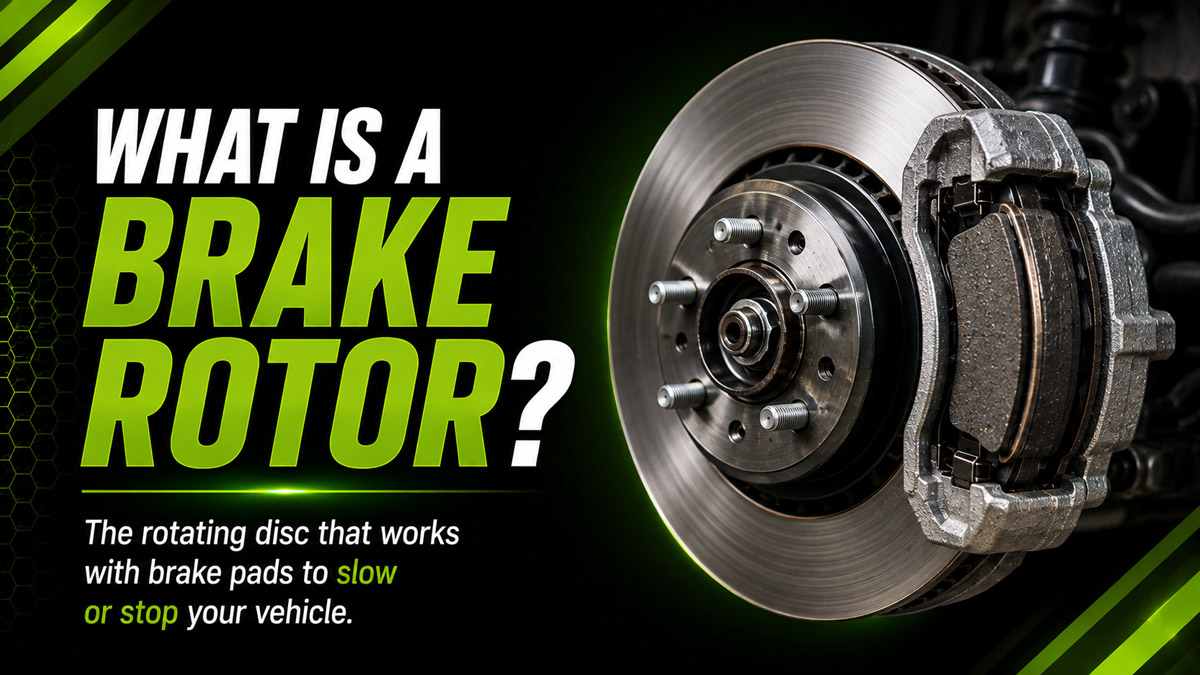
A brake rotor is a metal disc attached to a vehicle’s wheel hub that rotates with the wheel. When the brake pedal is pressed, the caliper squeezes brake pads against both sides of the rotor. Friction converts the vehicle’s motion into heat, slowing or stopping the wheel.
At a Glance
- A brake rotor is the rotating friction surface used by a disc-brake system.
- Most passenger vehicles use cast-iron rotors mounted behind the wheels.
- Brake pads clamp both sides of the rotor to slow the vehicle.
- Rotor thickness, surface condition and lateral runout determine whether a rotor remains serviceable.
- Brake vibration is often caused by uneven pad deposits rather than a physically bent rotor.
- Rotor specifications vary by vehicle, so the stamped minimum thickness and manufacturer limits take priority over general rules.
How Does a Brake Rotor Help Stop a Vehicle?
A brake rotor helps stop a vehicle by providing a rotating surface that the brake pads can clamp against. The friction between the pads and rotor converts kinetic energy into thermal energy, reducing wheel speed.
The process occurs in seconds:
- The driver presses the brake pedal.
- The master cylinder sends pressurized brake fluid through the brake lines.
- Hydraulic pressure moves one or more caliper pistons.
- The caliper presses the inner and outer brake pads against the rotor.
- Friction slows the rotor, wheel and vehicle.
- Heat produced during braking dissipates through the rotor and surrounding air.
A heavier or faster vehicle produces more braking energy. Doubling vehicle speed creates roughly four times as much kinetic energy for the brakes to absorb, which is why repeated high-speed stops can overheat otherwise healthy components.
The rotor must therefore do more than provide friction. The brake disc must remain flat, structurally sound and capable of absorbing substantial heat without cracking or developing severe thickness variation.
Where Are Brake Rotors Located?
Brake rotors are mounted on the wheel hubs, directly behind the wheels. The brake caliper fits around part of each rotor so the brake pads can contact both friction surfaces.
On most modern passenger vehicles, the front wheels use disc brakes and therefore have front rotors. Many vehicles also use rear rotors, although some economy cars, trucks and older vehicles use rear brake drums instead.
The rotor normally slides over the wheel studs or bolts to the hub assembly. The wheel then mounts in front of it. Removing a wheel usually exposes the caliper and much of the rotor.
Some vehicles combine the rear service brake and parking brake in one assembly. A rear rotor may contain a small drum-shaped surface inside its center hat for separate parking-brake shoes. Other designs use an electric or mechanical parking-brake mechanism built into the rear caliper.
What Are Brake Rotors Made Of?
Most brake rotors are made from grey cast iron because cast iron provides strong friction characteristics, good heat capacity, predictable wear and relatively low manufacturing cost.
Common rotor materials include:
- Grey cast iron: Used on most passenger cars, SUVs and light trucks.
- High-carbon cast iron: Contains more carbon to improve heat control, noise resistance and crack resistance.
- Carbon-ceramic composite: Used on some exotic and high-performance vehicles.
- Steel or stainless steel: Common on motorcycles and certain specialized applications.
- Composite two-piece construction: Combines an iron friction ring with an aluminum center hat.
Cast iron is effective but heavy and susceptible to surface rust. Carbon-ceramic rotors can weigh substantially less and tolerate temperatures above those experienced by ordinary street brakes, but replacement may cost several thousand dollars per axle.
Rotor material must be compatible with the brake-pad compound. Installing aggressive racing pads on ordinary street rotors, for example, can accelerate rotor wear and produce excessive noise when cold.
What Is the Difference Between Solid and Vented Rotors?
A solid rotor is one continuous metal disc, while a vented rotor contains internal air passages between two friction plates. Vented rotors dissipate heat more effectively and are commonly used on front brakes.
Front brakes often perform 60% to 80% of the braking work during a hard stop because vehicle weight transfers forward. Manufacturers therefore commonly install thicker, vented rotors at the front and smaller solid or vented rotors at the rear.
| Rotor design | Construction | Typical application | Main advantage |
|---|---|---|---|
| Solid | Single metal plate | Rear brakes, small vehicles | Low cost and low complexity |
| Vented | Two plates with internal vanes | Front brakes, heavier vehicles | Better cooling |
| Directional vented | Curved internal vanes | Performance vehicles | More efficient airflow |
| Pillar-vented | Internal posts or pillars | Selected modern vehicles | Cooling with controlled stiffness |
Directional rotors must be installed on the correct side of the vehicle. Installing a directional rotor backward can reduce its intended cooling performance even when the external slots appear visually correct.
Are Blank, Slotted or Drilled Rotors Best?
Blank or lightly grooved rotors are best for most daily-driven vehicles because they offer the largest continuous friction surface, predictable wear and a low risk of cracking.
| Rotor type | Best use | Advantages | Limitations |
|---|---|---|---|
| Blank | Daily driving and commuting | Quiet, durable and affordable | Less visually aggressive |
| Slotted | Towing, repeated hard braking or performance driving | Clears water, dust and pad gases | Faster pad wear and more noise |
| Drilled | Street performance and appearance | Lower weight and improved wet bite | Holes can develop cracks under severe heat |
| Drilled and slotted | Cosmetic or moderate performance use | Combined appearance and surface clearing | Reduced surface area and increased stress points |
Slotted rotors can help maintain a fresh pad surface, but the slots may create a faint humming sound and increase pad consumption. Drilled rotors are not automatically an upgrade. Poorly manufactured drilled holes can become stress-concentration points during repeated high-temperature braking.
For normal road use, rotor metallurgy, cooling capacity and manufacturing accuracy matter more than decorative holes or slots.
What Are Two-Piece and Carbon-Ceramic Rotors?
A two-piece rotor uses a separate friction ring and center hat, while a carbon-ceramic rotor uses a lightweight composite material instead of conventional cast iron. Both designs are intended for specialized performance requirements.
A two-piece rotor typically combines an iron outer ring with an aluminum hat. Floating or semi-floating hardware allows the friction ring to expand as it heats without transferring as much stress to the hub area. Benefits may include reduced unsprung weight, improved thermal control and replaceable friction rings.
Carbon-ceramic rotors use carbon-fiber-reinforced silicon carbide or a related composite. These rotors resist extreme temperatures, create little brake dust and may last much longer during suitable road use. However, they can be damaged by impact, require compatible pads and cannot be resurfaced on a conventional brake lathe.
Carbon-ceramic condition may be assessed through weight, visual inspection and manufacturer-specific measuring procedures rather than thickness alone. Replacement prices can reach approximately $5,000 to $15,000 per axle on some exotic vehicles.
How Hot Do Brake Rotors Get?
Brake rotors may reach approximately 100°C to 200°C during ordinary braking and several hundred degrees Celsius during repeated hard stops. Racing, mountain descents or severe towing can push rotor temperatures toward 500°C to 800°C or more.
Actual temperature depends on:
- Vehicle weight
- Road speed
- Braking frequency
- Rotor size and ventilation
- Brake-pad compound
- Cooling airflow
- Trailer or cargo load
A single normal stop rarely damages a healthy rotor. Heat problems develop when the rotor cannot release energy before the next braking event.
A common mistake is holding the brake pedal firmly after an extremely hard stop. The stationary pads can insulate one area of the hot rotor and transfer pad material unevenly. During performance driving, allowing the vehicle to roll slightly or completing a controlled cooldown can reduce this risk where conditions permit.
Never touch a rotor immediately after driving. A rotor that looks normal can still be hot enough to cause a serious burn.
How Thick Should a Brake Rotor Be?
A brake rotor must remain above the manufacturer’s stamped minimum thickness. Passenger-car rotors may be roughly 8 mm to more than 30 mm thick depending on their axle position, diameter and design, so no universal replacement thickness applies.
Many thick front vented rotors measure approximately 24 mm to 32 mm when new, but smaller solid rear rotors may be considerably thinner. The correct limit may be marked as:
- MIN TH
- MINIMUM THICKNESS
- DISC MIN
- discard thickness
Technicians measure rotor thickness with a micrometer at several points around the disc, avoiding the unworn outer lip. Measurements should be taken across the friction surfaces, usually at least 10 mm from the outer edge.
A rotor must be replaced if any measurement is at or below the minimum specification. A rotor intended for machining must also remain above the manufacturer’s minimum refinishing thickness after material is removed.
Even a rotor above minimum thickness may require replacement if it has serious cracks, heavy corrosion, deep scoring or excessive thickness variation.
How Can You Tell If a Brake Rotor Is Bad?
A bad brake rotor commonly causes brake-pedal pulsation, steering-wheel vibration, grinding, deep grooves, hot spots, cracking or inconsistent braking. Diagnosis should include measurement because several other brake and suspension faults can produce similar symptoms.
Common warning signs include:
- Pulsation that increases with braking speed
- Steering-wheel shake during braking
- Rhythmic scraping or grinding
- Blue or dark heat spots
- Grooves deep enough to catch a fingernail
- Cracks extending from drilled holes or rotor edges
- Severe rust flaking from the vanes or friction surface
- Rotor thickness below the stamped limit
- Lateral runout beyond the vehicle specification
Rotor runout is measured with a dial indicator while the rotor is secured to a clean hub. A commonly cited general tolerance is around 0.05 mm, or 0.002 inch, but some manufacturers specify a tighter or wider limit.
A technician should also check wheel-bearing play, hub rust, caliper movement and wheel-nut torque. Replacing a rotor without correcting a dirty hub or sticking caliper can cause the same symptoms to return.
Does Brake Vibration Mean the Rotor Is Warped?
No. Brake vibration does not automatically mean a rotor has physically warped. Uneven rotor thickness, hub runout and irregular brake-pad material deposits are more common explanations for pulsation.
When overheated pads remain clamped against a stationary hot rotor, friction material can transfer unevenly onto the disc. Each time the thicker or higher-friction area passes through the caliper, braking force changes slightly. The driver feels this variation through the pedal or steering wheel.
True rotor distortion can occur, but diagnosis requires measurement rather than appearance. A technician may check:
- Hub face cleanliness
- Wheel-bearing condition
- Rotor lateral runout
- Disc thickness variation
- Caliper slide and piston movement
- Wheel-nut torque consistency
Light deposits may sometimes improve after a correct bedding procedure, but severe pulsation usually requires machining or replacement. Re-bedding should not be attempted when the rotor is cracked, below minimum thickness or severely heat-damaged.
The practical rule is simple: measure before calling a rotor warped.
Can Damaged Brake Rotors Still Be Driven On?
Driving with a slightly worn but specification-compliant rotor may be possible, but driving with a cracked, severely scored, overheating or undersized rotor is unsafe. Brake performance can deteriorate rapidly when structural or hydraulic problems are present.
Stop driving and arrange inspection if:
- The brake pedal suddenly pulsates violently
- Grinding is continuous
- The vehicle pulls strongly while braking
- Smoke or a burning smell comes from a wheel
- A rotor has a crack that reaches an edge
- The brake warning light appears with reduced braking
- One wheel becomes substantially hotter than the others
Small surface heat checks can appear on competition rotors, but cracks that grow, connect drilled holes, reach an edge or catch a fingernail require serious attention. A frequently cited track-inspection rule treats cracks around 5 mm or longer as grounds for replacement, although the rotor manufacturer’s criteria should control.
Continuing to drive can damage pads and calipers, overheat wheel bearings and increase stopping distance.
Do Rotors Need Replacement With Every Brake-Pad Change?
No. Brake rotors do not automatically need replacement every time brake pads are changed. Rotors may be reused when they remain above minimum thickness and have an acceptable surface, runout and thickness variation.
A reusable rotor should have:
- Thickness above the manufacturer’s limit
- No structural cracks
- No severe corrosion
- No deep scoring
- Acceptable runout
- Acceptable thickness variation
- No major heat damage
Some repair shops recommend rotor replacement with every pad service because modern rotors are often relatively thin and replacement may cost little more than machining. New rotors also give new pads a consistent bedding surface and reduce the chance of noise or pulsation.
Replacing pads alone is reasonable when the existing rotors are smooth, correctly measured and wearing evenly. Installing new pads on badly grooved or uneven rotors can reduce initial contact area and cause noise, poor bedding or premature wear.
Rotors should normally be serviced in axle pairs so braking characteristics remain consistent from left to right.
Can Brake Rotors Be Resurfaced Instead of Replaced?
Yes, some cast-iron brake rotors can be resurfaced if enough material will remain after machining and the rotor has no cracks, severe corrosion or other non-machinable damage.
Resurfacing removes a small amount of metal to restore parallel friction surfaces and an appropriate surface finish. A finished rotor must remain above the vehicle manufacturer’s minimum refinishing or discard specification.
Replacement is usually better when:
- The rotor is near minimum thickness
- Replacement rotors are inexpensive
- Rust has weakened the cooling vanes
- Heat spots are severe
- Cracks are visible
- Machining would remove excessive material
- The rotor is carbon-ceramic
- Labor and machining cost approach the price of a new rotor
The surface finish also matters. An excessively rough finish can create noise and accelerated pad wear, while an overly smooth surface may interfere with bedding. Brake-lathe setup, tool condition and final non-directional finishing influence the result.
Carbon-ceramic rotors must not be placed on a traditional brake lathe.
Why Do Brake Rotors Rust After Rain or Washing?
Brake rotors rust after rain or washing because exposed cast iron oxidizes quickly when moisture and oxygen reach the surface. A thin orange film appearing overnight is usually harmless flash rust.
During the next drive, normal brake application usually wipes light surface rust from the pad contact area within a few stops. Temporary scraping may be heard as the pads clean the disc.
Rust becomes a concern when:
- The vehicle remains parked for weeks or months
- Corrosion forms deep pits
- Rust flakes develop around cooling vanes
- Part of the pad no longer contacts the rotor
- The rotor surface remains uneven after driving
- Corrosion reduces structural thickness
Vehicles parked near saltwater or driven on salted winter roads can develop more aggressive corrosion. Coated replacement rotors help protect the center hat, edges and internal vanes, but the pad-swept friction surfaces remain exposed.
Lubricants or rust-prevention sprays must never be applied to the braking surface.
How Long Do Brake Rotors Usually Last?
Brake rotors commonly last about 30,000 to 70,000 miles, or approximately 48,000 to 113,000 kilometers, but rotor life varies widely. Some rotors last through two pad sets, while others need replacement with the first set.
Rotor life is shortened by:
- Frequent city braking
- Mountain driving
- Towing
- High vehicle weight
- Aggressive pad compounds
- Sticking calipers
- Improper bedding
- Road salt and long parking periods
- Repeated high-temperature stops
Highway-driven vehicles may exceed the typical range because they brake less frequently. Heavy SUVs used for towing may consume rotors much sooner despite covering fewer miles.
Mileage is not the final replacement criterion. A rotor with 80,000 miles may remain serviceable if measurements and condition are acceptable, while a cracked or undersized rotor with 20,000 miles must be replaced.
Professionals judge rotors by measured condition, not age alone.
How Much Does Brake-Rotor Replacement Cost?
Brake-rotor replacement commonly costs about $300 to $800 per axle for mainstream passenger vehicles when pads and labor are included. Luxury, heavy-duty and performance braking systems can cost $1,000 or more per axle.
Typical cost factors include:
| Cost factor | Effect on price |
|---|---|
| Rotor size | Larger truck and SUV rotors cost more |
| Rotor design | Two-piece, coated or performance rotors cost more |
| Vehicle brand | Luxury and imported parts may carry higher prices |
| Caliper condition | Seized hardware adds parts and labor |
| Pad replacement | Pads are commonly replaced with the rotors |
| Labor rate | Shop rates vary significantly by location |
An individual standard rotor may cost roughly $50 to $200, while premium two-piece assemblies may cost several hundred dollars each. Carbon-ceramic systems can cost thousands of dollars per axle.
Quotes should state whether the price includes two rotors, pads, hardware, labor, brake-fluid service and taxes. Replacing only one rotor on an axle is generally avoided because left-to-right braking consistency matters.
The Bottom Line
A brake rotor is the rotating metal disc that brake pads clamp to convert a vehicle’s motion into heat and stop the wheels. Rotor condition depends on measured thickness, runout, surface quality and structural integrity rather than mileage alone. Brake vibration often comes from thickness variation or uneven pad deposits, not literal warping. Rotors may be reused with new pads when they meet every manufacturer specification, but cracked, overheated or undersized discs require replacement.