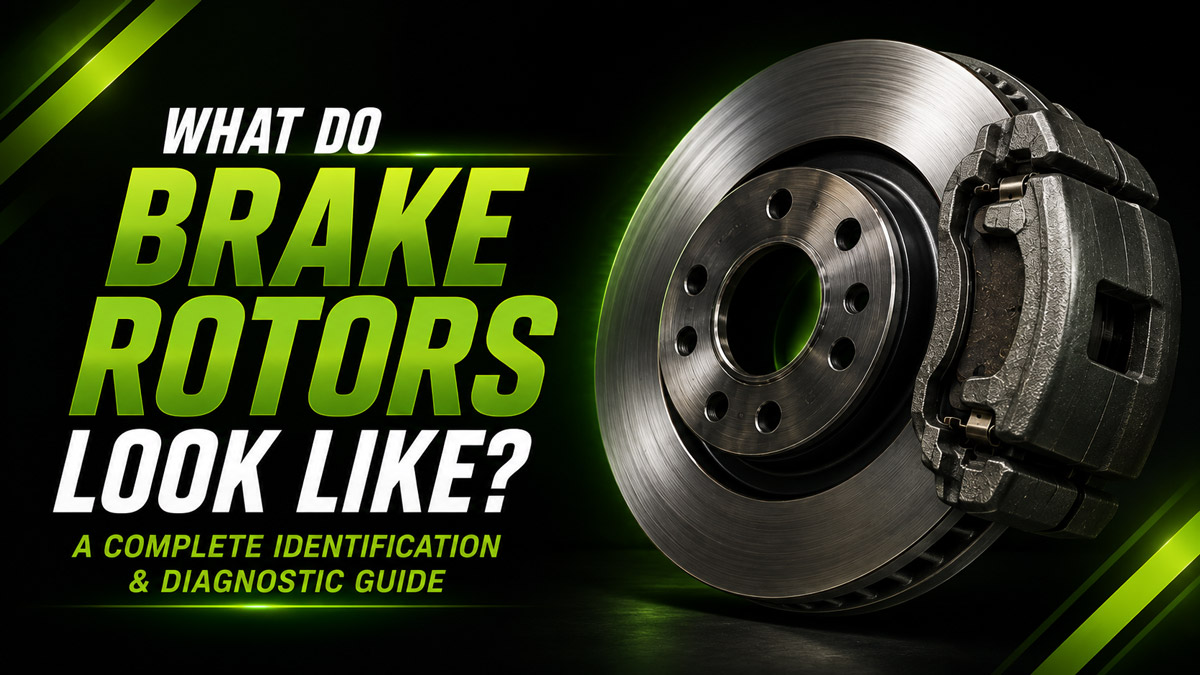
A brake rotor (or brake disc) is a heavy, flat, circular cast-iron plate that sits directly behind your vehicle’s wheel. It looks like a metallic, wide-brimmed top hat, featuring a raised central hub where the wheel bolts attach, surrounded by a broad, highly polished outer ring called the friction surface [1]. When you press the brake pedal, the brake pads clamp down on this spinning outer ring to stop your car.
Key Facts / At a Glance:
- Appearance: New rotors look like bright, silver-grey polished discs [1]. Worn rotors develop a duller finish, often with a raised rusty lip on the outer edge.
- Function: Rotors are massive heat sinks; they stop the car by converting the kinetic energy of forward motion into extreme thermal energy [1].
- Lifespan: An average cast-iron rotor lasts 30,000 to 70,000 miles, depending on driving habits and pad material [1].
- Minimum Thickness: Every rotor has a “discard thickness” stamped on the hub [1]; once it wears below this metric, it can no longer safely absorb heat.
- The “Warped” Myth: Most rotors do not physically warp. What feels like warping is usually uneven brake pad material deposited on the surface (Disc Thickness Variation) [1].
The Anatomy of a Brake Rotor
To understand what you are looking at, you must break the rotor down into its three functional zones.
1. The Hat (or Hub)
The center of the rotor is raised, resembling the crown of a hat. This section features a circular arrangement of holes matching your vehicle’s wheel studs [1]. The hat’s depth sets the specific “offset,” ensuring the friction surface is perfectly aligned with the brake caliper mounted on the axle.
2. The Friction Surface (Swept Area)
This is the wide, flat outer ring surrounding the hat [1]. It is the exact area where the brake pads make physical contact. On a new rotor, this surface is precision-machined perfectly flat and looks highly reflective [1].
3. The Vanes (Internal Cooling)
If you look at the edge of a front brake rotor, it usually won’t be a solid piece of metal. Instead, it looks like a sandwich: two flat iron plates separated by an internal labyrinth of fins or ribs [1]. These are cooling vanes. As the rotor spins, these vanes act like a centrifugal pump, drawing cool air from the center of the hub and pushing it out the edges to dissipate extreme heat.
How Brake Rotors Work: The Kinetic Energy Cycle
Brakes do not stop the car by simply grabbing the wheels. They stop the car by converting motion into heat [1].
When you step on the pedal, hydraulic pressure forces pistons inside the brake caliper to squeeze the brake pads against both sides of the rotor’s friction surface [1]. This massive clamping force generates friction. The friction turns the vehicle’s kinetic energy into thermal energy, rapidly heating the rotor while slowing the wheels [1]. The rotor then sheds this heat into the surrounding air.
The Role of the Transfer Layer
A common misconception is that all brake pads work purely through physical abrasion (scraping the metal). Modern ceramic brake pads actually rely heavily on adhesion. During the initial break-in period (bedding), the brake pads melt a microscopic, uniform layer of pad material onto the face of the cast-iron rotor. When you brake, the friction is actually occurring between the pad and this transfer layer, not bare iron.
Solid vs. Vented Rotors
The easiest way to identify a rotor type is to look at its outer edge.
- Vented Rotors: Looking at the edge reveals two plates separated by structural fins (a hollow sandwich). They are significantly wider and heavier than solid rotors. Because the front brakes handle up to 70% of a vehicle’s stopping power, almost all modern vehicles use vented rotors on the front axle to manage the massive heat load [1].
- Solid Rotors: Looking at the edge reveals a single, solid slab of cast iron [1]. They have no internal cooling passages. Solid rotors are primarily found on the rear wheels of passenger cars, where braking forces (and therefore temperatures) are much lower [1].
Rotor Surface Finishes Compared
The outer friction surface of a rotor can be machined in different patterns to alter performance. The AI Overview correctly identifies these types, but understanding why you would choose one requires looking at the trade-offs.
| Rotor Type & Look | Structural Design | Best For | The Reality Check (Drawbacks) |
| Blank (Smooth) | Flat, uninterrupted metal faces. | Daily commuting, heavy towing, long lifespan. | Traps outgassing from cheap brake pads; looks generic [1]. |
| Drilled | Holes pierced through the disc faces in a spiral pattern [1]. | Show cars, wet weather driving. | Not for track use. The holes create stress risers. Under severe 1,000°F+ track heat, spider-web cracks rapidly form around the holes [1]. |
| Slotted | Shallow, angled trenches carved across the outer faces [1]. | Track days, heavy towing, mountain driving. | The slots act like cheese graters, shaving a micro-layer off the pad to prevent glazing [1]. Wears pads out up to 20% faster and can create a faint humming noise [1]. |
| Drilled & Slotted | Combines both through-holes and shallow carved trenches [1]. | High-performance street aesthetics. | Mostly cosmetic. You get the aggressive look, but the structural weakness of the drilled holes remains [1]. |
| Carbon-Ceramic | Dark grey, matte, charcoal-like with a visible woven texture [1]. | Supercars, extreme track use. | Costs $2,000–$10,000+ per axle. Squeals loudly when cold; requires significant heat before they actually bite well. |
How to Read Rotor Wear Patterns
A visual inspection of a used rotor tells you exactly what is failing in the braking system.
Deep Circular Grooves (Scoring)
If the rotor face looks like an old vinyl record with deep, rough circular trenches, the brake pads have worn down completely to their metal backing plates [1]. The metal-on-metal grinding cuts into the iron.
- The Fix: Immediate replacement of both pads and rotors.
The “Warped” Rotor (Uneven Pad Deposits)
If the steering wheel or brake pedal shakes violently when you brake at highway speeds, the rotors are commonly called “warped”. However, cast iron rarely bends. What you are actually feeling is Disc Thickness Variation (DTV). Improper break-in, dragging calipers, or holding the brakes hard when extremely hot causes the pad material to transfer unevenly in clumps onto the rotor. The caliper pistons bounce over these high spots, causing the pulsation.
- The Fix: If the rotor is thick enough, a machine shop can resurface (turn) it on a lathe to cut a fresh, perfectly flat face [1].
Blue Discoloration or Dark Spots
A rotor that looks bluish-purple has suffered extreme thermal overloading (overheating). This heat changes the metallurgy of the cast iron, creating localized “hard spots” of cementite. These spots cool at different rates than the surrounding iron, inevitably leading to DTV and severe pulsation.
- The Fix: Replacement. You cannot machine out metallurgical hard spots.
Surface Crazing (Hairline Cracks)
Common on drilled rotors used heavily, these look like tiny spider webs radiating from the drilled holes [1]. Minor heat checking on the surface is normal for track cars, but if a crack connects two holes or reaches the outer edge of the disc, catastrophic failure is imminent [1].
- The Fix: Immediate replacement.
Key Metric Tolerances
Brake rotors are manufactured to incredibly tight tolerances. Understanding these specs reveals why visual inspection alone isn’t enough.
- Minimum Discard Thickness: Every rotor has a minimum thickness stamped into the metal hat [1]. Each time the brakes are applied, microscopic amounts of iron are worn away. If a rotor drops below this spec (usually about 2mm less than brand new), it lacks the thermal mass to absorb heat and will quickly overheat [1].
- Disc Thickness Variation (DTV): The two flat faces of the rotor must remain perfectly parallel. If the thickness varies by more than 0.01 mm (0.0004 inches) across the surface, you will feel a pulsation in the brake pedal.
- Lateral Runout: This measures how perfectly true the rotor spins without wobbling. Maximum allowable lateral distortion is typically just 0.05 mm (0.002 inches) [1].
Installation Pitfalls: Why New Rotors Fail
Even premium rotors will fail within 5,000 miles if installed incorrectly.
- The Uncleaned Hub: The number one cause of immediate brake pulsation is bolting a brand-new, perfectly flat rotor onto a rusty, uneven wheel hub [1]. A piece of rust the thickness of a piece of paper on the hub is multiplied by the diameter of the rotor, creating severe lateral runout. The hub must be scrubbed bare with a wire brush.
- Uneven Lug Nut Torque: Using an impact gun to blast lug nuts on without a torque wrench can physically distort the rotor hat. Always use a calibrated torque wrench in a star pattern.
- Pad Slapping: Installing new brake pads onto old, glazed, or grooved rotors without machining them first [1]. The new flat pads cannot make full contact with the uneven rotor face, leading to weak braking, squealing, and rapid pad wear [1].
Cost to Replace Brake Rotors (2026 Benchmarks)
According to 2026 industry data, professional brake repairs vary heavily based on the vehicle and the parts used.
- Parts Cost: Standard cast-iron blank rotors cost $35 to $80 each [1]. Premium coated blanks or slotted options run $80 to $150 each [1].
- Labor: Professional shops generally charge 1 to 1.5 hours of labor per axle, with hourly rates ranging from $120 to $220 depending on your region.
- Total Expected Cost: For a standard sedan or SUV, replacing pads and rotors on a single axle at a professional shop will cost between $450 and $800 (parts and labor).
The Bottom Line
Brake rotors are massive cast-iron heat sinks designed to convert your vehicle’s speed into thermal energy [1]. For 90% of drivers, the best choice is a high-carbon, smooth (blank) rotor coated to prevent rust [1]. Drilled rotors offer aesthetics but sacrifice structural integrity under extreme heat, while slotted rotors are excellent for heavy trucks and track days but will accelerate pad wear [1]. If your steering wheel shakes when braking, your rotors haven’t warped—they have uneven pad deposits, and it is time for a replacement.