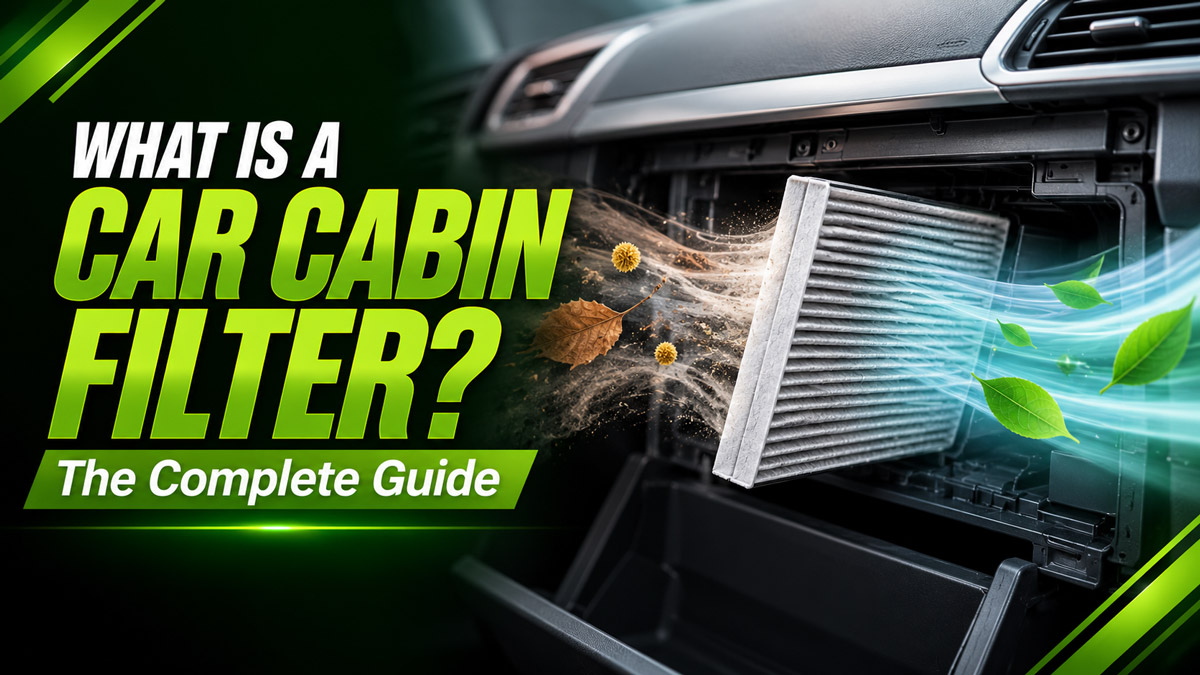
A car cabin filter is an automotive HVAC component that cleans the outside air before it enters the passenger compartment. It acts as a physical and chemical barrier, removing dust, pollen, exhaust fumes, and microscopic pollutants to protect passengers and prevent the vehicle’s heating and air conditioning systems from clogging.
Key Facts / At a Glance
- Primary Function: Filters breathable air entering the cabin via the HVAC system.
- Standard Lifespan: 12,000 to 15,000 miles, or exactly once per year.
- DIY Cost: $10 to $70 for parts, compared to $60 to $120 for professional installation.
- Location: Typically located behind the passenger-side glove box or under the dashboard.
- Critical Warning: Installing a cabin filter upside down restricts airflow by up to 30% and can damage the blower motor.
How Does a Car Cabin Filter Work?
A car cabin filter works by forcing incoming outside air through a dense matrix of synthetic fibers, capturing airborne contaminants before they reach the cabin vents. As the vehicle’s blower motor pulls air through the fresh air intake or recirculation plenum, the filter utilizes four distinct mechanical principles to trap harmful matter:
- Inertial Impaction: Large, heavy particles (dust, sand, insects) are too heavy to follow the twisting air paths and collide directly with the thick filter fibers.
- Interception: Medium-sized particles (pollen, larger mold spores) follow the airstream but brush against the sticky fiber edges, locking them into the material.
- Diffusion: Microscopic particles (smoke, fine soot) bounce randomly via Brownian motion, eventually tumbling into the dense fiber mesh.
- Adsorption: Found only in activated carbon filters, this chemical process traps gas-phase contaminants (toxic fumes, VOCs, odors) inside the microscopic pores of treated carbon granules.
What Are the Different Types of Cabin Filters?
There are four main types of car cabin filters: standard particulate, activated carbon, HEPA, and antimicrobial. Selecting the right filter depends entirely on your local climate, daily driving environment, and respiratory sensitivity.
| Filter Type | Tech Spec / Media | Best For | Average Cost | Pros | Cons |
| Particulate (Standard) | Single/multi-layer non-woven paper or cotton | Fleets, budget buyers, rural drivers | $10 – $20 | Maximum HVAC airflow; highly affordable. | Fails to block gasses, odors, or traffic smog. |
| Activated Carbon | Media infused with charcoal granules | Urban commuters, heavy traffic | $15 – $30 | Neutralizes exhaust smoke, ozone, and foul odors. | Reduces air velocity slightly faster as pores fill. |
| HEPA (High-Efficiency) | Ultra-dense fiberglass mesh | Allergy/asthma sufferers | $30 – $70 | Traps 99.97% of particles down to 0.3 microns. | High static resistance; can strain weaker blower motors. |
| Antimicrobial | Coated with plant-derived polyphenols | Humid, rainy climates | $40 – $75 | Stops mold growth inside damp HVAC housings. | Highest price premium; requires rigorous seasonal swaps. |
Which Cabin Filter Should You Choose?
- Choose Activated Carbon if: You spend more than an hour daily in stop-and-go highway traffic. The carbon actively scrubs the sulfur dioxide and diesel fumes that cause headaches during long commutes.
- Choose HEPA if: You have severe seasonal allergies or drive an EV designed for it (like Tesla’s Bioweapon Defense Mode). Expert Note: Do not install a true HEPA filter in an older economy car; the dense media can choke an underpowered 12V blower motor.
- Choose Antimicrobial if: Your car smells like a damp locker room when you first turn on the AC. The bio-agents actively kill the bacteria breeding on your evaporator core.
How Often Should You Replace Your Cabin Filter?
You should replace your car cabin filter every 12,000 to 15,000 miles, or at least once a year. However, severe driving conditions dictate a much shorter replacement interval.
If you drive primarily on gravel roads, in desert environments, or in dense urban smog, reduce your service interval to 5,000 to 7,500 miles. A completely choked filter forces the HVAC blower motor to work harder, which pulls excess amperage and frequently burns out the blower motor resistor—turning a $20 maintenance task into a $150 electrical repair.
Signs your cabin filter requires immediate replacement:
- Your windows fog up instantly on cold or rainy mornings (due to trapped internal humidity).
- Airflow from the dashboard vents is noticeably weak, even on the highest fan setting.
- A sour, musty, or dusty odor emits from the vents when the AC engages.
Engine Air Filter vs. Cabin Air Filter: What’s the Difference?
The engine air filter cleans the air entering the engine’s combustion cylinders, while the cabin air filter cleans the air entering the passenger compartment. Engine air filters are located under the hood inside a heavy plastic airbox. Cabin air filters are typically located inside the vehicle, behind the glove compartment. Never attempt to interchange them; they use different filtration media designed for entirely different airflow velocities and particle sizes.
How to Replace a Car Cabin Filter
Replacing a cabin filter takes 5 to 20 minutes, requires no special tools (beyond a basic screwdriver for some models), and saves $50 to $100 in dealership labor fees.
Before You Start:
- Time: 10 minutes.
- Cost: $15–$30 (Filter cost).
- Tools: Flashlight, microfiber cloth, vacuum with a crevice tool.
Step 1: Access the Housing
Turn off the vehicle’s ignition and engage the parking brake. Open the passenger-side glove box and empty it. Release the dampening arm on the right side (usually a plastic peg that slides off) and push the interior plastic walls inward to bypass the rubber stops. The glove box will drop toward the floorboard.
Step 2: Remove the HVAC Faceplate
Locate the thin, rectangular plastic door behind the glove box. Pinch the locking tabs on the left and right sides to pull the faceplate off.
Step 3: Extract and Clean
Carefully pull the old filter straight toward you. Keep it level—if you tilt it, dead leaves and debris will spill directly into the blower motor fan blades, which will cause a loud ticking noise when you turn on the AC. Vacuum any remaining debris out of the empty plastic slot.
Step 4: Install with Correct Airflow Direction
Identify the “Air Flow” arrow printed on the side of your new filter. In 90% of vehicles, the HVAC system pulls air from the cowl down into the cabin, meaning the arrow must point DOWN toward the floorboard. Slide the filter in.
Step 5: Reassemble
Snap the faceplate back into place, ensuring both sides click. Lift the glovebox, push the stoppers past the frame, and reattach the dampening arm.
Common Mistakes and Expert Troubleshooting
- The Reversed-Filter Mistake: Installing the filter upside down is the most common DIY error. Cabin filters are built with a structural backing on one side. If installed backward, the air pressure crushes the pleats, restricting airflow and causing a whining noise from the dashboard.
- Ignoring the Plenum Debris: Failing to vacuum the housing before inserting the new filter allows old mold spores to instantly contaminate the new media.
- OEM vs. Aftermarket Fitment: While aftermarket filters are perfectly fine, some budget brands are cut a quarter-inch too small. If the filter rattles in the tray, it is allowing unfiltered air to bypass the edges. Return it and buy an exact-fit OEM or premium aftermarket brand.
Frequently Asked Questions (FAQ)
Can I wash and reuse a car cabin filter?
No, you cannot wash a standard paper, carbon, or HEPA cabin filter. Water destroys the structural integrity of the paper pleats, washes away chemical treatments, and creates a breeding ground for mold. You must replace them with new units.
What happens if I just remove the cabin filter and don’t replace it?
Driving without a cabin filter allows dust, leaves, and bugs to enter the HVAC system directly. This debris will eventually coat the wet AC evaporator coil, turning into a thick mud that rots the aluminum, leading to a catastrophic AC system failure requiring dashboard removal.
Does my older car have a cabin air filter?
Most vehicles manufactured after 2000 have a cabin air filter. However, many domestic trucks and economy cars built in the 1990s and early 2000s simply used a plastic mesh screen at the cowl. Check your owner’s manual under “HVAC maintenance” to confirm.
Do electric vehicles (EVs) have cabin filters?
Yes, EVs use cabin filters to protect passengers. Because EVs lack engine noise, their HVAC blower motors are highly optimized for quiet operation. Heavily clogged cabin filters in EVs often result in noticeable high-pitched fan whining and reduced cabin heating efficiency.