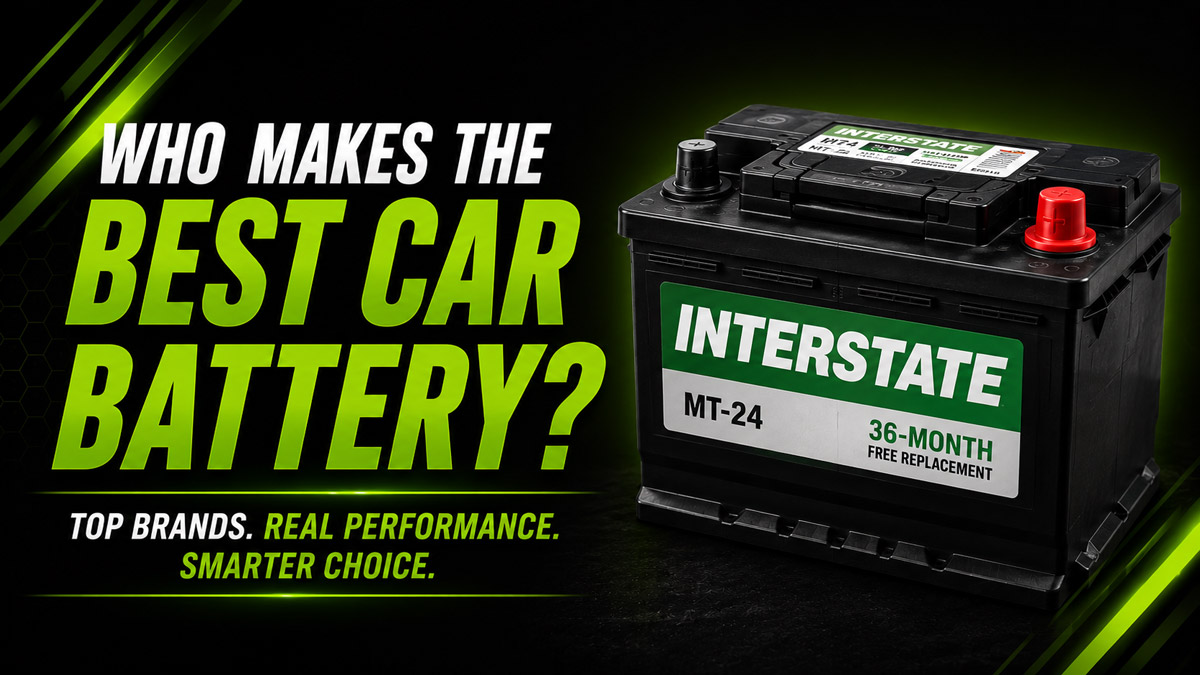
For the vast majority of drivers, the Interstate brand (specifically when purchased at Costco) is the best car battery because it offers the ideal balance of reliability, fresh inventory, and price. However, for absolute maximum performance and longevity regardless of cost, the Odyssey Extreme Series is the top choice.
- The Manufacturer Secret: Most brands are just marketing labels applied to batteries built by three companies: Clarios, East Penn, or Exide.
- The Smart Money: A Costco Interstate battery costs roughly 40% less than the identical battery at an auto parts store.
- The Ultimate Upgrade: Odyssey batteries use 99.99% pure virgin lead, lasting 7–10 years compared to the standard 3–5 years.
- The Number One Killer: Driving less than 15–20 minutes per trip chronically undercharges the battery, leading to early failure through sulfation.
- The Start-Stop Rule: Cars with engine start-stop systems must use an AGM or EFB battery; standard batteries will fail within months.
Who Actually Manufactures Car Batteries?
The reality of the automotive battery market is that most consumer brands are just stickers applied to cases manufactured by the “Big Three”: Clarios (formerly Johnson Controls), East Penn (Deka), and Exide. Knowing who builds the battery allows you to shop for quality rather than paying a brand tax.
Clarios is the undisputed giant, controlling over 50% of the market and manufacturing well-known brands like Interstate, DieHard, Optima, EverStart, and Motorcraft. East Penn is highly regarded for its “Made in USA” quality, producing heavier plates for brands like Deka, NAPA Legend, and Duracell. Exide is the smaller player, generally focusing on budget-oriented store brands.
You can often identify an East Penn battery by its distinct gray case and flat top, whereas Clarios batteries typically feature specific corner cuts and vent cap shapes.
What Is the Best Car Battery for the Money?
The “Smart Money” choice is unequivocally an Interstate battery purchased from Costco. You are getting a premium Clarios-manufactured battery for roughly $160–$180, which is about 40% less than what auto parts stores charge for identical specifications under the DieHard or Duralast labels.
Beyond price, Costco offers a massive hidden advantage: inventory turnover. Batteries degrade while sitting on a shelf. Because Costco sells through its stock rapidly, you rarely get a “stale” battery that has been sulfating for six months. You are purchasing fresh power.
What Is the Best High-Performance Car Battery?
If cost is not a barrier and you need maximum reliability, the Odyssey Extreme Series is the best battery available, typically priced between $300 and $400. It is the definitive choice for overlanders, vehicles with winches or heavy audio systems, or cars that sit unused for months.
Odyssey uses Thin Plate Pure Lead (TPPL) technology. While most competitors use recycled lead alloys, Odyssey uses 99.99% pure virgin lead, allowing them to pack thinner plates into the case for massive power. This results in a life expectancy of 7–10 years and the ability to sit for two years without charging, easily outperforming standard batteries.
What Is the Best Budget Car Battery?
The EverStart Maxx, sold exclusively at Walmart, is the best budget battery on the market, generally costing between $120 and $150. It hits the sweet spot for drivers needing a reliable replacement without a premium markup.
The EverStart Maxx is manufactured by Clarios, meaning it is often the exact same battery internals as premium brands, just with a different sticker. Additionally, the warranty is highly accessible since it can be returned or replaced at almost any Walmart nationwide, though you should expect slower service than at a dedicated auto parts store.
How Long Should a Car Battery Actually Last?
A standard flooded lead-acid battery should last 3 to 5 years under normal driving conditions, while an AGM (Absorbent Glass Mat) battery typically lasts 4 to 7 years. However, this lifespan is heavily dependent on climate and driving habits.
In extreme heat (like Phoenix or Miami), a standard battery may only survive 2 to 3 years because high temperatures evaporate the electrolyte. Conversely, in moderate climates with regular highway driving, that same battery can easily reach 5 years. If your battery fails before the 3-year mark, the issue is usually how the vehicle is being used, not a manufacturing defect.
Why Do Car Batteries Fail Early?
The number one cause of premature battery failure is chronic undercharging caused by short trips. Driving less than 15–20 minutes does not give the alternator enough time to replenish the energy used to start the engine.
When a battery is consistently undercharged, sulfate crystals form on the lead plates (sulfation), permanently reducing its capacity. The second major killer is parasitic drain. When your car is off, it should draw less than 50 milliamps (0.05 amps). If an aftermarket alarm or a stuck glove box light pushes that draw above 100mA, a brand-new battery will be destroyed within weeks.
How Does Heat Affect a Car Battery?
Heat is the true killer of car batteries, even though cold weather is usually when the failure becomes obvious. Operating a battery consistently above 77°F (25°C) cuts its lifespan by approximately 50% for every 15°F increase.
Extreme heat causes the water in the electrolyte to evaporate and accelerates the internal corrosion of the lead grids. The damage occurs during the summer, but the battery finally fails on the first cold morning of winter because cold oil requires more cranking power, and the heat-damaged battery can no longer deliver it.
What is the Difference Between AGM and Standard Flooded Batteries?
An AGM (Absorbent Glass Mat) battery suspends the electrolyte in fiberglass mats between the lead plates, whereas a standard flooded battery allows the liquid electrolyte to slosh freely. This structural difference makes AGM batteries significantly more durable.
AGM batteries charge up to five times faster, withstand deep discharges better, and are entirely spill-proof. They also handle the heavy electrical loads of modern vehicles (infotainment, heated seats, numerous sensors) far better than flooded batteries, which is why they have become the standard for newer cars.
Can You Use a Standard Battery in a Start-Stop Car?
Absolutely not. Vehicles equipped with engine start-stop technology (which shuts the engine off at red lights) MUST use an AGM or EFB (Enhanced Flooded Battery). Installing a standard flooded battery to save money is a trap.
A start-stop system forces the battery to start the engine dozens of times per commute while simultaneously powering the climate control and electronics while the engine is off. A standard battery cannot handle this rapid micro-cycling and will typically fail within 3 to 6 months if installed in a start-stop vehicle.
What Kind of Battery Does a Vintage Car Need?
Older vehicles (pre-1990s) should use a high-quality standard flooded lead-acid battery, not a modern AGM. The advice to “upgrade” to an AGM often fails for classic cars because of their charging systems.
AGM batteries require precise voltage regulation, with a maximum charge of 14.6V to 14.8V. Older alternators and mechanical voltage regulators often spike well above 15V, which will quickly cook and destroy an expensive AGM battery. Unless you have upgraded to a modern electronic voltage regulator, stick to traditional flooded batteries.
What Kind of Battery Does a Track Car Need?
Track and high-performance sports cars require Lithium (LiFePO4) batteries, such as those made by Antigravity, rather than traditional lead-acid or AGM options. The standard advice to buy the battery with the highest reserve capacity fails here because capacity adds immense weight.
A massive AGM battery can weigh 40 to 50 lbs, which ruins weight distribution on a track. A lithium replacement weighs only 10 to 15 lbs, offering massive weight savings for $600–$900. However, do not use lithium batteries in extreme cold without a built-in Battery Management System (BMS) heater.
How Many Cold Cranking Amps (CCA) Do You Really Need?
You need a battery that meets or slightly exceeds the Original Equipment Manufacturer (OEM) CCA specification for your specific vehicle—usually between 400 and 600 CCA for standard cars, and 700 to 800 CCA for large trucks.
Buying massive excess CCA is unnecessary and often counterproductive. To achieve higher CCA in the same physical case size, manufacturers must use thinner lead plates packed closer together. These thinner plates corrode faster, meaning a battery with excessively high CCA may actually have a shorter lifespan than a standard-rated battery.
How Do You Read a Car Battery Date Code?
You should never buy a car battery that is more than six months old. To verify its age, look for a round sticker on the top of the battery or a code stamped directly into the plastic case.
The code is simple: the letter represents the month, and the number represents the year. For example, “A” is January, “B” is February, and “C” is March. A code of “C6” means the battery was manufactured in March of 2026. If you are shopping in October 2026 and see a “B6” battery, leave it on the shelf.
How Does a Car Battery Warranty Actually Work?
Modern car battery warranties are primarily “Free Replacement” for a set period, usually 2 to 4 years. If the battery fails a load test during this window, you get a brand-new battery for free.
However, you must avoid “Prorated” warranties whenever possible. If a prorated battery dies in year 4 of a 5-year warranty, you only receive a tiny credit (e.g., $10) toward a new battery at the current MSRP. Furthermore, all warranties are void if the battery shows signs of abuse, such as a melted case, physical damage, or being deeply discharged below 10V due to a parasitic drain.
Do You Have to Register a New Car Battery?
If you drive a modern European vehicle (BMW, Audi, VW, Volvo) or late-model Ford or GM truck, yes, you must use a scan tool to register the new battery with the car’s computer.
Modern cars actively manage the charging rate based on the battery’s age and internal resistance. As a battery ages, the alternator pumps out higher voltage to force a charge. If you don’t “tell” the computer it has a new battery, it will hit the fresh battery with the aggressive voltage meant for the old one, boiling the electrolyte and killing it in under a year.
The Bottom Line
For most drivers, the absolute best battery choice is an Interstate AGM purchased from Costco, offering premium Clarios manufacturing at a heavily discounted price with guaranteed fresh stock. If you demand the highest possible longevity and durability, the Odyssey Extreme Series is the top tier. Remember that driving habits matter more than brand labels: if your daily commute is under 15 minutes, or if your car has a parasitic electrical drain, even the best battery on the market will fail prematurely.