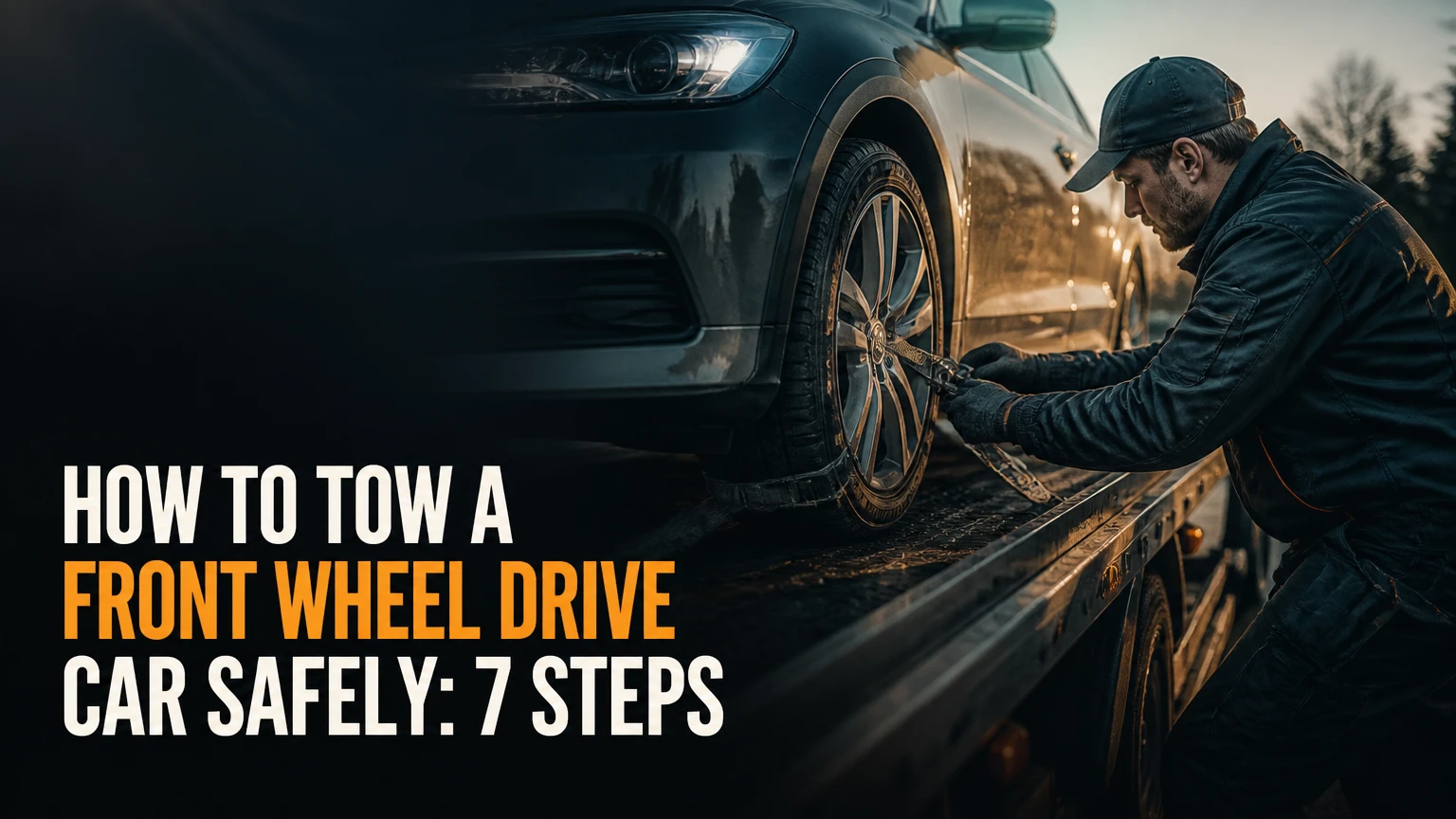
To tow a front-wheel-drive car safely, lift its front drive wheels onto a tow dolly or place the entire vehicle on a flatbed. Do not let the front wheels roll on the road unless the manufacturer specifically approves four-wheel towing for that exact vehicle. A tow dolly typically takes 20-30 minutes to load and secure.
Key Facts at a Glance
- A front-wheel-drive car sends engine power through a front transaxle and front axle shafts.
- A tow dolly lifts the front wheels, preventing road rotation of the FWD drivetrain.
- A flatbed provides the lowest mechanical risk because all four tires remain off the road.
- The owner’s manual controls transmission position, maximum speed, towing distance, and flat-towing approval.
- A tow dolly must be rated for the car’s weight and fitted with working straps, safety chains, and rear lighting.
- A car with locked wheels, failed brakes, severe suspension damage, or a disabled electronic parking brake usually requires a professional flatbed.
Why Front-Wheel-Drive Towing Requires Care
A front-wheel-drive car has a transaxle that combines the transmission and differential near the front axle. When the front tires roll on the road, the axle shafts and differential can turn internal transmission components even though the engine is off.
Many automatic transmissions rely on an engine-driven pump to circulate fluid. Road rotation can therefore move gears and bearings without supplying the lubrication and cooling flow present during normal driving. Heat, bearing wear, clutch damage, and fluid starvation can follow.
The exact risk varies by design. Some manual transmissions, older vehicles, and specially equipped cars tolerate limited four-wheel towing, while many modern automatics, hybrids, plug-in hybrids, and continuously variable transmissions do not. The vehicle’s owner’s manual is more authoritative than a general towing rule.
What happens if the front wheels stay on the ground?
A FWD car with its front wheels down can rotate the transaxle without the engine running. That rotation may damage the transmission, especially during a long tow or at highway speed, because the normal lubrication circuit may not operate.
The common mistake is assuming that putting an automatic transmission in Neutral solves the problem. Neutral disconnects engine power from the wheels, but it does not necessarily disconnect the wheels from every transmission component. Neutral is safe for loading and unloading only when the manufacturer’s procedure says so.
Which Towing Method Is Safest?
A flatbed tow truck is the safest general choice for a disabled FWD car because no wheels rotate against the road. A tow dolly is the practical lower-cost option when the front tires, steering, brakes, and suspension can be safely loaded. Four-wheel towing is acceptable only when the specific vehicle is approved and configured for it.
| Method | Wheels on road | Typical consumer cost | Typical setup or arrival time | Best use |
|---|---|---|---|---|
| Commercial flatbed | 0 | $75-$125 hook fee plus $3-$7 per mile | 20-45 minutes arrival; 10-20 minutes loading | Roadside recovery and damaged cars |
| Tow dolly rental | 2 rear wheels | $45-$95 per day, typical rental range | 20-30 minutes loading and inspection | Budget relocation of a rolling FWD car |
| Full car trailer | 0 | $60-$150 per day, typical rental range | 30-60 minutes including trailer checks | Cars with special drivetrain restrictions |
| Four-wheel tow bar | 4 | $1,500-$3,500 installed hardware, typical range | 5-8 hours initial installation | Approved RV towing combinations |
A flatbed is preferable when the car has a flat tire, broken steering linkage, collision damage, low ground clearance, or uncertain transmission status. A dolly isolates the front drivetrain, but it does not eliminate rear-tire, rear-bearing, suspension, or lighting concerns.
How does a tow dolly protect the drivetrain?
A tow dolly supports the front tires on its platform, so the front axle shafts do not rotate from road contact. The rear tires roll freely on the pavement, which normally leaves the front transaxle mechanically isolated.
Tow dollies usually include ramps, tire stops, wheel straps or tire nets, safety chains, and a lighting harness. The tow vehicle still needs a correctly sized hitch receiver, hitch ball, electrical connector, and towing capacity that exceeds the combined loaded weight.
A dolly is not suitable merely because the car is FWD. Confirm the dolly’s capacity, maximum tire width, wheelbase range, ground clearance, and manufacturer restrictions. Some rental companies prohibit certain vehicles, including low-clearance models and cars with rear-wheel steering or nonstandard suspension.
Before You Start: Equipment and Checks
Use a tow dolly with a rated capacity greater than the car’s actual curb weight, not merely its advertised class. Confirm the tow vehicle’s maximum trailer weight, tongue-weight limit, hitch rating, and gross combined weight rating in the owner’s manuals or door-jamb information.
| Item | Minimum check before loading | Typical specification or quantity |
|---|---|---|
| Tow dolly | Rated above vehicle curb weight and tire dimensions | 1 dolly, commonly 3,000-5,000-pound capacity |
| Hitch ball | Matches the dolly coupler size and rating | Commonly 2 inches, rating at least dolly load |
| Wheel straps | Covers both front tires without contacting brake lines | 2 tire nets or manufacturer-approved straps |
| Safety chains | Cross under the coupler and reach the tow vehicle | 2 chains with rated hooks |
| Lighting | Brake, turn, and tail lamps operate at the rear | 1 plug, commonly 4-flat or 7-way adapter |
| Tire and wheel kit | Tires, bearings, ramps, and coupler show no damage | 4 tire-pressure checks, 1 spare if available |
Set aside 30-45 minutes for a first-time hookup. The job requires a level surface, wheel chocks, gloves, a flashlight, and a way to access the disabled car’s ignition or shift mechanism.
Read the car manual before attaching anything. Record whether it specifies Neutral, Park, a particular key position, a maximum speed, a distance limit, steering-wheel instructions, or removal of a fuse.
How to Tow a FWD Car With a Tow Dolly
The following seven-step process applies to a conventional FWD car that rolls, steers, and brakes normally. Manufacturer instructions, rental-company instructions, and local law override this general sequence.
Step 1: Inspect and Hitch the Tow Dolly
Park the tow vehicle and dolly in a straight line on firm, level ground. Inspect the dolly tires, wheel bearings, ramps, coupler, safety chains, straps, lights, and welds before connecting it.
Lower the coupler fully onto the correctly sized hitch ball. Close and latch the coupler, insert its retaining pin, and cross the safety chains beneath the coupler so they can support the tongue if the hitch separates. Connect the lighting plug and check all lamps.
Success checkpoint: The coupler latch is pinned, both chains are crossed and attached to rated points, and the dolly lights match the tow vehicle’s brake and turn signals.
Common mistake: Using a ball that fits physically but has the wrong diameter or insufficient weight rating. Replace it before moving.
Step 2: Position the Ramps and Align the Car
Place the dolly directly behind the car, with both ramps fully extended and the wheel platforms unobstructed. Center the car with the dolly’s longitudinal axis before driving forward.
Check that the front tires are inflated enough to climb the ramps and that the steering wheels point straight ahead. Remove loose cargo that could shift during towing, and fold or secure low front air dams if the vehicle’s manual permits.
Success checkpoint: Both front tires will approach the ramps evenly, and the vehicle can climb without the bumper or underbody touching.
Common mistake: Approaching at an angle. Reposition the dolly instead of correcting sharply while climbing.
Step 3: Drive the Front Wheels Onto the Dolly
Start the car only if it is mechanically safe to do so. Drive up the ramps at walking speed, using a spotter outside the vehicle when visibility is limited.
Stop when both front tires contact the dolly’s tire stops. Keep the steering straight, apply the parking brake temporarily, and place the transmission in the position specified by the vehicle manual while you attach the restraints.
Low-clearance cars may need approved ramp extensions or a different recovery method. Do not place loose lumber under a rental dolly unless the dolly manufacturer expressly allows it, because an unsecured block can shift or alter the loading geometry.
Success checkpoint: Both tires sit fully on the platforms, against the stops, with equal side clearance and no contact between the body and dolly frame.
Common mistake: Stopping with one tire partly on a ramp or beside the stop. Unload and realign rather than trying to reposition the car while strapped.
Step 4: Secure Both Front Tires With Wheel Straps
Route one manufacturer-approved tire net over each front tire. Keep straps centered over the tread, away from brake hoses, suspension arms, body panels, and sharp edges.
Tighten each ratchet until the tire compresses slightly and cannot move forward, backward, or sideways. Do not attach ordinary tie-downs to steering components, control arms, exhaust parts, or plastic bumper brackets unless the dolly instructions identify those points.
After tightening, stow excess strap material so it cannot contact the tire. Use the dolly’s secondary safety chains or vehicle restraint system exactly as directed.
Success checkpoint: Each tire remains centered on its platform when pushed by hand, and both ratchets have locked handles with no loose webbing near the tires.
Common mistake: Tightening a strap across the sidewall. A sidewall strap can slip or damage the tire; reposition it over the tread.
Step 5: Set the Transmission, Parking Brake, and Steering
Release the car’s parking brake only after the front restraints are tight and the rear wheels are clear to roll. A manual-transmission car commonly needs Neutral on a dolly, but the owner’s manual may prescribe a different setting.
An automatic car is often left in Park when the front wheels are secured on a dolly, because Park prevents unwanted movement of the loaded front wheels. Some manufacturers specify Neutral, ignition-on procedures, or a fuse-removal step to protect the steering system, so do not generalize across models.
Follow the manual for the steering wheel. A locked steering wheel may be acceptable on some dollies, while other systems require the steering to remain unlocked. Never assume the answer from another car.
Success checkpoint: The parking brake is released, the required gear and key position are set, and the car’s steering instruction has been verified for that model.
Common mistake: Leaving an electronic parking brake engaged. Confirm the dashboard warning disappears, then verify that the rear wheels roll without dragging.
Step 6: Attach the Car’s Safety Chains and Check Clearance
Attach the dolly’s vehicle safety chains to the car’s approved frame or structural attachment points. Keep the chains clear of brake lines, fuel lines, wiring, suspension travel, and rotating components.
Walk around the combination and inspect bumper clearance, tire clearance, ramp pins, strap routing, and the connection between the dolly and tow vehicle. Confirm that the rear wheels remain on the road and that no tire is rubbing the body.
Success checkpoint: Every restraint remains tight, both ramps are pinned or stowed, and the car has clearance through turns without chain or tire interference.
Common mistake: Hooking chains to a thin bumper bracket. Use only points identified by the vehicle or dolly manufacturer.
Step 7: Test Slowly, Then Recheck the Load
Drive forward 50-100 feet in a safe area and brake gently. Stop, inspect both wheel straps, check the coupler and chains, and confirm that the car tracks straight.
Make a second inspection after approximately 5 miles, then at regular intervals required by the dolly manufacturer. Recheck after hard braking, rough pavement, rain, or any noticeable sway. Keep speed within the lowest limit printed in the car manual, dolly instructions, rental agreement, and local law.
Success checkpoint: The dolly tracks without sway, straps remain tight, the tires stay centered, and all lights work after the first road test.
Common mistake: Treating the initial hookup as permanent. Straps can settle during the first miles, so the first inspection is mandatory.
What Speed and Distance Limits Apply?
The applicable limit is the lowest number from the car owner’s manual, tow-dolly instructions, rental contract, and local regulations. A typical rental-dolly limit is 55 mph, but some manufacturers specify a different maximum, and road conditions can require a lower speed.
Do not choose a long route solely because the drivetrain is protected. Rear tires, wheel bearings, suspension components, and dolly tires still accumulate road wear. Stop immediately for sway, vibration, smoke, tire odor, strap movement, or a hot wheel hub.
Avoid sharp lane changes and increase following distance. A dolly combination cannot back up like a normal trailer because the loaded car’s front wheels are constrained while the rear portion pivots unpredictably.
Why can’t you back up normally with a tow dolly?
A tow-dolly combination should not be backed any significant distance because the dolly can jackknife and the towed car can steer unpredictably. The safest practice is to disconnect or manually reposition the combination before backing into a tight space.
If a few feet of movement is unavoidable, follow the dolly manufacturer’s instructions, keep the path straight, and use a spotter. Never reverse into traffic or around a corner with a loaded car attached.
Can You Flat-Tow a FWD Car on All Four Wheels?
A FWD car can be flat-towed only when the manufacturer approves that exact year, engine, transmission, and configuration. A tow bar, base plate, supplemental brakes, lighting system, and safety cables do not make an unapproved vehicle suitable for four-wheel towing.
Four-wheel towing can rotate the drive wheels, transaxle, electric motors, or hybrid transmission components. A manual transmission may be approved in one model and prohibited in an otherwise similar automatic model. Ford, Honda, Toyota, and other manufacturers publish model-specific recreational-towing instructions that must be followed.
An aftermarket transmission lubrication pump is not a universal solution. Pump pressure, fluid routing, electrical reliability, monitoring, and warranty approval must match the vehicle. A claim that every FWD car can be protected with a generic “40 PSI” pump is unsafe.
| Vehicle condition or drivetrain | Tow dolly | Flatbed | Four-wheel tow bar |
|---|---|---|---|
| Conventional FWD automatic, wheels rolling | Usually appropriate | Appropriate | Only if manual approves |
| Conventional FWD manual, wheels rolling | Usually appropriate | Appropriate | Model-specific approval |
| Hybrid or plug-in hybrid | Manual-specific | Preferred | Usually prohibited unless approved |
| AWD or four-wheel drive | Often prohibited | Preferred | Only with explicit approval |
| Locked front wheels | Usually unsuitable | Preferred | Prohibited until repaired |
| Collision-damaged steering or suspension | Unsafe | Preferred | Unsafe |
When Should You Use a Flatbed Instead?
Use a flatbed when the vehicle cannot roll freely, has severe underbody or suspension damage, or has uncertain manufacturer towing instructions. A flatbed also provides the best protection for long-distance transport, hybrids, AWD systems, luxury cars, and vehicles with low ground clearance.
A professional operator can use a winch, skates, soft straps, and manufacturer-approved tie-down points. The operator should secure the vehicle at its tires or approved structural points, avoid crushing plastic bodywork, and confirm that the loaded height clears bridges and overhead obstacles.
A flatbed does cost more than a dolly rental, but the cost difference is often smaller than one transmission repair. Typical roadside flatbed pricing varies by city, time, distance, membership coverage, and vehicle size; a quoted hook fee is not the complete bill.
What Does Each Method Cost?
Typical United States consumer costs range from $45-$95 per day for a tow-dolly rental to $1,500-$3,500 for installed four-wheel-towing hardware. Commercial flatbed service commonly adds a $75-$125 base hook fee and $3-$7 per mile, although local rates can be substantially different.
| Cost factor | Tow dolly | Flatbed service | Four-wheel towing |
|---|---|---|---|
| Initial equipment | $45-$95 per rental day | $75-$125 hook fee | $1,500-$3,500 installed |
| Distance charge | Fuel and rental mileage terms | $3-$7 per mile typical | Tow vehicle fuel |
| Loading time | 20-30 minutes | 10-20 minutes after arrival | 5 minutes after installation |
| Extra equipment | $10-$40 adapter or straps if needed | Usually included by operator | $500-$1,500 supplemental brakes and wiring |
| Main variable | Vehicle fit and rental policy | Location, mileage, time, vehicle size | Vehicle compatibility and installation |
Check whether the rental includes a spare tire, tire straps, lighting adapter, roadside assistance, and damage coverage. The cheapest daily rate can become expensive if the tow vehicle lacks the required hitch or the car needs a flatbed after a failed loading attempt.
Common Mistakes and How to Fix Them
Towing backward with the front wheels on the road
Putting the rear wheels on a dolly leaves the FWD front wheels rolling. That arrangement can spin the transaxle and cause the damage the dolly was meant to prevent.
Fix: Put the front drive wheels on the dolly. If the vehicle configuration prevents that, use a flatbed or full trailer.
Leaving the parking brake engaged
A locked rear axle drags the rear tires and overheats the brakes. Electronic parking brakes may remain active even when the lever or switch appears released.
Fix: Confirm the parking-brake warning is off and roll the vehicle a short distance before loading. If the brake will not release, request a flatbed.
Using loose or undersized straps
A strap over the wrong part of a tire can slip, while a strap with an inadequate working-load limit can fail under braking.
Fix: Use both supplied tire nets, center them over the tread, lock the ratchets, and inspect after 50-100 feet and again after 5 miles.
Locking the steering without checking instructions
Some dolly systems allow or require a locked steering wheel, while other vehicle or dolly instructions require an unlocked wheel. A universal rule is unreliable.
Fix: Follow both manufacturers’ procedures. If the key must remain in a particular position, secure it against movement and protect the battery from draining.
Ignoring clearance at the ramps
Front splitters, air dams, and low exhaust components can scrape before the tires reach the dolly stops.
Fix: Use a commercial ramp extension or choose a flatbed. Do not improvise with loose blocks unless the dolly manufacturer approves the method.
Assuming a dolly eliminates every towing risk
A dolly isolates the front drivetrain, but rear tires, wheel bearings, suspension parts, and the dolly itself still rotate and heat up.
Fix: Check tire pressure, inspect hubs for heat at stops, monitor sway, and obey the lowest published speed limit.
What Changes in Difficult Situations?
A disabled car is not automatically a dolly candidate. The loading method must match the failure.
- Flat front tire: Repair or replace the tire first, or use a flatbed. A damaged tire cannot be safely compressed by a wheel net.
- Locked front wheels: Use a flatbed, wheel skates, or a professional recovery operator. Do not drag the car up ramps.
- Locked rear wheels: Use a flatbed unless the brake can be safely released and the vehicle manufacturer permits dolly towing.
- Dead battery: Confirm the transmission can enter the required position and the parking brake can release. A jump pack may solve the electrical problem, but it does not authorize flat towing.
- Electronic shift selector: Consult the manual for a mechanical shift-lock release. Do not force the selector.
- Hybrid or electric vehicle: Use the manufacturer’s transport mode and flatbed instructions. Drive motors and regenerative braking systems can make conventional towing unsafe.
- Collision damage: Keep damaged steering, suspension, and airbags away from improvised restraints. Call a professional.
Which Method Fits Your Situation?
A stranded roadside driver should generally choose a professional flatbed, especially when the vehicle’s model instructions are unavailable. A budget mover can use a tow dolly after confirming capacity, tire fit, brakes, clearance, lighting, and the car’s transmission procedure.
An RV owner should select a vehicle listed as towable in the current owner’s manual. The setup may require a base plate, tow bar, safety cables, supplemental braking, a breakaway switch, and a lighting solution. A lube pump should be installed only when a qualified specialist and the vehicle manufacturer’s guidance support it.
| Situation | Recommended method | Reason | Avoid |
|---|---|---|---|
| Roadside breakdown with unknown damage | Flatbed | Prevents wheel and drivetrain rotation | Self-loading a nonrolling car |
| Rolling FWD car moved locally | Tow dolly | Lifts the front drive wheels | Rear-wheel dolly arrangement |
| Long-distance move | Flatbed or full trailer | Reduces tire and bearing exposure | High-speed improvised towing |
| RV travel with approved vehicle | Tow bar system | Reusable after correct installation | Assuming all FWD cars are towable |
| Hybrid, AWD, or EV transport | Flatbed unless manual says otherwise | Protects motors and transmissions | Generic Neutral towing |
| Low bumper or damaged suspension | Flatbed | Avoids ramp and loading damage | Wooden-block improvisation |
FAQ
Can I tow a FWD car with a rope or chain?
A rope or chain is not a substitute for a tow dolly or flatbed. Emergency pulling may be legal at very low speed in some jurisdictions, but the pulled car still has to steer, brake, and remain mechanically connected to the road safely. A rope also does nothing to prevent front-wheel drivetrain rotation.
Should the automatic transmission be in Park when using a dolly?
Many FWD automatic cars remain in Park when their front wheels are secured on a dolly, but the owner’s manual controls the answer. Some models require Neutral, a key position, a fuse removal, or a battery procedure. Confirm the exact year and transmission before moving.
How far can a car travel on a tow dolly?
A tow dolly has no universal distance limit. The safe distance depends on the car manual, dolly manufacturer, rental contract, tire condition, weather, and road quality. For a long trip, inspect the straps after 5 miles and at every fuel or rest stop, while checking tire and hub temperatures.
Do I need trailer brakes for a tow dolly?
Trailer-brake requirements depend on the dolly’s loaded weight and the jurisdiction. Some states require brakes above a specified trailer or combined weight, while some dollies use surge brakes. Check the tow vehicle, dolly, and local Department of Transportation rules before departure.
Can I tow a FWD car with the rear wheels on a dolly?
Do not place only the rear wheels on a dolly unless the vehicle manufacturer specifically approves that configuration. The front drive wheels would roll on the road and could rotate the transaxle without normal lubrication. Use a front-wheel dolly, full trailer, or flatbed instead.
Does Neutral prevent transmission damage during towing?
Neutral alone does not guarantee safe towing. Neutral may disconnect engine torque while leaving internal gears, bearings, pumps, or electric drive components connected to the rotating wheels. Safe towing requires the exact manufacturer-approved procedure for the vehicle’s transmission and drivetrain.
The Bottom Line
To answer how to tow a front wheel drive car, lift the front drive wheels with a correctly rated tow dolly or keep all four wheels off the road on a flatbed. Verify the owner’s manual before selecting Park, Neutral, steering-lock, or key-position settings, then secure the tires, chains, lights, and clearance before moving. When wheels are locked, the vehicle is damaged, or the drivetrain is hybrid, AWD, or uncertain, choose a professional flatbed.