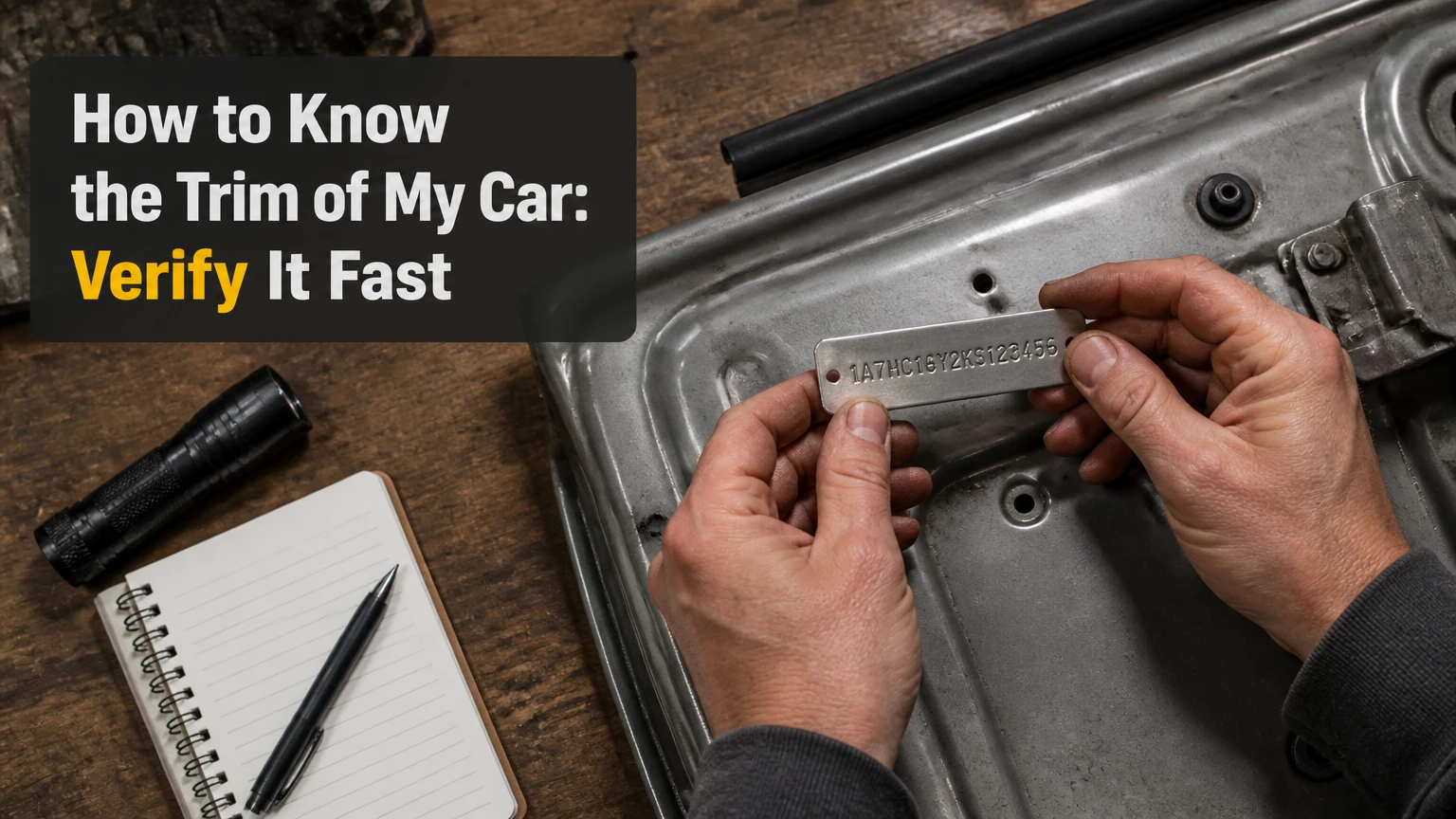
Your car’s trim is the factory equipment level assigned to a specific model, year, body style, and drivetrain. Find it most reliably by using the 17-character VIN with a manufacturer or authoritative decoder, then confirm the result against the vehicle label, original window sticker, build sheet, or dealer records.
Key Facts at a Glance
A trim identifies factory equipment, while a model identifies the vehicle family, such as Toyota Camry or Ford F-150.
A standard VIN has 17 characters, but a public VIN decoder may identify the model without revealing the exact retail trim.
The driver’s doorjamb label usually provides the production date, vehicle weight ratings, tire specifications, and sometimes a trim or model code.
A rear badge can suggest a trim, but badges are removable and may be replaced, added, or deleted after manufacture.
Factory packages and accessories do not automatically change the vehicle’s base trim.
Most trim lookups cost nothing when you use your paperwork, the manufacturer’s owner portal, NHTSA vPIC, or a dealership parts department.
What Does a Car Trim Mean?
A car trim is the manufacturer’s defined configuration within a model range. The trim controls a bundle of factory-installed features, such as engine output, wheel size, upholstery, infotainment equipment, driver-assistance systems, suspension tuning, and exterior styling.
For example, “Honda Civic” identifies the model, while “Sport Touring” identifies a higher-level configuration within a particular Civic model year. A trim is not always a simple ladder from basic to luxury because automakers often create separate sport, hybrid, off-road, and electric variants.
Model, trim, package, and option
These terms describe different levels of vehicle identity. The distinction matters because parts catalogs, insurance systems, and resale listings may treat each level differently.
| Vehicle term | Example value | What it identifies | Why it matters |
|---|---|---|---|
| Make | Honda | Manufacturer | Determines the brand’s parts and records |
| Model | Civic | Vehicle family | Narrows the body and platform |
| Model year | 2022 | Production specification year | Controls equipment and part revisions |
| Trim | EX | Factory equipment level | Identifies standard configuration |
| Package | Cold Weather Package | Group of optional features | Adds equipment without replacing the base trim |
| Accessory | Roof rack, dealer-installed | Add-on equipment | May not appear in factory build data |
A 2022 Honda Civic EX with an optional package remains an EX. A dealer-installed leather interior also does not convert an LX into an EX. The factory build record is the deciding reference when labels and visible equipment disagree.
Why Does Finding the Trim Matter?
The correct trim connects the vehicle to the right parts, valuation data, insurance description, and equipment list. A 2020 Ford Explorer XLT can use different wheels, brakes, suspension components, and electronic modules from a 2020 Explorer ST, even though both share the Explorer model name.
Trim identification becomes especially important in these situations:
- Replacement parts: Brake rotor diameter, wheel offset, shocks, air filters, sensors, and body panels can vary by trim, engine, or package.
- Vehicle valuation: Pricing tools compare vehicles with similar equipment, mileage, condition, and drivetrain.
- Insurance: The policy should describe the vehicle’s actual year, make, model, trim, and equipment.
- Recall searches: A recall may apply to a particular engine, body style, production period, or electronic system rather than every trim.
- Selling or buying: An incorrect trim can make an online listing misleading and distort the asking price.
- Warranty work: A manufacturer may need the precise build configuration before approving a component.
Trim alone is not enough for every parts decision. The VIN, engine code, transmission, production date, wheel size, and left- or right-hand-drive configuration can also control compatibility.
How Do I Find the Trim of My Car?
The fastest reliable process takes about 5-15 minutes and normally costs $0. Start with the VIN, use the vehicle’s documents as corroboration, and escalate to a manufacturer or dealer build sheet if the decoder produces only a generic model.
| Method | Typical time | Typical cost | Reliability for exact trim | Best use |
|---|---|---|---|---|
| Original window sticker | 2 minutes | $0-$20 for a reprint | Very high | Factory equipment and options |
| Manufacturer owner portal | 3-10 minutes | $0 | High | Build information and warranty records |
| NHTSA vPIC decoder | 2-5 minutes | $0 | Moderate | VIN identity and basic specifications |
| Doorjamb label | 1 minute | $0 | Moderate to high | Production and vehicle codes |
| Dealership build-sheet lookup | 10-30 minutes | $0-$50 typical | Very high | Conflicting or missing records |
| Feature comparison with brochure | 15-30 minutes | $0 | Moderate | Supporting evidence only |
Step 1: Locate and copy the VIN
Find the VIN at the lower driver-side windshield, on the driver’s doorjamb or door edge, and on documents such as the registration, title, insurance declarations page, or purchase contract. Photograph the dashboard VIN and copy the characters into a note rather than relying on memory.
A road-legal vehicle built for the United States after 1981 generally has a 17-character VIN. VINs exclude the letters I, O, and Q, reducing confusion with the numbers 1 and 0. Compare the windshield number with the door label before submitting it to a database.
Success checkpoint: The VIN contains 17 characters and matches at least one physical label and one document.
Common mistake: Entering a stock number, license plate, or title number instead of the VIN. A VIN begins with a manufacturer and vehicle identifier sequence, not a dealership inventory code.
Step 2: Run the VIN through an authoritative source
Enter the VIN into the National Highway Traffic Safety Administration’s vPIC decoder, the automaker’s owner website, or a reputable vehicle-information provider. NHTSA vPIC can return manufacturer-reported information such as make, model, model year, body type, engine details, and manufacturing plant.
Public decoders have an important limitation: they do not always expose the consumer-facing retail trim. VIN positions 4-8 commonly describe attributes such as vehicle descriptor information, but the meaning varies by manufacturer and market. The 10th VIN character commonly identifies model year in North American VIN systems, although some year codes repeat in 30-year cycles.
Do not treat a result such as “Toyota Camry sedan” as proof of LE, SE, XLE, or XSE. Use the decoder to confirm the vehicle identity, then obtain a build sheet or compare the factory equipment list.
Success checkpoint: The decoder matches the vehicle’s year, make, model, body style, engine, and drivetrain.
Common mistake: Assuming that every VIN decoder translates the trim code. Many free tools provide a partial decode, while manufacturer databases can map internal codes to the exact retail configuration.
Step 3: Read the driver’s doorjamb label
Open the driver’s door and inspect the pillar, door edge, or nearby body panel. The federal certification label commonly shows the manufacturer, month and year of manufacture, vehicle identification number, gross vehicle weight rating, gross axle weight ratings, and tire and loading information.
Some automakers include a trim abbreviation, model code, paint code, or production code. A code such as “EX,” “L,” or “XLT” may be directly useful, but a long alphanumeric code usually requires the manufacturer’s service database for interpretation.
The production month can help distinguish mid-year changes. Two vehicles with the same model year and trim name may have different parts if the automaker revised a component during production.
Success checkpoint: Record every code exactly, including punctuation, spaces, and leading zeroes. Photograph the label before cleaning or repainting the doorjamb.
Common mistake: Confusing the tire size printed on the label with the installed wheel size. A previous owner may have changed wheels and tires, while the certification label retains the original specification.
Step 4: Inspect exterior badges and emblems
Check the trunk, liftgate, front fenders, grille, and doors for markings such as “Limited,” “Touring,” “ST,” “Trailhawk,” “Hybrid,” or “AWD.” These markings can narrow the possibilities quickly, especially when the badge is a model-specific designation.
Badges are evidence, not authentication. A replacement liftgate may lack the original emblem, an owner may remove factory badges, and a seller may add a sport or luxury badge. Some automakers also use a badge for the powertrain rather than the trim, so “Hybrid,” “AWD,” or “EcoBoost” may describe a drivetrain or engine family.
Success checkpoint: Treat a badge as confirmed only when it agrees with the VIN-supported model and the factory equipment list.
Common mistake: Assuming an unbadged vehicle is the base trim. Badge deletion is common, and many factory configurations carry only the make and model name.
Step 5: Check the original documents
Search the buyer’s order, purchase agreement, finance contract, registration, title, insurance declarations page, and original window sticker. The Monroney label normally lists the exact trim, base price, installed options, destination charge, fuel-economy information, and standard equipment for a new vehicle.
The window sticker is stronger evidence than visible features because it records what the vehicle had when it left the factory. A used-car listing, dealership inventory page, or insurance database can contain an incorrect trim supplied by a previous owner or automated lookup.
Registration and title records may show only a generic model description, depending on the jurisdiction. Insurance declarations often include a trim field, but the insurer’s database can also contain a coding error. Verify important discrepancies rather than copying the first label you find.
Success checkpoint: Find a document that names both the model year and the factory trim, then compare it with the VIN.
Common mistake: Confusing the seller’s advertised “package” with the manufacturer’s trim. A “premium package” may be optional equipment on a lower trim.
Step 6: Match factory features to the correct model year
Use the manufacturer’s brochure, archived specifications page, official owner’s manual, or original window sticker for the exact model year. Compare multiple attributes instead of relying on one feature because automakers frequently make leather upholstery, a sunroof, or a larger screen optional across several trims.
Useful comparison points include:
- Engine displacement, cylinder count, motor output, or battery size
- Drive type, such as front-wheel drive, all-wheel drive, or four-wheel drive
- Wheel diameter and factory tire size
- Seat material and front-seat adjustment
- Headlamp type and exterior lighting
- Infotainment screen size and navigation
- Premium audio brand
- Heated, ventilated, or power seats
- Blind-spot monitoring and adaptive cruise control
- Suspension, towing, off-road, or performance equipment
Success checkpoint: At least four independent features match the same factory trim in the correct model-year brochure.
Common mistake: Comparing the vehicle with a current brochure. A trim name can remain the same while its equipment changes substantially between 2021 and 2022.
Which Trim Names and Codes Are Common?
Common trim labels include Base, S, DX, LX, L, LE, SE, Sport, EX, XLE, SV, XLT, Touring, Limited, Platinum, Denali, and Premium. These labels do not have a universal meaning: an “SE” may indicate sport styling at one manufacturer and a mid-level equipment grade at another.
| Trim label or family | Common role | Example equipment often associated | Important limitation |
|---|---|---|---|
| Base, S, L, DX | Entry configuration | Cloth seats, 16-inch wheels, basic audio | Equipment varies by model year |
| LX, LE, SV | Value or mid-level configuration | Power features, alloy wheels, larger display | LE does not mean luxury universally |
| EX, XLE, XLT | Upper-mid configuration | Heated seats, advanced safety, upgraded cabin | Packages may overlap equipment |
| SE, Sport, RS, GT | Sport-oriented configuration | 18-inch wheels, dark trim, sport suspension | Some versions change appearance only |
| Touring, Limited | Premium or long-distance configuration | Leather, premium audio, navigation | Touring can be a separate body or drivetrain |
| Platinum, Denali, Calligraphy | High-equipment configuration | Ventilated seats, panoramic roof, driver aids | High trim may still have paid options |
Trim naming also differs by market. A European, Canadian, Australian, or imported vehicle may use “variant,” “grade,” “specification,” or a local designation that does not match the United States lineup.
What Is the Difference Between Trim and Package?
A trim is the vehicle’s core factory configuration; a package is an optional group of equipment added to that configuration. A 2023 Subaru Outback Limited with a technology package remains a Limited, while a dealer-installed tow hitch is an accessory rather than a trim change.
| Identification item | Factory status | Example | Changes base trim? | Parts impact |
|---|---|---|---|---|
| Trim level | Standard configuration | Mazda CX-5 Carbon Edition | Yes, identifies configuration | Often significant |
| Option package | Factory-installed group | Cold Weather Package | No | Can affect seats, glass, or electronics |
| Standalone option | Factory-selected feature | Panoramic sunroof | No | Affects roof and interior parts |
| Dealer accessory | Added after manufacture | Tow hitch or cargo liner | No | Usually limited to accessory fit |
| Aftermarket modification | Third-party change | Lift kit or non-OEM audio | No | May alter compatibility substantially |
The distinction prevents a common buying error. A feature list can prove that a vehicle has an option, but it cannot prove that the option changed the factory trim name.
What Should You Use for Parts, Insurance, or Resale?
Use the highest level of verification required by the decision. A visible feature may be adequate for a floor mat, but a VIN-confirmed configuration is preferable for brakes, suspension, airbags, electronic modules, insurance valuation, and a high-value sale.
| Task | Minimum useful information | Preferred confirmation | Why the distinction matters |
|---|---|---|---|
| Floor mats | Year, model, body style | Trim and floor layout | Shape can differ by body style |
| Brake components | VIN, engine, drivetrain, production date | VIN plus parts-catalog fitment | Rotor and caliper dimensions can vary |
| Wheels and tires | Bolt pattern, diameter, offset, load rating | Door label plus VIN | Tire pressure and clearance are safety issues |
| Insurance policy | Year, make, model, trim | VIN-matched declarations page | Incorrect equipment can affect valuation |
| Resale listing | Trim, mileage, options, condition | Window sticker or build sheet | Trim and options influence comparable prices |
| Recall search | VIN | NHTSA or manufacturer VIN recall lookup | VIN determines campaign eligibility |
Practitioner rule: When a parts website offers “multiple trims,” never choose by appearance alone. Confirm engine, drivetrain, production date, brake package, and wheel size because trim names often conceal mechanical differences.
Can You Find the Trim by License Plate?
A license plate can sometimes retrieve a vehicle record through an insurer, dealership, registration system, or commercial lookup service, but the plate itself does not encode the trim. The VIN remains the primary identifier because plates can transfer between vehicles, change after sale, or be entered incorrectly.
License-plate searches also depend on location and privacy rules. A lookup available in one U.S. state may not expose the same information in another jurisdiction, and imported vehicles may not appear in North American databases.
Use a plate lookup only as a convenience. Confirm the returned year, make, model, VIN, engine, and trim against the physical vehicle and title before ordering parts or purchasing insurance.
What If the VIN Decoder Does Not Show the Trim?
A missing trim result usually means the public database lacks the automaker’s internal option mapping, not that the vehicle has no trim. Contact a franchised dealer’s parts or service department and request a VIN-based build sheet, vehicle inquiry report, or factory configuration printout.
Follow this escalation sequence:
- Re-enter the VIN and verify all 17 characters.
- Compare the result with the doorjamb label and title.
- Try the manufacturer’s owner portal or customer-care line.
- Search the original window sticker using the VIN.
- Ask a dealer for the factory build record.
- Ask a parts supplier to verify the exact component by VIN and production date.
Dealers may charge for historical records, although many parts departments provide a basic configuration lookup at no cost. A dealer is particularly useful for vehicles with mid-year changes, discontinued trims, fleet specifications, or internal codes that public websites do not translate.
Imported, rebuilt, and modified vehicles
Imported vehicles may have a VIN format, trim name, or database record that differs from the market where you now use the vehicle. A rebuilt vehicle may have a replaced door, missing certification label, altered drivetrain, or non-original body panel.
A modified vehicle still has a factory trim, but its current equipment may no longer match that trim. Lift kits, engine swaps, battery conversions, aftermarket seats, and replacement wheels require separate fitment checks. The VIN identifies the original build, not every modification completed later.
What Are the Most Common Trim Lookup Mistakes?
The most damaging errors come from treating one clue as definitive. A VIN decoder, badge, feature, or seller description can each be incomplete; two independent records provide a safer answer.
- Assuming the model equals the trim: “Ford F-150” is incomplete because XL, XLT, Lariat, King Ranch, and Platinum have different equipment.
- Trusting a badge by itself: Emblems can be removed, replaced, or added after delivery.
- Treating an option as a trim: A premium audio system or winter package may be optional on several grades.
- Using the wrong model year: Equipment and part numbers can change during a nameplate’s production run.
- Ignoring body style: Sedan, hatchback, coupe, wagon, cab configuration, and long-wheelbase versions may share a model name.
- Ordering by engine alone: The same engine can use different brakes, suspension, cooling, or electronics across trims.
- Relying on a seller’s listing: Automated marketplace data frequently converts internal codes into an approximate retail trim.
- Publishing the full VIN publicly: Share the VIN with a dealer, insurer, or parts provider when needed, but avoid posting documents that also reveal your address and personal information.
Expert insight: A factory option can make a lower trim look like a higher trim, while a high trim can lack a feature after an owner replaces or removes it. Factory records outrank visual inspection.
How Long and How Much Does Trim Identification Take?
A basic lookup usually takes 5-15 minutes and costs nothing. A dealer record or paid window-sticker service can take 10-30 minutes and typically costs $0-$50, depending on the vehicle’s age, market, and record availability.
| Situation | Time range | Cost range | Recommended method |
|---|---|---|---|
| VIN and documents available | 5-10 minutes | $0 | Decoder, registration, window sticker |
| Door label readable | 1-3 minutes | $0 | Label codes and VIN confirmation |
| No original paperwork | 15-30 minutes | $0-$20 | Manufacturer portal or sticker archive |
| Decoder gives generic model | 10-30 minutes | $0-$50 | Dealer build sheet |
| Imported vehicle | 30-60 minutes | $20-$100 typical | Brand specialist or market-specific database |
| Modified or rebuilt vehicle | 30-90 minutes | $0-$100 typical | VIN record plus physical inspection |
Paid history reports can add accident, title, mileage, and ownership information, but paying for a history report does not guarantee an exact trim. Choose the service for the specific information needed rather than assuming a higher price means better trim data.
What Is the Best Verification Method?
The original window sticker or manufacturer build sheet is usually the best source for the factory trim and installed options. A VIN decoder is the fastest starting point, while a dealer database is the strongest fallback when the public decoder returns a generic model or conflicting specifications.
For routine identification, use this two-source rule:
- Source one: VIN decoder or manufacturer record.
- Source two: Window sticker, doorjamb code, title, or equipment brochure.
- Escalation: Dealer build sheet when the two sources disagree.
A practical limitation deserves emphasis: no document can reliably describe modifications made after manufacture. Parts catalogs may also supersede trim labels with direct measurements, such as rotor diameter, wheel offset, battery capacity, or axle code. For safety-critical repairs, confirm the component specification rather than relying on trim alone.
FAQ
Is the VIN the same as the trim code?
No. The VIN identifies the complete vehicle record, while a trim code is a manufacturer-specific code for an equipment configuration. Some automakers encode trim-related information within the VIN or build code, but public decoders may not reveal the retail trim name. A factory build sheet can translate internal codes accurately.
Does the 10th VIN character tell me the trim?
No. The 10th VIN character generally identifies the model year in North American VIN systems, not the trim. Trim-related information may appear elsewhere in the VIN or in a separate manufacturer code, but decoding rules differ by automaker. Use the full VIN with a manufacturer database for configuration details.
Can a car have more than one trim?
A car has one factory trim for its original configuration, but it can have packages, standalone options, dealer accessories, and aftermarket modifications. A vehicle may also have a powertrain or appearance designation that resembles a trim name. Record the base trim separately from every package and later modification.
Does trim affect a car’s resale value?
Yes, trim can affect resale value because higher-equipment versions usually have different original prices and features. The effect depends on mileage, condition, demand, drivetrain, body style, options, and local market prices. Compare the vehicle with listings matching the same year, trim, engine, drivetrain, and mileage rather than using a generic model average.
Why do two cars with the same trim have different features?
Automakers can change standard equipment by model year, production date, market, body style, drivetrain, and factory package. Two vehicles labeled “Sport” may therefore have different wheels, screens, engines, or safety systems. Compare the VIN, original window sticker, and production date before assuming identical equipment.
The Bottom Line
To know the trim of your car, locate the 17-character VIN, verify it through NHTSA vPIC or the manufacturer, and confirm the result with the window sticker, doorjamb code, or factory build sheet. Use badges and visible features as supporting clues only. For parts, insurance, resale, or recalls, the exact year, body style, engine, drivetrain, production date, and factory options matter alongside the trim. A two-source check is the safest answer to how to know the trim of my car.