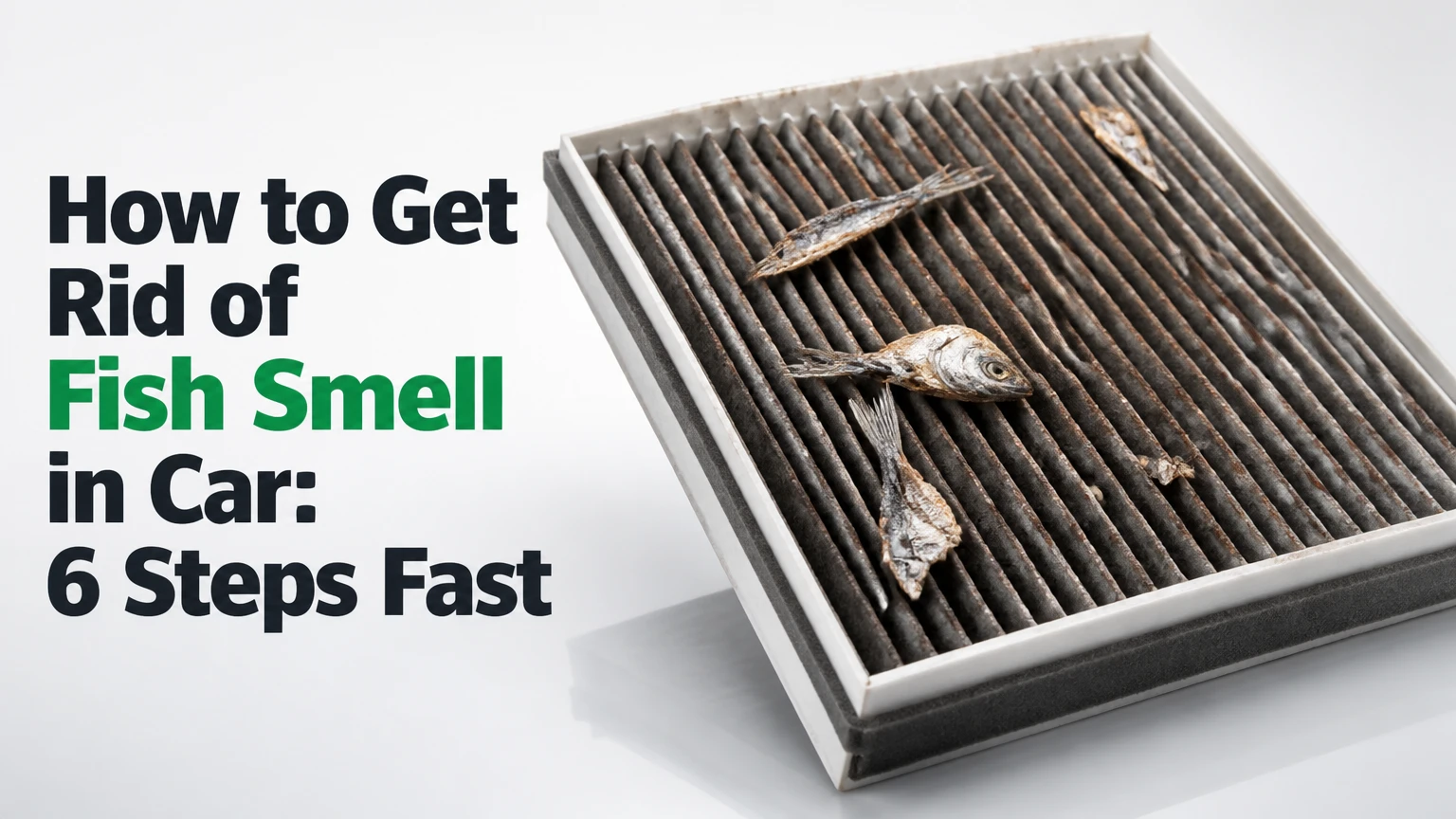
To get rid of fish smell in a car, remove every trace of seafood, extract contaminated liquid from upholstery or carpet, treat the residue, and dry the interior completely. Start with an enzyme cleaner for porous fabric, use a carefully tested mild acid solution only when appropriate, and inspect the cabin air filter if the odor returns when ventilation operates.
Key Facts at a Glance
- Fish odor usually comes from trimethylamine plus decomposing seafood residue, fish oil, packaging, or contaminated moisture.
- A fresh spill can often be handled in 1-3 active hours, followed by 12-48 hours of drying.
- Enzyme products work on organic residue; air fresheners and baking soda mainly mask or adsorb airborne odor.
- Never mix vinegar, bleach, chlorine dioxide, ammonia, or other cleaners.
- A smell that returns in hot weather usually indicates contamination inside carpet backing, seat foam, or trunk insulation.
- Typical DIY spending is about ৳500-৳2,500, while professional extraction and odor treatment commonly costs ৳5,000-৳20,000 or more.
Why Does Fish Smell Stay in a Car?
Fish odor remains in a vehicle because volatile compounds escape from residue trapped in porous materials, especially carpet backing, seat foam, trunk liners, and fabric seams. Trimethylamine is one important contributor, but the complete odor can also include sulfur compounds, amines, fatty residues, and compounds produced during decomposition.
A fish bag can leak into a carpet without leaving a large visible stain. Heat then increases evaporation from the contaminated foam, which explains why the smell may disappear overnight and return after the car sits in sunlight. Cleaning only the visible surface leaves the odor reservoir underneath.
The International Agency for Research on Cancer and toxicology references discuss trimethylamine as a volatile amine associated with fishy odors, but trimethylamine is not the only target in a vehicle. That distinction matters because an acidic spray may reduce the amine odor while leaving fish oil, tissue, and bacterial residue behind.
Air fresheners do not remove the source. Baking soda may reduce some airborne odor through adsorption, but a bowl of powder cannot draw fish juice out of seat foam. Permanent improvement requires source removal, liquid extraction, chemical or enzymatic treatment, and controlled drying.
What Should You Do Before Cleaning?
Before cleaning, remove seafood, packaging, mats, loose cargo, and contaminated absorbent material, then identify the wettest or strongest-smelling location. Park outdoors or in a well-ventilated covered area, switch off the vehicle, and test every cleaner on a hidden section before broad application.
Before You Start
| Requirement | Typical specification | Why it matters |
|---|---|---|
| Active cleaning time | 1-3 hours | Covers inspection, treatment, and extraction |
| Drying time | 12-48 hours | Prevents trapped moisture and mildew |
| DIY budget | ৳500-৳2,500 | Covers cleaner, towels, gloves, and filter |
| Enzyme cleaner | 500-1,000 mL | Needed for porous organic contamination |
| Microfiber towels | 4-8 towels | Separates blotting from final wiping |
| Wet-dry vacuum | 5-15 L capacity | Removes contaminated liquid from padding |
| Ventilation fan | 30-45 cm household fan | Moves humid air out of the cabin |
| Protective equipment | Nitrile gloves and eye protection | Reduces contact with seafood residue and chemicals |
Remove floor mats and inspect their undersides. Check the trunk floor, spare-tire well, jack compartment, seat rails, door pockets, child-seat padding, and the area beneath removable cargo trays. Fish liquid frequently travels downhill and collects beneath a liner rather than where the original bag rested.
Use your nose only as a guide. Look for oily marks, damp carpet, swollen cardboard, leaking coolers, flies, discoloration, or residue around seams. If the odor is strongest at the front passenger footwell, inspect the HVAC filter housing and air intake rather than assuming the trunk is responsible.
How to Get Rid of Fish Smell in Car in Six Steps
The six-step process is: remove the source, blot liquid, vacuum debris, apply a compatible treatment, extract and rinse, then dry and reassess. The factor that most determines success is penetration depth, because a surface spray cannot reliably remove fish residue absorbed into foam or carpet backing.
Step 1: Remove the Fish Source and Contaminated Items
Take all seafood, bags, cardboard, towels, and disposable liners out of the vehicle immediately. Seal waste in two bags, wash reusable containers separately, and remove fabric mats so the cabin can be inspected without hidden odor sources.
Place mats on a washable surface and inspect their rubber backing. Cleanable rubber can usually be washed with a mild automotive interior detergent, while saturated felt, jute, cardboard, or cheap trunk liners may be faster and safer to replace.
Success checkpoint: The interior has no visible seafood, packaging, pooled liquid, or damp disposable material.
Common mistake: Spraying deodorizer before removing the source. Fragrance can make the location harder to identify and may leave the organic residue untouched.
Step 2: Blot Fish Juice Without Scrubbing
Press folded microfiber towels firmly onto the spill for 10-20 seconds, lift them, rotate to a dry section, and repeat until little liquid transfers. For a large spill, place a clean towel over the area and apply hand pressure; do not grind the residue into the fibers.
Scrubbing spreads fish oil laterally and pushes liquid through carpet into the underlay. A shop vacuum can remove free liquid before chemical treatment, but avoid dragging a wet nozzle across delicate headliners or loose upholstery stitching.
Success checkpoint: The towel feels only slightly damp after repeated pressure, and no liquid beads appear when the carpet is pressed.
Common mistake: Using paper towels alone. Paper breaks apart, leaves cellulose behind, and provides less pressure than a folded microfiber towel.
Step 3: Vacuum Debris and Choose the Treatment
Vacuum dry particles first, then select a treatment based on the material and the contamination. For cloth seats, carpet, felt, and trunk lining, an automotive enzyme cleaner is usually the most suitable first choice because it targets proteins and other organic residue.
Choose a product labeled for upholstery or carpet, follow its dilution instructions, and do not assume that a household pet-odor formula is safe for every vehicle material. Enzyme activity depends on contact, temperature, and moisture, but commercial formulas differ substantially.
A mild white vinegar solution can neutralize alkaline amines, yet vinegar does not digest fish tissue or remove oil. Use it only on colorfast, water-safe fabric after a hidden-area test. Do not use vinegar on unsealed natural leather, exposed metal, or surfaces that the manufacturer labels acid-sensitive.
Success checkpoint: The selected product matches the surface, the label permits that use, and a hidden test area shows no dye transfer, whitening, stiffness, or gloss change.
Common mistake: Mixing products to make one “stronger” formula. Combining acids, oxidizers, bleach, ammonia, or disinfectants can create irritating or dangerous vapors.
Step 4: Apply Enough Cleaner for the Contamination Depth
Apply enzyme cleaner evenly to the affected fabric until the contaminated fibers are damp, not flooded. If the spill clearly reached the padding, use enough product to reach the same depth, but plan to extract the liquid afterward rather than leaving the foam saturated.
Allow the label-specified dwell time, commonly 15-30 minutes for a fresh surface spill. Some enzyme products require longer contact, while others warn against extended wetting; the manufacturer’s instructions control the application time.
A soft upholstery brush can distribute cleaner through carpet fibers. Brush lightly in one direction and avoid aggressive agitation on headliners, perforated leather, loose stitching, or aging foam.
Success checkpoint: The treatment reaches the affected fibers, remains wet for the stated dwell period, and no cleaner pools under trim or seat rails.
Common mistake: Applying a light mist to a deep spill. A mist may reach only the top fibers while the odor-producing residue remains in the backing.
Step 5: Extract the Contaminated Liquid
Use a wet-dry vacuum or carpet extractor to pull treatment, dissolved residue, and fish oil from the upholstery. Make several slow extraction passes, then perform one controlled rinse pass with a small amount of clean water if the product instructions permit rinsing.
Do not repeatedly soak a seat cushion that cannot be removed or ventilated from below. Seat foam dries slowly, and moisture trapped against the metal seat pan can promote corrosion or mildew. Extract until the material is damp rather than wet.
For fabric seats, press a clean towel into the area after vacuuming. For carpet, lift an accessible edge and check the underlay. If the underlay is wet or smells strongly, surface extraction alone is unlikely to solve the problem.
Success checkpoint: No liquid is visibly pooling, the extractor output becomes clearer, and the treated area feels damp rather than squishy.
Common mistake: Treating extraction as optional. Cleaner can loosen odor compounds without removing them, so evaporation may simply return them to the cabin air.
Step 6: Dry, Ventilate, and Recheck the Vehicle
Open the doors and windows, position a fan to blow humid air out rather than merely circulate it, and leave the vehicle ventilated until carpet and foam are fully dry. Typical drying takes 12-24 hours in warm, dry air and 24-48 hours in cool or humid conditions.
Avoid closing the vehicle overnight when the upholstery is still cool and damp. Do not use a high-temperature heat gun, hair dryer, or space heater inside the cabin because concentrated heat can deform plastics, damage adhesive, or create a fire risk.
After drying, close the vehicle for 30-60 minutes and then inspect the original area. Repeat the heat test by allowing the cabin to warm naturally, rather than using extreme heat. If odor returns, the source is probably deeper than the treated surface.
Success checkpoint: Carpet and seats feel dry at seams and edges, windows do not fog from interior moisture, and the odor does not return after the cabin warms.
Common mistake: Relying on fragrance during the drying period. Perfume can combine with trimethylamine and create a stronger, harder-to-diagnose odor.
Which Fish-Odor Treatment Works Best?
For fish residue on porous automotive fabric, an enzyme cleaner followed by extraction is generally the best first treatment. Vinegar is inexpensive and may neutralize amines, while ozone or chlorine dioxide should be reserved for controlled professional use after the physical source has been removed.
| Treatment | Best surface or situation | Typical time | Main limitation |
|---|---|---|---|
| Automotive enzyme cleaner | Cloth seats, carpet, trunk felt | 15-60 minutes dwell | Must contact organic residue |
| Diluted white vinegar | Tested, colorfast fabric with amine odor | 20-30 minutes | Does not remove oil or tissue |
| Baking soda | Dry residual airborne odor | 8-24 hours | Cannot extract absorbed liquid |
| Chlorine dioxide product | Persistent odor after cleaning | Product-specific | Oxidizer requires strict occupancy controls |
| Ozone treatment | Professional post-extraction deodorizing | 1-3 hours | Can irritate lungs and age rubber |
| Professional hot-water extraction | Deep carpet or foam contamination | 1-2 days total | Higher cost and possible trim removal |
Enzyme cleaners are not magic. Enzymes act on suitable organic material, not on every odor molecule, and they cannot reach a sealed cavity unless the treatment is applied there. A second application may help a shallow spill, but repeated saturation is a poor substitute for lifting carpet or replacing contaminated foam.
Vinegar is also narrower than many home remedies suggest. Acid can protonate volatile amines and reduce their volatility, but the resulting residue still requires removal, and the vinegar smell may persist for one to several days. Never combine vinegar with bleach or chlorine-based products.
Baking soda is useful after drying as a low-risk adsorbent for residual odor in a removable mat or tray. It is not a substitute for blotting, extraction, or source removal. Activated carbon in a small cabin air purifier can reduce airborne odor while cleaning proceeds, but it does not treat the upholstery.
Should You Use Ozone or Chlorine Dioxide in a Car?
Ozone and chlorine dioxide can oxidize odor compounds in enclosed spaces, but neither should be the first response to a fish spill. Both treatments require an empty vehicle, strict label compliance, thorough airing, and prior removal of contaminated food, liquid, carpet, and foam.
The U.S. Environmental Protection Agency warns that “whether in pure form or mixed with other chemicals, ozone can be harmful to health.” Ozone is a respiratory irritant, and residual exposure is unacceptable while people or animals occupy the car. Ozone can also accelerate deterioration of some rubber, elastomers, dyes, and plastics.
Chlorine dioxide gas has similar occupancy and handling concerns. A labeled automotive product may be appropriate for a trained detailer, but improvised tablets, foggers, or unverified “bombs” create concentration and ventilation risks.
Use oxidation only after extraction and drying. Otherwise, the treatment may destroy some airborne odor while the wet organic source continues generating new odor. Ask a professional how the vehicle will be ventilated and whether the cabin filter, carpet backing, or seat foam will be treated separately.
What Does Fish-Smell Removal Cost and How Long Does It Take?
Typical DIY fish-odor removal costs ৳500-৳2,500 and requires 1-3 hours of active work plus 12-48 hours of drying. Professional service commonly costs ৳5,000-৳20,000 or more when hot-water extraction, carpet lifting, foam replacement, HVAC treatment, or controlled oxidation is necessary.
| Situation | DIY time | Typical DIY cost | Professional range |
|---|---|---|---|
| Sealed grocery bag, no leak | 30-60 minutes | ৳200-৳700 | ৳2,000-৳5,000 |
| Fresh spill on one floor mat | 1-2 hours plus drying | ৳500-৳1,500 | ৳3,000-৳8,000 |
| Seat or carpet saturation | 2-4 hours plus drying | ৳1,000-৳2,500 | ৳5,000-৳12,000 |
| Forgotten seafood in hot trunk | 3-6 hours plus drying | ৳1,500-৳4,000 | ৳10,000-৳20,000+ |
| Contaminated foam or underlay | 1-2 days of work | ৳2,000-৳8,000 | ৳15,000-৳30,000+ |
| HVAC or evaporator contamination | 2-5 hours | ৳1,000-৳3,500 | ৳5,000-৳15,000 |
Prices vary by country, vehicle size, labor rates, and whether the detailer owns an extractor. The higher professional range is reasonable when technicians must remove seats, lift carpet, replace insulation, or perform several drying cycles.
A detailer should identify and extract the source before selling an ozone-only service. An ozone treatment that temporarily hides odor without correcting saturated underlay often produces a disappointing return visit.
How Do You Clean Different Car Interior Materials?
Fabric, leather, vinyl, rubber, and headliner materials require different moisture levels and cleaners. Fabric can usually tolerate controlled damp treatment and extraction, while leather and headliners require minimal liquid because their backing, coatings, or adhesives can be damaged.
| Interior material | First treatment | Liquid limit | Avoid |
|---|---|---|---|
| Woven cloth seat | Upholstery enzyme cleaner | Damp, not flooded | Hard scrubbing |
| Nylon carpet | Enzyme cleaner and extraction | Moderate with vacuum access | Leaving underlay wet |
| Natural leather | Leather-safe cleaner, then conditioner | Lightly damp cloth | Vinegar soak and enzyme saturation |
| Vinyl or faux leather | Mild interior detergent | Light spray on towel | Strong solvent or acidic pooling |
| Rubber mat | Mild detergent and water rinse | Full wash if removed | Returning it before dry |
| Headliner | Foam cleaner on towel or soft brush | Minimal moisture | Saturating adhesive backing |
For leather, remove residue with a damp microfiber cloth and a pH-balanced leather cleaner. Dry the surface promptly and apply a compatible conditioner only after the odor source is gone. Fish liquid can enter perforations, seams, and seat creases, so persistent odor may require professional disassembly.
For vinyl and faux leather, wipe the surface rather than soaking it. If fish juice entered a seam, use a narrow, lightly dampened cloth and vacuum nearby carpet separately. Never force liquid into perforated seat ventilation channels.
Headliners are especially vulnerable. Spray cleaner onto a towel, not directly onto the ceiling, and work a small section at a time. Sagging fabric after cleaning usually indicates loosened adhesive from excessive moisture.
Why Does the Fish Smell Return When the Car Gets Hot?
Fish odor that returns when the car gets hot usually comes from residue inside carpet underlay, seat foam, trunk insulation, or a concealed cavity. Heat increases vapor release, so a temporarily fresh cabin can reveal the contamination again after solar warming.
Perform a location test before repeating treatment. Place clean towels over the trunk floor, rear footwell, front footwell, and seats for 20-30 minutes in a warm cabin, then smell each towel outside the car. The strongest towel identifies the area that needs lifting or deeper extraction.
If the carpet surface is dry but the backing is wet or oily, remove the trim and lift the carpet if the vehicle design permits. Replace foam, felt, cardboard, or jute that remains strongly contaminated after extraction. Replacement is often more reliable than repeated chemical applications.
A professional detailer should quote separately for extraction, carpet removal, foam replacement, and odor treatment. Ask whether the quoted service includes the source material, because “odor bomb” pricing alone may not address the reservoir.
Why Does the Odor Appear When the Air Conditioner Runs?
Fish odor that appears only when the air conditioner runs usually indicates contamination in the cabin air filter, HVAC housing, evaporator area, or air intake. Replacing the cabin filter is the simplest first step, but a filter change will not clean a contaminated evaporator or cowl intake.
Run the blower with the vehicle stationary and compare fresh-air mode with recirculation mode. Odor only in fresh-air mode points toward the cowl intake or outside debris, while odor mainly in recirculation mode points toward cabin ducting, filter housing, or evaporator surfaces.
Replace the cabin air filter using the vehicle manufacturer’s part specification, then inspect the old filter for fish scales, dampness, mold, or oily discoloration. Clean accessible intake screens and use only an HVAC cleaner labeled for automotive evaporators, following the product instructions.
Do not spray household enzyme cleaner deep into electrical components or blindly into vents. If the smell persists after a filter replacement and approved HVAC treatment, an automotive technician may need to access the blower housing or evaporator case.
Common Mistakes and How to Fix Them
| Mistake | Why it fails | Corrective action |
|---|---|---|
| Air freshener only | Masks odor while residue remains | Remove source and extract contamination |
| Bleach on upholstery | Discolors fibers and damages coatings | Use material-specific cleaner |
| Vinegar mixed with bleach | Can release toxic chlorine gas | Stop, ventilate, and never combine chemicals |
| Repeated soaking | Traps moisture beneath carpet or foam | Extract thoroughly and extend drying |
| Ignoring the cabin filter | Reintroduces odor through vents | Inspect and replace the filter |
| Closing wet doors overnight | Raises humidity and encourages mildew | Use airflow until seams are dry |
One practitioner rule is to clean one area at a time and keep an untreated control area. If the whole interior is sprayed immediately, you lose the ability to identify where the odor originated and may spread contamination.
A second rule is to treat the underside, not just the visible face. Fish liquid follows gravity through carpet and commonly reaches underlay, seat rails, or the spare-tire well.
A third rule is to judge success after heat exposure, not immediately after fragrance or wet cleaning. Odor molecules are least revealing while the cabin is cold, wet, or strongly scented.
Which Situation Needs a Different Approach?
Fresh, Small Spill
Blot immediately, remove the mat or affected cushion if possible, apply a compatible enzyme cleaner, extract it, and ventilate. A spill treated before it reaches foam has a much better chance of resolving in one cycle.
Forgotten Seafood in a Hot Trunk
Remove the trunk liner and inspect the spare-tire well, side pockets, jack compartment, and insulation. If the liner or felt remains oily after two extraction cycles, replacement may cost less and work better than repeated deodorizing.
No Wet-Dry Vacuum Available
Blot with several clean towels, use only enough cleaner to dampen the affected surface, and press with dry towels repeatedly. A household carpet extractor or rental machine is preferable; do not leave a heavily saturated seat or carpet to air-dry unaided.
Leather Seats
Use a leather-safe cleaner on a cloth, wipe residue from seams, and dry quickly. Avoid vinegar, enzyme saturation, baking soda paste, and aggressive brushing unless the leather-care manufacturer specifically permits them.
Odor After a Flood or Drain Leak
Fish odor may be confused with mildew, dirty water, or a blocked HVAC drain. Check for damp carpet, window condensation, and recurring moisture before applying an odor product, because a leak must be repaired first.
When Should You Hire a Professional?
Hire a professional detailer when fish liquid soaked seat foam or carpet backing, the source is inaccessible, the odor returns after two complete cleaning and drying cycles, or the air conditioner carries the odor into the cabin. Professional extraction is also safer when the vehicle has sensitive leather, complex airbags, or extensive trim.
Choose a detailer who can describe the process in this order: source inspection, removal or replacement of contaminated material, hot-water or low-moisture extraction, drying verification, cabin-filter inspection, and optional controlled oxidation. A provider who begins with fragrance or promises a guaranteed result without inspecting the interior is using the wrong diagnostic sequence.
Ask whether the service includes moisture extraction and drying. Mold prevention depends more on moisture control than on the brand name of the deodorizer.
FAQ
Can coffee grounds remove fish smell from a car?
Coffee grounds can add a stronger aroma and may adsorb a small amount of airborne odor, but they do not remove fish liquid from carpet, foam, or trunk insulation. Use source removal, an appropriate cleaner, extraction, and ventilation instead. Keep loose grounds away from seat tracks, vents, and electrical connectors.
Is baking soda better than vinegar for fish odor?
Baking soda is safer for dry, removable mats and residual airborne odor, while vinegar can chemically reduce alkaline amine odor on tested, water-safe fabric. Neither method removes deep fish oil as reliably as extraction, and neither should be applied as a wet paste to leather, headliners, or inaccessible foam.
How long should I leave vinegar in car upholstery?
For a tested, colorfast, water-safe fabric, a diluted vinegar solution may remain for about 20-30 minutes before extraction or blotting. Product and material instructions take priority. Do not leave the upholstery wet for hours, because trapped moisture can create a new mildew odor.
Can fish smell damage a car?
Fish odor itself usually does not damage vehicle components, but decomposing organic residue and trapped moisture can stain fabric, encourage microbial growth, corrode nearby metal, and degrade foam. Prompt removal is particularly important around seat rails, carpet underlay, spare-tire wells, and electrical connectors.
Should I replace the cabin air filter after a fish spill?
Replace the cabin air filter when it is damp, visibly contaminated, oily, or still smells after the interior has been cleaned. A clean filter can prevent odor recirculation, but filter replacement cannot correct fish residue inside the HVAC housing or evaporator case.
How can I tell whether the smell is fish or mildew?
Fish odor is often sharp, amine-like, or seafood-specific and may intensify with heat, while mildew smells damp, earthy, or sour and usually accompanies moisture or window fogging. Inspect carpet backing, under-seat areas, and HVAC drainage before selecting a treatment, because both odors can coexist.
The Bottom Line
To get rid of fish smell in car interiors, remove the seafood source, blot instead of scrubbing, use a material-compatible cleaner, extract contaminated liquid, and dry every layer completely. Enzyme treatment is the practical first choice for fabric, while leather, HVAC contamination, saturated foam, and returning heat-activated odor may require specialized service.