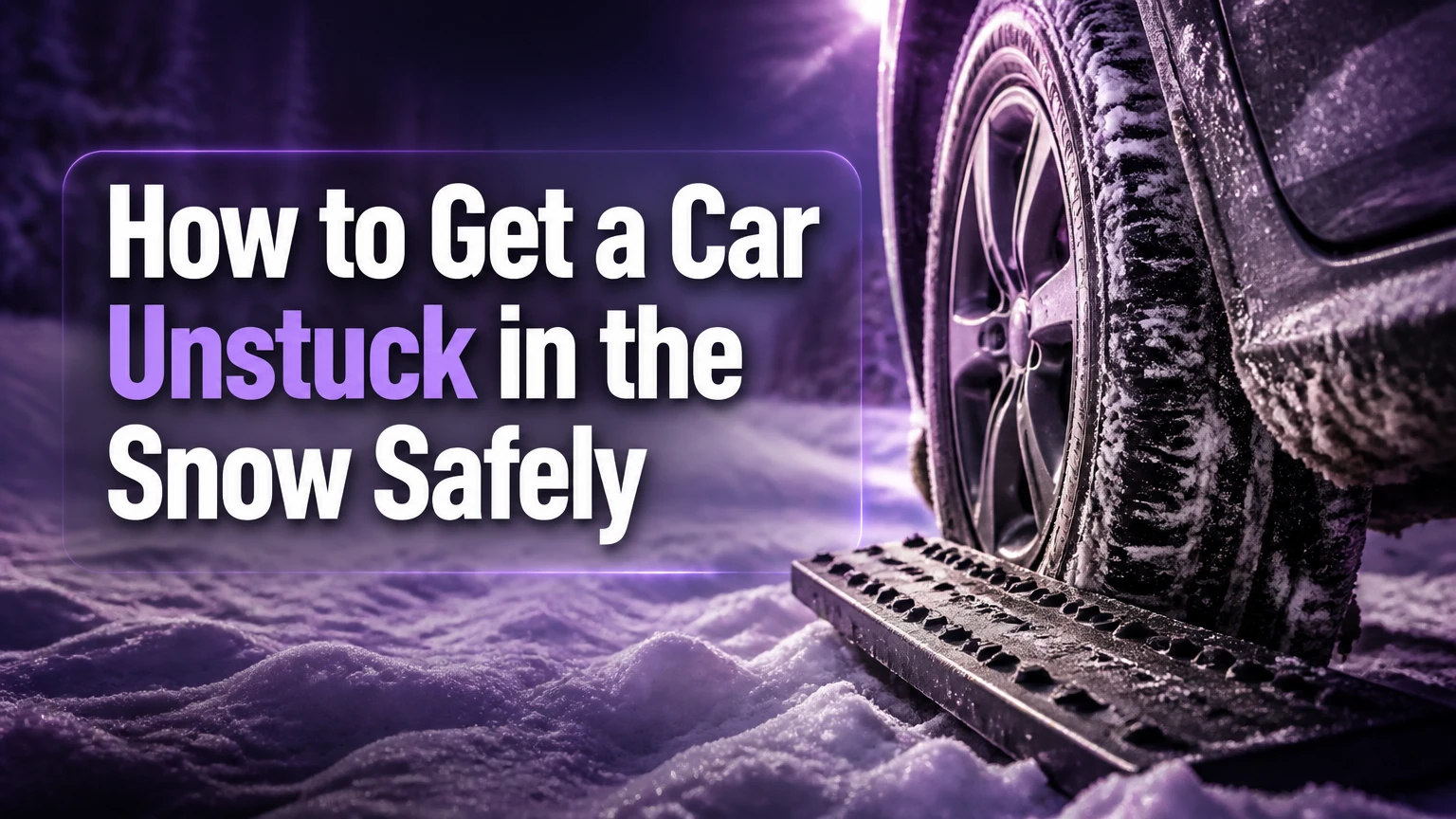
To get a car unstuck in the snow, first protect occupants, clear the exhaust and underbody, straighten the drive path, add traction, and use gentle forward and reverse momentum. Most minor snow entrapments take 10-20 minutes to clear. The factor that determines success is tire contact with firm ground, not engine power or all-wheel drive.
Key Facts at a Glance
A blocked tailpipe can allow fatal carbon monoxide to accumulate inside a running vehicle within minutes.
Digging around the drive tires and beneath a high-centered vehicle usually works before rocking or towing.
Wheelspin melts and polishes snow into ice, making the recovery hole deeper and more slippery.
Traction control should usually remain on, unless its power reduction prevents controlled movement; follow the vehicle manual.
Passenger-car tires should not automatically be lowered to 10-15 PSI; use the manufacturer’s limits and reinflate before normal-speed driving.
Stop self-recovery when the vehicle is high-centered, in danger of sliding, mechanically damaged, or exposed to traffic.
Why Vehicles Get Stuck in Snow
A vehicle becomes immobilized when available tire friction cannot overcome snow resistance, ice, slope, or underbody contact. Tires generate forward force where rubber contacts the surface, while packed snow in front of the tread or beneath the chassis acts like a physical barrier.
Snow tires improve the situation because their rubber remains more flexible in cold temperatures and their tread channels evacuate snow. They do not defeat a buried exhaust, a snowbank under the frame, or a polished ice trench. A heavy engine also does not guarantee traction because weight increases both tire load and the resistance that must be moved.
An open differential does not literally send all power to the wheel with the least resistance in every condition. Instead, it allows different wheel speeds and limits usable torque when one drive wheel reaches its traction threshold; electronic brake control, a limited-slip differential, or a locking differential can change the result. That distinction matters because disabling stability control cannot create grip where the tires have none.
How to Get a Car Unstuck in the Snow
Follow this sequence: make the vehicle safe, inspect the obstruction, clear snow, apply traction, attempt one or two gentle momentum cycles, and escalate to professional recovery. A typical self-recovery takes 10-30 minutes and costs $0-$100 when the driver already has a shovel, traction material, or boards.
Before You Start
| Requirement | Typical value | Why it matters |
|---|---|---|
| Self-recovery time | 10-30 minutes | Allows digging, traction placement, and short attempts |
| Basic difficulty | Moderate physical effort | Snow removal often determines success |
| Compact shovel | 1 steel or reinforced plastic shovel | Clears tire paths and underbody snow |
| Traction material | 2 boards or 2 rubber mats | Creates a firm surface under drive tires |
| Tire gauge | 1 digital or pencil gauge | Prevents unsafe pressure changes |
| Warning equipment | 2-3 reflective triangles or flares | Increases visibility near traffic |
| Winter clothing | Coat, gloves, boots, hat | Prevents cold injury during recovery |
Park the vehicle, set the parking brake, and ask passengers to leave the cabin if the vehicle is in a dangerous position or the exhaust is blocked. Turn on hazard lights when traffic can approach, and call emergency services if the car is on a live lane, near a drop-off, or occupied by someone becoming cold or confused.
Step 1: Check the Exhaust and Recovery Area
Check the tailpipe before running the engine for heat or attempting movement. Clear snow from the exhaust outlet and create an open area around it; the National Highway Traffic Safety Administration warns that carbon monoxide can build inside a vehicle when a tailpipe is blocked.
Keep the vehicle’s occupants away from moving wheels, tow lines, and the likely escape path. Remove loose objects from the path, identify a safe direction of travel, and check whether the car is resting against another vehicle, curb, buried object, or snowbank.
You will know the area is safe when the exhaust is open, traffic is warned, no person is beside a tire, and the intended path ends in a place where the vehicle can stop. Do not ask someone to push while the engine is driving the wheels.
Step 2: Straighten the Wheels and Select the Escape Path
Point the front wheels straight toward the intended exit before applying power. Straight wheels reduce scrub resistance and help the vehicle climb onto a cleared track, although a small steering input toward the escape path can help a tire find an edge when the vehicle is already moving.
Identify which wheels drive the car. Front-wheel drive uses the front axle, rear-wheel drive uses the rear axle, and all-wheel-drive systems vary by design and operating mode. The owner’s manual determines whether the vehicle has Snow, Low, Mud and Ruts, X-Mode, 4H, or a lockable center differential.
You will know the setup is correct when the transmission is in the lowest appropriate range, the wheels face the exit, and the driver can see the recovery path. Do not select 4L on high-traction pavement unless the vehicle manufacturer permits it.
Step 3: Manage Traction and Stability Controls
Leave traction control and electronic stability control on for the first attempt, especially on an ordinary road. These systems reduce wheelspin and maintain directional control; disable or reduce traction control only when the system repeatedly cuts power before the tires can climb out, and restore it immediately after recovery.
Vehicle controls differ substantially. Some systems have a brief button press for reduced wheelspin and a long press for stability-control intervention, while others automatically select a snow calibration. The dashboard symbol and owner’s manual provide the reliable instructions.
You will know the setting is appropriate when the drive wheels rotate slowly without the engine repeatedly losing power. A continuously flashing traction-control lamp during stationary wheelspin is a warning to reduce throttle, not permission to accelerate harder.
Step 4: Dig Out the Tires and Underbody
Dig a shallow ramp in the direction of travel, extending about 2-3 feet in front of and behind the drive tires. Clear packed snow from the tire sidewalls, bumper edges, and the centerline beneath the vehicle, then remove the ridge created by previous wheelspin.
If snow touches the underbody, crossmembers, or suspension, the vehicle may be high-centered. Dig beneath the chassis until the tires carry the vehicle’s weight and the underbody no longer rests on compacted snow. Do not crawl underneath a vehicle supported only by a jack.
| Vehicle position | Primary obstruction | First clearing target | Typical recovery outlook |
|---|---|---|---|
| Tires buried 4-8 inches | Loose snow around tread | 2-3-foot ramps | Often 10-20 minutes |
| Tires in a polished trench | Ice ridge and low grip | Ridge ahead of each drive tire | Often 15-30 minutes |
| Chassis resting on snow | High-centered underbody | Centerline and crossmember area | May require boards or tow |
| One wheel in a ditch | Uneven load and sidewall risk | Exit side plus downhill edge | Professional recovery often safer |
| Snowbank against bumper | Plow-like resistance | Bumper face and tire approaches | Avoid repeated throttle |
You will know digging worked when you can see tread contact with firm ground and no hard snowbank sits directly against the bumper or underbody. Common mistake: clearing only in front of the tires while leaving a packed ridge behind them, which prevents a controlled reverse attempt.
Step 5: Place Traction Aids Under the Drive Tires
Place traction boards, rubber mats, sand, gravel, or commercial carpet under the drive tires, with the material packed tightly against the tread in the intended direction of movement. Use the rubber side of a floor mat against the tire when possible, but expect a mat to tear or eject if the tire spins.
Commercial boards provide the most predictable result because their molded ribs resist bending and spread load over soft snow. Sand and kitty litter work better on ice or a short polished patch than in deep powder, where they disappear beneath the tread.
| Traction aid | Typical price | Best surface | Main limitation |
|---|---|---|---|
| Rubber floor mats | $0 already owned | Short icy patch | Can eject or be damaged |
| Bagged sand | $5-$15 | Ice and compact snow | Heavy, disperses quickly |
| Non-clumping kitty litter | $8-$20 | Thin ice layer | Poor support in deep snow |
| Plastic traction boards | $60-$200 | Deep or soft snow | Cargo space and cost |
| Gravel | $5-$15 | Packed snow and ice | Can damage paint and scatter |
| Cardboard | $0-$5 | Emergency dry surface | Becomes useless when wet |
Place aids at least several inches under the tread, not several feet away. If the tire is deeply buried, dig a channel first so the board can lie flat. Stand to the side while the driver applies only enough throttle to climb onto the aid.
You will know the aid is working when the vehicle climbs without rapid wheelspin and the tire remains centered on the board. Common mistake: placing a loose mat behind a spinning tire, which turns it into a projectile.
Step 6: Rock the Vehicle Gently
Use a controlled rocking cycle only after clearing snow and adding traction. For an automatic transmission, select Drive, apply light throttle until the vehicle moves forward, release the accelerator before wheelspin, allow it to roll back, select Reverse when stationary or at the manufacturer’s permitted speed, and repeat for two or three cycles.
Manual-transmission drivers should use a high-enough gear and smooth clutch engagement rather than aggressive clutch slipping. Hybrid and electric vehicles may have different creep and traction responses, so the manufacturer’s recovery instructions take priority.
| Rocking limit | Recommended value | Reason |
|---|---|---|
| Throttle duration | 1-2 seconds | Limits wheelspin and heat |
| Attempt count | 2-3 cycles | Prevents deeper trench formation |
| Wheelspin speed | Near zero, never sustained | Protects tires and drivetrain |
| Rest period | 5-10 minutes if hot | Allows clutch or transmission cooling |
| Steering angle | Mostly straight | Reduces rolling resistance |
You will know rocking worked when the vehicle gains a few more inches on each cycle and reaches the cleared ramp. Stop immediately if the tires spin, the engine races without movement, the transmission smells burnt, or the vehicle shifts sideways.
Step 7: Drive Clear and Re-engage the Safety Systems
Once free, continue slowly along the cleared route rather than stopping immediately in the original hole. Drive far enough to reach firm, level ground, then stop and inspect the tires, wheel wells, bumpers, underbody, and exhaust.
Re-enable traction control and stability control if you changed their settings. Brush packed snow from the wheels because accumulation can create imbalance, interfere with steering, or freeze the brakes. The American Automobile Association recommends removing snow from the vehicle before driving because loose roof snow can obstruct other drivers’ visibility.
Should You Lower Tire Pressure in Snow?
Lowering tire pressure can improve flotation in deep, soft snow, but a 10-15 PSI setting is unsafe as a universal instruction for passenger cars. Use only a pressure reduction approved for the tire and vehicle, make small changes with a gauge, and reinflate to the door-jamb specification before normal road speeds.
Airing down increases the tire’s contact patch and allows the tread to conform to uneven snow. The benefit is greatest in deep, low-speed terrain, not on a polished urban ice patch. A partially unseated tire can lose air rapidly, damage its bead, or expose the wheel to impact.
Passenger cars and crossovers generally should not be reduced to off-road pressures without manufacturer guidance. A portable 12-volt compressor, accurate gauge, and valve tool are prerequisites. Never use a tire-pressure-monitoring warning as the target pressure.
Which Recovery Method Works Best?
Shoveling plus traction boards is the safest and most repeatable combination for most drivers. Rocking costs nothing but should follow excavation, while tire deflation and external recovery require more equipment and create greater mechanical or personal risk.
| Method | Typical time | Typical cost | Best use | Principal risk |
|---|---|---|---|---|
| Shovel and clear | 10-25 minutes | $0-$60 | Buried tires or snowbank | Physical exhaustion |
| Sand or mats | 2-10 minutes | $0-$20 | Short low-grip section | Ejection or limited support |
| Traction boards | 5-15 minutes | $60-$200 | Deep soft snow | Incorrect placement |
| Gentle rocking | 2-5 minutes | $0 | Shallow trench | Transmission or clutch heat |
| Professional winch or tow | 30-120 minutes | $75-$300+ | High-centering or danger | Improper attachment |
A floor mat is an emergency aid, not a substitute for a recovery board. Sand provides particles for the tread to grip, but it cannot bridge a deep hole. A tow truck is usually cheaper than damaged suspension, a burned clutch, or a collision caused by uncontrolled movement.
When Should You Stop and Call for Recovery?
Call roadside assistance when the vehicle is high-centered, sliding toward a hazard, blocking traffic, mechanically damaged, or still immobile after clearing and two or three gentle attempts. Professional recovery is also appropriate when you lack a rated attachment point, cannot maintain a safe exclusion zone, or are alone in severe cold.
Do not use a bumper, suspension arm, trailer ball, or random frame hole as a tow point. A recovery strap must match the vehicle and load, connect to designated recovery points, and remain clear of people. Kinetic pulling stores substantial energy, so inexperienced drivers should leave it to trained operators.
Use a winch only with a rated line, appropriate anchor, damper, gloves, and a stable anchor point. Never stand in line with a loaded strap or winch cable. Metal tow hooks can become dangerous projectiles if they break, which is why loop-ended recovery straps and rated shackles are preferred for compatible recovery systems.
Common Mistakes and How to Fix Them
Spinning the Tires
Hard acceleration polishes snow into ice and excavates a deeper hole. Release the throttle, select Park, clear the new ridge, and add traction before trying again.
Turning Traction Control Off Immediately
Traction-control reduction can help in some stuck conditions, but switching every system off removes useful directional control. Restore the system if the vehicle begins sliding or if the driver cannot control wheelspin.
Rocking Too Aggressively
Fast shifts, high engine speed, and clutch slipping generate heat. Use short, gentle cycles, pause when warning lights or odors appear, and stop if the transmission temperature rises.
Using a Jack on Soft Snow
A jack can sink, tip, or leave the vehicle unstable. If lifting is unavoidable, use the manufacturer’s lift point, a broad solid base, wheel chocks, and no body parts beneath the vehicle; professional recovery is safer for high-centering.
Leaving Snow Under the Chassis
A vehicle with tires spinning freely may still be resting on its belly. Dig the centerline and around crossmembers until the tires regain load.
Driving Away Without Inspecting the Vehicle
Packed snow can hide damaged brake lines, underbody panels, or a displaced bumper. Inspect before reaching speed, and stop if steering vibration, brake pull, warning lights, or fluid leaks appear.
What Changes for FWD, RWD, AWD, and 4WD?
Front-wheel-drive cars often recover well from shallow snow because the engine’s weight loads the drive axle, but they can lose clearance at the front bumper. Rear-wheel-drive vehicles benefit from careful traction placement and may need more weight over the rear axle, although adding unsecured cargo creates a crash hazard.
All-wheel drive can send torque to more than one axle, which improves acceleration on snow. AWD does not shorten braking distance or create lateral grip on ice, so winter tires remain more important than the badge on the liftgate.
| Drivetrain | Put traction under | Useful setting | Frequent limitation |
|---|---|---|---|
| FWD sedan | Front tires | Snow mode or Drive | Low front clearance |
| RWD pickup | Rear tires | 4H if approved | Light unloaded rear axle |
| AWD crossover | Front and rear as needed | Snow or X-Mode | No advantage during braking |
| 4WD truck | Driven axle pair | 4H or 4L off-road | Binding on firm pavement |
| EV with dual motors | Manufacturer-specified wheels | Snow or low-traction mode | High instant torque |
Check the vehicle manual before using a center-lock, low-range, or stability-control override. Tire type, tread depth, and surface conditions matter more than drivetrain labels during the first few feet of movement.
How Long Does Recovery Take and What Does It Cost?
A minor stuck vehicle usually takes 10-20 minutes and costs nothing if the driver has a shovel and usable floor mats. Deep snow, high-centering, poor visibility, and roadside-assistance demand can extend the event to 30-120 minutes, while a commercial recovery commonly costs $75-$300 or more in the United States.
| Situation | Self-recovery time | Typical service cost | Best financial choice |
|---|---|---|---|
| One axle buried | 10-20 minutes | $75-$150 | Dig and add traction |
| Ice trench | 15-30 minutes | $100-$200 | Sand, mats, or boards |
| High-centered SUV | 30-60 minutes | $150-$300+ | Call a recovery provider |
| Rural off-road recovery | 30-120 minutes | $200-$600+ | Use trained 4WD recovery |
| Traffic-lane obstruction | Do not self-recover near traffic | Varies by location | Call emergency or roadside services |
Prices vary by membership plan, distance, weather demand, vehicle size, and whether a winch is required. Roadside assistance may cover a standard tow but charge separately for extended extraction.
How Can You Prepare Before Winter?
Keep a collapsible shovel, work gloves, a flashlight, reflective warning devices, a tire gauge, a blanket, water, and a phone power bank in the vehicle. Add sand or non-clumping litter for ordinary cars, while drivers in rural areas may justify traction boards and a 12-volt compressor.
Inspect winter tires before the first storm. The U.S. Tire Manufacturers Association recommends checking inflation regularly because cold temperatures reduce pressure, and the correct target is the vehicle manufacturer’s placard, not the maximum pressure molded into the tire sidewall.
Practice locating the traction-control button, drive-mode selector, tow points, jack points, and tire-pressure label in daylight. A recovery plan that depends on searching the owner’s manual in a snowstorm is incomplete.
Troubleshooting Stuck Snow Vehicles
What if the Vehicle Moves Only a Few Inches?
A short movement followed by a hard stop usually indicates a packed ridge or an ice trench ahead of the drive tires. Stop, select Park, secure the vehicle, shovel the ridge flat, and place traction material in the trench before another low-throttle attempt.
What if the Tires Spin on Ice?
Release the accelerator immediately because continued spinning removes heat and pressure-resistant snow while polishing the surface. Scrape the ice, apply a thin layer of sand or gravel, and place a rubber mat or board tightly against the tread.
What if the Frame Is Resting on Snow?
The vehicle is high-centered when the underbody carries weight that should rest on the tires. Dig beneath the centerline and exit side first; a jack alone will not provide a driving surface, and lifting on an unstable snow base can cause a fall.
What if the Car Is on a Slope?
Do not rock a vehicle toward a drop-off, road, frozen pond, or person. Keep the wheels pointed along the safest exit, use chocks where appropriate, and call professional recovery if gravity could carry the vehicle beyond the cleared path.
What if the Exhaust Cannot Stay Clear?
Turn the engine off and leave the vehicle if a safe shelter is nearby and the car is not protecting occupants from immediate exposure. If staying inside is necessary, keep the tailpipe open, crack a window, and run the engine only intermittently while monitoring occupants for headache, dizziness, nausea, weakness, or confusion.
FAQ
Is AWD enough to prevent getting stuck in snow?
No. AWD improves the ability to accelerate by distributing torque across axles, but it does not increase tire friction beyond the available surface grip. Winter tires, adequate tread, appropriate speed, and clearance remain decisive. AWD vehicles can still high-center or slide on ice.
Should I use hot water to melt snow around tires?
No. Hot water can refreeze rapidly, create a larger ice sheet, crack cold glass, and damage sensitive components. Use a shovel, scraper, sand, gravel, or traction board instead. Warm water is especially unsuitable near brakes, wheel bearings, and electrical connectors.
Can I put cardboard under a stuck tire?
Cardboard can provide brief assistance on a shallow, dry surface, but it collapses when wet and offers little support in deep snow. Use a rubber mat or purpose-built traction board when available. Keep hands and feet away from the tire as the driver applies power.
Is sand or kitty litter better for snow recovery?
Sand generally provides more durable bite on ice and compact snow, while non-clumping kitty litter is lighter and easier to store. Neither material replaces excavation in deep snow because loose particles sink beneath a heavily loaded tire.
How fast can I drive after lowering tire pressure?
Drive only slowly until the tires are reinflated to the vehicle’s specified cold pressure. Reduced pressure can unseat a tire or damage its sidewall during cornering, braking, or pothole impacts. A tire-pressure gauge and portable compressor belong in the vehicle before airing down.
Will a tow strap pull any car free?
No. A tow strap is suitable only when the vehicle has a compatible, rated recovery point and the recovery method matches the equipment. A trailer hitch ball, bumper, suspension component, or improvised metal hook can fail violently. Call a trained recovery operator when those conditions are uncertain.
The Bottom Line
The safest way to get a car unstuck in the snow is to clear the exhaust, choose a safe exit, dig the drive tires and underbody free, add traction, and use brief, gentle momentum. Do not substitute engine power for grip. If the vehicle remains high-centered, overheats, slides, or sits near traffic, stop self-recovery and call for professional assistance. A prepared winter car with a shovel, gauge, traction material, lighting, and charged phone solves more snow recoveries than aggressive throttle ever will.